
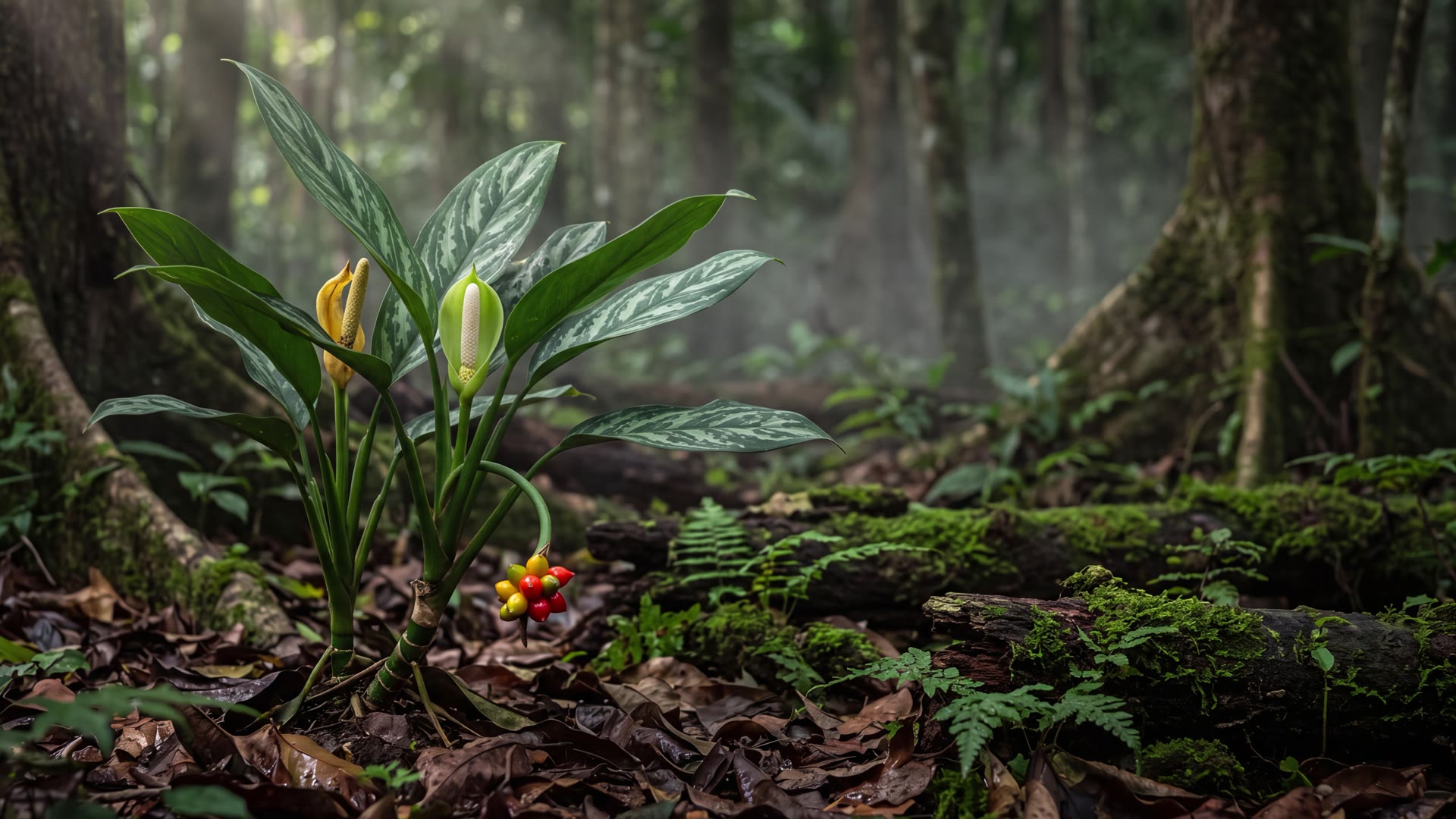
Subfamily Aroideae·Tribe Aglaonemateae
Aglaonema
DESCRIPTION
Aglaonema is a genus of 26 accepted species of evergreen herbs in the family Araceae, native from northeastern India and Bangladesh through Myanmar, Indo-China and southern China, down the Malay Peninsula and across the Malay Archipelago to the Philippines, Sulawesi, the Moluccas and New Guinea. Nicolson, who revised the genus in 1969, called them relatively inconspicuous plants of dark places in the rain forest of southeastern Asia. Most stand on an erect, scarcely branched stem that sheds its lower leaves as it grows, so that the leaves crowd at the top of a stem ringed below with leaf scars; the few creeping species have stems that lie under the humus, buried there by fallen leaves. The leaves are often patterned in silver and pale green. The genus belongs to the tribe Aglaonemateae of the subfamily Aroideae, which it shares with Aglaodorum, a plant of tidal mudflats, and Boycea, a Bornean genus named in 2022. Its flowers are unisexual and naked: at the foot of the spadix a short zone of pistils, each a one-chambered ovary holding a single ovule, and above them free stamens, tightly packed, with no perianth and no consistent grouping to mark out a flower, so that Nicolson found it almost impossible to say how many make one. The fruit is a berry that turns from green through yellow, rarely white, to red, around a single seed almost as large as itself, with no endosperm. The name means “shining stamen” in Greek. Schott published it on September 8th, 1829, in the Viennese Wiener Zeitschrift für Kunst, founding it on a plant grown at Schönbrunn that he called Aglaonema oblongifolium; in 1832 he renamed it Aglaonema integrifolium and described it as perhaps an Indian plant, with a whitish, sweet-scented spathe. Both names, Nicolson showed, belong to the Penang species that Jack had described in 1820 as Calla nitida, and Aglaonema nitidum is the type of the genus.
The plant on the windowsill is the Chinese evergreen: in the United States, Nicolson wrote, Aglaonema modestum was commonly called so and was popular as a house plant; in Chinese it is “Wan-lien-tching,” literally “10,000 years green,” and is thought to bring good fortune to its owner. The species was long thought to be native to the Philippines, where its type was supposedly collected, but Merrill thought it highly probable that the type had been gathered in Manila from plants the Chinese had brought from southeastern China, a species they had probably cultivated for a long time and spread through the Orient, as more recently in the United States; Nicolson’s findings supported him. Gardens have been part of the genus from the start: by the time Kunth gathered it together in 1841, several species were in cultivation as ornamental foliage plants, and N. E. Brown described six new species from cultivated plants in the late 1880s and early 1890s, among them Aglaonema rotundum, whose “native country” he did not know. The cultivars, in Henny’s 1988 account, came from wild-collected species and from mutations noticed by collectors and nurserymen; breeding played a small part, though four important commercial cultivars were hybrids raised in Florida in the 1960s.
Nicolson recognized the two sections for the first time in 1969, naming Chamaecaulon as new. In its creeping stems, very short sheaths and cataphylls among the leaves he found it similar to Aglaodorum and the African Anubias, both plants of tidal mudflats or swamps, and he saw the small, poorly known Aglaonema pumilum and Aglaonema rotundum as intermediate between the two sections. He once thought of a third section for the three northern species with a sessile spadix, Aglaonema ovatum, Aglaonema modestum and Aglaonema hookerianum, and gave it up, since nothing else set them apart and subsessile spadices turn up in other species too. In 2020 Van and colleagues, sequencing chloroplast DNA from plants of southern Vietnam, found Aglaodorum griffithii nested within Aglaonema and proposed to sink Aglaodorum into it; Kew still keeps Aglaodorum as a genus of one species.
The Flora of Thailand finds the genus readily identified by its suffruticose habit and distinctive infructescences; leaves alone are another matter, for some species of Dieffenbachia, Nicolson wrote, cannot be told from Aglaonema with certainty from vegetative material, and Schismatoglottis, occasionally confused with it, is easily told by its inflorescence. The creeping species look superficially like some Homalomena but lack its aromatic tissues and bear their red berries exposed. Schott and Engler separated Aglaodorum by staminodes among its pistils, which Nicolson took for a misreading of a pressed fruiting specimen; the Flora of Thailand, finding them hard to see, tells it more readily by its spongy rhizome and petioles and its large spongy fruits, which float away when ripe, where the fruits of Aglaonema are red, or more rarely pink, and dispersed by birds.
Chinese evergreen is the name Nicolson found in use for Aglaonema modestum in the United States, and the Genera of Araceae gives it to the genus. Besides Nicolson’s Wan-lien-tching, the Chinese names are those of the Flora of China, which builds the names of the genus and of both its Chinese species on wan nian qing; the Thai names are those of the Flora of Thailand. Lempoei, with its probable variant lempoeng, is the only local name Nicolson found recorded more than twice for Aglaonema simplex, on three plants cultivated at Bogor, though he thought it might be more an adjective, for light or soft wood, than a name. The earliest in print are Kamel’s, the first author, Nicolson says, to publish on a species of the genus: in 1704 Kamel recorded that his “Dracunculus Luzonis primus,” a plant with white-spotted leaves from Leyte and “Omauvana,” was called gavay sin buaya and panan quilon. Nicolson could not decide whether it is Aglaonema commutatum or the plant he called Aglaonema crispum, now Aglaonema robeleynii; Kew places Blume’s name for it, Aglaonema maculatum, under Aglaonema commutatum.
DISTRIBUTION
Wholly Asian, in the tropics and subtropics. Kew maps the genus in 20 places, from Assam, the eastern Himalaya and Bangladesh through Myanmar, Thailand and Indo-China to southern China, out to the Nicobar Islands, down the Malay Peninsula to Sumatra, Java, Borneo and the Lesser Sunda Islands, and east through the Philippines and Sulawesi to the Moluccas and New Guinea. One species covers most of it. Aglaonema simplex is native in 16 of the 20 places, and Nicolson called it the most variable species in the genus, tending at the edges of its range to intergrade with others: in Myanmar and western Thailand, where the northern species with sessile spadices may be its closest relatives, and in the Philippines and Sulawesi, where it may contribute, with Aglaonema nitidum and Aglaonema marantifolium, to the variability of the plants there. Blume described Aglaonema simplex and Aglaonema marantifolium together in 1837, and to Nicolson the first was one of the commonest species of western Malesia and the second the commonest of eastern Malesia; Aglaonema marantifolium, of the Moluccas and New Guinea, is the only species Kew records in New Guinea.
On Kew’s count Malesia holds 16 of the 26 species, Indo-China 12, the Indian subcontinent 8, China 2 and Papuasia 1. Thailand has the most, 9, the same nine the Flora of Thailand describes; Myanmar, Vietnam and the Philippines have 7 each. Eleven species are native to a single place: Aglaonema chermsiriwattanae in Thailand, Aglaonema flemingianum in Peninsular Malaysia, Aglaonema manabendrae in Assam, Aglaonema tassae in the eastern Himalaya, Aglaonema nicobaricum in the Nicobars, Aglaonema cordifolium, Aglaonema robeleynii and Aglaonema tricolor in the Philippines, and Aglaonema pictum, Aglaonema rotundum and Aglaonema vittatum in Sumatra. Engler recognized 41 species in 1915; Nicolson, counting 76 binomials published in the genus, accepted 21 in 1969. Kew’s 26 fold his Aglaonema tenuipes into Aglaonema simplex and reduce his Aglaonema stenophyllum to a variety of Aglaonema philippinense, but restore Aglaonema birmanicum and Aglaonema nicobaricum, which he had sunk in Aglaonema simplex and which the Flora of Thailand still sinks there, as the Flora of China does Aglaonema birmanicum; and they add five species named since, Aglaonema tricolor in 1980, Aglaonema chermsiriwattanae in 1997, Aglaonema flemingianum in 1998, Aglaonema tassae in 2018 and Aglaonema manabendrae in 2021. Kew lists species of the genus as introduced in ten places, nine of them for Aglaonema commutatum, from India and Bangladesh to the Comoros, the Cook Islands and the Caribbean; its ability to naturalize, Nicolson found, makes it hard to be certain which collections from its native Philippines and Sulawesi come from the wild and which are escapes.
CHROMOSOMES
2n = 40 in 6 of the 10 species counted (60%).
+ 12 rarer counts
Shares add up to more than 100% because some species have been counted at more than one number, usually diploid and polyploid forms of the same species (e.g. Aglaonema brevispathum at 10 and 13 and 27 and 38 and 40).
10 of 26 species have a published 2n count.
Base chromosome number: x = 6 (Henny et al. 2009; Nicolson 1969), x = 20 (Nicolson 1969).
What chromosome numbers mean for a cross, in the Chromosomes and Crossing guide.
Counted species (10)
- Aglaonema brevispathum10, 13, 27, 38, 40
- Aglaonema cochinchinense40
- Aglaonema commutatum14, 118, 119, 120
- Aglaonema costatum14, 22, 40
- Aglaonema modestum56
- Aglaonema nitidum40
- Aglaonema pictum16, 40, 42
- Aglaonema robeleynii60
- Aglaonema simplex40, 42, 60
- Aglaonema treubii80, 100
Sources (8)
- Chen, J.; Devanand, P. S.; Norman, D. J.; Henny, R. J.; Chao, C. T. 2004. Genetic Relationships of Aglaonema Species and Cultivars Inferred from AFLP Markers. Annals of Botany 93(2): 157–166.
- Henny, R. J.; Chen, J. 2003. Cultivar Development of Ornamental Foliage Plants. Plant Breeding Reviews, Volume 23 (ed. J. Janick), John Wiley & Sons 23: 245.
- Henny, R. J.; Chen, J.; Mellich, T. A. 2009. Tropical Foliage Plant Development: Breeding Techniques for Aglaonema and Dieffenbachia. EDIS (University of Florida IFAS Extension) 2009(5).
- Marchant, C. J. 1971. Chromosome variation in Araceae: II. Richardieae to Colocasieae. Kew Bulletin 25(1): 47–56.
- Nicolson, D. H. 1969. A Revision of the Genus Aglaonema (Araceae). Smithsonian Contributions to Botany 1.
- Sharma, A. K.; Datta, K. B. 1961. A Cytological Study to work out the Trend of Evolution in Aglaonema and Richardia. Caryologia 14(3): 439–454.
- Subramanian, D.; Munian, M. 1988. Cytotaxonomical Studies in South Indian Araceae. Cytologia 53(1): 59–66.
- Yeh, D. M.; Yang, W. J.; Chang, F. C.; Chung, M. C.; Chen, W. L.; Huang, H. W. 2007. Breeding and Micropropagation of Aglaonema. Acta Horticulturae 755(755): 93–98.
ECOLOGY
Aglaonema is a genus of humid tropical forest, in the words of the Genera of Araceae, and only occasionally of deciduous forest or regrowth; Boyce and colleagues give primary and secondary perhumid to everwet evergreen forest, with a few species restricted to kerangas or to monsoonal semi-deciduous forest, the last not in Borneo. Aglaonema simplex rarely grows above 1,500 m, though it has been reported at “7000 feet” on Mount Kinabalu, and Aglaonema hookerianum keeps below 1,000 m, in forest that receives more than 80 inches of rain a year. Aglaonema pictum is usually recorded between 1,000 and 2,000 m on the slopes of the major volcanoes of Sumatra, and Aglaonema nebulosum, a plant of lowland swamp forest in Nicolson’s account, was reported by Singh and colleagues in 2018 from 1,100–1,600 m in the wet hill forest of Meghalaya, its first record in India. Aglaonema nitidum, Nicolson found, flowers without season, being largely restricted to the equatorial region, where rain falls daily rather than seasonally and the plants live in dark places where the humidity is always high. Where the year has a wet season, Nicolson tied flowering to it: Aglaonema ovatum flowers in April and May and Aglaonema hookerianum in June and July, both probably in response to the onset of the summer monsoon. In Thailand the Flora finds the genus most abundant in the wetter south and north, though the species with rhizome-like stems tend to keep to seasonally dry mixed deciduous and evergreen forest. The charts below draw the genus’s measured envelope across its native range, and all 20 of its native places resolve in the climate data.
The species are terrestrial herbs of the tropical forest floor, almost always in shade, as Van and colleagues put it. The larger plants lean: Aglaonema marantifolium rarely stands erect over five feet, Nicolson observed, although its stem may be up to ten feet long, and Aglaonema rotundum seems to pull its stem down with contractile roots. Some grow on limestone or in peat: Aglaonema costatum in damp, shady places at the foot of limestone hills on Langkawi, Aglaonema nitidum in lowland dipterocarp forest, freshwater peat-swamp forest and damp pockets on limestone, and Aglaonema nebulosum in peat and freshwater forests in Nicolson’s account, though Boyce and colleagues describe it as restricted to kerangas. A species can be dense: in a 16-hectare plot of dry evergreen forest at Sakaerat in northeastern Thailand, O-Thong and colleagues counted 11,232 plants of Aglaonema simplex, 702 to the hectare, growing in clumps. At Mulu in Sarawak, Chai and Wong found that anthesis in Aglaonema nitidum and Aglaonema simplex lasts 26 hours: the female flowers become receptive at about four in the morning, as the spathe opens wide and the male zone gives off a scent reminiscent of citrus alcohol, and the pollen is shed the next morning. Flies of the genus Colocasiomyia, in their view the most likely pollinators, feed on the stigmatic secretions and pollen and mate on the male zone; the flies of the Colocasiomyia toshiokai group are recorded only on Homalomena and Aglaonema, and in the botanic garden at Bogor Colocasiomyia heterodonta laid its eggs on a spadix of Aglaonema pictum. At Mulu the fruits took about three months to ripen. The Flora of Thailand has them dispersed by birds, but O-Thong and colleagues, citing earlier reports, note that the ripe fruits of Aglaonema simplex tend to fall and germinate beside the parent, and take this to explain its clumps; in Bali, Lestari and Asih found its seeds broken by a bird and suspected that birds spread them too, though not far.
Araceae · Form
Morphology
A herb of the forest floor, usually a cane-like stem crowned with leaves that are often patterned in silver, in a few species a stem that creeps beneath the leaf litter. The flowers are naked and single-sexed, and each female flower is a single chamber with a single ovule, which ripens into a berry, red in most species, holding one large seed with no endosperm.
A short, cane-like stem that sheds its lower leaves and lies down when it grows too heavy, or, in a few species, a creeping stem buried by leaf fall. Every node holds a bud and can root, and in Aglaonema marantifolium a ring of canals full of gummy sap runs through the stem.
The stem
Most species of Aglaonema, in Nicolson’s 1969 revision, are erect, with relatively unbranched stems and distinct internodes. Growth is continuous but the lower leaves fall, leaving a tuft of leaves at the top of a stem marked below by circular leaf scars, an erect habit Nicolson found rather unusual in the family. Aglaonema vittatum stands 10–15 cm tall on a stem 2–7 mm thick, while Aglaonema densinervium, which Nicolson thought probably the largest species, reaches 90–200 cm on a stem up to 6 cm thick.
Tall stems do not stay upright. A stem of Aglaonema marantifolium may be ten feet (3 m) long, Nicolson wrote, but cannot carry the weight of the plant, and large plants recline against their neighbors without climbing. On a rocky mountaintop on Panay the collector B. Frank Brown reported in 1982 the pink-petioled aglaonema grown as ‘Tricolor’ by the thousands, its stems 6 to 8 feet (about 2–2.5 m) long twining around the cliffs, fallen over and still growing.
Creeping stems
In Aglaonema brevispathum and Aglaonema costatum, which Nicolson set apart as section Chamaecaulon, the stem is repent and branched, usually less than 1 cm thick, with internodes usually under 0.5 cm. In the wild it lies beneath the humus of the forest floor and looks subterranean, but leaf fall has only buried it, and in cultivation it creeps on the surface. Aglaonema pumilum and Aglaonema rotundum seemed to Nicolson to fall between the two sections, decumbent and sometimes with cataphylls among the leaves.
Buds, roots and sap
Erect plants look unbranched, but every node holds a reserve bud, which usually waits until the shoot tip is lost; Nicolson saw such buds grow out wherever a node was strongly rooted, which is why the creeping stems branch freely. Roots arise at the nodes, often nearly as thick as the stem in section Chamaecaulon, up to 0.5 cm in Aglaonema costatum, and the Flora of Thailand found the decumbent stems of larger Aglaonema ovatum producing greatly thickened roots, a feature not reported before and apparently diagnostic. Inside the stem of Aglaonema marantifolium, Van Tieghem found in 1867 a ring of about 20 schizogenous canals, each about 0.24 mm across and full of gummy sap; the stem of Aglaonema simplex was almost the same but lacked them.

Fig · A short stem, erect or lying down
A crown of leaves on sheathed petioles, each blade simple and entire, its main veins arching in parallel to the tip, and often painted in silver, white or pink. The patterns are strongest on young leaves, and in one species often only the seedlings carry them.
Petiole, sheath and cataphylls
The petiole is usually about as long as the blade or slightly shorter, its base drawn out into a sheath that may do no more than clasp the stem or may run its whole length. Though it varies even on one plant, its length separates species: more than half the petiole in Aglaonema pictum, much less in its relatives Aglaonema nebulosum and Aglaonema vittatum, papery and rather saw-toothed at the margin in Aglaonema nitidum and Aglaonema robeleynii (Nicolson’s Aglaonema crispum), just long enough to clasp the stem in section Chamaecaulon. Hay set Aglaonema flemingianum, described in 1998, apart from every other species by its very short petiole, about a fifth the length of the blade and sheathed throughout, and its very numerous primary veins. Cataphylls, which Nicolson read as bladeless leaf sheaths, come between the inflorescences in every species he knew; in his section Chamaecaulon one also clasps each petiole, drying papery and persistent in Aglaonema brevispathum, soon dissolving in Aglaonema costatum.
The blade and its veins
The blade is generally narrowly oblong to narrowly elliptic, acute to acuminate at the tip and rounded to obtuse at the base. Its extremes lie far apart: 6.5–10.5 cm long in Aglaonema vittatum, broadly ovate and nearly as wide as long in Aglaonema rotundum, cordate in Aglaonema cordifolium, and up to 50 cm by 20 cm in Aglaonema nitidum. In Aglaonema simplex, the most variable species in Nicolson’s account, the blades run from 1.5 to 11 times as long as wide, and one plant can carry narrow lower leaves and broad upper ones.
The venation is essentially parallel. In Ertl’s account of Aglaonema commutatum, the primary laterals arch out from the midrib and curve up to the tip, with finer veins linking them down to the fifth or sixth order. Blume sorted species in 1837 by whether the primaries stand out, but Nicolson found both kinds within Aglaonema marantifolium and within Aglaonema nitidum. The genus usually has 5–8 primary lateral veins leaving the midrib at 40–60°; Aglaonema vittatum has 2–3, Aglaonema flemingianum about 12 on each side. NC State Extension uses these few main veins to tell Aglaonema from Dieffenbachia.
Painted leaves
Nicolson described an ashy band covering about two-thirds of the center of the leaf in Aglaonema robeleynii; ashy streaks along the primary veins in Aglaonema nitidum and Aglaonema commutatum; scattered white or yellowish spots and a white midrib in Aglaonema costatum and Aglaonema brevispathum; silvery blotches spattered over the leaf of Aglaonema pictum; and whitish or pink veins on the glossy upper surface of Aglaonema rotundum, whose underside is dark red. N. E. Brown, describing that species in 1893, knew of no other aroid with such clearly defined pink midribs. Bergdolt traced the patterns to groups of cells whose chloroplasts fail to enlarge and green.
In the wild the patterns come and go. Nicolson found plain-leaved plants in a population of spotted Aglaonema brevispathum on Ko Chang, and the patterns of Aglaonema costatum strongest on the youngest leaves, fading with age. Seedlings of Aglaonema nitidum often carry ashy streaks along the primary veins, and he suspected that its variegated form, f. curtisii, perpetuates this juvenile character; the Flora of Thailand finds the species almost always silver-gray beside the primary veins in the peat swamp forests of southern Thailand and Malaysia, while Aglaonema simplex is never variegated, though its shade of green varies between populations. A seedling’s first leaves are not foliage leaves at all: the cotyledon is followed by several scale-like cataphylls before the first true leaf.

Fig · Plain, spotted and streaked leaves
One to several inflorescences at a time, each a boat-shaped spathe around a spadix of naked, single-sexed flowers, a few female ones below and a mass of stamens above. They open before dawn, smell of citrus and are worked by small flies.
Arrangement and the spathe
Mayo, Bogner and Boyce give one to nine inflorescences in each floral sympodium, on peduncles shorter or longer than the petiole that bend down in fruit; section Chamaecaulon bears them singly, Aglaonema densinervium up to seven together. The spathe is ovate, erect and not divided into tube and blade, green to yellowish white. In Aglaonema simplex it inflates at female anthesis and falls at the onset of the male phase; in Aglaonema nitidum, in the Flora of Thailand and at Mulu, it is white at anthesis, turns green and stays until the growing fruits force it off; in Aglaonema robeleynii it fades from green to yellow and then black. Aglaonema pictum and Aglaonema nebulosum have a globose spathe around a club-shaped spadix, and in Aglaonema nebulosum, Boyce and colleagues observed, a rapid extension of the stipe at the onset of female anthesis lifts the male part well clear of the spathe.
The spadix and its flowers
The spadix runs from slender and cylindric to club-shaped, on a stipe from almost nothing to half its own length; in Aglaonema modestum, Aglaonema hookerianum and Aglaonema ovatum it is sessile, most of the female part fused to the spathe. The female flowers sit below, few in number: about five in Aglaonema pumilum, up to 38 in Aglaonema simplex. In most species they stand in several spirals, but Aglaonema flemingianum has a single whorl, one of the differences by which Nicolson told apart the tidal-mudflat genus Aglaodorum. The male zone above is fertile to the tip.
Nicolson could not settle how many stamens make a male flower. There is no perianth and no consistent grouping, only a mass of thick stamens, each with four pollen sacs in two pairs opening by pores at the top. Engler called the male flowers two-stamened. In Nicolson’s serial sections three stamens of Aglaonema nitidum shared one vascular trace, as if forming a reduced flower, but in Aglaonema nebulosum seven were linked, so that a flower might hold one to seven stamens. For practical purposes, he concluded, each stamen appears to be a male flower. The connective is thickened, and Boyce and Wong suggest that in this tribe it acts as an osmophore, a scent gland. The pollen grains are large, 37–67 µm, smooth and without apertures.
The female flower is a single chamber with a single ovule at its base, under a short, thick style and a broad, disk-like stigma, golden yellow when receptive. How many carpels went into it is unknown: Van Tieghem read three, but Nicolson found the traces varying so much from flower to flower that a pistil could be read as one, two, three or more.
Chromosomes
Pfitzer in 1957 took 20 as the basic number, with triploid, tetraploid and hexaploid plants derived from it; the triploids were sterile, and the hexaploid Aglaonema commutatum, with 118–120 chromosomes, was apomictic, its pollen aborting. All the plants counted were cultivated, most of them variegated, and Nicolson wondered whether polyploidy exists only in cultivation. In 2022 Saensouk and colleagues counted plants from natural areas of Thailand: 2n = 40 in Aglaonema modestum and 2n = 42 in Aglaonema simplex.
Who comes
The flowers are female first. In cultivated plants the spathe usually unfurls in the night, the female flowers are receptive that day, and the pollen appears about two days later, when they no longer are. At Mulu National Park in Sarawak, Chai and Wong timed anthesis in Aglaonema nitidum and Aglaonema simplex at 26 hours: at about 4 a.m. the stigmas became receptive and the male zone gave off a scent reminiscent of citrus alcohol, and the pollen came at 5–5:30 the next morning, unscented. The visitors were Colocasiomyia flies, 5–45 to an inflorescence of Aglaonema nitidum and 3–7 in Aglaonema simplex; they mated on the male zone and fed on stigmatic secretions and pollen, but Chai and Wong found no sign of their eating floral tissue. At Bogor, Shi and colleagues found the eggs of Colocasiomyia heterodonta on a spadix of Aglaonema pictum mostly on the lower male zone, fewer among the pistils. The original 1990 survey of the garden counted eggs of both flies on a single Aglaonema pictum inflorescence: 4 of Colocasiomyia xanthogaster and about 19 of Colocasiomyia heterodonta.

Fig · Female flowers below, stamens above
A small cluster of berries, green turning yellow and then red, in some species ripening white, pink or orange, each holding one seed almost as large as the fruit. The embryo consumes the endosperm as it grows and has a second leaf before the seed is ripe.
After flowering the peduncle bends down and the female zone swells into a globose, few-fruited cluster of ellipsoid berries with a fleshy outer layer, green at first, turning yellow, white or pink and finally red in the Flora of Thailand’s account. Boyce and colleagues illustrate a population of Aglaonema nitidum whose fruits are ripe when pale pink, though most ripen through to scarlet; Nicolson called it the only species that often has white berries. The fruits of Aglaonema modestum ripen orange in his account, dark orange in the Flora of Thailand and red in the Flora of China. Size runs from 0.4–0.6 cm in Aglaonema tassae to 2–3 cm in Aglaonema hookerianum and up to 3 cm in Aglaonema marantifolium, whose seed reaches 2.5 cm in fresh material.
The seed is solitary, erect and ellipsoid, almost as large as the fruit, with a thin, smooth testa and no endosperm. Campbell, studying Aglaonema modestum, found the embryo consuming the endosperm until it almost fills the embryo sac: a very short root at one end, a large cotyledon at the other, its sheathing base hiding the stem tip, and a second leaf formed before the seed ripens. Even so the embryo takes up only about half the seed; the rest is the massive base of the ovule. Germination is hypogeal, the seed coat and cotyledon staying below ground.
Ripening takes months: about three at Mulu for Aglaonema nitidum and Aglaonema simplex, four to six in Florida greenhouses after hand pollination, and in Aglaonema tassae flowers of April to June bear fruit in November and December. The Flora of Thailand gives the berries as bird-dispersed; at Mulu, Chai and Wong list them as falling by themselves or taken by birds, but mark that dispersal as not observed. Seed can also form without fertilization: Pfitzer found the hexaploid Aglaonema commutatum fruiting abundantly although its pollen degenerated.

Fig · One large seed to each berry
Araceae · In cultivation
Cultivation
UF/IFAS Extension calls the genus Chinese evergreen and counts it among the most popular tropical foliage plants, for its patterned leaves, its tolerance of low light and low humidity, and its few pests. Florida has grown it commercially since the 1930s, though it took almost 30 years for its ability to survive dim interiors to be widely recognized. The trade grows hybrids and selections for their leaves, and the growing guides advise removing the flowers.
Peat-based, moist and open, with a tenth to a fifth of its volume in air. The wild plants root in forest humus, limestone pockets and peat, and the danger the growing guides name is a pot that stays wet.
In the forest the plants root in humus. Mayo, Bogner and Boyce record them on the forest floor and in humus deposits on limestone and in peat, and Nicolson records Aglaonema nitidum from freshwater peat-swamp forest and from damp pockets on limestone. At Sakaerat in northeastern Thailand, O-Thong and colleagues found Aglaonema simplex commoner where the soil held more clay, had a higher pH and more exchangeable magnesium, and scarcer among rocky outcrops.
Florida’s production guidelines ask for a mix of sphagnum peat, pine bark, vermiculite or perlite with a total porosity of 50–75%, 10–20% of the volume as air, a dry bulk density of 0.2–0.8 g/cm³ and a pH of 6.0–6.5, kept moist at 50–80% of container capacity. In trials at Apopka begun in 1972, Conover and Poole grew ‘Fransher’ best in Peace River peat with cypress shavings, or with pine bark and sand, and worst in Douglas fir bark, sphagnum peat and perlite. The plant is not fussy: Gilman’s UF/IFAS profile finds any fertile, nematode-free soil or artificial mix suitable, and the plants survive in peat and perlite, in sand or in hydroponics. What they will not take is water that does not drain: NC State Extension asks for an acid, well-drained mix and ties root rot to overwatering, and the RHS, potting on every two or three years, warns of stem and root rots in very wet compost.
A moderate, steady feed with micronutrients, copper above all, and far less indoors. Salt, not hunger, burns the tips.
Florida growers feed with controlled-release or soluble fertilizers carrying micronutrients, in a 3:1:2 ratio of nitrogen, phosphate and potash, at 2–2.5 lb of nitrogen per 1,000 square feet a month (about 10–12 g per square meter) or 150–200 ppm nitrogen in a soluble feed. Most cultivars are prone to copper deficiency, which turns the newest leaves chlorotic, sometimes dwarfed and deformed; the remedy is copper sulfate on the soil or copper sprays, and soil kept above 65 °F (18 °C), since roots take up copper poorly from cold soil. The root zone is checked every two or three weeks by the pour-through method: a soluble-salts reading of 1 dS/m means the plant will go short unless it is fed, 2 dS/m is adequate, and 3 dS/m or more calls for less fertilizer or a leaching.
More is not better. Conover and Poole found that doubling the fertilizer for ‘Fransher’ from 1,500 lb of nitrogen per acre a year added basal shoots but no other growth, and judged that even the lower rate may be more than necessary. Indoors the guide suggests a 20-20-20 soluble fertilizer at 50 ppm nitrogen once a month, warning that overfeeding builds up salts that injure the leaf tips and margins. The RHS gives a balanced liquid fertilizer monthly in the growing season, and Gilman rates the plant’s salt tolerance poor.
Shade, warmth above 60 °F (16 °C) and an even regime. The plants live in rooms too dim for most foliage plants, but a chill below 55 °F (13 °C) marks many cultivars with greasy patches.
Light
Florida growers produce the crop under 75–90% shade, 1,250–3,000 foot-candles (about 13,000–32,000 lux), most of them at 80–90%, because toward the bright end the leaves lose color and stand upright; badly bleached leaves may not fully recover. Indoors the plants tolerate as little as 25 foot-candles (about 270 lux) but never full sun, which scorches them. Gilman finds that they do well in conditions too dark for most tropical plants, and outdoors in USDA zones 10B–11 he puts them on the north side of buildings or under heavy tree shade, since direct sun turns the leaves yellow.
Warmth and chilling
Chilling is the genus’s weakness. UF/IFAS describes injury at anything from just above freezing to 59 °F (15 °C): two days after the chill, dark, greasy-looking patches appear between the midrib and the margin, and a leaf with more than half its area damaged may yellow and fall. Mature and old leaves suffer, young ones hardly at all, and cultivars differ widely. After 24 hours at 35 °F (2 °C), ‘Silver Queen’ had 68% of its leaves injured, and 30% even at 55 °F (13 °C), while ‘Emerald Star’, ‘Stars’ and ‘Jewel of India’ were untouched. For sensitive cultivars the guide keeps greenhouses above 60 °F (16 °C). ‘Silver Queen’ still dominated the market 30 years after its introduction, Hull and Henny wrote in 1995, but its sensitivity limited its production in south Florida, where growers did not want the added expense of winter heating. Eric Schmidt of Harry P. Leu Gardens in Orlando, Florida (USDA zone 9b/10a), wrote to the Aroid-L mailing list on July 7th, 2006, that ‘Alumina’ is one of the hardier Aglaonema, tolerating temperatures down to about freezing, and on August 14th, 2006, that ‘Queen of Siam’, a plant at the garden, is another, tolerating down into the low 30s °F (about 0 °C). The RHS rates Aglaonema modestum H1b, a plant for a minimum of 10–15 °C (50–59 °F).
Air and water
In the forest the genus belongs to the mesophytes, which Boyce and Wong describe as intolerant of atmospheric dryness, dry roots and direct sun, among the first plants to die out when a forest is heavily disturbed; in a pot, the Florida researchers count tolerance of low humidity among its virtues. NC State finds that it prefers high humidity but tolerates drier air, though the leaves brown in very dry air or a draft, and the RHS mists Aglaonema modestum daily. The medium is kept moist but not saturated; Gilman lets it dry slightly between waterings, but not for more than a few days. Steadiness matters: the Florida guide blames a new leaf emerging with a bent, fishhook-like tip on fluctuating light, feeding, water or temperature.
Flowering on demand
The Florida guide removes inflorescences as they appear, to keep the plant full and long-lived. Breeders need the opposite. Under natural conditions, Henny and colleagues wrote, a stem produces only three to five inflorescences a year, and in Henny’s collection plants of one cultivar grown together did not always flower at the same time. In December 1981 Henny sprayed ‘Treubii’ once with gibberellic acid at 100–400 ppm; every treated plant opened its first inflorescence within 148 days, with normal flowers and viable pollen, while only one untreated plant flowered. A single 250 ppm spray then brought several species and hybrids into flower together within five months, so that they could be crossed for the first time; plants sprayed on November 10th, 1982 flowered from mid-April into July, some pots of three or four stems producing upwards of 50 inflorescences, a heavier flowering than the spray normally gives. In Taiwan, Yeh and colleagues had plants flowering 23–48 weeks after one such spray.
Cuttings and suckers in the trade, tissue culture with difficulty, seed for the breeders. The older hybrid cultivars come from crosses made in Florida in the 1960s, and leaf patterns follow simple rules.
Cuttings, suckers and tissue culture
Commercial plants start almost entirely from cuttings, Yeh and colleagues wrote in 2007. The Florida guide roots cuttings with four or five leaves and divides the basal shoots, or suckers, of which cultivars make anything from more than four to none. Henny added cane cuttings and, for cultivars of Aglaonema commutatum, naturally apomictic seed; the RHS separates basal shoots with three or four leaves and roots attached, in spring. Tissue culture had little success with this genus, mainly because of microbes living inside the tissues, and in 1995 Hull and Henny named it as the brake on introducing new cultivars. Yeh and colleagues proposed a way around it: pieces of female flowers cultured with dicamba and thidiazuron gave shoots with neither contamination nor browning, which, they wrote, promised several plants from one inflorescence without significant damage to the mother plant.
Seed and breeding
Henny’s first attempts at crossing were largely unsuccessful until he found that humidity governs the pollen. Inflorescences of ‘Chartreuse Halo’, Aglaonema pictum and ‘Treubii’ kept at 100% relative humidity for 24 hours after pollination germinated their pollen well, those at 50% poorly; each pollinated spadix has since been wrapped in damp paper towel inside a plastic bag for a day, and seed failures became rare. Because the female flowers are receptive two days before the pollen appears, no emasculation is needed; pollen is brushed from another inflorescence and used fresh, since it keeps only a day or two. The seed ripens in four to six months, its fleshy covering turning bright red, and is cleaned and sown at once, before it dries, at about 80 °F (27 °C). Peter Boyce, in a seed-sowing note to the Aroid-L mailing list on April 9th, 2004, gave the germination time as four to six or more weeks at 70–84 °F (21–29 °C) for Aglaonema seed sown covered to its own depth. A first leaf takes eight to ten weeks, and a seedling needs at least a year to reach a size worth judging, though a hybrid shows its mature leaf pattern in its first leaf.
Where the cultivars come from
The four hybrids among the older cultivars, Henny wrote, were ‘Silver Queen’, raised by Bob McColley of Bamboo Nursery in Orlando, and ‘Silver King’, ‘Parrot Jungle’ and ‘Fransher’, raised by Nat DeLeon of Miami. Henny thought ‘Silver Queen’, ‘Silver King’ and ‘Parrot Jungle’ most likely all came from Aglaonema commutatum ‘Treubii’ × Aglaonema nitidum ‘Curtisii’, though a selection of Aglaonema pictum was reported as a parent of two of them, and Nicolson had already suspected that some reported hybrid origins were simply apomixis. The Florida guide of 2003 counted 29 Aglaonema hybrids that received US patents during the 1990s. Breeders, Henny and colleagues wrote in 2009, commonly crossed Aglaonema nitidum, Aglaonema commutatum, Aglaonema costatum and Aglaonema rotundum, for new leaf patterns and petiole colors, more branching and better resistance to chilling; the University of Florida’s ‘Diamond Bay’ and ‘Emerald Bay’ were selected from mutations of ‘Silver Bay’ and ‘Golden Bay’ in tissue culture.
The leaf patterns follow simple rules. Henny found variegation dominant over plain green and each pattern controlled by its own allele of a single gene; the alleles are codominant, so a seedling can show two patterns superimposed on one leaf, but never more than two. Petiole color is more complicated, but by Henny’s guidelines a pink petiole appears only when one parent has it and the other a pink, russet or white one, never from a cross with a green-petioled parent.
A short list of insects, a root rot first noticed in Florida nurseries in 1943, and a set of troubles that are not pests at all. The sap can irritate, and the ASPCA lists the plant as toxic to pets.
NC State Extension names aphids, mealybugs, spider mites and scale, armored or soft; the RHS warns of mealybugs in the leaf axils; and Gilman adds soil-borne nematodes and mites.
The serious trouble is root rot. Pythium splendens root rot was first noticed in nurseries in Orange County, Florida, in 1943, on Aglaonema modestum. Over about three weeks the plants are stunted and droop, then rot off at ground level and fall over; other aroids suffered less. In Miller’s trials of 1959, beds of Chinese evergreen planted in infested peat lost 87.4% of their plants untreated, against at most 1.27% after the soil was fumigated. Leaf spots caused by anthracnose fungi have been recorded as well. The growing guides’ defense is prevention: a mix allowed to dry between waterings, cuttings inspected on arrival, since shipping can spread disease, and propagation containers kept off the ground.
Several complaints are not pests: in the Florida guide’s table, dark, greasy patches are chilling, upright, washed-out leaves too much light or heat, deformed chlorotic new leaves copper deficiency, and brown tips salt. The plant is also not to be eaten. The ASPCA lists Chinese evergreen, Aglaonema modestum, as toxic to dogs, cats and horses: its insoluble calcium oxalates cause oral irritation, pain and swelling of the mouth, tongue and lips, excessive drooling, vomiting (not in horses) and difficulty swallowing. NC State rates the genus low in severity but notes that the sap can cause contact dermatitis, and the RHS calls it harmful if eaten and a skin and eye irritant, to be handled in gloves.
Aglaonema Timeline
An interactive timeline showing the year each Aglaonema species was first described as Aglaonema (species may previously have been classified in other genera)
Sources
The papers behind the morphology & cultivation tab
- Nicolson, D. H. (1969). A revision of the genus Aglaonema (Araceae). Smithsonian Contributions to Botany 1: 1–69.
- Mayo, S. J., Bogner, J. & Boyce, P. C. (1997). The Genera of Araceae. Kew: Royal Botanic Gardens. xii + 370 pp.
- Boyce, P. C., Sookchaloem, D., Hetterscheid, W. L. A., Gusman, G., Jacobsen, N., Idei, T. & Nguyen, V. D. (2012). Araceae. In: Santisuk, T. & Larsen, K. (eds), Flora of Thailand 11(2): 101–325. Bangkok: The Forest Herbarium.
- Li, H. & Boyce, P. C. (2010). Aglaonema. In: Wu, Z. Y., Raven, P. H. & Hong, D. Y. (eds), Flora of China 23: 22–23. Beijing: Science Press; St. Louis: Missouri Botanical Garden Press.
- Boyce, P. C., Wong, S. Y., Low, S. L., Ting, A. P. J., Low, S. E., Ooi, I. H. & Ng, K. K. (2010). The Araceae of Borneo – the genera. Aroideana 33: 3–74.
- Boyce, P. C. & Wong, S. Y. (2012). The Araceae of Malesia I: Introduction. Malayan Nature Journal 64(1): 33–67.
- Hay, A. (1998). A new species of Aglaonema Schott (Araceae) from Terengganu, Malaysia. Gardens' Bulletin Singapore 50(1): 1–4.
- Brown, N. E. (1893). Aglaonema rotundum. The Gardeners' Chronicle, ser. 3, 14: 86.
- Brown, B. F. (1982). The search for the natural habitat of the pink petioled Aglaonema. Aroideana 5(3): 89–95.
- Tag, H. & Nangkar, A. (2018). Aglaonema tassai (Araceae; Tribe: Areae) – sp. nov. from Arunachal Pradesh, Northeast India. Pleione 12(2): 309–314.
- Saensouk, P., Saensouk, S. & Senavongse, R. (2022). Cytogenetic studies of six species in family Araceae from Thailand. Caryologia 75(2): 5–13.
- Chai, S. K. & Wong, S. Y. (2019). Five pollination guilds of aroids (Araceae) at Mulu National Park (Sarawak, Malaysian Borneo). Webbia 74(2): 353–371.
- Shi, T., Toda, M. J., Takenaka Takano, K., Yafuso, M., Suwito, A., Wong, S. Y., Shang, S.-Q. & Gao, J.-J. (2019). A review of taxonomy and flower-breeding ecology of the Colocasiomyia toshiokai species group (Diptera: Drosophilidae), with description of a new species from Indonesia. European Journal of Entomology 116: 341–361.
- O-Thong, N., Tasen, W., Marod, D., Thinkampheang, S. & Phumphuang, W. (2024). Spatial distribution of the ethnomedicinal plant Aglaonema simplex at the Sakaerat Environmental Research Station, Northeastern Thailand. Biodiversitas 25(7): 3043–3050.
- Henny, R. J. (1983). Breeding guidelines in the genus Aglaonema. Aroideana 5(4): 99–100.
- Henny, R. J. (1983). Stimulation of flowering in Aglaonema with gibberellic acid (GA3). Aroideana 6(3): 71–72.
- Henny, R. J. & Fooshee, W. C. (1983). Flowering of Aglaonema with gibberellic acid (GA3): a follow-up report. Aroideana 6(4): 135–136.
- Henny, R. J. (1983). Aglaonema breeding – past, present and future. Proceedings of the Florida State Horticultural Society 96: 140.
- Henny, R. J. (1988). Aglaonema breeding. Aroideana 11(2): 15–22.
- Conover, C. A. & Poole, R. T. (1975). Influence of media and fertilizer rates on Aglaonema 'Fransher'. Proceedings of the Florida State Horticultural Society 87: 431–434.
- Hull, D. L. & Henny, R. J. (1995). Anthurium and Aglaonema production in Dade County, Florida. Proceedings of the Florida State Horticultural Society 108: 4.
- Yeh, D. M., Yang, W. J., Chang, F. C., Chung, M. C., Chen, W. L. & Huang, H. W. (2007). Breeding and micropropagation of Aglaonema. Acta Horticulturae 755: 93–98.
- Chen, J., McConnell, D. B., Henny, R. J. & Everitt, K. C. (2003). Cultural guidelines for commercial production of interiorscape Aglaonema. UF/IFAS EDIS ENH957 (EP160).
- Chen, J., Henley, R. W., Henny, R. J., Caldwell, R. D. & Robinson, C. A. (2001). Chilling injury in tropical foliage plants: II. Aglaonema. UF/IFAS EDIS ENH843 (EP103).
- Henny, R. J. & Chen, J. (2008). Tropical foliage plant development: origin of new cultivars. UF/IFAS EDIS ENH1092 (EP356).
- Henny, R. J., Chen, J. & Mellich, T. A. (2009). Tropical foliage plant development: breeding techniques for Aglaonema and Dieffenbachia. UF/IFAS EDIS ENH1117 (EP382).
- Gilman, E. F., Klein, R. W. & Hansen, G. (2018). Aglaonema modestum, Chinese evergreen. UF/IFAS EDIS FPS25 (FP025).
- North Carolina State Extension. Aglaonema (Chinese evergreen, golden evergreen, Philippine evergreen, poison dart plant). North Carolina Extension Gardener Plant Toolbox.
- ASPCA. Chinese evergreen. Toxic and non-toxic plants, ASPCA Animal Poison Control.
- Van Tieghem, P. (1867). Recherches sur la structure des Aroïdées. Annales des Sciences Naturelles, Botanique, série 5, 6: 72–210.
- Campbell, D. H. (1912). The embryo-sac of Aglaonema. Scottish Botanical Review 1: 100–115.
- Engler, A. (1920). Araceae. Pars generalis et index familiae generalis. Das Pflanzenreich IV.23A (Heft 74): 1–71. Leipzig: Wilhelm Engelmann.
- Ertl, O. (1932). Vergleichende Untersuchungen über die Entwicklung der Blattnervatur der Araceen. Flora 126(2): 115–248.
- Bergdolt, B. (1955). Anatomische und entwicklungsgeschichtliche Untersuchungen der Panaschierung und anderer Blattmuster bei Araceen. Zeitschrift für Botanik 43: 309–340.
- Pfitzer, P. (1957). Chromosomenzahlen von Araceen. Chromosoma 8: 436–446.
- Miller, H. N. (1959). Control of Pythium root rot of Chinese evergreen by soil fumigation. Proceedings of the Florida State Horticultural Society 71: 416–419.
- Aroid-L mailing list, Eric Schmidt, July 7th, 2006
- Aroid-L mailing list, Eric Schmidt, August 14th, 2006
- Aroid-L mailing list, Peter Boyce, April 9th, 2004
- Royal Horticultural Society. Aglaonema modestum (Chinese evergreen). RHS plant profile.
- Royal Horticultural Society. Mealybug (glasshouse): identification and control. RHS Advice.