
Subfamily Aroideae·Tribe Philodendreae
Philodendron
DESCRIPTION
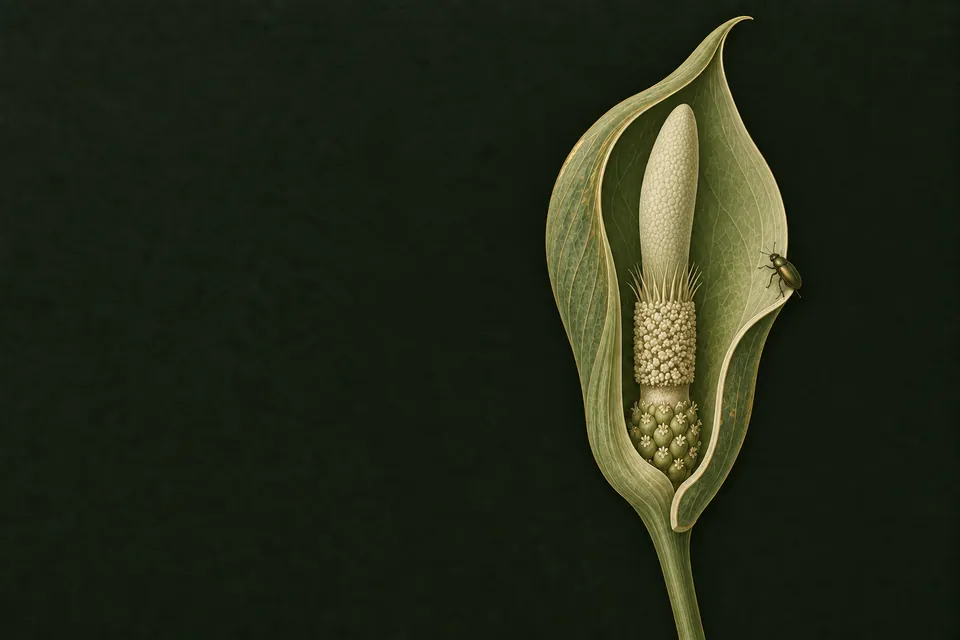
Philodendron is a genus of 628 accepted species of climbing and creeping hemiepiphytes, epiphytes and terrestrial herbs, a few of them stout and tree-like, in the family Araceae. It is native from northern Mexico through Central America and the West Indies to tropical South America, and south to Paraguay and northeastern Argentina. After Anthurium it is the largest genus in the family, and estimates of its true size, undescribed species included, run from 700 to 1,500 species. Its closest relatives are Adelonema, the American plants once placed in Homalomena, and Homalomena itself, which differs in its consistently terrestrial habit, usually anise-scented sap and the staminode that most of its female flowers carry beside the pistil. The inflorescence is a thick spathe that stays around a spadix of naked, unisexual flowers: female flowers below, then a band of sterile male flowers, then the fertile male flowers above. The fruit is a berry, white, orange or red, holding one seed to many, and resin canals run through the roots, stems, leaves and inflorescence.
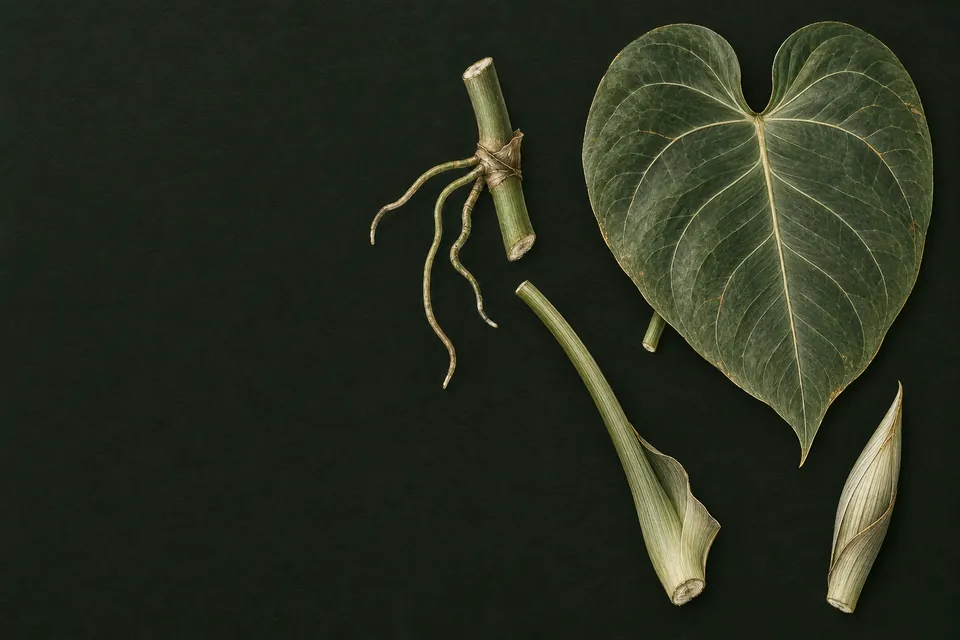
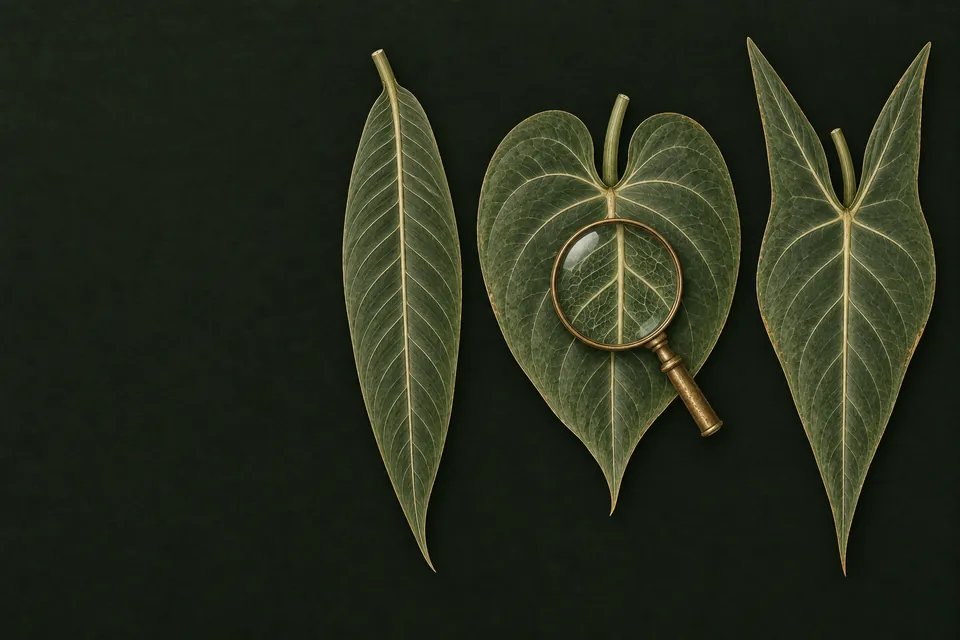
Most species climb, and how they climb is the genus’s signature: anchor roots hold the stem to the trunk and feeder roots run down to the soil. Each new leaf is wrapped in a bract-like cataphyll that falls away or lingers, intact, partly decayed or reduced to fibers, and the blade runs from simple and heart-shaped to pinnatifid or bipinnatifid and, rarely, pedately compound. The blade varies so widely that the cataphyll, the cut petiole and the sap say more about a plant than its leaf does; the morphology guide reads the plant from those organs outward, and the identification guide explains why a nursery plant of unknown origin can seldom be taken past its subgenus. The name is Greek: philos, fond of, and dendron, tree, for the mostly epiphytic or hemiepiphytic habit. Schott published it in 1829, first spelled Philodendrum, a spelling the Code set aside.
Three subgenera have been recognized since Mayo’s work of the 1980s and early 1990s. They descend from Schott’s four groups of 1832: Meconostigma and Sphincterostigma, which Engler joined in 1899 as subgenus Meconostigma, and Calostigma and Euphilodendron, which became sections of the large subgenus Philodendron. Kunth’s treatment of 1841 was the first to move the plants of subgenus Pteromischum out of Monstera and into Philodendron, and Mayo raised them to subgenus in 1989. Croat’s key separates subgenus Meconostigma, with stems often tree-like, male flowers up to ten times longer than wide and a sterile zone as long as the fertile male zone or longer, from subgenus Philodendron, with stems seldom tree-like, male flowers two to three times longer than wide and a sterile zone much shorter than the fertile male zone. Canal and colleagues add that Meconostigma and Pteromischum are well defined by their structure, while subgenus Philodendron is extremely variable and is defined chiefly by lacking what marks the other two. DNA studies with broad sampling recover all three as natural groups, but how they branch from one another is unsettled: in the 2025 study of 302 taxa the maximum-likelihood tree joins Meconostigma with Pteromischum, while the Bayesian tree sets Meconostigma apart from the other two. Published counts for the two large subgenera differ from paper to paper: subgenus Pteromischum has 76 species in Buturi and colleagues (2016), 78 in Vasconcelos and colleagues (2018), 82 in Canal and colleagues (2019) and 83 in Cedeño-Fonseca and colleagues (2025); subgenus Philodendron has about 400 in the first two, about 460 in the third and 530 in the fourth; subgenus Meconostigma has held at 21.
Kew lists these eight genus names as synonyms of Philodendron, seven of them from the nineteenth century. Calostigma, Meconostigma and Sphincterostigma are Schott’s groups of 1832, ranked later as subgenera and sections, and Arosma and Telipodus are Rafinesque’s names of 1837. Two Schott names have come back into discussion. Sakuragui and colleagues revived Thaumatophyllum in 2018 for subgenus Meconostigma, and Vasconcelos and colleagues, adopting it in the same year, suggested reviving Elopium for subgenus Pteromischum. Canal and colleagues in 2019 and Cedeño-Fonseca and colleagues in 2025 declined to split the genus, because the order in which the subgenera branch is unresolved. This site follows Kew and keeps all three subgenera in Philodendron, so Philodendron bipinnatifidum and Philodendron xanadu are filed here. Part I of the identification guide sets out both sides, and naming the subgenus carries the same information under either system.
The English names are those printed in University of Florida extension publications on the plants of the foliage trade. Several are tied to names that are no longer the accepted ones: Philodendron selloum is a synonym of Philodendron bipinnatifidum, and the heartleaf philodendron appears in Florida publications under both Philodendron scandens and Philodendron hederaceum var. oxycardium. The Brazilian names come from Brazilian floras and anatomy papers: cipó-imbé for the genus as a whole, imbé for Philodendron quinquenervium, which the flora of Igarassu in Pernambuco treats under its synonym Philodendron acutatum, and guaimbé for Philodendron bipinnatifidum in Rio Grande do Sul. The same flora advises against applying the name Philodendron imbe to the plant known as imbé, because the application of that name is doubtful.
DISTRIBUTION
Wholly American, and almost wholly tropical. The range runs from northern Mexico, where Philodendron dressleri, a plant of the tropical deciduous forest of Nayarit and Sinaloa, is the only species mapped in the northwest, through Central America and the West Indies to tropical South America, and south through Brazil to Paraguay and northeastern Argentina, where five of the six species belong to subgenus Meconostigma. DNA trees most probably place the genus’s origin in Amazonia. From there it spread to southeastern Brazil and to the Chocó and the northern Andes, and from the Chocó and the Andes to Central America in several separate waves rather than one; the Caribbean islands were reached in many separate crossings that produced no significant radiation there. Central America is the genus’s second center of diversity.
The center of the genus is the northwest of South America, where the wet lowlands meet the Andes. Of the 623 mapped species, 242 are native in Colombia, 153 in Ecuador, 118 in Venezuela, 108 in Peru and 102 in Panama. Counted by region (a species that spans two regions is counted in both), 369 occur in Western South America, 162 in Brazil, 143 in Northern South America, 122 in Central America, 29 in Mexico, 18 in the Caribbean and 6 in Southern South America. Endemism is high: 381 of the 623 species are confined to a single one of the 40 places, among them 91 found only in Colombia, 57 only in Ecuador, 56 only in Venezuela, 40 only in Peru, 36 only in Southeast Brazil and 32 only in Panama. A few species are wide: Philodendron hederaceum is native in 31 of the 40 places, Philodendron fragrantissimum in 19 and Philodendron jacquinii in 18. The single-place counts depend on the range lists behind them: Kew lists Philodendron atabapoense for Venezuela (Amazonas) alone, while Eduardo G. Gonçalves, who had collected it in the field, wrote on the Aroid-L mailing list that it is a widespread species of northern South America, occurring from Venezuela to Amapá state on Brazil’s northern coast (February 4th, 2005).
The range map draws 623 of the 628. Two of the 628 are named natural hybrids, Philodendron × joepii and Philodendron × lucasiorum, which the map does not draw; Kew gives no distribution for Philodendron populneum or Philodendron robustum; and Philodendron imbe, published in 1841 and known from Rio de Janeiro, is listed by Kew only as extinct in Southeast Brazil, so it has no native place to draw. Kew also marks Philodendron hederaceum in French Guiana and Guyana, Philodendron roraimae in French Guiana and Philodendron placidum in Suriname as doubtful, and those records are left off the map, although all three species are native elsewhere. Eight places carry records of introduced species, which are not native ranges and are not counted: Hawaii (Philodendron gloriosum, Philodendron lacerum and Philodendron sagittifolium), Bangladesh (Philodendron bipinnatifidum and Philodendron hederaceum), the Seychelles (Philodendron hederaceum), the Cook Islands and the Society Islands (Philodendron mamei), and, within the range of other species, Belize (Philodendron bipinnatifidum), Puerto Rico (Philodendron ornatum) and Cuba (Philodendron pinnatifidum).
CHROMOSOMES
2n = 32 in 19 of the 41 species counted (46%).
+ 4 rarer counts
Shares add up to more than 100% because some species have been counted at more than one number, usually diploid and polyploid forms of the same species (e.g. Philodendron hederaceum at 20 and 30 and 32).
41 of 628 species have a published 2n count.
What chromosome numbers mean for a cross, in the Chromosomes and Crossing guide.
Counted species (41)
- Philodendron angustilobum34
- Philodendron annulatum32
- Philodendron barrosoanum32
- Philodendron billietiae32
- Philodendron bipennifolium32
- Philodendron bipinnatifidum36
- Philodendron burle-marxii34
- Philodendron callosum28
- Philodendron corcovadense36
- Philodendron distantilobum32
- Philodendron eximium32
- Philodendron fragrantissimum32
- Philodendron giganteum30
- Philodendron glaziovii34
- Philodendron goeldii32
- Philodendron hederaceum20, 30, 32
- Philodendron inconcinnum32
- Philodendron krugii34
- Philodendron lacerum32
- Philodendron lundii36
- Philodendron maximum34
- Philodendron megalophyllum34
- Philodendron melinonii30
- Philodendron mello-barretoanum34
- Philodendron nadruzianum32
- Philodendron pedatum32
- Philodendron quinquelobum32
- Philodendron quinquenervium32
- Philodendron radiatum32
- Philodendron renauxii34
- Philodendron saxicola36
- Philodendron schmidtiae32
- Philodendron smithii32
- Philodendron speciosum36
- Philodendron squamiferum32
- Philodendron tatei34
- Philodendron tenue34
- Philodendron tripartitum34
- Philodendron uleanum34
- Philodendron undulatum36
- Philodendron wendlandii34, 54
Sources (11)
- Chen, J.; Li, F.; Xu, C.; Liu, J.; Hou, Z.; Huang, Z.; Gan, Z.; Mao, Y.; Yan, X.; Hu, H.; Wang, Z.; Wang, S.; Fu, H.; Bu, S. 2026. Hybridization footprint and the mechanism of leaf color differences in Philodendron cultivars. Horticulture Research 13(5): uhag041.
- Croat, T. B. 1997. A revision of Philodendron subgenus Philodendron (Araceae) for Mexico and Central America. Annals of the Missouri Botanical Garden 84(3): 311.
- Henny, R. J.; Chen, J. 2003. Cultivar Development of Ornamental Foliage Plants. Plant Breeding Reviews, Volume 23 (ed. J. Janick), John Wiley & Sons 23: 245.
- Lakshmanan, P. S.; Van Laere, K.; Eeckhaut, T.; Van Huylenbroeck, J.; Van Bockstaele, E.; Khrustaleva, L. 2015. Karyotype analysis and visualization of 45S rRNA genes using fluorescence in situ hybridization in aroids (Araceae). Comparative Cytogenetics 9(2): 145–160.
- Marchant, C. J. 1971. Chromosome variation in Araceae: II. Richardieae to Colocasieae. Kew Bulletin 25(1): 47–56.
- Marchant, C. J. 1971. Chromosome variation in Araceae: III. Philodendreae to Pythonieae. Kew Bulletin 25(2): 323–329.
- Mayo, S. J. 1991. A revision of Philodendron subgenus Meconostigma (Araceae). Kew Bulletin 46(4): 601–681.
- Sharma, A. K.; Mukhopadhyay, S. 1965. Chromosome Studies in Typhonium and Arisaema with a View to Find Out the Mode of Origin and Affinity of the Two. Cytologia 30.
- Simmonds, N. W. 1954. Chromosome behaviour in some tropical plants. Heredity 8(1): 139–146.
- Subramanian, D.; Munian, M. 1988. Cytotaxonomical Studies in South Indian Araceae. Cytologia 53(1): 59–66.
- Vasconcelos, E. V.; Vasconcelos, S.; Ribeiro, T.; Benko-Iseppon, A. M.; Brasileiro-Vidal, A. C. 2018. Karyotype heterogeneity in Philodendron s.l. (Araceae) revealed by chromosome mapping of rDNA loci. PLOS ONE 13(11): e0207318.
ECOLOGY
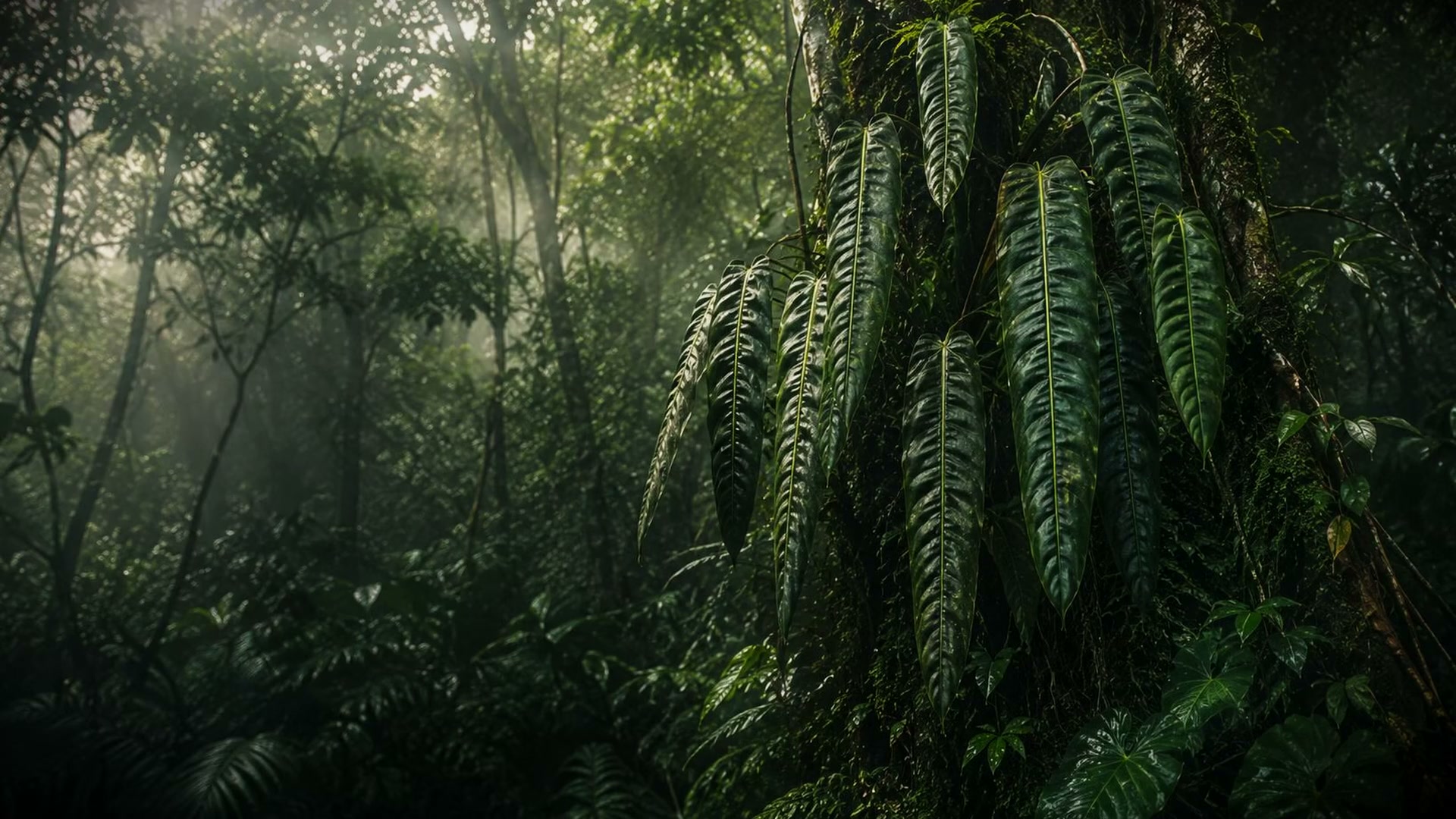
Philodendron is a plant of humid forest. Most species live in the wet lowlands, in lower mountain ranges and at middle elevations of the higher mountains, in life zones that run from tropical moist forest to premontane rain forest, and in the forests where it grows the genus is often the most conspicuous element of the vegetation, for its abundance, its climbing habit and its frequently large, showy leaves. Diversity is greatest in the perhumid rainforests of the Chocó and western Amazonia, where the dated DNA tree finds higher rates of speciation than elsewhere in the Neotropics and suggests that the uplift of the northern Andes, by making the lowlands beside them perhumid, helped drive them. The genus is not confined to that wet core. It also grows in freshwater swamps, along stream banks, in regrowth forest, on rock outcrops and on roadbanks, and as terrestrial plants in open habitats such as the seasonal dry forests of South America; subgenus Meconostigma ranges from the Amazonian and Atlantic forests to the savanna-like Cerrado. Philodendron brevispathum is reported from both swamp and savanna country: Eduardo G. Gonçalves wrote on the Aroid-L mailing list that it is common in Mauritia palm swamps (May 23rd, 2002), and Thomas B. Croat recorded it among the few aroids on the small islands of vegetation scattered through the savannas of southern Beni Department, Bolivia, on a collecting trip from June 14th to August 25th, 2000 (November 5th, 2000). From sea level the genus climbs above 2,000 m, though in the Andes only very few species grow in the forests above that. Philodendron crassispathum, of Costa Rica and Panama, grows between 1,100 and 2,600 m. The charts below draw the genus’s measured envelope across nearly all of its native range.
In habit Philodendron is one of the most variable genera in the family. It runs from terrestrial through epiphytic to hemiepiphytic, and the climbers take two routes to the canopy. Hemiepiphytes begin as seeds on the host tree and send roots to the ground later: Philodendron megalophyllum, which often lives on ant nests, Philodendron solimoesense, Philodendron goeldii and Philodendron radiatum. Nomadic vines start on the ground or low on a trunk and keep climbing as the lower stem rots behind them, dropping feeder roots from above while typically keeping their hold on the soil; older accounts call these secondary hemiepiphytes. Vines such as Philodendron hederaceum may run stems well over 30 m long, while the slower appressed climbers rarely pass about 2 m, and some species send out thin flagelliform shoots to reposition themselves, as Philodendron fragrantissimum does. Philodendron linnaei carries the habit to an extreme, stacking rosettes of leaves along a trunk and joining them with slender climbing shoots. Few species are terrestrial, among them Philodendron glanduliferum, Philodendron grandipes and Philodendron malesevichiae, along with the tree-like species of subgenus Meconostigma. Accounts of Philodendron glanduliferum differ: Croat’s 1997 revision describes it as terrestrial, its stem usually creeping, while Matuda, who named the species in 1962 from a wild-collected cutting grown and flowered in a greenhouse, called it a robust climber. Philodendron insigne is a litter-basket epiphyte, its leaves forming an inverted cone that collects debris for the roots. The genus also has lithophytes, some of them on cliffs, and plants of swamps and stream sides, and Philodendron rheophyticum, of Paraná, was found only on river banks, at times partly submerged.
The berries are exposed when the spathe splits, and birds, mammals and ants may eat them: Euphonia anneae has been seen taking the fruits of Philodendron popenoei, and the kinkajou Potos flavus those of Philodendron crassispathum, both in Costa Rica. The flowers are pollinated, in the species watched, by scarab beetles, chiefly of the genera Cyclocephala and Erioscelis. In those species an inflorescence heats and scents itself at dusk, the beetles stay in the spathe through the night and much of the next day, feeding on sterile flowers and mating, and they leave through falling pollen and resin as the spathe tightens. One study of Philodendron solimoesense in French Guiana calculates that the warmth is itself a reward, because a beetle that stays active in the warm chamber spends far less energy than it would outside. Heat, scent, resin and the clock of the two nights are the subject of the pollination guide.
Araceae · Form
Morphology
A genus that is a vine, a tree and a river-edge plant by turns, and whose leaf, the part everyone looks at, is a poor guide to identity. Croat judged the sheath that wraps each new leaf probably the most diagnostic character in the taxonomy of the genus; the scars it leaves behind and what runs out of a cut are read alongside it. Three companion guides take those characters apart: morphology, identification and reproduction.
Terrestrial, epiphytic or hemiepiphytic; a vine, an appressed climber or a free-standing trunk. In subgenus Philodendron the stem is a chain of articles, each a cataphyll and a leaf, and the leaf changes less with height than in Monstera or Syngonium.
How the plants live
Croat’s 1997 revision of subgenus Philodendron for Mexico and Central America, from which most of the counts below are taken, calls the genus one of the most variable in the family in habit. Its species grow on the ground, on trees, or both, and the specialists sort the climbers by where they begin. A primary hemiepiphyte germinates on a tree and grows slowly until it is big enough to send aerial roots to the soil; Philodendron megalophyllum and Philodendron solimoesense do this on ant nests in South America, and Philodendron radiatum is the only Central American species known to live that way. A secondary hemiepiphyte begins on the ground or low on a trunk, climbs, and may lose its connection with the soil as it goes. Most species of Philodendron section Philodendron are of this kind, some as vines and some as appressed climbers.
The two climbing styles differ in scale. A vine such as Philodendron hederaceum can make stems well over 30 m long with internodes of 10–20 cm, and often hangs from the branches before it flowers. An appressed climber lies against the trunk, rarely makes a stem longer than about 2 m, and in most species has internodes that are broader than long at maturity. Few species are consistently terrestrial, among them Philodendron glanduliferum, Philodendron grandipes and Philodendron malesevichiae, and many herbarium labels that say “epiphyte” probably describe plants that were rooted in the soil¹. Accounts of Philodendron glanduliferum differ: Croat describes it as terrestrial, with a stem to 1 m long that usually creeps¹, while Matuda, who named the species in 1962 from a wild-collected cutting grown and flowered in a greenhouse, called it a robust climber⁷⁶.
At one end of the range stand the self-heading plants. Philodendron subgenus Meconostigma, the group raised to the genus Thaumatophyllum in the split of 2018, is arborescent: Philodendron bipinnatifidum has a stout stem 8–12 cm across, hemiepiphytic or terrestrial, and Philodendron corcovadense a thinner one, 1.8–4 cm, that is more often found in the crown of a large tree. Philodendron brasiliense, of the same group, is a small plant of wet ground. Writing on Aroid-L under its synonym Philodendron cymbispathum, Eduardo G. Gonçalves said on March 12th, 1997 that it usually grows along river banks or marshes⁶¹, and on March 20th, 1997 described a self-heading plant with a crowd of leaves at the top of an erect stem that looks like a dwarf Philodendron bipinnatifidum, and wrote that the whole plant can reach about 1.20 m⁶². Few species of subgenus Philodendron share the very stout, generally erect stem that is common in subgenus Meconostigma; Croat names Philodendron warszewiczii and Philodendron bazii as the nearest, and the internodes of Philodendron gigas are up to 10 cm across. At the other end is the rheophyte. Philodendron rheophyticum, described in 2015 from the banks of the Paraná River in Brazil, lives at the water’s edge; its authors point out that the habit is very rare in the genus and had been recorded in only two species before, Philodendron flumineum and Philodendron carajasense. Others grow on rock and sand: section Philopsammos appears to be limited to the Guayana Highland, especially of Venezuela, with extensions into adjacent Guyana, Brazil and Colombia, and in general its species grow in white sand savannas, on sandstone outcrops and on the tepuis, the table mountains of the region⁷⁷. Philodendron callosum is another plant of open ground: in a reply to a plant identification request on Aroid-L on June 26th, 2000, Gonçalves described it as a plant of Venezuela and northern Brazil that usually grows in exposed patches over white sand or on rocky outcrops⁶³.
The stem, and how it changes with height
In subgenus Philodendron each article of the stem bears a cataphyll and a single leaf, and in a mature plant it ends in an inflorescence; the next article grows from a bud at the base of the cataphyll. A stem that looks unbranched, with an inflorescence in every leaf axil, is really a series of replacements. Juvenile plants grow differently, making articles with an indeterminate number of leaves before settling into the one-leaf rhythm. Subgenus Pteromischum, whose petioles are conspicuously sheathed, makes several leaves per article and branches more freely. The cataphylls, the petiole scars and the two kinds of root that this stem carries are read in the morphology guide.
As a stem climbs, its internodes get shorter and thicker and its leaves larger, and in most species of subgenus Philodendron the change from juvenile to adult foliage is gradual, with no abrupt switch. The exceptions are small. The juvenile leaves of Philodendron hederaceum var. hederaceum lie close to the trunk on short petioles, dark and velvety above and purplish beneath, like the shingle leaves of Monstera, and are replaced higher up by spreading, semiglossy leaves on long petioles. A plant that is dislodged, or that outgrows its support, goes into a searching phase of long internodes and small leaves and may throw out a flagelliform shoot to find another trunk. Philodendron fragrantissimum can do this even when undisturbed, and Philodendron linnaei of South America makes it a way of life: rosettes of leaves joined by slender runners that climb the trunk.

Fig · Four habits

Fig · One plant of subgenus Meconostigma
A cataphyll, a petiole and a blade, and the blade is a weak guide to identity, because its shape varies so widely. It runs from heart-shaped to three-lobed to pinnately cut, and nearly the whole range turns up among the Central American species of subgenus Philodendron alone.
Cataphyll and petiole
Every leaf is wrapped, while it develops, in a cataphyll, a bract-like sheath that Ray and later authors call the prophyll. Croat judged it probably the most diagnostic feature in the taxonomy of the genus, and how it ages (it falls, persists whole, or decays to a net of fibers) is the subject of the first part of the morphology guide, with the petiole’s outline in cross-section, the ring at its top, and the sap and resin of a cut, and the sugary droplets on the youngest leaves. In subgenus Pteromischum the sheath belongs to the petiole as well: the petioles carry a conspicuous sheath, so that on an adult plant the winged petiole alone is definitive. In the rheophyte Philodendron rheophyticum the sheath stands upright and closed, 7–12.5 cm long on a petiole of 0.3–3.1 cm.
The stem scales and the upper face of the petiole can separate look-alikes that the blade leaves ambiguous. Eduardo G. Gonçalves cautioned on Aroid-L, on December 6th, 2002 and again on May 8th, 2003, that plants sold as Philodendron selloum or Philodendron bipinnatifidum may instead be Philodendron mello-barretoanum or Philodendron lundii⁶⁴,⁶⁵. By his account Philodendron bipinnatifidum has soft, readily detachable stem scales and a concave upper petiole; Philodendron mello-barretoanum has hard scales that do not come away easily and a concave upper petiole; and Philodendron lundii has no persistent scales and a flattened upper petiole⁶⁵.
The blade
Virtually the whole range of leaf shape in the genus is found among the Central American species of subgenus Philodendron alone, Croat concluded. The only shapes missing are the kidney-shaped, pedately compound blade of Philodendron goeldii in subgenus Meconostigma and the pinnately lobed blades with a few sickle-shaped divisions that belong to section Schizophyllum. Ovate to ovate-triangular is the commonest outline: of the species he treated, 22 have ovate-cordate blades and 11 broadly cordate ones, at least 55 have well-developed posterior lobes, whether cordate, sagittate or hastate, and only 15 have non-cordate blades prominently longer than wide. Eight have lobed blades. Six are trilobed in Croat’s treatment (Philodendron anisotomum, Philodendron cotobrusense, Philodendron madronense, Philodendron rothschuhianum, Philodendron tripartitum and Philodendron angustilobum; Kew now includes Philodendron rothschuhianum in Philodendron anisotomum) and two are pinnately lobed (Philodendron radiatum and Philodendron warszewiczii). In those species margins are typically entire on a simple blade, never toothed and rarely sinuate, though often undulate on a large one.
Size is as wide as shape. The median blade of those Central American species is 57 cm long, only 19 exceed 75 cm, and only Philodendron gigas regularly passes a meter, with a longest recorded blade of 137 cm. At the other end Philodendron brewsterense has the smallest, up to 11 cm. Beneath the outline lies the venation, which Croat reads as carefully as the sap: most of those species have 3–6 pairs of primary lateral veins, though the count runs from 2 pairs in Philodendron chirripoense to 25 in Philodendron madronense, and the basal veins, the posterior rib and the pale lines and “stitching” a 10× lens shows between the veins all help to separate species.
The other subgenera cut the blade differently. In Philodendron bipinnatifidum it is ovate, bipinnatifid and sagittate at the base, 44.5–63.5 cm long on a petiole of 40–65.5 cm in plants from Paraná, Brazil, while in Philodendron corcovadense, the only other arborescent species there, it is entire, ovate and sagittate, 38–41 cm. The leaves of subgenus Pteromischum are usually thinner, more oblong and more often asymmetric than those of subgenus Philodendron, and Philodendron rheophyticum carries narrow obovate blades 16–31 cm long on which the lateral veins can hardly be seen. How much weight the blade can bear in identification is weighed in the last part of the morphology guide.
Two cases from Aroid-L show how little a juvenile blade settles. On June 12th, 2007 Steve Lucas observed that many sellers, especially on eBay, appeared to be offering juvenile Philodendron bipennifolium as Philodendron panduriforme and the reverse⁶⁶, and on June 15th, 2007 Tom Croat, who regards them as different species, said that Philodendron panduriforme is usually more deeply three-lobed⁶⁷. Croat wrote on March 19th, 2007 that Philodendron brandtianum never becomes three-lobed, and that a plant shown under the name Philodendron variifolium was in his identification Philodendron brandtianum⁶⁸; on November 10th, 2009 Lucas, a grower, wrote that the true Philodendron variifolium looks nothing like the juvenile plant commonly sold under that name⁶⁹.

Fig · Four ways to cut a blade
One spathe around a spadix in three bands: female flowers at the base, a sterile male band, fertile male flowers above. A closed chamber under a waist in most species, and no flowerless appendix.
The spathe
The inflorescence stands in the axil of one of the upper leaves, often emerging from the mass of cataphyll fibers, and is typically held erect or nearly so whichever way the stem hangs. A flowering unit (a sympodium) may carry anywhere from one to ten, and up to eleven in South America. Of the Central American species of subgenus Philodendron, 38 usually have a single one, while Philodendron gigas and Philodendron heleniae may have up to seven, and the 2016 Lita-San Lorenzo revision gives Philodendron heleniae subsp. heleniae two to ten. The spathe has a tube below and a blade above. In most species of subgenus Philodendron the two are separated by a constriction, a waist, and the tube is the chamber in which the female flowers wait; the spathes of subgenera Meconostigma and Pteromischum are not likely to be constricted, or only weakly so (moderately, in Philodendron bipinnatifidum and Philodendron corcovadense). Philodendron appendiculatum of Brazil has a strongly waisted spathe and Philodendron propinquum, in subgenus Pteromischum, none. Among the Central American species of subgenus Philodendron, length runs from 4.5 cm in Philodendron clewellii to 30 cm in Philodendron warszewiczii. The tube is usually green, red or violet outside and darker inside, the blade paler, and in species that have resin canals the resin wells up on the inner face of the blade and sometimes the upper tube.
The spadix and the flower
The spadix carries naked, unisexual flowers with no perianth. The female flowers fill the base, closed in the tube. Above them is a band of sterile male flowers, staminodes rich in oil that the beetles eat, swollen where the spathe is waisted, and the fertile male flowers fill the rest. In the Central American species of subgenus Philodendron the male part is on average 2.2 times as long as the female, and spathes average 16.5 cm against 15.8 cm for the spadix. The sterile band is a short collar in some species, and in Philodendron bipinnatifidum it runs 5–10.5 cm, about as long as the fertile zone above it. There is no flowerless appendix like the one on the spadix of Alocasia, though several species, among them Philodendron appendiculatum of Brazil, carry a tip of sterile male flowers above the fertile zone, 2.8–3.2 cm long in that species. A female flower is a single naked ovary, 0.5 mm long in Philodendron sousae and 9.2 mm in Philodendron advena, with 2–17 locules in Croat's account, 4–10 in the Central American species of subgenus Philodendron, and up to 47 in subgenus Meconostigma.
The heat, the scent, the resin and the beetles are the subject of the reproduction guide, which opens with the anatomy of the inflorescence.

Fig · Spathe and spadix
In nearly every species the spathe stays on until the berries ripen, then splits away and leaves them standing bare on the spadix. The berry is soft, the seeds are minute and mostly pale, and how many a berry holds depends on the species.
After pollination the spathe recloses and, in nearly every species, the female part of the spadix ripens inside it. The spathe swells a little to make room. When the berries are ripe it opens again, breaks free at its base, and falls, usually with the withered male part of the spadix, leaving a scar just above the peduncle and the berries on what remains; sometimes the old spathe lingers on the peduncle, deeply fissured, with fragments of its inner face exposed. Few intervals have been recorded, by methods that cannot be compared, and they are set side by side in the fruit and seed part of the reproduction guide.
The berry is cylindrical to obovoid, usually with a thickened cap-like apex that tears away when the berry is ripe; in subgenus Philodendron the rest is soft and fleshy, and the seeds can be seen through its thin sides. Most berries are whitish. In 17 Central American species of subgenus Philodendron they are at least sometimes pale orange to orange, and Philodendron fragrantissimum usually has bright red to purple-red ones. Berry color was known for only 53 of the 96 species in Croat’s count, and it counts for less in classification than it does in Anthurium. The immature berries of Philodendron bipinnatifidum measured 1.8–2 cm across. The pulp around the seeds is juicy or gelatinous, usually sweet and sticky.
The seeds are minute. In the sample of Central American species of subgenus Philodendron that Croat measured, they range from 0.5 to 5 mm long, averaging 1.67 mm, and from 0.1 to 3 mm across, averaging 0.7 mm; the longest, 5 mm, belong to Philodendron jacquinii and Philodendron hederaceum. Those of Philodendron bipinnatifidum are about 1 mm. They are mostly oblong or ellipsoid and brown, tan or white. How many a berry can set follows from its ovules. A species with a basal placenta has one ovule per locule and a few larger seeds, while species with axile placentation usually have ten or more per locule, up to 36 in Philodendron fragrantissimum, the highest count among the Central American species of subgenus Philodendron, in ovaries that run from 2 to 17 locules and to 47 in subgenus Meconostigma. Two published counts per berry are 6–8 in Philodendron trisectifolium and 452 ± 165 in Philodendron fragrantissimum, as set out in the same part of the reproduction guide.
What carries the seed away is little recorded. Infructescences pecked apart by birds are common, ants carry off single seeds, and a large infructescence, faintly scented when ripe, may tempt mammals. Grayum thought the white, scented fruits of subgenus Pteromischum were taken by bats and the orange ones by animals active by day.

Fig · From spathe to berries
Araceae · In cultivation
Cultivation
Two kinds of plant sit under one name in the trade: the vines, headed by the heartleaf, and the self-heading plants, the tree philodendron, ‘Xanadu’ and the colored hybrids. The vines are plants of the forest understory and the tree philodendrons of more open ground, and much of what goes wrong with either follows from a pot that stays wet, light that is too bright or too dim, and cold. Most of the numbers below come from Florida’s foliage industry and from university extension services, where Philodendron cultivation has been measured. Names follow the sources: the heartleaf is Philodendron scandens or Philodendron oxycardium in the older literature and Philodendron hederaceum here, and the tree philodendron is Philodendron selloum there and Philodendron bipinnatifidum here. In one Aroid-L exchange, a member who asked about the cultivars ‘Brasil’, ‘Rio’ and ‘Gabby’ was told that they are Philodendron hederaceum, not Philodendron cordatum⁴⁵,⁴⁶, and two plants sold at retail as Philodendron cordatum, a green one and a “Lemon” one, were identified from photographs as Philodendron hederaceum⁴⁷,⁴⁸. Mature Philodendron cordatum was described in the same exchange as having purplish “shotgun” spots on the petiole and midrib and leaves larger than those of Philodendron hederaceum and of a different shape⁴⁷.
Bright shade to bright indirect light. The heartleaf takes far less than the tree philodendron and the colored hybrids; direct sun discolors it, and too little light draws out the petioles and fades the color.
The vines
The heartleaf is the standard low-light philodendron. The University of Florida’s landscape sheet for Philodendron scandens recommends partial to deep shade, calls its tolerance of low light very high, and warns that direct sun often discolors the foliage. The Royal Horticultural Society asks for bright but filtered or indirect light for Philodendron hederaceum and keeps philodendrons out of direct summer sun, which can scorch the leaves. Clemson’s extension service says most philodendrons prefer indirect or curtain-filtered light but tolerate low light, and the Missouri Botanical Garden adds that in too dark a place the stems of Philodendron hederaceum become spindly.
The numbers, and what they describe
Some foot-candle figures describe production, not a living room. Florida’s production guide grows the philodendrons in its Table 1 other than the tree philodendron for interiors under 80–88% shade, 1,500–2,500 foot-candles, and the tree philodendron, Philodendron selloum in that guide, under 40–76% shade, 3,000–5,000 foot-candles. For the finished plant indoors it says most philodendrons tolerate light as low as 75 foot-candles and that 150 foot-candles or more keeps color and leaf size (McConnell and colleagues, UF/IFAS EP150). A University of Missouri extension note gives the heartleaf, Philodendron scandens oxycardium, a floor of 15 foot-candles and says it needs at least 200 to really thrive and develop its mature form. Two peer-reviewed measurements sit beneath these: the light compensation point of Philodendron scandens subsp. oxycardium fell from 33 to 7 µE m–2 s–1 over 15 weeks of acclimatization, and the vine length and grade of Philodendron oxycardium grown on totem poles rose as shade fell from 80% to 40%.
The tree philodendron and the hybrids
The tree philodendron wants more. The University of Florida says Philodendron selloum looks as if it would need deep shade but grows quite well in full sun or partial shade; Clemson puts Philodendron bipinnatifidum near an east, west or south window; and North Carolina State says it prefers high light, that low light and overwatering give smaller leaves with fewer or no lobes, and that full sun can scorch them. The Missouri Botanical Garden also advises against full direct sun for it, so the sources do not agree about sun. The colored hybrids also want high light to keep their color. In the Florida production guide Philodendron ‘Autumn’ and ‘Prince of Orange’ require high interior light to keep their color and keep growing, and ‘Red Emerald’ and ‘Red Empress’ need it for their best color, though a University of Missouri note says ‘Prince of Orange’ tends to hold its color better in low light than most hybrids. For Philodendron ‘Pink Princess’, which it calls a hybrid selection, the Missouri Botanical Garden warns that too much shade reduces the variegation and makes the growth leggy.
Reading the plant
Too little light shows in the petioles, which become excessively long on an open plant, and in yellowing lower leaves and dying tips, which Clemson also ties to overwatering. Too much can show as faded or bleached leaves (a low fertilizer rate does the same), burned patches in the centers and tips of the foliage, and irregular dead patches along the margins where water stress meets high light.
Evenly moist but never soggy; a pot that stays wet does much of the harm. Moderate to high humidity is preferred, and the drier air of a home is tolerated.
Water
Clemson and Iowa State both say to keep the mix evenly moist, not soggy, and Clemson, Iowa State and the Royal Horticultural Society say never to leave the pot standing in water. The interval is put differently. Iowa State says to water when the top of the soil is dry, UF/IFAS says when the top inch is dry for the heartleaf and for the hybrids, the Royal Horticultural Society says to let the top of the compost dry out first and to use rainwater or filtered water where possible, and the University of Missouri says that keeping the medium uniformly moist is a good rule, with frequency depending on the size of the container and plant and on the setting. Growth slows in winter: the Missouri Botanical Garden has Philodendron hederaceum watered regularly in the growing season and less from fall to late winter, and North Carolina State says to slow down in winter.
The sources disagree about drought in the tree philodendron. The Missouri Botanical Garden says Philodendron bipinnatifidum needs consistent and regular moisture and is intolerant of drought, and North Carolina State agrees, while the Florida landscape sheet rates Philodendron selloum moderately drought tolerant.
Humidity
Philodendrons tolerate the drier air of most homes, and Clemson, Iowa State and the Royal Horticultural Society all say so. Clemson and Iowa State say they grow best in high humidity; the Royal Horticultural Society says they prefer moderately humid air. Commercial production runs at 60–100% relative humidity. One controlled comparison on a houseplant philodendron gives figures. Philodendron scandens, six plants in each of two chambers at 99% and 45% relative humidity for three months, gained 352% and 114% of its starting fresh weight, though final dry weights did not differ, and its aerial roots weighed 0.7 g fresh in the humid chamber against 0.02 g in the dry one. The Royal Horticultural Society gives a number for one species, 60–80% for Philodendron melanochrysum, and its cultivation notes advise misting for several, among them Philodendron erubescens, Philodendron bipinnatifidum and Philodendron xanadu; North Carolina State says Philodendron hederaceum appreciates it.
Not every grower mists. Noel Calvert, of GueCal Colombian Tropicals, advises against spraying the leaves at all: the blade is built to shed water quickly, and a leaf kept wet indoors collects dust and spores, so the advice is to water the surface of the mix instead, from lightly to a full drench as the pot and climate require. Production research points the same way for bacteria. UF/IFAS names splashing water as a main route of the Xanthomonas leaf spot that infects most aroids and advises against overhead watering where it can be avoided, and the soft rots described under Common Problems need free water on the leaf.
Water quality and salt
Salt is the slow problem. The Florida landscape sheets rate the soil salt tolerance of Philodendron scandens, Philodendron selloum, Philodendron martianum, Philodendron bipennifolium and ‘Xanadu’ as poor, though the text of the sheets for Philodendron bipennifolium and Philodendron martianum calls the plants slightly or somewhat salt tolerant. North Carolina State says Philodendron bipinnatifidum does not tolerate salt buildup, so the soil should be flushed regularly or the plant given rainwater or distilled water, and the Florida production guide treats scorch on the tips of older leaves as sodium toxicity, to be met with a less saline water source.
A loose, free-draining mix that still holds water, a damp support for the climbers, and light feeding.
The mix
The commercial recipe is plain: sphagnum peat, pine bark, vermiculite or perlite combined by volume, with good moisture-holding capacity and aeration, soluble salts of 1–2 dS/m and a pH of 6.0–6.5, and for totems three feet and taller 10–20% coarse sand so that wind does not tip them. The Royal Horticultural Society asks for a loose, free-draining compost, slightly acidic at pH 5–6, and suggests two parts orchid compost to one part peat-free ericaceous compost in a pot only a few centimeters wider than the rootball, repotted in spring. Clemson and Iowa State find general-purpose potting soil enough, Iowa State adds that philodendrons do well slightly pot-bound, North Carolina State asks for a moist, well-drained soil high in organic matter for Philodendron bipinnatifidum, and the Missouri Botanical Garden says to use a soil-based potting mix for Philodendron hederaceum. In a trial of soilless mixes for compact growth of Philodendron xanadu in India, 50% cocopeat with 20% vermicompost, 10% neem cake, 10% perlite and 10% vermiculite ranked among the best.
Growers of the climbing species tend to disagree with the extension services. Noel Calvert, of the Colombian nursery GueCal Colombian Tropicals, holds that what is sold as soil, and even potting mixes made for annuals, suffocates the roots of Philodendron, Anthurium and Syngonium, and that the mix should imitate the rain-forest floor instead, where seeds germinate on litter and moss and the roots feed on fallen leaves as they break them down. The reasoning behind it is set out under Substrate on the Monstera page.
Support
Climbers want something to climb, and climbing changes the plant. The Florida sheet for the heartleaf grows it on a totem pole or other moisture-retentive support column and notes that as the stems climb a trunk or other vertical support the leaves become larger, eventually 12 inches or more. The Royal Horticultural Society trains climbing types onto a moss pole, into which they will root if it is kept moist, and in production, tip cuttings from stock plants grown on a pole give the larger leaves wanted for totems. That is the change of leaf with height described under Habit & Stem, put to use. Aerial roots take up nitrogen too: in a study of three aroids that included Philodendron scandens, young aerial feeder roots took up nitrogen better than soil roots. The Royal Horticultural Society says the bushy, self-heading plants do not generally need support, though Clemson notes that their leaf stalks are brittle.
Feeding
Feeding is light, and the sources do not agree on how often. The Royal Horticultural Society feeds a liquid houseplant fertilizer monthly from April to September and stops in winter, South Dakota State says monthly, Iowa State once or twice a month in spring and summer, and UF/IFAS every three to four months for the heartleaf; Clemson says a dilute water-soluble fertilizer or a time-release one. The commercial rate is 3 lb nitrogen per 1,000 sq ft per month at an N:P:K ratio of 3:1:2 or 3:1:3, which is a rate per area of production space, not per pot. For Philodendron scandens oxycardium in 15 cm pots, about 5 g of 19-6-12 per pot per three months gave the best plants. Leaf tips that curl and brown mean too much fertilizer (Clemson), and the Florida guide advises neither repotting nor fertilizing for about four weeks after a plant is moved indoors, and no fertilizer at soluble salts of 2.0 dS/m or more.
Warm and frost-tender: comfortable at room temperature, uneasy below about 55 °F, damaged by several hours at 33–40 °F. The tree philodendron is the hardy exception.
In the house
Ordinary home temperatures suit them. Iowa State gives 65–80 °F as well tolerated, Clemson gives nights of 65–70 °F and days of 75–85 °F as ideal, the Florida production guide recommends 70–80 °F for plants indoors, and the Royal Horticultural Society says at least 15 °C (59 °F). The floors differ with the plant. UF/IFAS says temperatures below 50 °F are too cool for the heartleaf; Penn State Extension describes cold injury as dark green to brown blotches between the leaf veins below 50 °F and says to keep philodendrons above 55 °F; and the Missouri Botanical Garden and North Carolina State move Philodendron bipinnatifidum indoors when the temperature drops below 60 °F. In production, growth and quality decline when day temperatures routinely exceed 95 °F or night temperatures drop below 65 °F (EP150, shadehouse 70–90 °F). In storage Philodendron scandens oxycardium was damaged by two or more days in air at 36 °F, though two days at 41 °F or four days at 46 °F did not harm the foliage, and three or four days at 41 °F did (Poole and Conover, UF/IFAS research report RH-93-6).
Cold and hardiness
The Florida production guide names chlorosis of the lower leaves after several hours at 33–40 °F as cold injury. A UF/IFAS ranking of foliage plants by chilling sensitivity puts Philodendron bipinnatifidum (as selloum) and the cultivars ‘Hope’, ‘Moonlight’, ‘Deja Vu’ and ‘Golden Xanadu’ among the resistant, and Philodendron hederaceum var. hederaceum and var. oxycardium and the cultivars ‘Imperial Green’ and ‘Imperial Red’ among the moderately resistant; none of the philodendrons it lists is sensitive. Mature Philodendron bipinnatifidum tolerates temperatures slightly below freezing for brief periods. That fits the plant’s home range: Eduardo G. Gonçalves, who treated Philodendron mello-barretoanum and Philodendron lundii as species separate from Philodendron bipinnatifidum, wrote on December 14th, 2001 that Philodendron bipinnatifidum in that narrower sense comes from southeastern South America, including Argentina, Paraguay, Uruguay, southern Brazil and the Brazilian coast as far north as Rio de Janeiro⁷⁰, and on October 11th, 2002 that it usually occurs in areas with occasional frosts⁷¹.
Outdoors, the Florida landscape sheets give USDA zones 8B–11 for Philodendron selloum, 10B–11 for Philodendron scandens, Philodendron bipennifolium and Philodendron martianum, and 10–11 for ‘Xanadu’. The Missouri Botanical Garden gives zones 9–11 for Philodendron bipinnatifidum and 11–12 for Philodendron hederaceum, and the Royal Horticultural Society rates Philodendron hederaceum var. hederaceum H1B, a plant for a heated house that can stand outdoors in summer, with a minimum of 10–15 °C.
Growers writing on Aroid-L describe how plants fared in hard cold. Tony Avent, of Plant Delights Nursery in Raleigh, North Carolina (USDA zone 7b), wrote that a Philodendron bipinnatifidum grown as Philodendron selloum, set out as an expected annual in an unprotected display bed in Raleigh, where he then worked for the state, was still alive some 12 years later after at least two and possibly three winters of 0 °F, mulched in some years and not in others⁴⁹. It had gone to the ground in the low 20s °F and resprouted late, probably in early May⁵⁰. By December 14th, 2001, he counted at least four winters of 0 °F for the Philodendron selloum, describing it this time as mulched lightly in its first winter and left unmulched since, and as virtually unattended and almost shaded out since he left eight years earlier; a couple of locally purchased plants of the same name had not survived his winters⁵¹. On March 12th, 2002, he added that Philodendron selloum from a zone 9–10 area of northeastern Argentina had done well in his zone 7 garden for 15 years or more⁵². Eric Schmidt, of Harry P. Leu Gardens in Orlando, Florida, wrote that a Philodendron corcovadense he had watched growing in a yard near the gardens for 20 years survived the 20 °F freeze of December 1989, with some stems freezing back and others only defoliated⁵³. He recalled that a majority of the Philodendron bipinnatifidum in Orlando froze to the ground in that freeze, when two nights fell to 19–20 °F⁵⁴. One writer, signing as HEL, reported that plants at Marie Selby Botanical Gardens grown from Leopoldo Seidel’s seed, listed under the name Philodendron Angra dos Reis (probably a collecting locality), had survived 24 °F and the death of the live oak that hosted them; he believed he had brought them to the Gardens in 1975 or 1976⁵⁵. That report gives no length of cold. These are individual growers’ reports, not hardiness ratings.
Stem cuttings for the vines, offsets and seed for the tree philodendron, tissue culture for the named self-heading hybrids.
Cuttings
The vines root from the nodes. Florida’s production guide propagates Philodendron scandens oxycardium from stem cuttings of 1–1½ inches with a node and an attached leaf; buds break in 3–5 weeks and roots form in 4–6 weeks. For the house, the Royal Horticultural Society takes a piece of stem about 10 cm (4 in) long, cut just below a leaf joint, strips the lower leaves and roots it in water. Iowa State roots sections of 3–6 inches with the lower leaves removed, in water or perlite, uses at least two nodes for types that do not trail, and finds that cuttings carrying aerial roots root more reliably. The evidence on rooting hormone is mixed. In a 1959 trial of Philodendron oxycardium, single-eye cuttings dipped in IBA or NAA rooted less well after four weeks than untreated ones (70.8% untreated, 52.3% at 100 ppm and 27.7% at 1,500 ppm), and bud break fell with them; in a Korean trial of Philodendron hederaceum var. oxycardium, auxin raised rooting from 85.4% to 94.5%. What a cutting becomes depends on where it came from: tip cuttings from stock plants grown on a pole give the larger leaves wanted for totems.
Offsets, layering and division
The self-heading plants are not rooted from ordinary cuttings, because of their short internodes and large stems and leaves. The Florida landscape sheet gives division of the offshoots, or seed, for Philodendron selloum; Clemson says some philodendrons produce offsets, and Iowa State that they can be separated gently from the parent and potted up. Layering is listed for some vines: the Royal Horticultural Society gives layering or air layering in spring for Philodendron hederaceum, UF/IFAS gives cuttings or layering for Philodendron bipennifolium, and Clemson says philodendrons can be propagated at any season from stem cuttings or by air layering.
In practice, air layering works as well for Philodendron as it does for Monstera, and once a stem has matured and begun to form woody bark it is the only reliable way to propagate it: cuttings of old stems tend to rot in water, while young green stems root readily in water and can be air layered too. Damp moss is wrapped around the stem at a node and sealed in plastic wrap, and the stem is cut below the layer once healthy roots are visible through it.
Tissue culture
Most named self-heading hybrids are produced by tissue culture, and most plants from culture have basal shoots that make them compact, where most plants from seed or conventional cuttings make few side shoots. Published protocols give figures. Shoot tips of Philodendron bipinnatifidum yielded 11.4 shoots per explant on 1 mg L–1 BAP with 0.5 mg L–1 IBA, rooted at 100% on NAA and survived at 100%. Philodendron ‘Birkin’ gave 16.65 shoots per explant. Philodendron ‘White Knight’ gave 13.9 shoots per petiole, and its plantlets survived at 100% in a mix of 10% peat moss, 50% orchid stone and 40% coconut husk chips; the authors call its usual propagation by stem cuttings slow and inefficient.
Julius Boos wrote on Aroid-L in 2006 that the millions of Philodendron bipinnatifidum sold as Philodendron selloum in the preceding few years had been produced only by tissue culture and were all clones of one plant⁵⁶, and in 2008 that this one plant was probably selected for its leaf shape and divisions⁵⁷. Older plants raised from seed of hand-pollinated breeder plants were genetically variable, he wrote: some grew larger, some had finer leaf divisions, and the color and texture of the veins and petioles, and even the color of the spathe, differed from plant to plant, as can still be seen in very old plantings made before tissue culture⁵⁶,⁵⁷.
In 2009 Boos, a co-author of the description of Philodendron xanadu, wrote that in tissue culture the plant becomes very plastic, its blades keeping juvenile features, with reduced rear lobes, for many years, up to 20 years or more, even when planted in the ground⁵⁸. He wrote that the dwarfing and multiplying chemicals used in tissue culture leave a commercial 3-gallon pot of Philodendron xanadu almost unrecognizable beside an old plant left to grow out⁵⁹. The grow-out, he wrote, may take years, up to 15 or more, or one plant may suddenly take off with the blades and rear lobes greatly enlarged, and growing a larger plant on its own may hasten it; he had seen the change, rarely, in individual plants in commercial beds, while another enthusiast of subgenus Meconostigma held that the rear lobes never enlarge⁵⁹. A Miami grower who went through batches of thousands of tissue-cultured starts of Philodendron xanadu kept about 50 that differed from their siblings, some much larger and some with darker petioles, and Boos thought a genetic factor probably played a part in that variation as well⁵⁸,⁵⁹.
Seed
Seed is used mainly for the tree philodendron. Florida growers sow the tiny seeds on the surface of the medium, cover them with fine sphagnum, and germinate them best at 75–80 °F, at 300–600 foot-candles until about the two-leaf stage and 1,500–2,500 after. Viability is very limited unless the seed is properly processed and vacuum-packed. In seed from wild Amazonian plants, six species germinated only in light, from 99.0% for Philodendron goeldii and 90.5% for Philodendron fragrantissimum to 5.3% for Philodendron melinonii. Making the seed, from pollination to ripe berry, is the subject of the reproduction guide.
Wet roots and cold cause much of the damage. Spider mites, mealybugs and scales are the pests, and the soft rots and leaf spots are diseases of wet leaves.
Pests
The list is the standard glasshouse set. In the Florida research notes the pests of the heartleaf, Philodendron scandens oxycardium, are aphids, caterpillars, fungus gnats, mealybugs, mites, scales and thrips, with brown soft scale (Coccus hesperidum) and lantania scale (Hemiberlesia lantania) reported on it specifically; both notes also describe shore flies, whose larvae are not known to damage the plant. The Florida landscape sheets list mites, scale, thrips and mealybugs for Philodendron bipennifolium, mites, scale and mealybugs for Philodendron martianum, and scale for Philodendron scandens, and Clemson lists aphids, mealybugs, scales and spider mites. Mealybugs show as white cottony masses in the leaf axils, under the leaves and on the roots, and fungus gnat larvae feed on the roots and root hairs and on leaves and stems that touch the soil. The guides to spider mites, mealybugs, armored and soft scales, thrips, aphids and fungus gnats cover each, and the pest management guide sets them side by side.
Diseases
Most are diseases of a wet leaf or a wet root. Bacterial blight of Philodendron selloum begins as small, very dark green spots that spread rapidly to the petioles, and the infected leaves collapse in a foul-smelling wet rot (Penn State Extension). In Florida greenhouses it is caused by Erwinia chrysanthemi and Erwinia carotovora, needs free moisture on the leaf, can run its course in as little as two days, and is not controlled well enough for bactericides to be recommended. A soft rot caused by Dickeya dieffenbachiae broke out in three areas of Philodendron ‘Congo’ fields, 5 ha in all, at Guangzhou in 2010–2011. “Red-edge”, reddish-brown margins on the lower leaves, is caused by Xanthomonas campestris pv. dieffenbachiae in the older literature, now Xanthomonas phaseoli pv. dieffenbachiae, which usually enters through the hydathodes, so that symptoms often start at the leaf margins; strains from Philodendron are among the 58 aroid isolates characterized by genome sequencing (van der Wolf and colleagues 2022). Some strains originally isolated from Philodendron were redesignated Xanthomonas euvesicatoria (Chuang and colleagues 2025). A plant with bacterial leaf spot should never be used as a source of cuttings.
Fungal and water-mold leaf spots include Phytophthora parasitica, whose water-soaked spots dry with a yellow halo, and, on Philodendron tatei ‘Congo’ in China, three species of Colletotrichum whose sunken brown lesions with a yellow halo infected 35–65% of wounded leaves in point inoculations against 0–35% of unwounded ones. In the root, Pythium blackens and softens the roots of rooted cuttings, southern blight (Sclerotium rolfsii) shows white mycelium and brown sclerotia, and the Royal Horticultural Society warns that overwatering or poorly draining compost can lead to root rot, with yellowing leaves and eventual collapse.
Disorders that are neither
Yellowing lower leaves and dying growing tips come from too little light or too much water (Clemson). Leaf tips that curl downward and margins that brown, with dying roots, mean too much fertilizer (Penn State Extension). A V-shaped chlorosis spreading from the petiole to the margins of older leaves, with the midrib still green, is magnesium deficiency, and Penn State Extension sees it in cool greenhouses and treats it with a teaspoon of Epsom salts to a gallon. Cold shows as chlorosis of the lower leaves or brown blotches between the veins, and strong light as bleached leaves and sunburned patches (see Light and Temperature).
Toxicity
All parts are toxic if eaten. The Royal Horticultural Society lists philodendrons as harmful if eaten and a skin and eye irritant and allergen, and advises gloves for handling and pruning. Clemson, Iowa State and North Carolina State name calcium oxalate crystals as the cause of burning and swelling of the mouth, drooling and vomiting, and say to keep the plants from pets and children. The crystals, in 19 Philodendron taxa, are raphides, druses, styloids and prisms (Klimko, Wawrzyńska and Wiland-Szymańska 2016).
Philodendron Timeline
An interactive timeline showing the year each Philodendron species was first described as Philodendron (species may previously have been classified in other genera)
Philodendron Species & Cultivars
Named cultivars whose species is not given: it is unknown or disputed, or the plant was selected from another cultivar not in the archive. Counted as cultivars.
Philodendron Hybrids and Hybrid Cultivars
From the parentage and hybridizer recorded for each hybrid, registered or not; most records do not say which parent bore the seed. Old names appear under their current name. ⇄ marks a cross made both ways; ? marks one with no recorded result. Click a name for its record; “Start here” re-centres the graph on it.
Sources
The papers behind the morphology & cultivation tab
- Croat, T. B. (1997). A revision of Philodendron subgenus Philodendron (Araceae) for Mexico and Central America. Annals of the Missouri Botanical Garden 84(3): 311–704.
- McConnell, D. B., Chen, J., Henny, R. J. & Everitt, K. C. (2003). Cultural guidelines for commercial production of interiorscape Philodendron. UF/IFAS EDIS ENH893 (EP150).
- Russ, K., Pertuit, A. & Smith, B. H. (2016). Philodendron. Clemson Cooperative Extension, Home & Garden Information Center, HGIC 1509 (revised January 15, 2016).
- Royal Horticultural Society (n.d.). How to grow philodendrons. RHS Growing Guide.
- Steil, A. (2025). Growing philodendrons at home. Iowa State University Extension and Outreach, Yard and Garden (last reviewed January 2025).
- Buturi, C. V., Temponi, L. G. & Sakuragui, C. M. (2016). O gênero Philodendron (Araceae) no estado do Paraná. Rodriguésia 67(3): 795–814.
- NC State Extension (n.d.). Philodendron bipinnatifidum (cut-leaf philodendron). North Carolina Extension Gardener Plant Toolbox.
- Gilman, E. F. (2007). Philodendron scandens, heart leaf philodendron. UF/IFAS EDIS FPS472 (FP472).
- Gilman, E. F. (2007). Philodendron selloum, selloum. UF/IFAS EDIS FPS473 (FP473).
- Henny, R. J., Osborne, L. S. & Chase, A. R. (1991). Philodendron – Vining. CFREC-Apopka Foliage Plant Research Note RH-91-26. University of Florida, IFAS, Central Florida Research and Education Center, Apopka.
- Henley, R. W., Chase, A. R. & Osborne, L. S. (1991). Philodendrons – self-heading types. CFREC-Apopka Foliage Plant Research Note RH-91-27. University of Florida, IFAS, Central Florida Research and Education Center, Apopka.
- Missouri Botanical Garden (n.d.). Philodendron bipinnatifidum. Plant Finder (taxon 276569).
- Gilman, E. F. (2007). Philodendron bipennifolium, horsehead philodendron. UF/IFAS EDIS FPS470 (FP470).
- Sakuragui, C. M., Calazans, L. S. B., de Oliveira, L. L., de Morais, É. B., Benko-Iseppon, A. M., Vasconcelos, S., Schrago, C. E. G. & Mayo, S. J. (2018). Recognition of the genus Thaumatophyllum Schott – formerly Philodendron subg. Meconostigma (Araceae) – based on molecular and morphological evidence. PhytoKeys 98: 51–71.
- Gilman, E. F. (2007). Philodendron martianum, flask philodendron. UF/IFAS EDIS FPS471 (FP471).
- UF/IFAS Gardening Solutions (n.d.). Heartleaf philodendron. University of Florida/IFAS Extension.
- Trinklein, D. (2014). Philodendrons as interior plants. Missouri Environment and Garden 20(1), January 3, 2014. University of Missouri Integrated Pest Management.
- Moorman, G. W. (2023). Philodendron diseases. Penn State Extension (updated July 5, 2023).
- Missouri Botanical Garden (n.d.). Philodendron hederaceum. Plant Finder (taxon 276387).
- Royal Horticultural Society (n.d.). Philodendron hederaceum var. hederaceum (ivy-leaved philodendron, heart leaf philodendron). RHS Plants.
- Buturi, C. V., Temponi, L. G. & Sakuragui, C. M. (2015). A new species of Philodendron subg. Pteromischum (Araceae) from the Paraná River, Brazil. Phytotaxa 202(4): 284–288.
- Gilman, E. F. (2007). Philodendron x 'Xanadu', 'Xanadu' philodendron. UF/IFAS EDIS FPS474 (FP474).
- NC State Extension (n.d.). Philodendron hederaceum (heartleaf philodendron). North Carolina Extension Gardener Plant Toolbox.
- Sheeran, L. & Rasmussen, A. (2023). Aerial roots elevate indoor plant health: physiological and morphological responses of three high-humidity adapted Araceae species to indoor humidity levels. Plant, Cell & Environment 46(6): 1873–1884.
- Xue, L., Zhang, Y., Duan, T., Li, M., White, J. F., Liu, Y. & Li, C. (2020). Characterization and pathogenicity of Colletotrichum species on Philodendron tatei cv. Congo in Gansu Province, China. Plant Disease 104(10): 2571–2584.
- Stamps, R. H., Natarajan, S., Parsons, L. R. & Chen, J. (2010). Cold protection of foliage plants in shadehouses and greenhouses. UF/IFAS EDIS ENH1168 (EP429).
- Poole, R. T. & Conover, C. A. (1993). Effects of low temperature storage on quality of twenty-two foliage plants. CFREC-Apopka Research Report RH-93-6. University of Florida, Central Florida Research and Education Center, Apopka.
- UF/IFAS Gardening Solutions (n.d.). Hybrid philodendrons. University of Florida/IFAS Extension.
- South Dakota State University Extension (n.d.). Philodendron: houseplant how-to. SDSU Extension.
- Missouri Botanical Garden (n.d.). Philodendron 'Pink Princess'. Plant Finder (taxon 269192).
- Fonteno, W. C. & McWilliams, E. L. (1978). Light compensation points and acclimatization of four tropical foliage plants. Journal of the American Society for Horticultural Science 103(1): 52–56.
- Conover, C. A. & Poole, R. T. (1974). Influence of shade and fertilizer source and level on growth, quality and foliar content of Philodendron oxycardium Schott. Journal of the American Society for Horticultural Science 99(2): 150–152.
- Poole, R. T. & Conover, C. A. (1990). Leachate electrical conductivity and pH for ten foliage plants. Journal of Environmental Horticulture 8(4): 166–172.
- Joiner, J. N. & Wentzel, R. E. (1959). Rooting and bud growth responses of Philodendron oxycardium to various levels of 3-indolebutyric acid, naphthaleneacetic acid and sucrose. Proceedings of the Florida State Horticultural Society 72: 375–377.
- Lee, J. H., Shin, E. J., Kim, E. A., Jang, I. T., Lee, S. & Nam, S. Y. (2024). Effects of different concentrations of exogenous auxins (IAA, IBA, and NAA) on growth and rooting ability of Philodendron hederaceum var. oxycardium (Schott) Croat stem cuttings. Journal of People, Plants, and Environment 27(4): 279–289.
- Alawaadh, A. A., Dewir, Y. H., Alwihibi, M. S., Aldubai, A. A., El-Hendawy, S. & Naidoo, Y. (2020). Micropropagation of lacy tree philodendron (Philodendron bipinnatifidum Schott ex Endl.). HortScience 55(3): 294–299.
- Akramian, M., Khaleghi, A. & Salehi-Arjmand, H. (2024). Optimization of plant growth regulators for in vitro mass propagation of Philodendron cv. Birkin through shoot tip culture. Greenhouse Plant Production Journal 1(1): 55–62.
- Kang, I. & Sivanesan, I. (2025). Micropropagation of Philodendron 'White Knight' via shoot regeneration from petiole explants. Plants 14(11): 1714.
- Batista, C. A., Ferraz, I. D. K., Calvi, G. P. & Soares, M. L. C. (2023). Germinação e morfologia de frutos, sementes e plântulas de seis espécies abundantes de Philodendron Schott na Amazônia Central, Brasil. FLOVET – Boletim do Grupo de Pesquisa da Flora, Vegetação e Etnobotânica 1(12): e2023004.
- Chaitra, K., Sankar, M., Sreelatha, U. & Anupama, T. V. (2024). Optimizing soilless growing media for compact growth of Philodendron xanadu. Journal of Applied Horticulture 26(3): 314–318.
- Lin, B. R., Shen, H. F., Zhou, J. N., Pu, X. M., Chen, Z. N. & Feng, J. J. (2012). First report of a soft rot of Philodendron 'Congo' in China caused by Dickeya dieffenbachiae. Plant Disease 96(3): 452.
- van der Wolf, J., Krijger, M., Mendes, O., Brankovics, B., Bonants, P., Didden, L. & Meekes, E. (2022). Molecular characterization of Xanthomonas species isolated from Araceae and the development of a triplex TaqMan assay for detection of Xanthomonas phaseoli pv. dieffenbachiae. European Journal of Plant Pathology 163(1): 167–179.
- Ridings, W. H. & McRitchie, J. J. (1974). Phytophthora leaf spot of Philodendron oxycardium and related species. Proceedings of the Florida State Horticultural Society 87: 442–446.
- Klimko, M., Wawrzyńska, M. & Wiland-Szymańska, J. (2016). Calcium oxalate crystals in some Philodendron Schott (Araceae) species. Steciana 20(3): 103–116.
- Aroid-L mailing list, a member, September 18th, 2019
- Aroid-L mailing list, a member, September 22nd, 2019
- Aroid-L mailing list, a member, September 22nd, 2019
- Aroid-L mailing list, a member, September 24th, 2019
- Aroid-L mailing list, Tony Avent, June 12th, 1998
- Aroid-L mailing list, Tony Avent, June 13th, 1998
- Aroid-L mailing list, Tony Avent, December 14th, 2001
- Aroid-L mailing list, Tony Avent, March 12th, 2002
- Aroid-L mailing list, Eric Schmidt, March 2nd, 2005
- Aroid-L mailing list, Eric Schmidt, January 4th, 2008
- Aroid-L mailing list, a member, August 16th, 2008
- Aroid-L mailing list, Julius Boos, March 30th, 2006
- Aroid-L mailing list, Julius Boos, January 16th, 2008
- Aroid-L mailing list, Julius Boos, August 21st, 2009
- Aroid-L mailing list, Julius Boos, September 30th, 2009
- Royal Horticultural Society (2024). Care tips for thirsty houseplants [RHS Urban Show 2024, houseplant profiles]. Accessed 15 October 2026.
- Aroid-L mailing list, Eduardo Gomes Gonçalves, March 12th, 1997
- Aroid-L mailing list, Eduardo Gomes Gonçalves, March 20th, 1997
- Aroid-L mailing list, Eduardo Gonçalves, June 26th, 2000
- Aroid-L mailing list, Eduardo G. Gonçalves, December 6th, 2002
- Aroid-L mailing list, Eduardo G. Gonçalves, May 8th, 2003
- Aroid-L mailing list, Steve Lucas, June 12th, 2007
- Aroid-L mailing list, Tom Croat, June 15th, 2007
- Aroid-L mailing list, Tom Croat, March 19th, 2007
- Aroid-L mailing list, Steve Lucas, November 10th, 2009
- Aroid-L mailing list, Eduardo G. Gonçalves, December 14th, 2001
- Aroid-L mailing list, Eduardo G. Gonçalves, October 11th, 2002
- Royal Horticultural Society. Philodendron erubescens. RHS plant profile.
- Royal Horticultural Society. Philodendron bipinnatifidum. RHS plant profile.
- Royal Horticultural Society. Philodendron xanadu. RHS plant profile.
- Croat, T. B., Delannay, X., Duncan, S. & Kostelac, C. V. (2016). Revision of Philodendron from the Lita-San Lorenzo Region (Esmeraldas Province, Ecuador). Aroideana 39(1): 26–315.
- Matuda, E. (1962). Notas sobre el género Philodendron (Aráceas) en México. Boletín de la Sociedad Botánica de México 27: 47–51.
- Bunting, G. S. (1986). New taxa of Venezuelan Araceae. Phytologia 60(5): 293–344.
- Chuang, S.-C., Dobhal, S., Keith, L. M., Alvarez, A. M. & Arif, M. (2025). Xanthomonas spp. Infecting Araceae and Araliaceae: Taxonomy, Phylogeny, and Potential Virulence Mechanisms. Biology 14: 766.
Complete Philodendron Bibliography
Every source cited across all Philodendron species, cultivar and hybrid pages
- iNaturalist inaturalist.org
- Philodendron acreanum Aroidpedia page
- Philodendron acuminatissimum Aroidpedia page
- Philodendron acutifolium Aroidpedia page
- Philodendron adamantinum Aroidpedia page
- Philodendron advena Aroidpedia page
- Philodendron alatiundulatum Aroidpedia page
- Philodendron alliodorum Aroidpedia page
- Philodendron alternans Aroidpedia page
- Philodendron altomacaense Aroidpedia page
- Philodendron angustilobum Aroidpedia page
- Philodendron angustisectum Aroidpedia page
- Philodendron anisotomum Aroidpedia page
- Philodendron antonioanum Aroidpedia page
- Philodendron appendiculatum Aroidpedia page
- Philodendron applanatum Aroidpedia page
- Philodendron aromaticum Aroidpedia page
- Philodendron asplundii Aroidpedia page
- Philodendron atabapoense Aroidpedia page
- Philodendron atratum Aroidpedia page
- Philodendron attenuatum Aroidpedia page
- Philodendron aurantiifolium Aroidpedia page
- Philodendron auriculatum Aroidpedia page
- Philodendron bakeri Aroidpedia page
- Philodendron barrosoanum Aroidpedia page
- Philodendron baudoense Aroidpedia page
- Philodendron billietiae Aroidpedia page
- Philodendron bipennifolium Aroidpedia page
- Philodendron bipinnatifidum Aroidpedia page
- Philodendron biribiriense Aroidpedia page
- Philodendron blanchetianum Aroidpedia page
- Philodendron bonifaziae Aroidpedia page
- Philodendron brandtianum Aroidpedia page
- Philodendron brasiliense Aroidpedia page
- Philodendron brenesii Aroidpedia page
- Philodendron brevispathum Aroidpedia page
- Philodendron brunneicaule Aroidpedia page
- Philodendron burgeri Aroidpedia page
- Philodendron burle-marxii Aroidpedia page
- Philodendron callosum Aroidpedia page
- Philodendron campii Aroidpedia page
- Philodendron camposportoanum Aroidpedia page
- Philodendron cardosoi Aroidpedia page
- Philodendron carinatum Aroidpedia page
- Philodendron chanchamayense Aroidpedia page
- Philodendron cipoense Aroidpedia page
- Philodendron clarkei Aroidpedia page
- Philodendron consanguineum Aroidpedia page
- Philodendron copense Aroidpedia page
- Philodendron corcovadense Aroidpedia page
- Philodendron cordatum Aroidpedia page
- Philodendron correae Aroidpedia page
- Philodendron cotobrusense Aroidpedia page
- Philodendron cotonense Aroidpedia page
- Philodendron crassinervium Aroidpedia page
- Philodendron crassispathum Aroidpedia page
- Philodendron cretosum Aroidpedia page
- Philodendron croatii Aroidpedia page
- Philodendron curvilobum Aroidpedia page
- Philodendron danielii Aroidpedia page
- Philodendron danteanum Aroidpedia page
- International Aroid Society Aroid Cultivar Registry aroidcultivars.org
- Philodendron 'Amazon Rainbow' Aroidpedia page
- Philodendron 'Corsinianum' Aroidpedia page
- Philodendron 'Cosmic' Aroidpedia page
- Philodendron 'Cream Paradise' Aroidpedia page
- Philodendron 'Glorious' Aroidpedia page
- Philodendron 'Hiraya Manawari' Aroidpedia page
- Philodendron 'Kitina' Aroidpedia page
- Philodendron 'Majestic' Aroidpedia page
- Philodendron 'Mocha Congo' Aroidpedia page
- Philodendron 'Pele Wao' Aroidpedia page
- Philodendron 'Phantom Flame' Aroidpedia page
- Philodendron 'Splendid' Aroidpedia page
- Philodendron 'Texas Jose Buono' Aroidpedia page
- Croat, T.B. & Lambert, N. 1986. The Araceae of Venezuela. Aroideana 9: 3–213 aroid.org
- Synopsis Aroidearum Complectens Enumerationem Systematicam Generum et Specierum Huju Ordinis 102 (1856) biodiversitylibrary.org
- Aroideana 27: 88, f. 22-24 (2004) aroid.org
- Das Pflanzenreich IV.23Db (Heft 60) (1913) biodiversitylibrary.org
- Aroideana 39 (2016) aroid.org
- Archivos (Arquivos) do Jardim Botânico do Rio de Janeiro 15 (1957) archive.org
- Aroideana 36E (2013) aroid.org
- Grayum, M. H. (1996). Revision of Philodendron subgenus Pteromischum (Araceae) for Pacific and Caribbean Tropical America. Systematic Botany Monographs 47: 1–233 jstor.org
- Kew Bulletin 52 (1997) doi.org PHILODENDRON BIRIBIRIENSEp. 673PHILODENDRON CIPOENSEp. 674
- Oesterreichisches Botanisches Wochenblatt 5: 289 (1855) biodiversitylibrary.org
- Phytologia 60: 310 (1986) biodiversitylibrary.org
- Systematic Botany Monographs 47 (1996) doi.org PHILODENDRON BURGERIp. 188PHILODENDRON CROATIIp. 168
- Annals of the Missouri Botanical Garden 50: 23 (1964) biodiversitylibrary.org
- Annals of the Missouri Botanical Garden 84: 393 (1997) biodiversitylibrary.org
- Annals of the Missouri Botanical Garden 84: 394 (1997) biodiversitylibrary.org
- Annals of the Missouri Botanical Garden 84: 396 (1997) biodiversitylibrary.org
- Annals of the Missouri Botanical Garden 84: 400 (1997) biodiversitylibrary.org
- Annals of the Missouri Botanical Garden 84: 402 (1997) biodiversitylibrary.org
- Annals of the Missouri Botanical Garden 84: 403 (1997) biodiversitylibrary.org
- Annals of the Missouri Botanical Garden 84: 406 (1997) biodiversitylibrary.org
- Annals of the Missouri Botanical Garden 84: 414 (1997) biodiversitylibrary.org
- Annals of the Missouri Botanical Garden 84: 416 (1997) biodiversitylibrary.org
- Annals of the Missouri Botanical Garden 84: 418 (1997) biodiversitylibrary.org
- Annals of the Missouri Botanical Garden 84: 420 (1997) biodiversitylibrary.org
- Annals of the Missouri Botanical Garden 84: 421 (1997) biodiversitylibrary.org
- Annals of the Missouri Botanical Garden 84: 422 (1997) biodiversitylibrary.org
- Annals of the Missouri Botanical Garden 84: 423 (1997) biodiversitylibrary.org
- Annals of the Missouri Botanical Garden 84: 425 (1997) biodiversitylibrary.org
- Annals of the Missouri Botanical Garden 84: 427 (1997) biodiversitylibrary.org
- Archivos (Arquivos) do Jardim Botânico do Rio de Janeiro 14: [269] (1956) archive.org
- Aroid-L mailing list, Eduardo G. Gonçalves, December 14th, 2001 hort.net
- Aroid-L mailing list, Eduardo G. Gonçalves, December 28th, 2001 hort.net
- Aroid-L mailing list, Eduardo G. Gonçalves, December 6th, 2002 hort.net
- Aroid-L mailing list, Eduardo G. Gonçalves, February 4th, 2005 hort.net
- Aroid-L mailing list, Eduardo G. Gonçalves, July 12th, 2001 hort.net
- Aroid-L mailing list, Eduardo G. Gonçalves, May 23rd, 2002 hort.net
- Aroid-L mailing list, Eduardo G. Gonçalves, May 8th, 2003 hort.net
- Aroid-L mailing list, Eduardo G. Gonçalves, October 11th, 2002 hort.net
- Aroid-L mailing list, Eduardo G. Gonçalves, September 12th, 2006 hort.net
- Aroid-L mailing list, Eduardo Gomes Gonçalves, March 12th, 1997 hort.net
- Aroid-L mailing list, Eduardo Gomes Gonçalves, March 20th, 1997 hort.net
- Aroid-L mailing list, Eduardo Gonçalves, June 26th, 2000 hort.net
- Aroid-L mailing list, Eric Schmidt, December 10th, 2010 hort.net
- Aroid-L mailing list, Hermine, May 31st, 2000 hort.net
- Aroid-L mailing list, Neil Crafter, May 31st, 2000 hort.net
- Aroid-L mailing list, Steve Lucas, June 12th, 2007 hort.net
- Aroid-L mailing list, Steve Lucas, November 10th, 2009 hort.net
- Aroid-L mailing list, Thomas B. Croat, November 5th, 2000 hort.net
- Aroid-L mailing list, Tom Croat, April 21st, 2008 hort.net
- Aroid-L mailing list, Tom Croat, December 9th, 2002 hort.net
- Aroid-L mailing list, Tom Croat, June 15th, 2007 hort.net
- Aroid-L mailing list, Tom Croat, March 19th, 2007 hort.net
- Aroid-L mailing list, Tom Croat, March 21st, 2007 hort.net
- Aroid-L mailing list, Tom Croat, November 13th, 2009 hort.net
- Boletim de Botánica, Departamento de Botánica, Instituto de Biociencias, Universidade de São Paulo 17: 48 (1998) revistas.usp.br
- Boletim de Botánica, Departamento de Botánica, Instituto de Biociencias, Universidade de São Paulo 17: 50 (1998) revistas.usp.br
- Bonplandia 7: 164 (1859) biodiversitylibrary.org
- Bonplandia 7: 29 (1859) biodiversitylibrary.org
- Botanical Museum Leaflets 18: 121 (1958) biodiversitylibrary.org
- Botanische Jahrbücher für Systematik, Pflanzengeschichte und Pflanzengeographie 26: 543 (1899) biodiversitylibrary.org
- Botanische Jahrbücher für Systematik, Pflanzengeschichte und Pflanzengeographie 26: 549 (1899) biodiversitylibrary.org
- Botanische Jahrbücher für Systematik, Pflanzengeschichte und Pflanzengeographie 37: 125 (1905) biodiversitylibrary.org
- Botanische Jahrbücher für Systematik, Pflanzengeschichte und Pflanzengeographie 6: 281 (1885) biodiversitylibrary.org
- Edwards's botanical register 23: (1837) biodiversitylibrary.org
- Enumeratio Plantarum Omnium Hucusque Cognitarum, Secundum Familias Naturales Disposita, Adjectis Characteribus, Differntiis et Synonymis 3: 49 (1841) biodiversitylibrary.org
- Flora Brasiliensis 3(2): 168 (1878) biodiversitylibrary.org
- Gartenflora 33: 280 (1884) biodiversitylibrary.org
- Genera plantarum secundum ordines naturales disposita (Endlicher) 1: 237 (1837) biodiversitylibrary.org
- Gibernau M, Gonçalves EG, Navarro DMAF, Maia ACD. 2023. Chemical diversity of floral scents in 9 species of Philodendron (Araceae) from French Guiana. Botany Letters 170(1): 53–64 tandfonline.com
- Gonçalves-Souza et al. 2017, Annals of Botany 119: 533–543 doi.org
- Journal of Botany, British and Foreign 39: 277 (1901) biodiversitylibrary.org
- Kew Bulletin 46: 648 (1991) doi.org
- Kew Bulletin 60: 129 (2005) doi.org
- Maldonado MA, et al. 2015. The selective florivory of Erioscelis emarginata matches its role as a pollinator of Philodendron. Entomologia Experimentalis et Applicata 156(3): 290–300 onlinelibrary.wiley.com
- Notizblatt des Botanischen Gartens und Museums zu Berlin-Dahlem 11: 620 (1932) biodiversitylibrary.org
- Nova Genera ac Species Plantarum quas in Regno Chilensi Peruviano 3: 87 (1845) biodiversitylibrary.org
- Nova Genera ac Species Plantarum quas in Regno Chilensi Peruviano iii (1845) biodiversitylibrary.org
- Novon 11: 381 (2001) biodiversitylibrary.org
- Novon 18: 429 (2008) biodiversitylibrary.org
- Novon 18: 431 (2008) biodiversitylibrary.org
- Novon 18: 432 (2008) biodiversitylibrary.org
- Novon 18: 433 (2008) biodiversitylibrary.org
- Novon 30: 20 (2022) biodiversitylibrary.org
- Novon 4: 211 (1994) biodiversitylibrary.org
- Novon 5: 24 (1995) biodiversitylibrary.org
- Oesterreichische Botanische Zeitschrift 8: 178 (1858) biodiversitylibrary.org
- Oesterreichische Botanische Zeitschrift 8: 179 (1858) biodiversitylibrary.org
- Pereira et al. 2014, Biological Journal of the Linnean Society 111: 679–691 doi.org
- Phytologia 60: 307 (1986) biodiversitylibrary.org
- Phytologia 60: 311 (1986) biodiversitylibrary.org
- Phytologia 60: 314 (1986) biodiversitylibrary.org
- Phytologia 64: 467 (1988) biodiversitylibrary.org
- Phytologia 73: 30 (1992) biodiversitylibrary.org
- Pinheiro-Costa BK, Maia ACD, Oliveira R, et al. 2025. Pollination of endangered Philodendron cipoense (Araceae): floral scent ensures the attraction of several specialized cyclocephaline beetle species (Melolonthidae, Cyclocephalini). Arthropod-Plant Interactions 19: article 29. link.springer.com
- Publications of the Field Museum of Natural History 18: 140 (1937) biodiversitylibrary.org
- Rhodora 66: 118 (1964) biodiversitylibrary.org
- Rodriguesia 56: 97 (2005) doi.org
- Sakuragui et al. 2018, PhytoKeys 98: 51–71 doi.org
- Sakuragui, C.M., Mayo, S.J. & Zappi, D.C. 2005. Taxonomic revision of Brazilian species of Philodendron section Macrobelium. Kew Bulletin 60: 465–513 jstor.org
- Seymour RS, Barnhart MC, Bartholomew GA. 1984. Respiratory gas exchange during thermogenesis in Philodendron selloum Koch. Planta 161(3): 229–232 bearworks.missouristate.edu
- Valente TP, Negrelle RRB. 2011. Harvesting of cipó-preto (roots of Philodendron corcovadense Kunth) in the South of Brazil. Forests, Trees and Livelihoods 20(2-3): 211–212. tandfonline.com
- Valente TP, Negrelle RRB. 2013. Sustainability of non-timber forest products harvesting – cipó-preto roots (Philodendron corcovadense Kunth) in south Brazil. Forests, Trees and Livelihoods 22(3). tandfonline.com
- Willdenowia 34: 525 (2004) bioone.org
Chromosome counts
The 11 papers behind the published chromosome numbers on the Philodendron pages and in the genus's Chromosomes section.
- Chen, J.; Li, F.; Xu, C.; Liu, J.; Hou, Z.; Huang, Z.; Gan, Z.; Mao, Y.; Yan, X.; Hu, H.; Wang, Z.; Wang, S.; Fu, H.; Bu, S. 2026. Hybridization footprint and the mechanism of leaf color differences in Philodendron cultivars. Horticulture Research 13(5): uhag041.
- Croat, T. B. 1997. A revision of Philodendron subgenus Philodendron (Araceae) for Mexico and Central America. Annals of the Missouri Botanical Garden 84(3): 311.
- Henny, R. J.; Chen, J. 2003. Cultivar Development of Ornamental Foliage Plants. Plant Breeding Reviews, Volume 23 (ed. J. Janick), John Wiley & Sons 23: 245.
- Lakshmanan, P. S.; Van Laere, K.; Eeckhaut, T.; Van Huylenbroeck, J.; Van Bockstaele, E.; Khrustaleva, L. 2015. Karyotype analysis and visualization of 45S rRNA genes using fluorescence in situ hybridization in aroids (Araceae). Comparative Cytogenetics 9(2): 145–160.
- Marchant, C. J. 1971. Chromosome variation in Araceae: II. Richardieae to Colocasieae. Kew Bulletin 25(1): 47–56.
- Marchant, C. J. 1971. Chromosome variation in Araceae: III. Philodendreae to Pythonieae. Kew Bulletin 25(2): 323–329.
- Mayo, S. J. 1991. A revision of Philodendron subgenus Meconostigma (Araceae). Kew Bulletin 46(4): 601–681.
- Sharma, A. K.; Mukhopadhyay, S. 1965. Chromosome Studies in Typhonium and Arisaema with a View to Find Out the Mode of Origin and Affinity of the Two. Cytologia 30.
- Simmonds, N. W. 1954. Chromosome behaviour in some tropical plants. Heredity 8(1): 139–146.
- Subramanian, D.; Munian, M. 1988. Cytotaxonomical Studies in South Indian Araceae. Cytologia 53(1): 59–66.
- Vasconcelos, E. V.; Vasconcelos, S.; Ribeiro, T.; Benko-Iseppon, A. M.; Brasileiro-Vidal, A. C. 2018. Karyotype heterogeneity in Philodendron s.l. (Araceae) revealed by chromosome mapping of rDNA loci. PLOS ONE 13(11): e0207318.