

Araceae · Identification
IDENTIFYING PHILODENDRON
One genus or two, and which book covers your plant
The Guide
The argument is about rank, not plants
Ask what a Philodendron is and you will get two answers, and the disagreement is not about any plant. Everyone concerned agrees on the shape of the family tree. What they disagree about is what to call one of its branches — and that is a decision, not a discovery.
This page is about that, and about the second problem it distracts from: the genus is enormous, unevenly worked, and its own specialists describe it as one of the most poorly known in the family2.
- 628 species in the genus
- ~1,000 where the predictions sit
- 3 subgenera, all natural groups
- 1 or 2 genera, depending who you ask
The size of it
Philodendron is the second largest genus in the family. The count of described species has been given as about 5001 and as 5642 within four years of each other, and this site's roster stands at 628 — the differences are just the dates on which somebody counted. The number that matters is the other one: at least a thousand species are predicted1.
So on the most generous reading the genus is around two-thirds described, and Croat's own assessment in 2022 was that it remains one of the most poorly known, especially at the sectional level2. That last clause matters more than it looks, and Part II comes back to it: in some genera you can place a plant in a section and let the section find you a key. Here, the sections are part of what is unresolved.
And then the thing everyone actually argues about
One group within the genus — the plants long treated as Philodendron subgenus Meconostigma, which includes the big split-leaf plants sold as tree philodendrons — has been raised to a genus of its own, Thaumatophyllum. Some sources use it. Others do not. The elevation has been called somewhat controversial in print3.
Part I sets out what the molecular work actually found: different analyses of the same branching point have reached different answers, so this is partly a dispute about evidence, not only about labels. What is not in dispute is the rank question once a branching order is taken as given — both a one-genus and a two-genus arrangement are natural groups on the topology this site follows.
Where this sits
Philodendron Morphology is how to read the plant, and it is unusually important here because the characters that work in this genus are not the ones a photograph shows. It opens by saying the blade is the problem rather than the answer, and spends its length on the cataphyll, the petiole in cross-section, the sap, the stem scars and the roots. That page argues it; this page assumes it.
Aroid Identification is the general account — what a name is attached to, what a key is, why names change, and what a cultivar name does and does not mean. Part I below is a worked instance of one mechanism from it, and Part III of another.
What follows: whether this is one genus or two and why it is a fair question; which book covers your plant, given that the standard one covers a single subgenus in a single region; and what to do about a plant that came from a nursery rather than a forest.
Part I
One genus, or two
The plants sold as tree philodendrons — the big, sun-loving, eventually trunk-forming ones — are labeled Philodendron by some sources and Thaumatophyllum by others. Both labels are defensible. That is not a hedge; it is the actual result, and it is worth understanding because it recurs all over botany.
What the molecular work found
The genus has long been divided into three groups. A 2018 study sequenced four chloroplast regions and a nuclear marker across the whole alliance to test whether those groups are real1.
| The group | What it holds | Split | Not split |
|---|---|---|---|
| subg. Meconostigma | 21 species, South American, mainly big sun-loving plants that become tree-like1 | the genus Thaumatophyllum | a subgenus |
| subg. Pteromischum | 78 species1 | a subgenus of Philodendron | a subgenus |
| subg. Philodendron | the great majority of the genus | a subgenus of Philodendron | a subgenus |
The study confirmed the monophyly of Philodendron in the broad sense and of all three of its lineages1. Its combined analyses, and its chloroplast tree run alone, placed Meconostigma as sister to the other two taken together; run separately under two other methods, the same data did not resolve the question, returning either low support for that placement or no resolution at all1.
That confirmation was not a foregone conclusion
It is worth knowing that this was a real question rather than a formality. Several earlier analyses had left Philodendron in the broad sense looking possibly not monophyletic — one line of work because the position of subgenus Pteromischum relative to Adelonema would not resolve, and another because Pteromischum species kept turning up inside subgenus Philodendron1.
Then look at what those studies had to work with. Of the 78 species in subgenus Pteromischum, they included two, two, and three1. Sampled properly, the group held together.
The lesson, before the result
A genus that appeared to be falling apart was not. The instability was in the sampling, not in the plants. Three studies in a row reported a doubt that a fourth removed by including more of the group in question.
Keep it in hand. The same lesson returns further down this page, pointing the other way.
Why that particular result settles nothing
Read the last two columns of the table again. Every box in both of them is a natural group — provided Meconostigma really is sister to the rest, which is the placement the caveat above says is not the only result in print5.
Keep one genus and you have Philodendron with three natural subgenera. Split it and you have two genera, both natural, one with two natural subgenera, on that topology. Neither arrangement then creates a group that excludes part of its own ancestry, and the tree is the same tree in both cases; only the labels move. Where the topology itself is unresolved, that is a different, harder question — not one this page settles.
So what is actually being disagreed about
Rank. Not relationship — how much difference deserves a genus. The group is morphologically distinct and ecologically distinct on any topology1. Whether it is also sister to everything else in the genus — whether its lineage separated before any of the rest did — is the part later analyses do not agree on: one leaves that same node a polytomy and cautions that taxonomic and nomenclatural conclusions should be made carefully while it stands unresolved5. To one taxonomist, on the topology where it is sister to the rest, that settles a genus. To another it is a very good subgenus regardless. There is no measurement that decides rank, because rank is not a thing found in nature; it is a convention for how finely to cut.
The elevation was made by Sakuragui and colleagues in 20181 and it has been described in print as somewhat controversial3 — which is an unusually fair summary. Nobody is wrong about a plant.
One caveat the study states about itself
Its sampling was uneven, and heavily so. It covered about 86% of the species of the split-off group, and about 23% of Philodendron in the narrow sense1.
That is the right way round for testing whether the small group holds together — and the wrong way round for testing everything it is being compared against. The result is good evidence about Thaumatophyllum; it is thinner evidence about the three quarters of Philodendron that were not in the analysis.
What this site does, and what you should do
Aroidpedia keeps Philodendron broad. Every plant here is filed under Philodendron, including the Meconostigma group, so a search for a tree philodendron finds it where you would expect. That is a house convention chosen for consistency, not a ruling against the 2018 elevation, and this page is the place where the alternative is stated in full.
For your own records, the useful move is not to pick a side but to know the equivalence. If a source says Thaumatophyllum bipinnatifidum and another says Philodendron bipinnatifidum, they mean the same plant and neither has made an error. Write down whichever you prefer, and write down which convention you used — because in twenty years the other one may be standard, and the note is what makes your record still readable.
That is the general lesson too, and it is worth carrying out of this page. A name change is not always evidence arriving. Sometimes the evidence has not moved at all, and only the decision about how to describe it has.
Part II
Which book covers your plant
There is no single treatment of this genus and there never has been. What exists is a set of treatments, each covering one subgenus, usually in one region, written by different people over thirty years. Finding the right one is most of the work.
The literature, by subgenus
These are the recent treatments of the three groups, as listed by the 2018 phylogeny1. Only the third is used directly on this page; the rest are named so you know they exist and who to look for.
| Group | Treatments | Covering |
|---|---|---|
| subg. Meconostigma (Thaumatophyllum) |
Mayo 1991; Gonçalves & Salviani 20021 | The group as a whole — it is only 21 species, so this is the one place a reader can hope for near-complete coverage. |
| subg. Pteromischum | Grayum 1996; Barbosa & Sakuragui 20141 | Pacific and Caribbean tropical America; and separately the extra-Amazonian species. |
| subg. Philodendron | Croat 19974; Sakuragui et al. 2005; Sakuragui et al. 20121 | Mexico and Central America; and separately two sections in Brazil. |
The one most readers will need
Croat's 1997 revision of subgenus Philodendron for Mexico and Central America is the substantial regional treatment, and it is worth knowing exactly what it does and does not contain4:
| Croat 1997 covers | |
|---|---|
| Region | Mexico and Central America, where 128 taxa of the genus occur across two subgenera. |
| Group | One subgenus only — subg. Philodendron, 103 taxa: 95 species and 8 varieties or subspecies. |
| Largest sections in it | sect. Calostigma, 52 taxa; sect. Philodendron, 62 taxa. |
| Basis | Field study between 1967 and 1993 — and all but 15 of the 95 species were examined in the field or in cultivation. |
That last line is worth pausing on
Eighty of ninety-five species, seen alive. That is unusual, and it makes this treatment unusually trustworthy about the characters that only a living plant shows — the ones the morphology guide spends its length on, like how a cataphyll dies and what color the sap runs.
A key built by someone who grew most of the plants asks different questions from one built off a herbarium shelf.
Why you cannot route by section here
In some genera the practical move is to place your plant in a section and let the section deliver you a key. In Anthurium that works, and the guide to that genus is built on it. In Philodendron it does not.
The sections of this genus are themselves under suspicion. The 2018 phylogeny reports that most of them may be artificial, their diagnostic characters potentially homoplasic — the same form arising repeatedly in unrelated lineages — and notes that Croat had said as much himself in 19971. Croat's own summary in 2022 was that the genus remains one of the most poorly known especially at the sectional level2.
(What homoplasy does to a classification is set out in Part III of the hub and is not repeated here.)
So the routing rule for this genus is different
Route by subgenus and region, not by section. Which of the three groups is it in, and where did it come from — those two answers pick your treatment. A section name may be useful for talking about the plant. It is not reliable for finding it.
Part III
A plant with no origin
Most cultivated Philodendron arrive with no record of where they came from. That is not merely inconvenient for identification — it changes what kind of name the plant can have at all, and a single 2022 paper shows the rule working on two plants at once.
Two hybrids, one paper, two kinds of name
Croat described a hybrid found growing in the forests of eastern French Guiana, with parentage presumed to lie within section Schizophyllum. It received a botanical name at species rank — a nothospecies, the category for a hybrid: Philodendron × joepii2.
In the same paper he treated a similar hybrid of unknown original provenance. That one could not have a botanical name. It received a cultivar name instead: Philodendron ‘Bette Waterbury’2.
The rule, made visible
Two plants that look much alike. One is known to have arisen in a forest, in a place, among identifiable relatives. The other turned up in cultivation and nobody can say from where.
The first can be given a botanical name. The second cannot. Not because it is less interesting or less real — because a botanical name is a claim about a wild entity, and there is no evidence to support one. What it gets instead is a cultivar name, which is a claim about a cultivated selection and is exactly as valid for that.
The distinction between species, hybrid and cultivar is set out in Part IV of the hub, including how to read the typography. What this genus adds is the demonstration: provenance is not background information. It is the thing that decides which kind of name is available.
What that means for a plant you bought
If your Philodendron came from a nursery with no locality, then whatever else is true, you cannot rule out that it is a hybrid — and no key to wild species will tell you, because every one of them will still return a species name. That is the hub's warning about keys, and this genus supplies occasions for it. The paper discussed above is itself a case in point: it handles two plants of hybrid origin at once — one named as a nothospecies, and the other, from Brazil, named as a cultivar because no locality supports a botanical name, with its own parentage left undecided2.
The practical consequence, stated plainly
For a nursery plant of unknown origin, the honest ceiling is usually a subgenus, sometimes a species group, and an open question about whether it is a hybrid at all.
That is a real result and it is worth writing down. What is not worth writing down is a confident species name arrived at by matching photographs, in a genus whose own specialists call it one of the most poorly known in the family2.
A name on a nursery label also need not be a published name. Philodendron glaucophyllum was being sold as if it were a species, yet on May 15th, 2006, Peter Boyce wrote that, as far as he could tell, the name had not been published12. Tom Croat replied that it was a made-up name for Philodendron hastatum from the Rio de Janeiro area13, and the next day clarified that when he said there was no such name he meant only that it is not published to his knowledge14. Eduardo Gonçalves wrote that wild Philodendron hastatum is bluish, mainly when young, and that he had seen adult wild plants with completely bluish leaves. Bluish leaves are the normal wild pattern, in his view, so a bluish plant needs no new name15.
Philodendron domesticum is the exception to the rule above, and it shows the problem from the other side. A botanical name was published for a plant with no known origin: George Bunting published it as a species in 1966, for a cultivated plant that horticulture had been calling Philodendron hastatum16. In an email that Steve Lucas posted to the Aroid-L mailing list on March 4th, 2007, Tom Croat said that the plant had nothing to do with Philodendron hastatum K. Koch and was just another cultivated plant of unknown origin. He had never seen the type, and he judged that describing the plant had accomplished nothing16.
A name can also drift away from its plant. “Santa Leopoldina” is a place name, a city in Espírito Santo, Brazil, and in cultivation it came to be attached to more than one plant. Eduardo Gonçalves, who redescribed wild Philodendron spiritus-sancti, wrote on February 26th, 2007, that it was the only plant called “Santa Leopoldina” to have been formally described17. Others had carried the name as well: a plant awaiting description, which he expected to be named Philodendron superbum once wild-collected material is obtained, the Amazonian Philodendron billietiae and Philodendron atabapoense, and the southern Philodendron curvilobum17. He was not certain that the original plant really came from the city of that name, and he wrote that Philodendron spiritus-sancti was the closer choice for it. In his view a geographic label on the original plants would have avoided the confusion, and his advice to anyone collecting plants was to keep geographic information with every one17.
A species name and a cultivar-style name can also get run together on a label. Eduardo Gonçalves wrote on December 28th, 2001 that Philodendron burle-marxii is a hard-to-find species that grows in the Brazilian states of Amazonas and Acre, that he had found it in Acre, and that it has strap-like leaves18. A plant that circulated as Philodendron burle-marxii and also as Philodendron ‘Burle Marx Fantasy’ was not the species, Tom Croat wrote on April 21st, 2008; he described the species as having somewhat strap-shaped leaves, did not know the other plant, and said it had not been published19. A grower who signed as Hermine described the two plants’ leaves on May 31st, 2000: the strap-shaped leaves of Philodendron burle-marxii stick out from alternating sides of the stem, while those of ‘Burle Marx Fantasy’ are elongated, heart-shaped, and overlap like shingles20.
A published name can end up on the wrong plant as well. Tom Croat wrote on March 19th, 2007 that a plant shown under the name Philodendron variifolium was, in his identification, Philodendron brandtianum, and that Philodendron variifolium Schott is a different plant that people had mistakenly been calling Philodendron brandtianum for years21. Steve Lucas, a grower, wrote on November 3rd, 2009 that the real Philodendron variifolium looks nothing like the juvenile plant commonly sold under that name22.
Part IV
What to check, and what to write down
The characters that work in this genus have an awkward property in common: nearly all of them require you to either keep something you were going to throw away, or cut something. None of them is visible in a photograph of a leaf. That is the whole practical shape of identifying a Philodendron.
The order of operations
-
Establish the subgenus and the origin
These two together choose your treatment, as Part II set out — not the section, which in this genus is not a reliable router. If the plant is one of the big tree-forming Meconostigma plants, you are in a group of only 21 species and your odds are excellent. Size is not a safe test of membership, though: on March 20th, 1997 Eduardo Gonçalves, using the synonym Philodendron cymbispathum, described Philodendron brasiliense, also written Thaumatophyllum brasiliense, as a self-heading plant with a crowd of leaves at the top of an erect stem that looks like a dwarf Philodendron bipinnatifidum, with sagittate to hastate leaves, and wrote that the whole plant can reach about 1.20 m23. If the plant is not in that group, the question is which region it came from.
-
Stop tidying the plant
The dead and dying cataphylls on the stem are diagnostic, and how they fall apart is part of the character. The morphology guide makes this point at length and it is the single most commonly destroyed evidence in the genus. Leave them until you have read them.
-
Cut a petiole across
The cross-section is a character, and it cannot be seen any other way. One clean cut on one mature petiole.
-
Watch what comes out of a cut
Sap and resin, their presence and their color, are diagnostic in this genus — and a plant that has never been cut has never been asked. Note it at the moment of cutting; it changes.
-
Then the stem, then the leaf
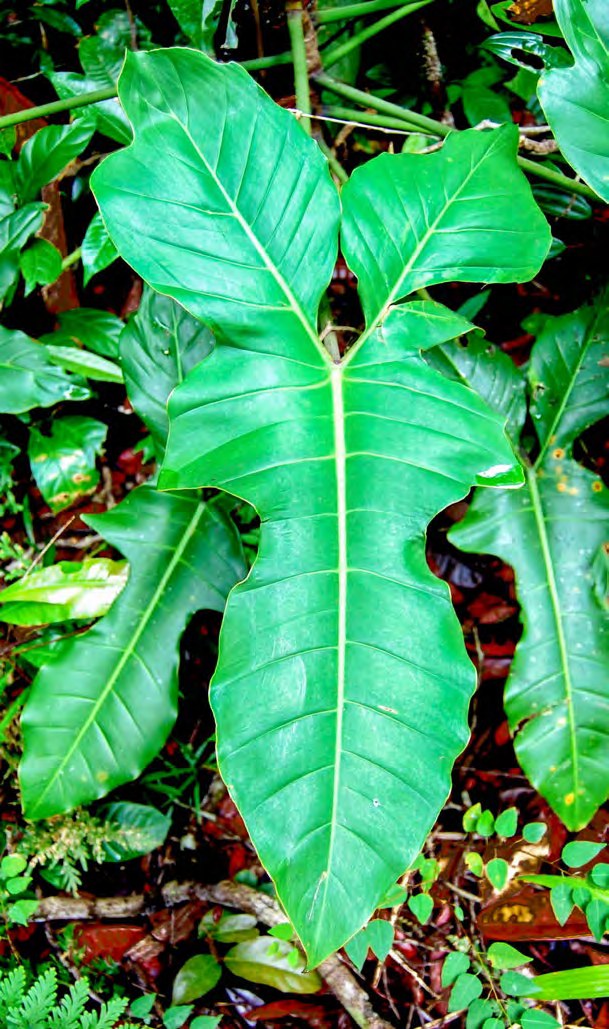
Scars, internodes, where the plant puts itself. The blade comes last, deliberately, and it is the one thing you already photographed. Two look-alikes show the limit of the blade. Steve Lucas observed in 2007 that many sellers, especially on eBay, appeared to be offering juvenile Philodendron bipennifolium as Philodendron panduriforme and the reverse24, and Tom Croat, who regards them as different species, wrote that Philodendron panduriforme is usually more deeply three-lobed than Philodendron bipennifolium25.
Why this genus rewards a living plant
Croat examined 80 of the 95 species in his revision in the field or in cultivation4, and it shows in what the treatment asks for. Sap color, resin, the way a cataphyll decays — these are questions you can only put to a plant that is alive and that you are willing to damage slightly.
A grower is unusually well placed to answer them. It is the one advantage you have over a herbarium sheet, and most people never use it.
One reply on the Aroid-L mailing list shows what such questions look like. Plants sold as Philodendron selloum, which Eduardo Gonçalves treated as the same species as Philodendron bipinnatifidum, may instead be Philodendron mello-barretoanum or Philodendron lundii. On May 8th, 2003 he told a reader holding seed of both names to raise the plants and read the stems and petioles: soft, easily detached stem scales and a petiole concave above point to Philodendron bipinnatifidum; hard scales that do not detach easily, with a petiole concave above, to Philodendron mello-barretoanum; no persistent scales and a petiole flattened above, to Philodendron lundii26.
Writing it down
The notation for a partial determination — cf., aff., and naming a rank above species — is set out in the Anthurium guide and works the same way here. Write the rank you reached, the treatment you used and its date, and what you could not answer.
This genus needs two additions to that habit:
| Also record | Because |
|---|---|
| Which convention you used for the Meconostigma group | Philodendron or Thaumatophyllum — both are current, and Part I is why. A record that does not say which is ambiguous the moment the other becomes standard. |
| Whether hybrid status is open | For a plant of unknown provenance it usually is, and a key to wild species cannot close it2. Recording the question is more useful than answering it wrongly. |
Neither line costs anything. Both are the difference between a record that stays readable and one that has to be started again by whoever comes after — which, in a genus that may be only two-thirds described, will probably be someone with better information than you had.
Sources
The papers behind this guide
Five sources. Two phylogenies, which between them set out what the argument in Part I is actually about; one regional revision, which is the book most readers will need; and two short papers that each do a specific job.
- Vasconcelos, S., Soares, M. de L., Sakuragui, C. M., Croat, T. B., Oliveira, G. & Benko-Iseppon, A. M. (2018). New insights on the phylogenetic relationships among the traditional Philodendron subgenera and the other groups of the Homalomena clade (Araceae). Molecular Phylogenetics and Evolution 127: 168–178. doi:10.1016/j.ympev.2018.05.017 The whole of Part I. Confirms the monophyly of Philodendron in the broad sense and of all three of its lineages, and its combined analyses placed Meconostigma as sister to the other two — which is why, under that topology, both the one-genus and the two-genus arrangements produce only natural groups. Its own separate ML and MP runs did not resolve the same node, and reference 5 below leaves it a polytomy. Also states its own uneven sampling (about 86% of the split-off group against about 23% of Philodendron), reports the earlier studies that had doubted monophyly on two or three species of Pteromischum, credits Sakuragui et al. 2018 with the elevation, and lists the recent treatments of each subgenus used in Part II. ⚠ Note the author line: Sakuragui, who erected the genus, and Croat, who does not use it, are both on this paper. It is not a dispute between camps.
- Croat, T. B. (2022). Philodendron × joepii, a new nothospecies in section Schizophyllum (Araceae) from French Guiana, and Philodendron ‘Bette Waterbury’, a new cultivar name for a similar hybrid of unknown original provenance. Aroideana 45(2). Part III, and the title is the argument. Two similar hybrids in one paper: the one found growing in the forests of French Guiana gets a botanical name at species rank, the one of unknown provenance gets a cultivar name. Provenance decides which kind of name is possible. Also the source of the count of 564 described species and of Croat's assessment that the genus remains one of the most poorly known, especially at the sectional level.
- Hay, A., Llano-Almario, M. & Carlsen, M. M. (2024). A note on the priority of the simultaneously validated synonymous sectional names in Anthurium Schott (Araceae—Pothoideae), sect. Schizoplacium (Schott) Engl. and sect. Dactylophyllium (Schott) Engl., and typification of their respective lectotype species. Aroideana 47(3). Cited here for one clause of its introduction, which describes the raising of subgenus Meconostigma to generic rank as somewhat controversial — a characterization from outside the argument, in a paper about a different genus entirely, and a fair one.
- Croat, T. B. (1997). A Revision of Philodendron Subgenus Philodendron (Araceae) for Mexico and Central America. Annals of the Missouri Botanical Garden 84(3). The substantial regional treatment, and the one most readers will need. Covers a single subgenus in a single region: 103 taxa, being 95 species and 8 varieties or subspecies, out of 128 taxa of the genus known from the area. Built on field study between 1967 and 1993, with all but 15 of the 95 species examined in the field or in cultivation — which is why it asks about sap, resin and cataphylls rather than about pressed outlines.
- Canal, D., Köster, N., Celis, M., Croat, T. B. & Borsch, T. (2019). Out of Amazonia and back again: historical biogeography of the species-rich Neotropical genus Philodendron (Araceae). Annals of the Missouri Botanical Garden 104: 49–68. The phylogenetic framework this site uses for the genus elsewhere. Leaves the branching order among Meconostigma, Pteromischum and subgenus Philodendron a polytomy, and states plainly that “the relationships among the three subgenera remain unclear… Taxonomic and nomenclatural conclusions within Philodendron should therefore be made with caution” (pp. 59, 61).
- Mayo, S. J. (1991). A revision of Philodendron subgenus Meconostigma (Araceae). Kew Bulletin 46(4): 601–681. The treatment of subg. Meconostigma (Thaumatophyllum) in the table in Part II.
- Gonçalves, E. G. & Salviani, E. R. (2002). New species and changing concepts of Philodendron subgenus Meconostigma (Araceae). Aroideana 25: 2–16. The later work on subg. Meconostigma named beside Mayo in Part II.
- Grayum, M. H. (1996). Revision of Philodendron subgenus Pteromischum (Araceae) for Pacific and Caribbean tropical America. Systematic Botany Monographs 47: 1–233. The treatment of subg. Pteromischum for Pacific and Caribbean tropical America in Part II.
- Barbosa, J. F. & Sakuragui, C. M. (2014). Taxonomy and conservation of the Brazilian extra-Amazonian species of Philodendron subg. Pteromischum (Araceae). Phytotaxa 191(1): 45–65. The extra-Amazonian Pteromischum species in Part II.
- Sakuragui, C. M., Mayo, S. J. & Zappi, D. C. (2005). Taxonomic revision of Brazilian species of Philodendron section Macrobelium. Kew Bulletin 60(4): 465–513. One of the two Brazilian sections of subg. Philodendron in Part II.
- Sakuragui, C. M., Calazans, L. S. B., de Morais, É. B., Coelho, M. A. N. & Pellegrini, M. O. O. (2012). Diversity and conservation of Philodendron Schott (Araceae) in Atlantic Forest of Rio de Janeiro State, Brazil. Feddes Repertorium 122(7–8): 472–496 (‘2011’). doi:10.1002/fedr.201200014 The second of the two Brazilian treatments of subg. Philodendron in Part II: the species of the Atlantic Forest of Rio de Janeiro State.
- Aroid-L mailing list, Peter Boyce, May 15th, 2006. Part III. On the name Philodendron glaucophyllum: as far as the writer could tell, it had not been published.
- Aroid-L mailing list, Tom Croat, May 15th, 2006. Part III. Reply in the same thread: a made-up name for Philodendron hastatum from the Rio de Janeiro area.
- Aroid-L mailing list, Tom Croat, May 16th, 2006. Part III. What Croat meant by saying there was no such name: that it is not published, to his knowledge.
- Aroid-L mailing list, Eduardo Gonçalves, May 16th, 2006. Part III. On the bluish leaves of wild Philodendron hastatum, young and adult.
- Aroid-L mailing list, Steve Lucas, March 4th, 2007. Part III. Lucas posts an email he had received from Tom Croat about Philodendron domesticum. The 1966 publication and the plant’s lack of a known origin are stated by Lucas; the rest is Croat’s.
- Aroid-L mailing list, Eduardo Gonçalves, February 26th, 2007. Part III. On the plants that have been called “Santa Leopoldina,” and on keeping the locality with a collected plant.
- Aroid-L mailing list, Eduardo Gonçalves, December 28th, 2001. Part III. On Philodendron burle-marxii: where it grows, that the writer found it in Acre, and its strap-like leaves.
- Aroid-L mailing list, Tom Croat, April 21st, 2008. Part III. A plant circulated as Philodendron burle-marxii and as ‘Burle Marx Fantasy’ was not the species, which Croat described as having somewhat strap-shaped leaves; he did not know the other plant and said it had not been published.
- Aroid-L mailing list, Hermine, May 31st, 2000. Part III. A grower’s description of the leaves of Philodendron burle-marxii and of ‘Burle Marx Fantasy’.
- Aroid-L mailing list, Tom Croat, March 19th, 2007. Part III. A plant shown as Philodendron variifolium identified as Philodendron brandtianum, and Philodendron variifolium Schott as a different plant.
- Aroid-L mailing list, Steve Lucas, November 3rd, 2009. Part III. The real Philodendron variifolium compared with the juvenile plant commonly sold under that name.
- Aroid-L mailing list, Eduardo Gonçalves, March 20th, 1997. Part IV. Philodendron brasiliense, under the synonym Philodendron cymbispathum: habit, leaf shape and size.
- Aroid-L mailing list, Steve Lucas, June 11th, 2007. Part IV. Sellers offering juvenile Philodendron bipennifolium as Philodendron panduriforme and the reverse.
- Aroid-L mailing list, Tom Croat, June 15th, 2007. Part IV. Philodendron panduriforme is usually more deeply three-lobed.
- Aroid-L mailing list, Eduardo Gonçalves, May 8th, 2003. Part IV. Plants sold as Philodendron selloum that may be other species, and how stem scales and the upper side of the petiole tell three of them apart.