

Subfamily Aroideae·Tribe Thomsonieae
Amorphophallus
DESCRIPTION
Amorphophallus contains 248 species, 247 of them accepted by Kew’s World Checklist of Vascular Plants. These are mostly tuberous herbs that alternate a single, tree-like compound leaf with a solitary spathe-and-spadix inflorescence, often separated by dormancy. The tuber is the plant’s persistent body; the apparent trunk is the leaf stalk. Blume’s name was validly published by Decaisne in 1834, and the genus belongs to tribe Thomsonieae. It includes the titan arum, Amorphophallus titanum, and the food plants Amorphophallus konjac and Amorphophallus paeoniifolius.
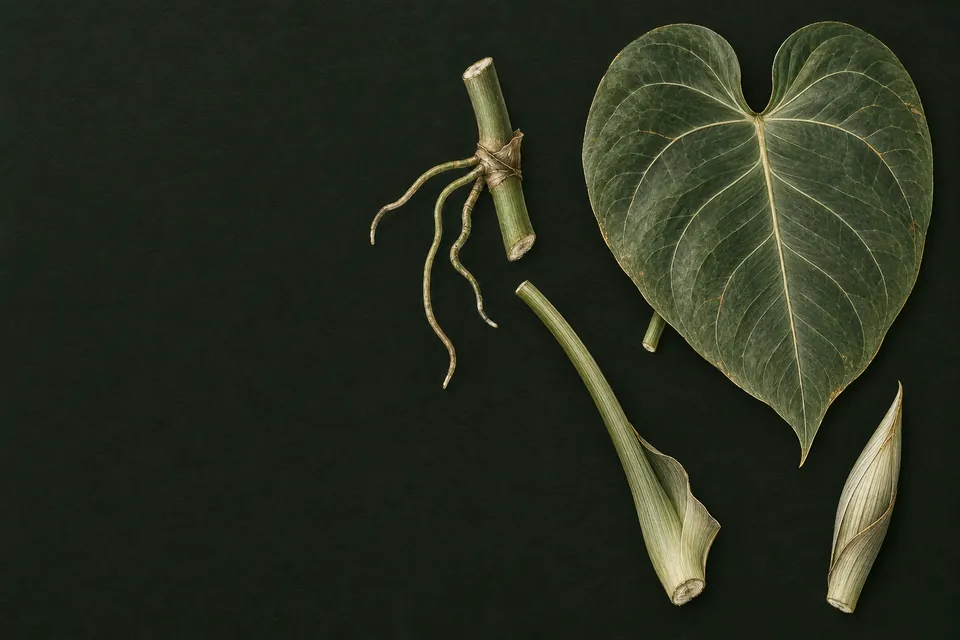
Ittenbach, working on the African species, described an acaulescent plant whose underground tuber produces one leaf at a time. The blade begins on a three-part plan and divides repeatedly until it resembles a crown of branches. A mature tuber may instead produce one inflorescence, usually without a leaf: a spadix bearing pistillate flowers below, staminate flowers above, and often a sterile appendix, enclosed at the base by the spathe. The tuber stores the resources for both structures and carries the plant through its resting period.
The botanical name is Amorphophallus Blume ex Decne. (1834), typified by Amorphophallus paeoniifolius. Yuzammi and Pouchon and colleagues place it in tribe Thomsonieae of subfamily Aroideae. Claudel and colleagues sampled 157 species and recovered the genus as a strongly supported monophyletic group divided into four subgenera. Pouchon and colleagues later used 71 plastid genes from 36 species to support all four and resolve their backbone as Afrophallus, then Scutandrium, with Metandrium sister to subgenus Amorphophallus.
The extremes are unusually conspicuous. Claudel and colleagues cite a spathe of more than 2 m and tubers of up to 150 kg for Amorphophallus titanum, a species of western Sumatra. Hetterscheid and Ittenbach described Amorphophallus konjac as a long-selected crop in China and Japan, where its tuber supplies konnyaku flour. Yuzammi treated both wild and cultivated Amorphophallus paeoniifolius in Java, while Singh and Gadgil compared its wild and cultivated populations in Karnataka. Its edible tuber gives it the name elephant foot yam.
Go deeper: Amorphophallus morphology guide · Amorphophallus identification guide
Claudel and colleagues recognized these four molecular clades in 2017. Their paper supplied diagnoses for the two new names, Scutandrium and Afrophallus, but not for the pre-existing Metandrium or the autonymous subgenus Amorphophallus; those two cannot be assigned from a published character list alone. Pouchon and colleagues confirmed the monophyly of all four with plastid-genome data in 2023.
Hetterscheid and Claudel formally absorbed Pseudodracontium into Amorphophallus in 2012, and Claudel and colleagues’ 2017 classification placed its species in subgenus Scutandrium. Wilbert Hetterscheid wrote on Aroid-L on June 23rd, 2000, that Gonatopus is often mistaken for Amorphophallus in Africa and offered the tuber contrast as a rule of thumb. He wrote on Aroid-L on December 16th, 2000, that the leaflet arrangement usually separates Sauromatum and Arisaema from most Amorphophallus.
DISTRIBUTION
The genus is native across the Old World tropics and subtropics, from West, Central and East Africa and Madagascar through India, China and Southeast Asia to New Guinea and northern Australia. The range data behind the lists below count 124 species in Indo-China and 72 in Malesia, making Indo-China the principal center of diversity; Thailand has 63 mapped species, Vietnam 40 and Laos 31. Africa has 40 species across its tropical regions and Madagascar, while only two reach Australia. Cultivation has carried several food species beyond their native ranges.
The distribution is highly uneven. The same dataset counts 22 species in West-Central Tropical Africa, 21 on the Indian subcontinent, 14 in China, 11 in West Tropical Africa and eight each in East Tropical Africa and Madagascar. Beyond Thailand, Vietnam, Laos and Myanmar, with 63, 40, 31 and 18, the richest records are the Philippines with 22, Borneo with 21, and Sumatra and India with 15 each.
Endemism is especially strong on islands. Miranda and colleagues recognized 22 Philippine species in 2025, 20 of them endemic. Yuzammi treated eight species on Java in 2009, five endemic there. Local ranges may be much smaller still: Tamayo and colleagues described Amorphophallus calcicolus only from forest over karst in one reserve on Bohol. At the opposite extreme, Amorphophallus paeoniifolius ranges from tropical Asia to northern Australia and has also been widely carried in cultivation.
Go deeper: Amorphophallus identification guide
ECOLOGY
CHROMOSOMES
2n = 26 in 23 of the 27 species counted (85%).
+ 1 rarer count
Shares add up to more than 100% because some species have been counted at more than one number, usually diploid and polyploid forms of the same species (e.g. Amorphophallus bulbifer at 26 and 36 and 39).
27 of 248 species have a published 2n count.
What chromosome numbers mean for a cross, in the Chromosomes and Crossing guide.
Counted species (27)
- Amorphophallus abyssinicus26
- Amorphophallus albus26
- Amorphophallus ankarana26
- Amorphophallus asterostigmatus26
- Amorphophallus bulbifer26, 36, 39
- Amorphophallus commutatus26
- Amorphophallus gallaensis26
- Amorphophallus goetzei26
- Amorphophallus gomboczianus26
- Amorphophallus haematospadix26
- Amorphophallus hildebrandtii26
- Amorphophallus hohenackeri26
- Amorphophallus kiusianus26
- Amorphophallus konjac26
- Amorphophallus konkanensis26
- Amorphophallus lacourii26
- Amorphophallus longituberosus28
- Amorphophallus margaritifer26
- Amorphophallus maximus26
- Amorphophallus muelleri39
- Amorphophallus paeoniifolius26, 28
- Amorphophallus palawanensis26
- Amorphophallus prainii28
- Amorphophallus rivieri39
- Amorphophallus titanum26
- Amorphophallus variabilis26
- Amorphophallus yunnanensis26
Sources (23)
- Anil, S. R.; Devi, A. A.; Asha, K. I.; Beevy, S. S.; Siril, E. A. 2023. Intraspecific inflorescence and palynological variations in the morphotypes of Amorphophallus paeoniifolius. Research Square (preprint).
- Bogner, J.; Hetterscheid, W. L. A. 1992. Notes on the genus Amorphophallus (Araceae). 1. Three new species from tropical Asia. Blumea 36: 467–475.
- Boyce, P. C.; Sookchaloem, D.; Hetterscheid, W. L. A.; Gusman, G.; Jacobsen, N.; Idei, T.; Nguyen, V. D. 2012. Araceae. Flora of Thailand 11(2): 1–221.
- Claudel, C. 2025. The genus Amorphophallus Blume (Araceae): phylogenetic studies and evolutionary patterns. University of Hamburg (doctoral dissertation, Faculty of Mathematics, Informatics and Natural Sciences).
- Das, D.; Neog, B.; Dutta, S.; Raidongia, L.; Das, A. B.; Hatimuriya, R. 2020. Karyomorphological analysis of some edible aroids of Upper Brahmaputra Valley of Assam. Journal of Cytology and Genetics 21(NS): 27–39.
- DBT Network Programme n.d. Species Datasheet A-028.003.007: Amorphophallus konkanensis Hett., S. R. Yadav & K. S. Patil. Species datasheet (Department of Biotechnology, India), not a journal publication.
- De Sarker, D.; Hetterscheid, W. L. A. 1997. Notes on the Genus Amorphophallus (Araceae), 9: Cytological Investigation of Amorphophallus (Plesmonium) margaritifer (Roxb.) Kunth. Aroideana 20.
- Flach, M.; Rumawas, F. (eds.) 1996. Amorphophallus (chapter in Plant Resources of South-East Asia No 9: Plants yielding non-seed carbohydrates). Plant Resources of South-East Asia No 9: Plants yielding non-seed carbohydrates, Backhuys Publishers, Leiden 9: 45.
- Gao, Y.; Zhang, Y.; Feng, C.; Chu, H.; Feng, C.; Wang, H.; Wu, L.; Yin, S.; Liu, C.; Chen, H.; Li, Z.; Zou, Z.; Tang, L. 2022. A chromosome-level genome assembly of Amorphophallus konjac provides insights into konjac glucomannan biosynthesis. Computational and Structural Biotechnology Journal 20: 1002–1011.
- Gholave, A. R.; Jadhav, J. P.; Yadav, S. R. 2014. Cytotaxonomical Studies on Three Varieties of Amorphophallus commutatus (Araceae) Endemic to the Western Ghats. Cytologia 79(3): 359–363.
- Giordano, C. 1999. Karyological and Palynological Observations on Amorphophallus titanum (Becc.) Becc. ex Arcangeli (Araceae). Caryologia 52(1-2): 65–73.
- Hetterscheid, W. L. A.; Ittenbach, S.; Bogner, J. 1999. Notes on the genus Amorphophallus (Araceae). 10. Revision of the endemic Amorphophallus species of Madagascar. Botanische Jahrbucher fur Systematik (Bot. Jahrb. Syst.) 121: 1–17.
- Hetterscheid, W. L. A.; Yadav, S. R.; Patil, K. S. 1994. Notes on the genus Amorphophallus (Araceae) - 5. Amorphophallus konkanensis, a new species from India, and taxonomic reflections on Amorphophallus section Rhaphiophallus. Blumea 39(1/2): 289–294.
- Hetterscheid, W.; Ittenbach, S. 1996. Everything you Always Wanted to Know about Amorphophallus, but Were Afraid To Stick Your Nose Into!!!!!. Aroideana 19.
- Itô, T. 1942. Chromosomen und Sexualität von der Araceae. Cytologia 12(2-3): 313–325.
- Li, H. 2010. Araceae. Flora of China, vol. 23 23: 3–79.
- Marchant, C. J. 1971. Chromosome variation in Araceae: II. Richardieae to Colocasieae. Kew Bulletin 25(1): 47–56.
- Marchant, C. J. 1971. Chromosome variation in Araceae: III. Philodendreae to Pythonieae. Kew Bulletin 25(2): 323–329.
- Nakajima, G. 1933. Chromosome numbers in some angiosperms. The Japanese Journal of Genetics 9(1): 1–5.
- Patil, K. S.; Dixit, G. B. 1995. Cytological Studies in Araceae Part 1. Aroideana 18.
- Ramachandran, K. 1977. Karyological Studies on Four South Indian Species of Amorphophallus. Cytologia 42(3-4): 645–652.
- Santosa, E.; Sugiyama, N.; Kawabata, S.; Hikosaka, S. 2012. Genetic variations of Amorphophallus variabilis Blume (Araceae) in Java using AFLP. Journal of Agronomy Indonesia (J. Agron. Indonesia) 40(1): 62–68.
- Yin, S.; Chu, H.; Zhang, Y.; Lu, F.; Tang, L.; Gao, Y. 2021. Population genetic diversity and genetic structure of Amorphophallus yunnanensis in Southwestern China and its conservation implication. Taiwania 66(2): 126–134.
CLIMATE
Most Amorphophallus are warm-climate geophytes whose tubers bridge a seasonal rest. Hetterscheid and Ittenbach found a continental difference in timing: Asian non-evergreen species usually separate flowering and leaf growth into different seasons, while African and Madagascan species produce both in the same season, with the inflorescence first. Rainfall often triggers renewed growth, but dormancy is not universal and the timing is not a simple temperature response. Ayop and colleagues followed Amorphophallus paeoniifolius through a monsoon-linked cycle of dormancy, leafing, flowering, fruiting and senescence on Bohol.
The annual cycle is an allocation problem as well as a response to weather. A leaf rebuilds the tuber; an inflorescence spends stored reserves before it can replace them. In Asian seasonal species, flowering and successful fruiting may therefore occupy a season without a leaf. African and Madagascan species follow a different calendar, flowering and leafing in the same growing season. Claudel and colleagues made that shared timing the most prominent defining character of subgenus Afrophallus.
There are exceptions at both ends. Some Asian species retain leaves for more than one year, and Amorphophallus rhizomatosus can carry leaf and inflorescence together despite belonging to subgenus Scutandrium, whose diagnosis otherwise describes alternating leaf and flowering years. Season, provenance and whether a plant is evergreen are therefore more informative together than any one calendar rule.
Go deeper: Amorphophallus morphology guide · Amorphophallus identification guide
HABITAT & POLLINATION
The genus occupies deeply shaded rainforest, seasonal forest, forest margins, disturbed woodland, open scrub, savanna and limestone or karst. Singh and Gadgil found Indian plants most abundant in open scrub but associated them with humid sites and intermediate disturbance. The inflorescences commonly imitate carrion, dung or other fermenting resources with color, texture and odor. Claudel’s review identifies beetles as the principal known pollinator group; flies visit many species but are less often demonstrated as pollinators. Heat can intensify scent release, although Claudel and colleagues found that 20 of 80 measured species showed no heating above their 1.5 °C threshold.
Habitats vary sharply among species. Singh and Gadgil recorded plants in Karnataka from open scrub and mesa through disturbed evergreen forest and plantations. Tamayo and colleagues found Amorphophallus calcicolus only in forest over karst limestone on Bohol. In Ghana, Amorphophallus johnsonii occurs in rainforest and savanna forms; Beath observed its fish-and-feces odor attracting the carrion beetle Phaeochrous amplus in rainforest.
Deception is diverse rather than a single carrion-flower formula. Claudel and Lev-Yadun reported that dimethyl oligosulfides, compounds associated with decomposing flesh and carnivore dung, occur in all four subgenera and are the most abundant compounds in about half of the 92 species whose scent Kite and Hetterscheid analyzed. Other lineages smell of cheese, anise, fruit or fermentation, and scent can vary among individuals of one species. Odor advertises a false resource; the spathe base receives visitors while pistillate flowers are receptive, and pollen is released later, reducing self-pollination.
Claudel found that beetles are the most likely main pollinators of the genus, while attracted flies often contribute less to actual pollination. The evidence remains narrow: many records concern visitors rather than demonstrated pollen transfer, and only a small part of the genus has been studied. Carrion and dung mimicry should therefore not be read as proof that every fly or beetle inside a spathe is a pollinator.
Thermogenesis is equally variable. Claudel and colleagues measured 119 flowering series across 80 species: 20 species were non-thermogenic under their threshold, while others heated the appendix, the staminate zone or both. Heat helps volatilize odor, but it did not track overall plant size and was inferred to have been lost repeatedly within the genus. The titan arum is spectacular, not a template for every species.
Go deeper: Amorphophallus reproduction guide · Amorphophallus morphology guide
Araceae · Form
Morphology
From a buried tuber, Amorphophallus stages its life one act at a time — a single immense leaf in one season, an extraordinary inflorescence in another.
One giant compound leaf per season — often mistaken for a small tree — on a long, mottled, trunk-like petiole.
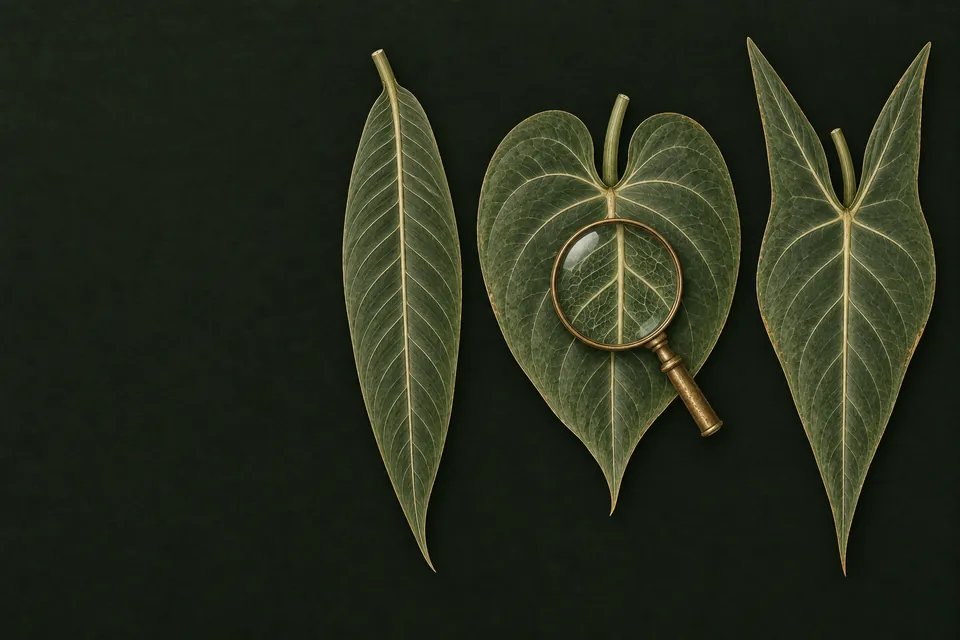
The apparent crown is one leaf on a single petiole. Its blade begins on a three-part plan, then branches repeatedly until the plan can be hard to see. The mottling, color and texture of the petiole are conspicuous but variable, while bulbils at the branch junctions occur only in some species and sometimes only in some clones. Ittenbach’s 2003 revision found that the blade alone usually carries little diagnostic weight.
One leaf, repeatedly divided
Ittenbach described the blade as pinnate on a ternate ground plan: two lateral divisions and one terminal division, each subdividing again, sometimes through several orders. Ittenbach describes the adult leaf as standing alone and erect, sheathed at the base by one to four cataphylls, and Hetterscheid and Ittenbach put the morphological variation of the genus above that of any other aroid genus. Seedlings may begin with an undivided sagittate leaf or an already three-parted one, and Hetterscheid and Ittenbach record first leaves divided into three to five parts, before the mature architecture appears.
What reads as a small tree is, botanically, a single leaf. The mottled, trunk-like column is the petiole; the “canopy” is one blade divided into three primary divisions and divided again from there, in some species into hundreds of leaflets. Most species raise one leaf per season, each larger than the last as the tuber beneath gains the weight to flower. In a few species, small tubercles at the junctions of the divisions are more than a curiosity — in Amorphophallus bulbifer and its relatives they are bulbils, ready-made propagules that root where they fall. According to Wilbert Hetterscheid, vegetative plants of Amorphophallus bulbifer are difficult to separate from Amorphophallus muelleri, another bulbil-bearing species, but the tuber may help: smooth in Amorphophallus bulbifer, and covered all over with distinct, raised, annulate root scars in Amorphophallus muelleri (August 7th, 1997; March 20th, 2004).
Useful, but rarely decisive
Petiole markings and texture can vary within a species. Michael Pascall of Whyanbeel Arboretum in Far North Queensland raised seed of a strongly spotted form of Amorphophallus galbra and got only one seedling with a spotted petiole, the rest being all green; in his view only the flower settles the identity of such variable plants (August 16th, 2001). Ron McHatton found petiole roughness in Amorphophallus paeoniifolius ranging from virtually smooth in one group raised from seed in central Florida to extremely rough in another (October 25th, 2008). Color can still help, though: Wilbert Hetterscheid, answering a photograph query about a plant raised from seed sold as Amorphophallus paeoniifolius, took the red coloration as a clue to Amorphophallus koratensis, which he said is often mistaken for Amorphophallus paeoniifolius when in leaf, having never seen red in proper Amorphophallus paeoniifolius; the exchange left that plant’s identity open (June 18th, 2011; June 23rd, 2011).
Go deeper: Amorphophallus morphology guide · Amorphophallus identification guide
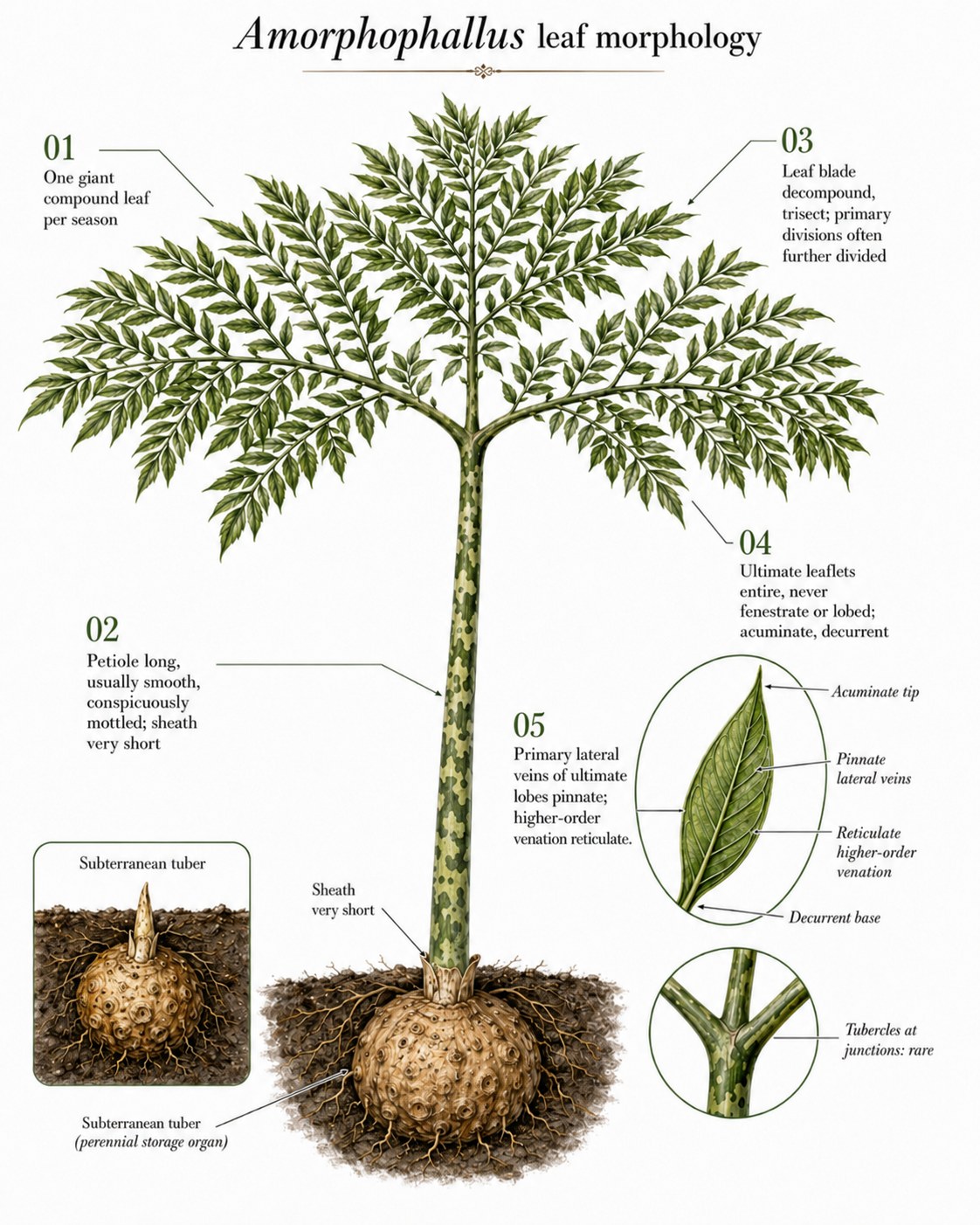
Fig · Leaf architecture
Seasonally dormant herbs growing from a tuber — modest in most species, colossal in the giants.
For most species, the tuber is the year-round plant and everything above ground is temporary. A growing season usually produces one leaf; a mature tuber may instead spend its reserves on an inflorescence. The next tuber forms above the remains of the old one and contractile roots pull it back to depth. Hetterscheid and Ittenbach found an important geographic split: Asian species usually separate leafing and flowering by season, while African and Madagascan species normally produce both in the same season.
A tuber rebuilt each season
Ittenbach found that the tuber does not merely enlarge in place. Stored reserves support the season’s growth, while the leaf’s assimilates build a replacement tuber above the remains of the previous one; contractile roots then draw the new tuber downward. Among the African species, Ittenbach found discus-shaped tubers dominant, rounded ones typical of the smaller species and elliptical ones exceptional; the large species have small round tubers when young and change shape as they grow, and some spread by daughter tubers or stolons. Dormancy is typical, but the genus also contains rare semi-evergreen or evergreen species.
The permanent plant is the tuber; leaf and inflorescence are temporary organs sent up one at a time. The cycle runs in seasons: a leaf to feed the tuber, then dormancy; another leaf, or — once the tuber has banked the reserves — an inflorescence; then dormancy again. Each flowering costs a full cycle. One documented Amorphophallus paeoniifolius bloomed from a 24 kg tuber after ten years in cultivation, and weighed 29 kg by the following season. Tuber size at flowering varies widely: at Fairchild Tropical Garden in Miami, Florida, the first Amorphophallus gigas to bloom there, raised from seed from the 1993 expedition of James Symon and Wilbert Hetterscheid, had an inflorescence 132 inches (about 335 cm) tall on May 31st, 1999, from a tuber that weighed only 4.5 pounds (about 2 kg) (May 20th, 1999; June 4th, 1999). The wait from seed varies too: Kathy Upton reported that one of her seedlings of Amorphophallus titanum at the University of Missouri–St. Louis opened a miniature inflorescence about two feet tall three years and three months after planting, and that a second plant of the same batch flowered six years and four months after planting, from a tuber 12 inches (30 cm) across that weighed 10 pounds (about 4.5 kg) when repotted in dormancy (April 29th, 1998; May 4th, 1998; June 13th, 2001; June 20th, 2001).
Two seasonal calendars
Hetterscheid and Ittenbach found that Asian non-evergreen species usually carry a leaf and an inflorescence in separate seasons; when both occur in one season, the leaf precedes the inflorescence. African and Madagascan species normally flower first and then produce a leaf in the same season, whether or not fruit sets. Ayop, Gentallan and Estrada followed Amorphophallus paeoniifolius for a year on Bohol and found a monsoon-linked cycle of active growth, senescence and complete loss of the aerial parts, but their calendar belongs to that species and place rather than to the whole genus.
The tuber itself helps with identification. Wilbert Hetterscheid wrote that an Amorphophallus tuber usually has a noticeable depression on top in which the bud rests, whereas Gonatopus, an African genus often misidentified as Amorphophallus, is more pyramidal (June 23rd, 2000). Two growers who bought tubers in California as Amorphophallus abyssinicus concluded they had Gonatopus: one described tubers pointed on top like a pyramid, slow to break dormancy, with a very short leaf and a knob or knee in the stem (June 22nd, 2000), the other a tuber flat as a pancake with no hint of a depression where the bud sits (June 24th, 2000).
Go deeper: Amorphophallus morphology guide · Amorphophallus identification guide
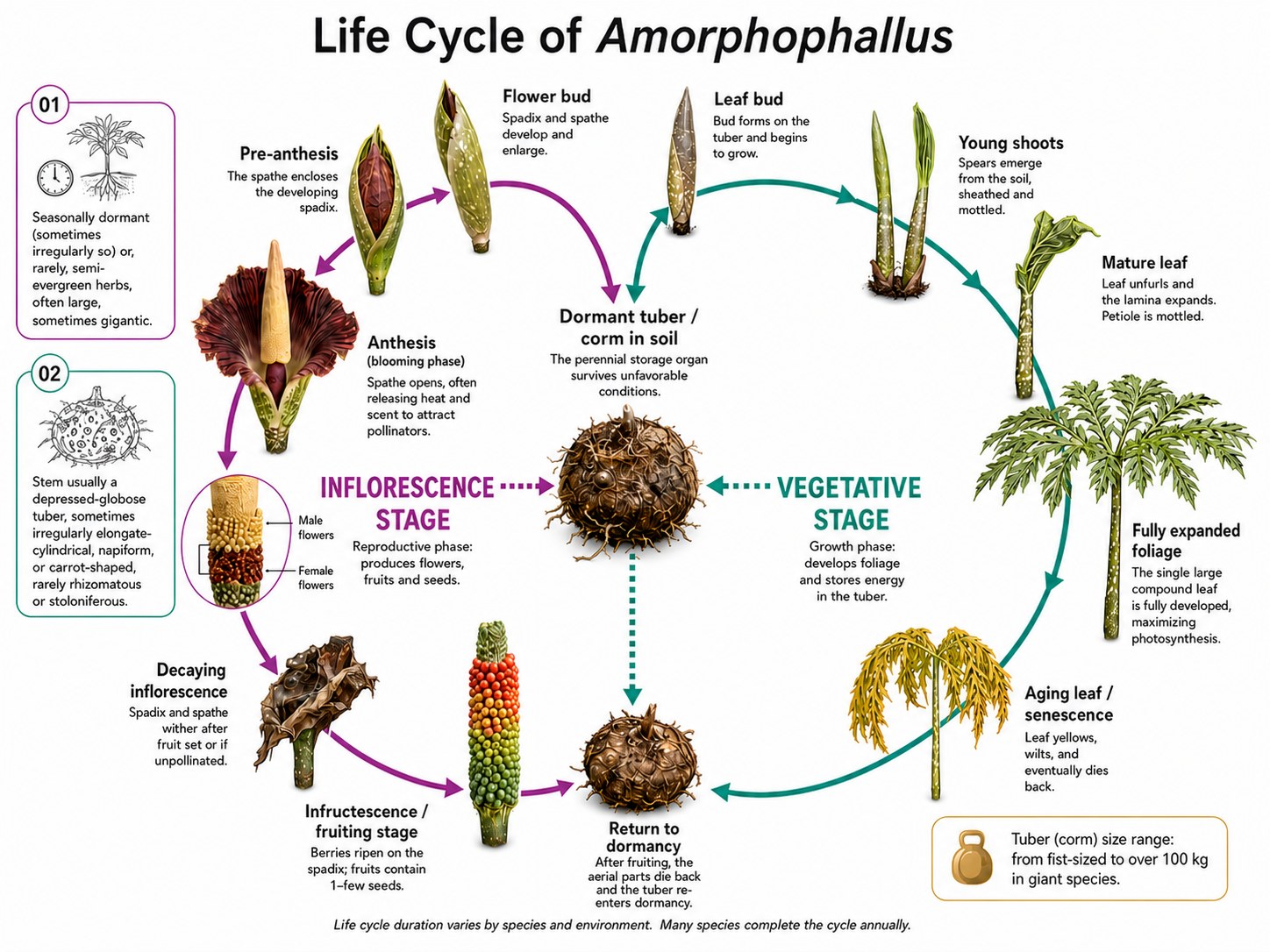
Fig · The annual cycle
A single spathe-and-spadix, usually rising before the leaf — the genus’s signature act.
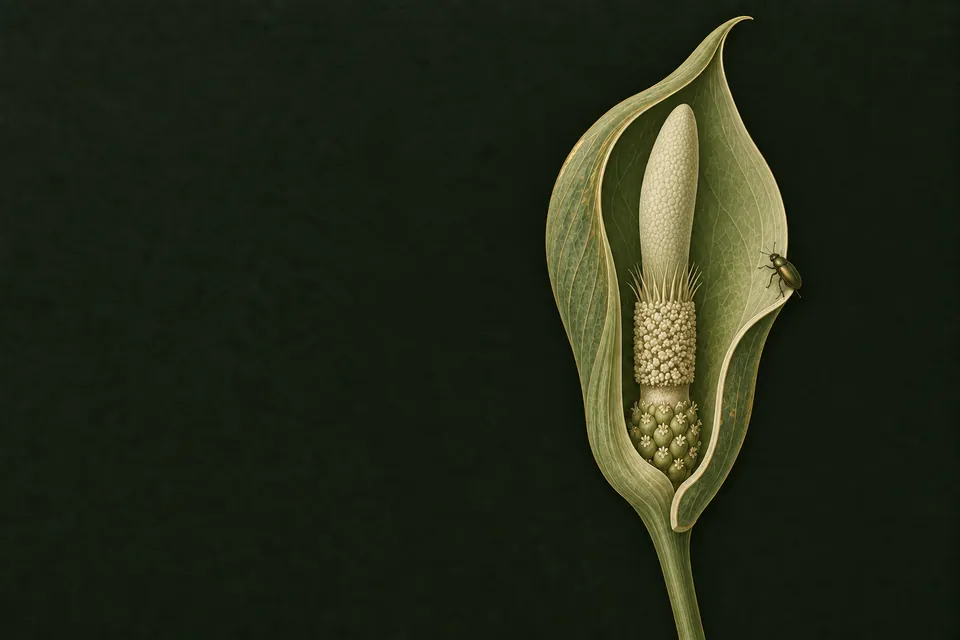
A spathe wraps a spadix divided from bottom to top into female flowers, sometimes a sterile interval, male flowers and usually a sterile appendix. The lower spathe forms the floral chamber; the limb above supplies the display. The female phase comes first and pollen follows later. Hetterscheid and Ittenbach show how dramatically the proportions, surfaces and shapes vary, while Kite and Hetterscheid found phylogenetic trends in scent, though close relatives sometimes differ, so no single pattern covers the genus.
The flowering habit
Inflorescences are usually solitary and usually appear without the leaf, emerging from conspicuous cataphylls. The peduncle runs from very short to long, is often partly buried, and generally wears the same mottled patterning as the petiole.
The spathe
One wrapper with two jobs. The lower portion — rolled or fused into a tube, bell-shaped to cylindrical — encloses the floral chamber, its inner surface smooth, ribbed, or lined with scale- and hair-like processes. The limb above stands erect or spreads wide, smooth, ribbed, or frilled at the margins, and carries the display.
The spadix, zone by zone
Reading upward: a pistillate zone of naked female flowers, each gynoecium one- to four-chambered under a stigma that is variably shaped; sometimes a sterile interstice; a staminate zone of flowers with one to six stamens (rarely eight), free or sometimes fused, in some species into synandria, shedding pollen through apical pores or terminal slits; and above it all the appendix — present in nearly every species, endlessly variable in shape and texture, and responsible for the genus’s silhouette. All flowers are unisexual and naked, without any perianth, and the females are receptive before the males shed.
Variation that matters
The descriptor sets built on Hetterscheid and Ittenbach’s work record appendices ranging from absent to far longer than the spathe, spathe bases that may be smooth, warty, grooved or lined with hair-like processes, and sterile zones that may separate the sexes or be absent. For the African species, Ittenbach’s revision places most of its diagnostic weight on the flowers, spadix and spathe rather than on the leaf blade. This is why an inflorescence usually carries more identification evidence than a vegetative crown.
Scent and heat
In most species the appendix is the scent organ, and many inflorescences warm as they open — but the genus refuses a single story: heating differs species to species, and some species do not measurably heat at all. The full account — who visits, what the heat does, and what the scent is made of — is in the Amorphophallus pollination guide.
Go deeper: Amorphophallus reproduction guide · Amorphophallus identification guide
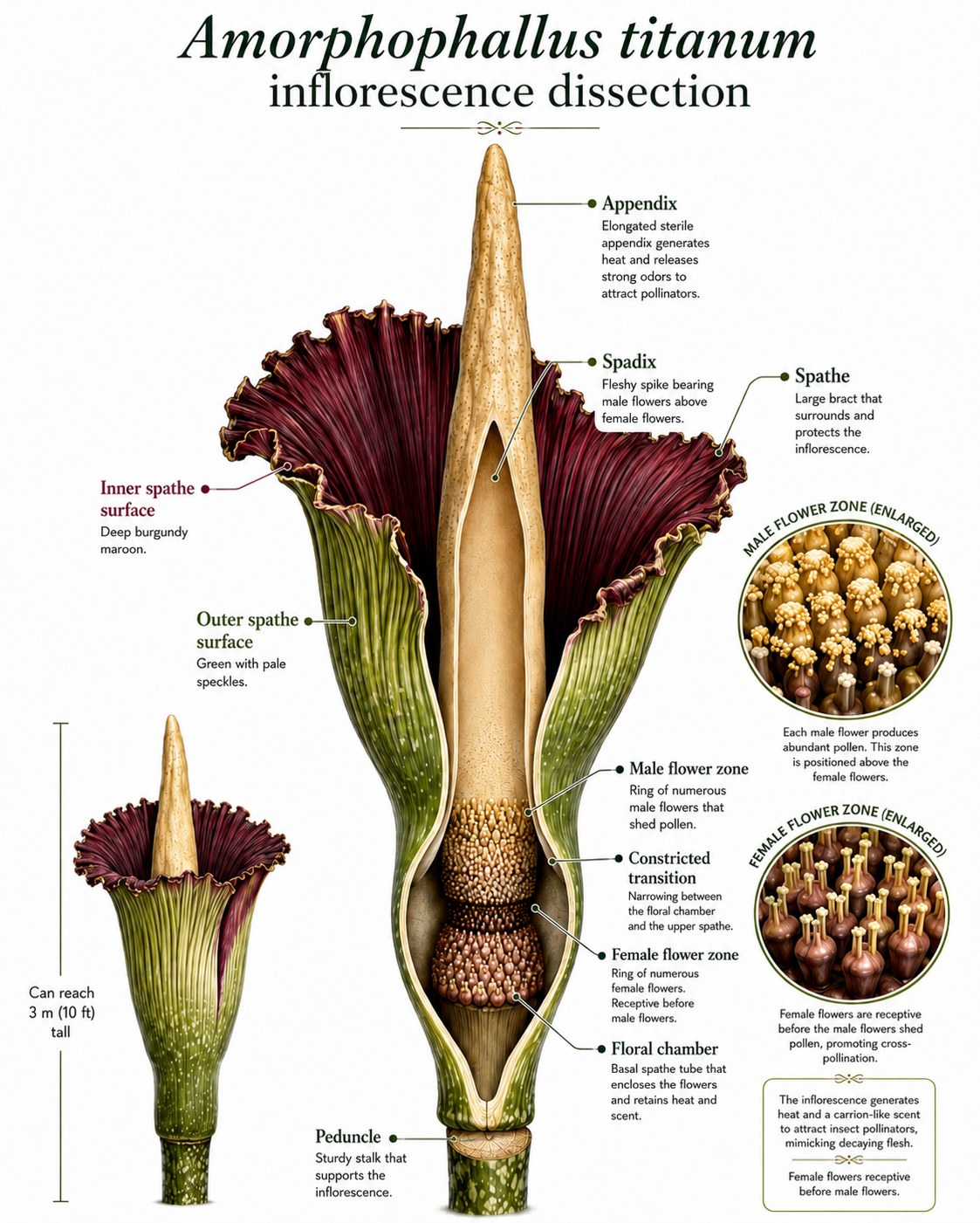
Fig · Amorphophallus titanum, dissected
Berries ripen on the naked, persisting spadix — orange to red in most species, blue in a few.
After pollination, the spathe and appendix disappear while the female zone develops into an upright head of fleshy berries. Color, fruit number and seed number vary by species. Hetterscheid and Ittenbach describe seeds with a thin coat and no endosperm, which makes fresh handling important. The inflorescence and fruiting cycle can consume an entire season in Asian species, while African and Madagascan plants normally produce a leaf alongside the developing crop.
The fruiting axis
After anthesis the spathe and appendix wither and fall, and the former pistillate zone ripens into a club of fleshy berries carried upright on the peduncle. Most species ripen to orange or red, with blue, white and other colors also known. An Amorphophallus titanum infructescence is about 60 cm long and 10 cm thick, with berries to 3 cm. The seed carries no endosperm and a large, superficially green embryo — Amorphophallus seed is short-lived and best sown fresh.
Engler’s 1889 family treatment gives an infructescence of Amorphophallus titanum about 60 cm long and 10 cm thick, with berries to 3 cm. Hetterscheid and Ittenbach warn that the thin-coated, endosperm-free seeds should not be allowed to dry: once dry, they cannot be successfully rehydrated. Ayop, Gentallan and Estrada found 2–4 seeds per fruit in Amorphophallus paeoniifolius on Bohol; that count belongs to one species and should not be generalized to the genus.
Go deeper: Amorphophallus reproduction guide · Amorphophallus morphology guide
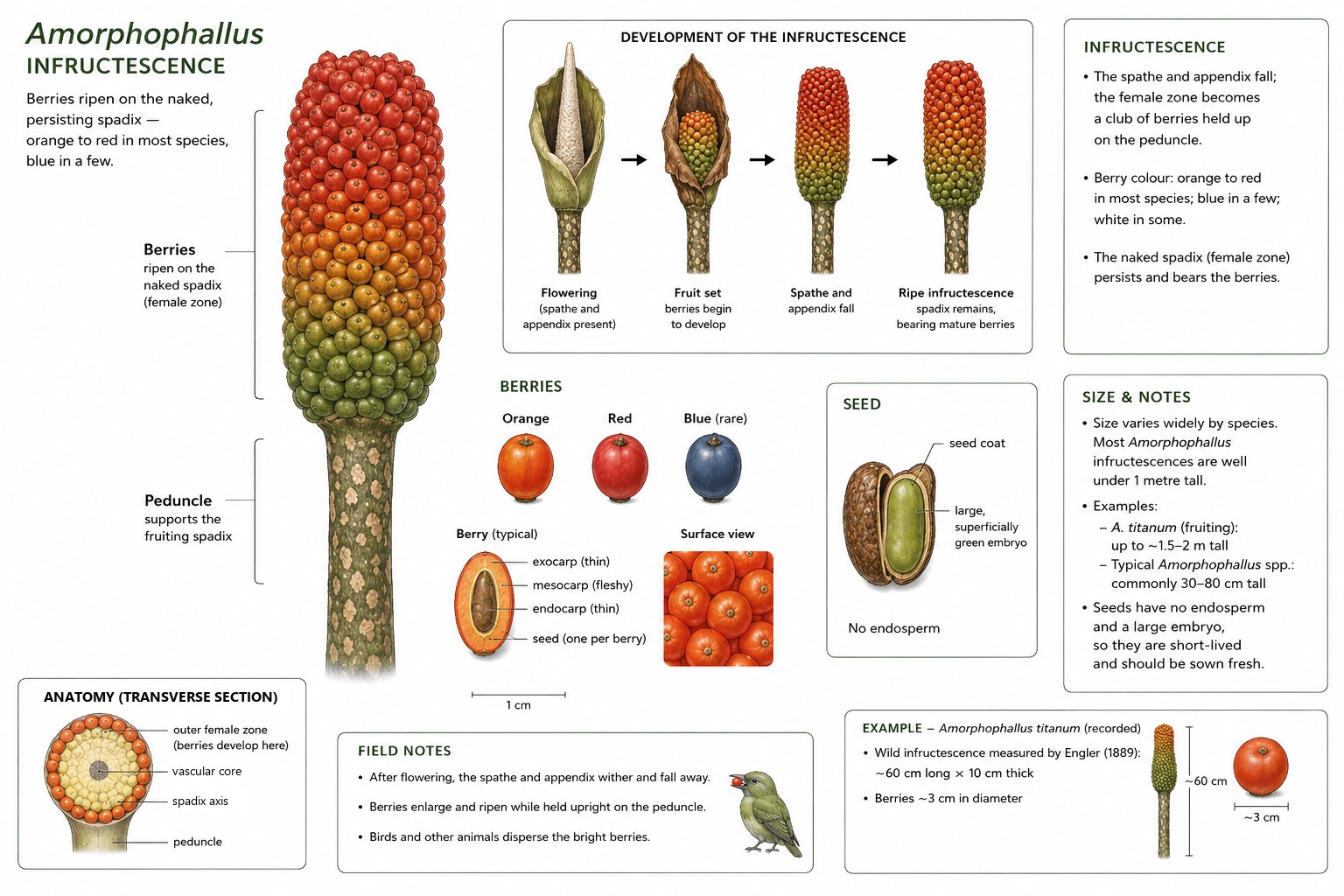
Fig · Infructescence & seed
Araceae · Care
Cultivation
Amorphophallus are less commonly collected by hobbyists, and are more often seen in tropical botanical gardens. They thrive under specific conditions, but are generally easy and rewarding to cultivate if those conditions are met.
Moisture-retentive but never waterlogged — a chunky, airy mix is the whole secret.
Product links on this page go to Amazon. As an Amazon Associate, Aroidpedia earns from qualifying purchases.
Amorphophallus prefer a rich substrate that retains moisture while not getting excessively water-logged and anoxic. A mix of peat moss/coco peat, perlite, pine fines or rice hulls, orchid bark and worm castings will work excellently for most growers.
Advanced growers may see success with semi-hydroponic growing media as well (LECA, PON, etc.). Additives like humic acid, systemic BONIDE granules or dolomitic lime can also benefit Amorphophallus, depending on species and individual growing conditions.
One published protocol, one species
Lobin and colleagues grew Amorphophallus titanum at Bonn in a compost of 75% Einheitserde ED73 and 25% washed sand, over a gravel drainage layer; the commercial compost itself was based on peat and clay dust. Their protocol belongs to one giant species in a heated conservatory, but it supports the same functional priorities: a water-retentive organic base, added mineral structure and dependable drainage.
Go deeper: Amorphophallus morphology guide
Slower growers than their cousins, but still hungry — feed lightly, every other watering.
Amorphophallus are slower growing than other Araceae genera, but can still benefit from fertilization with every other watering. This can be done either externally, with fertilizer added to the watering solution (General Hydroponics Flora Series), or internally, with slow-release forms of fertilizer added to the substrate (Nutricote, bone meal & blood meal).
Too much can show on the leaf edges. Scott Hyndman of Vero Beach, Florida (USDA zone 10a), wrote that he over-fertilized his large Amorphophallus paeoniifolius in a 150-gallon (about 570-liter) pot, especially while the new tuber was growing: the leaf edges turned yellow, then brown and crumbly, which he attributed to high soluble salts, and the foliage looked as though the plant was about to die, yet it produced a healthy tuber that was about to bloom when he wrote on May 5th, 2001.
Lobin and colleagues’ Amorphophallus titanum protocol at Bonn used liquid feed every two weeks during active growth, reduced it in winter and stopped when leaves began to wither and shortly before the spathe opened. It is a single-species botanic-garden regime, not a general dose for the genus, but it reinforces the seasonal rule: feed the leaf that is rebuilding the tuber, then stop as growth closes.
Go deeper: Amorphophallus morphology guide
Warm, bright shade and steady moisture while in leaf — and a real rest when the leaf is gone.
Temperature
Like many other tropical genera, Amorphophallus prefer warm temperatures between 70–85°F (21–30°C). Anything below 50°F (10°C) is detrimental, while temperatures below 40°F (4°C) are injurious.
Humidity
60–80% RH is recommended for optimal growth and maintaining an acceptable VPD (Vapor Pressure Deficit), though many growers have reported Amorphophallus will adapt to ambient humidity as low as 30% if needed (this will result in very high VPDs and nutrient burn is possible, so lighter fertilization is recommended).
Watering
While in active growth, substrate should be kept consistently moist and should never be allowed to dry out.
Light
When grown outdoors, shade cloth blocking 70–80% of sunlight is recommended. For plants grown indoors under artificial lighting, this is equivalent to about 2000–3000 FC (400–600 µmol) and is ideal for growth and flowering. A minimum of 200 FC (40 µmol) is required for maintenance, though no growth will take place at such low light densities. While still considered low light, Amorphophallus will grow, albeit slowly, starting at 400 FC (80 µmol).
Root-zone temperature
Soil temperature matters too, at least in young plants: Ron McHatton, who at one time grew about 4,000 Amorphophallus titanum from seed, found it important for keeping them growing. The optimum seemed to be near 80°F (27°C), and the plants tended to overheat if the soil went much higher. He added that wet potting mix can fall to 50°F (10°C) through evaporation when the air is 60°F (16°C) (November 27th, 2007).
Hardiness reports
A few species are the exception. Marco Motta’s Amorphophallus Resting Table lists five as frost resistant (Amorphophallus albus, Amorphophallus bulbifer, Amorphophallus konjac, Amorphophallus yuloensis and Amorphophallus yunnanensis) and three more as under test (Amorphophallus coaetaneus, Amorphophallus dunnii and Amorphophallus henryi). In a message to the Aroid-L mailing list on February 19th, 1997, Tony Avent reported that Amorphophallus bulbifer had survived 0°F (−18°C) in the garden at Plant Delights Nursery in Raleigh, North Carolina (USDA zone 7), for relatively short periods.
Growers’ reports on the frost-resistant species come with limits. Steve Marak wrote to the Aroid-L mailing list that winters in northwest Arkansas (USDA zone 6) reached about −20°F (−29°C) every five years or so, for short periods, and that he left his Amorphophallus konjac in the ground all year (May 7th, 2003). In 2007 he wrote that he had grown it outdoors there for more than 20 years (zone 7 for the last seven or eight of them), but that the other clones he acquired were less vigorous outdoors than the first he grew, and a couple disappeared (August 14th, 2007). Victor Soukup wrote from a suburb of Cincinnati, Ohio (zone 6), in 1997 that Amorphophallus konjac had not survived outdoors there several years earlier, and in 1999 that it would overwinter there with proper siting and winter protection as necessary (January 15th, 1997; April 20th, 1999). Marak’s one outdoor Amorphophallus bulbifer had come through about three years without special treatment, including the ice storm of January 2009, though the area had seen nothing below 0°F (−18°C) for about nine years (September 30th, 2009).
One of the three species Motta lists as under test, Amorphophallus coaetaneus, has a first-hand report: two plants that Russell Coker set in the ground in Mobile, Alabama (zone 8b), and covered with oak leaves once frost had cut them back came through what he called the coldest, wettest winter in recent memory, with several nights in a row in the 20s°F (about −7 to −2°C), and returned the next spring, the first emerging with a flower and both carrying leaves almost two months later (June 28th, 2010). Wilbert Hetterscheid had written in 2006 that the species is not hardy at all (December 29th, 2006).
Dormancy
Most species signal the end of the season on their own: the leaf yellows and collapses, and no new growth follows. From that point, reduce watering and then stop altogether — a dormant tuber sitting in wet substrate is at risk of rot. What happens to the tuber next depends on the species. Marco Motta’s Amorphophallus Resting Table records it for 113 of them:
Watering does not always stop with the leaf. Wilbert Hetterscheid noted that Amorphophallus polyanthus, one of the four in the Evergreen row above, has a strong tendency to flower immediately after leaf senescence sets in, sometimes while old leaves are still more or less present, so he advised not withholding water from a mature plant when the leaves start to turn yellow, then keeping it dry after flowering, although now and then he found plants thriving again quite soon after flowering (February 22nd, 2010).
Each species page shows its own entry (and the Potting tab has the full table), with Motta’s notes where he made them: some species that rest in soil are also quite drought resistant, and a few should be kept in soil only while young. Repot into fresh substrate when the new bud emerges, and resume watering once active growth is visible. The length of the rest varies by species and by individual — some tubers wake in weeks, others sit for many months. Seedlings may skip the rest at first: Allan, a grower in Canada, raised about 30 Amorphophallus hewittii from seed and lost only a couple; the seedlings kept making leaves for about two years before going dormant for the first time, and the rest has so far lasted only about two to three months (April 18th, 2007).
Go deeper: Amorphophallus morphology guide · Amorphophallus identification guide
Pot size is where growers part ways: three practices side by side, and every species’ entry in one table.
Similar to Alocasia, it is important to not use pots that are too large for Amorphophallus. While other Araceae genera prefer or tolerate over-potting, Amorphophallus will readily rot and die off if the roots and rhizome are surrounded by too much wet substrate. This has to do with the way Amorphophallus grow their roots: in the corm or bare rhizome state, roots will form horizontally to anchor the plant, and then will begin extending downwards, rather than filling the pot radially.
Many growers are misled by the size of the foliage and let it decide the size of the pot, but the rule of thumb for Amorphophallus is to use the smallest/tightest pot that can fit the rhizome and existing root system, and perhaps 20–30% substrate. A longer, narrower pot is preferable to a shorter, wider one.
Not every grower pots tight, and the sources on this page differ:
See the full table · 167 species
| Species | Rest | Pot | Offsets | Soil | Frost | Leaf cuttings |
|---|---|---|---|---|---|---|
| Amorphophallus aberrans | Deep pot | |||||
| Amorphophallus abyssinicus | Store dry | Standard pot | Offsets in soil | Rich | ||
| Amorphophallus albispathus | Store dry | Deep pot | Branched tuber | Heavy | Thorge Tielitz, 2021 | |
| Amorphophallus albus | Store dry | Standard pot | Offsets in soil | Rich | Frost resistant | Amorph's R Us, 2011 |
| Amorphophallus allenii | Craig Allen, 2021 | |||||
| Amorphophallus andranogidroensis | Standard pot | Offsets in soil | Well draining/Calcareous? | |||
| Amorphophallus angolensis | Store in soil | Standard pot | Offsets in soil | Well draining | Willem Eijer, 2016 | |
| Amorphophallus angulatus | Store in soil | Foliar (leaf bulbils) | Peaty, well draining | |||
| Amorphophallus angustispathus | Deep pot | Alan Galloway, 2015 | ||||
| Amorphophallus ankarana | Store dry | Standard pot | Offsets in soil | Heavy soil | ||
| Amorphophallus annulifer | No offsets | Average soil | ||||
| Amorphophallus antsingyensis | Store dry | Standard pot | Offsets in soil | Rich, well draining soil | ||
| Amorphophallus aphyllus | Store dry | Standard pot | Offsets in soil | Heavy soil | Marco Giovanni Motta, 2016 | |
| Amorphophallus asper | Thorge Tielitz, 2021seedling leaf with petiole | |||||
| Amorphophallus asterostigmatus | Store dry | Deep pot | Offsets in soil | Rich | ||
| Amorphophallus atrorubens | Deep pot | |||||
| Amorphophallus atroviridis | Store dry | No offsets | Heavy | ZD, 2013 | ||
| Amorphophallus bangkokensis | Store in soil | Large, room for offsets | ||||
| Amorphophallus barbatus | Alan Galloway, 2015 | |||||
| Amorphophallus barthlottii | Store in soil | None? (uncertain) | ||||
| Amorphophallus baumannii | Store in soil | |||||
| Amorphophallus beccarii | Store in soil | Foliar (leaf bulbils) | Well draining | Thorge Tielitz, 2021 | ||
| Amorphophallus bequaertii | Store in soil | Foliar? (uncertain) | Well draining | |||
| Amorphophallus bolikhamxayensis | Björn Malkmus-Hussein, 2012 | |||||
| Amorphophallus borneensis | Store in soil | Standard pot | Medium to heavy | |||
| Amorphophallus boyceanus | Store in soil | |||||
| Amorphophallus brachyphyllus | Store in soil | Standard pot | Side shoots | Well draining | Björn Malkmus-Hussein, 2012 | |
| Amorphophallus brevipetiolatus | Alan Galloway, 2016 | |||||
| Amorphophallus brevispathus | Large, room for offsets | Björn Malkmus-Hussein, 2012 | ||||
| Amorphophallus bufo(As Amorphophallus manta: no offsets; soil: well draining, rich soil.) | Store in soil | Foliar (leaf bulbils) | Well draining | Thorge Tielitz, 2021recorded as Amorphophallus manta; seedling leaf with petiole | ||
| Amorphophallus bulbifer | Store dry | Standard pot | Foliar (leaf bulbils) | Any soil | Frost resistant | Zachary Hill, 2012 |
| Amorphophallus canaliculatus | Store in soil | No offsets | Loose, well draining | |||
| Amorphophallus carneus | Store dry | Large, room for offsets | Offsets in soil | Fertile soil | ||
| Amorphophallus cicatricifer | Store dry | Large, room for offsets | Offsets in soil | Heavy, loamy soil | ||
| Amorphophallus cirrifer | Store dry | Deep pot | Loamy soil | |||
| Amorphophallus coaetaneus(As Amorphophallus arnautovii: evergreen (does not rest); soil: average soil.) | Store in soil | Large, room for offsets | Forms a chain | Well draining | Under test | Amorph's R Us, 2011 |
| Amorphophallus commutatus | Store in soil | Offsets in soil | Average, fertile | |||
| Amorphophallus consimilis | Standard pot | |||||
| Amorphophallus costatus | Store in soil | Loose, fertile | ||||
| Amorphophallus coudercii | Store dry | Deep pot | Branched tuber | Heavy soil with loam | ||
| Amorphophallus crispifolius | Björn Malkmus-Hussein, 2012 | |||||
| Amorphophallus croatii | Store in soil | Standard pot | No offsets | Björn Malkmus-Hussein, 2012 | ||
| Amorphophallus cruddasianus | Deep pot | No offsets | ||||
| Amorphophallus curvistylis | Offsets in soil | Heavy soil with loam | ||||
| Amorphophallus decus-silvae | Store in soil | Standard pot | No offsets | Well draining | Thorge Tielitz, 2021 | |
| Amorphophallus discophorus | Store in soil | Standard pot | Stephan Müller, 2012 | |||
| Amorphophallus dracontioides | Store dry | Standard pot | Offsets in soil | Any soil | ||
| Amorphophallus dunnii(As Amorphophallus odoratus: offsets in soil.) | Store in soil | Deep pot | Heavier, well draining | Under test | ||
| Amorphophallus dzui | Store in soil | Deep pot | Marco Giovanni Motta, 2016 | |||
| Amorphophallus eburneus | Store in soil | No offsets | Well draining | Björn Malkmus-Hussein, 2012 | ||
| Amorphophallus eichleri | Store in soil | Offsets in soil | Well drained, organic | |||
| Amorphophallus elatus | Store dry | Deep pot | No offsets | Any soil | Björn Malkmus-Hussein, 2012 | |
| Amorphophallus elegans | Store in soil | Standard pot | No offsets | Fertile, well draining | ||
| Amorphophallus erythrorrhachis | Standard pot | |||||
| Amorphophallus excentricus | Store in soilis also quite drought resistant | Standard pot | Offsets in soil | Fertile soil | ||
| Amorphophallus fallax | Miguel Pascal, 2011formerly Pseudodracontium fallax | |||||
| Amorphophallus ferruginosus | Björn Malkmus-Hussein, 2012 | |||||
| Amorphophallus flotoi | Zachary Hill, 2012recorded as Amorphophallus pseudoharmandii; 'Hot Legs' | |||||
| Amorphophallus fuscus | Offsets in soil | |||||
| Amorphophallus galbra | Store in soil | Loose, well draining | ||||
| Amorphophallus gallaensis | Store in soil | Standard pot | ||||
| Amorphophallus gallowayi | Standard pot | No offsets | DRH, 2018 | |||
| Amorphophallus gigas | Store in soil | Standard pot | No offsets | Fertile, well draining | Steve Jackson, 2017seedling leaf with petiole | |
| Amorphophallus glaucophyllus | Standard pot | |||||
| Amorphophallus glossophyllus | Store in soilis also quite drought resistant | Deep pot | Branched tuber | Fertile soil maybe loam | ||
| Amorphophallus gomboczianus | Store in soil | No offsets | Well draining, loamless | |||
| Amorphophallus haematospadix | Store dry | Offsets in soil | Heavy soil | Steve Jackson, 2012 | ||
| Amorphophallus harmandii(Recorded by Motta as Amorphophallus parvulus.) | Store dry | Deep pot | Branched tuber | Well draining, rich soil | ||
| Amorphophallus hayi | Store in soil | Deep pot | Branched tuber | Well draining | ||
| Amorphophallus henryi | Store dry | Standard pot | Offsets in soil | Fertile, loamy soil | Under test | LIN(???), 2018 |
| Amorphophallus hewittii | Store in soil | Standard pot | No offsets | Rich, well draining soil Limestone | Steve Jackson, 2012 | |
| Amorphophallus hildebrandtii | Store dry | Offsets in soil | Rich | |||
| Amorphophallus hirsutus | Store in soil | Standard pot | No offsets | Well draining | Thorge Tielitz, 2021 | |
| Amorphophallus hirtus | Store dry | Offsets in soil | Rich | LIN(???), 2018 | ||
| Amorphophallus hohenackeri | Store drystore offsets in soil | Large, room for offsets | Offsets in soil | Rich | ||
| Amorphophallus hottae | Store in soil | Standard pot | Foliar (leaf bulbils) | |||
| Amorphophallus infundibuliformis | Store in soil | Standard pot | Loose, well draining | |||
| Amorphophallus interruptus | Store in soilis also quite drought resistant | Deep pot | Christian Treder, 2012 | |||
| Amorphophallus johnsonii | Standard pot | Offsets in soil | Well draining | Björn Malkmus-Hussein, 2012 | ||
| Amorphophallus josefbogneri | Offsets in soil | Björn Malkmus-Hussein, 2012 | ||||
| Amorphophallus julaihii | Store in soil | |||||
| Amorphophallus kachinensis(As Amorphophallus corrugatus: soil: fertile, well draining.) | Store dry | Standard pot | Offsets in soil | Björn Malkmus-Hussein, 2012recorded as Amorphophallus corrugatus | ||
| Amorphophallus kiusianus | Store in soilcold, 15 or 16 °C | Standard pot | No offsets | Fertile soil | ||
| Amorphophallus konjac | Store dry | Large, room for offsets | Offsets in soil | Any fertile soil | Frost resistant | |
| Amorphophallus konkanensis | Store dry | Standard pot | Offsets in soil | Fertile soil | ||
| Amorphophallus koratensis | Store in soilwhen young | Large, room for offsets | Offsets in soil | Rich soil added loam | ||
| Amorphophallus krausei | Store dry | Large, room for offsets | Offsets in soil | Rich soil added loam | ||
| Amorphophallus lacourii | Miguel Pascal, 2011spotted form; formerly Pseudodracontium lacourii | |||||
| Amorphophallus lambii | Store in soil | No offsets | Loose, fertile | Björn Malkmus-Hussein, 2012 | ||
| Amorphophallus lanceolatus | Miguel Pascal, 2011formerly Pseudodracontium lanceolatum | |||||
| Amorphophallus lanuginosus | Deep pot | Christian Treder, 2012 | ||||
| Amorphophallus laoticus | Deep pot | No offsets | Thorge Tielitz, 2021 | |||
| Amorphophallus lewallei | Store dry | Standard pot | Offsets in soil | Rich, loamy soil | ||
| Amorphophallus linearis | Store in soil | Deep pot | ||||
| Amorphophallus longispathaceus(Recorded by Motta as Amorphophallus dactylifer.) | Store in soil | Standard pot | Offsets in soil | Marco Giovanni Motta, 2013recorded as Amorphophallus dactylifer | ||
| Amorphophallus longituberosus | Store drycareful, may rot | Deep pot | No offsets | Rich, loamy soil | Christian Treder, 2012 | |
| Amorphophallus lunatus | Store dry | Deep pot | Rarely branches | |||
| Amorphophallus macrophyllus | Thorge Tielitz, 2021'Bluto'; mature leaf with petiole | |||||
| Amorphophallus macrorhizus | Store dryuncertain | Deep pot | May branch | Rich with added loam | Björn Malkmus-Hussein, 2012 | |
| Amorphophallus mangelsdorffii | Store dry | Well draining | ||||
| Amorphophallus margaritifer | Standard pot | |||||
| Amorphophallus maximus | Store dry | Standard pot | Offsets in soil | Rich | ||
| Amorphophallus maxwellii | Store dry | Large, room for offsets | Offsets in soil | Rich with added loam | Stephan Müller, 2011 | |
| Amorphophallus mossambicensis | Standard pot | |||||
| Amorphophallus muelleri(As Amorphophallus erubescens: soil: heavy, loam rich.) | Store dry | Standard pot | Foliar (leaf bulbils) | Well draining, rich soil | Amorph's R Us, 2011 | |
| Amorphophallus myosuroides | Store in soil | Offsets in soil | ||||
| Amorphophallus mysorensis | Store in soil | Standard pot | ||||
| Amorphophallus napalensis | Store drystore dry in soil | Standard pot | Offsets in soil | Rich | ||
| Amorphophallus napiger | Deep pot | No offsets | ||||
| Amorphophallus natolii | Björn Malkmus-Hussein, 2012 | |||||
| Amorphophallus niahensis | Björn Malkmus-Hussein, 2012 | |||||
| Amorphophallus obscurus | Evergreeneverwet tropical | Deep pot | Divides easily by itself | |||
| Amorphophallus ochroleucus | Store in soilwarm | Standard pot | Offsets in soil | Steve Jackson, 2012 | ||
| Amorphophallus ongsakulii | Store dry | Offsets in soil | Björn Malkmus-Hussein, 2012 | |||
| Amorphophallus operculatus | Store dry | Deep pot | Offsets in soil | Fertile, well draining | Björn Malkmus-Hussein, 2012 | |
| Amorphophallus opertus | Store in soil | Standard pot | Offsets in soil | Rich with added loam | Cory Dale, 2017 | |
| Amorphophallus paeoniifolius | Store dry | Standard pot | Offsets in soil | Fertile, well draining | Amorph's R Us, 2012 | |
| Amorphophallus palawanensis | Store in soilcan also be stored dry | Standard pot | Self-divides | Rich with added loam | ||
| Amorphophallus pendulus | Store in soil | No offsets | Loose, well draining | |||
| Amorphophallus pilosus | Deep pot | |||||
| Amorphophallus plicatus | Standard pot | Thorge Tielitz, 2021 | ||||
| Amorphophallus polyanthus | Evergreeneverwet tropical | Deep pot | Offsets in soil | |||
| Amorphophallus prainii | Store in soil | Standard pot | Slow to offset | Rich | Steve Jackson, 2017 | |
| Amorphophallus preussii | Store in soil | Standard pot | No offsets | Well draining | ||
| Amorphophallus prolificus | Large, room for offsets | Offsets in soil | ||||
| Amorphophallus pulchellus | Offsets in soil | |||||
| Amorphophallus pusillus | Evergreeneverwet tropical | Deep pot | Divides easily by itself | Well draining | ||
| Amorphophallus pygmaeus | Store dry | Deep pot | Divides easily by itself | Average, rich soil | Björn Malkmus-Hussein, 2012 | |
| Amorphophallus ravenii | David Livingston, 2021 | |||||
| Amorphophallus reflexus | Rarely branches | Thorge Tielitz, 2021 | ||||
| Amorphophallus rhizomatosus | Store in soil | Deep pot | ||||
| Amorphophallus richardsiae | Standard pot | |||||
| Amorphophallus rostratus | Steve Jackson, 2012 | |||||
| Amorphophallus rugosus | Store in soil | Standard pot | ||||
| Amorphophallus sagittarius | Store in soil | Standard pot | Self-divides | Well draining | Björn Malkmus-Hussein, 2014 | |
| Amorphophallus salmoneus | Store dry | Standard pot | Offsets in soil | Rich | ||
| Amorphophallus saraburensis | Deep pot | |||||
| Amorphophallus saururus | Deep pot | Divides by itself | Björn Malkmus-Hussein, 2012 | |||
| Amorphophallus scaber | Store in soilonly when young | Offsets in soil | Fertile soil, added loam | |||
| Amorphophallus schmidtiae | Standard pot | |||||
| Amorphophallus scutatus | Deep pot | No offsets | Christian Treder, 2016 | |||
| Amorphophallus serrulatus | Evergreeneverwet tropical | Standard pot | No offsets | |||
| Amorphophallus sinuatus | Store in soil | No offsets | ||||
| Amorphophallus sizemoreae | Store dry | Standard pot | Zachary Hill, 2012 | |||
| Amorphophallus smithsonianus | Store dry | Standard pot | Rich, added loam | |||
| Amorphophallus sparsiflorus | Store in soil | Standard pot | Foliar (leaf bulbils) | Well draining, loose | ||
| Amorphophallus spectabilis | Store in soil | Willem Eijer, 2021 | ||||
| Amorphophallus staudtii | Store in soil | |||||
| Amorphophallus sumawongii | Deep pot | Björn Malkmus-Hussein, 2012 | ||||
| Amorphophallus symonianus | Store dry | Standard pot | Well draining, rich soil | |||
| Amorphophallus synandrifer | Deep pot | |||||
| Amorphophallus taurostigma | Standard pot | |||||
| Amorphophallus tenuispadix | Deep pot | |||||
| Amorphophallus tenuistylis | Deep pot | Christian Treder, 2012 | ||||
| Amorphophallus thaiensis | Standard pot | Offsets in soil | ||||
| Amorphophallus tinekeae | Store in soil | |||||
| Amorphophallus titanum | Store in soil | Standard pot | No offsets | Well draining, rich soil | Björn Malkmus-Hussein, 2012 | |
| Amorphophallus tonkinensis | Store in soil | Standard pot | No offsets | Well draining | Cory Dale, 2017 | |
| Amorphophallus tuberculatus | Store in soil | Standard pot | Offsets in soil | Björn Malkmus-Hussein, 2012 | ||
| Amorphophallus variabilis | Store dry | Standard pot | Offsets in soil | Average soil w/loam | ||
| Amorphophallus venustus | No offsets | |||||
| Amorphophallus verticillatus | Store in soil | Large, room for offsets | Marco Giovanni Motta, 2013 | |||
| Amorphophallus vogelianus | Standard pot | Offsets in soil | Björn Malkmus-Hussein, 2012 | |||
| Amorphophallus xiei | Store in soilnot completely dry | |||||
| Amorphophallus yuloensis | Store dry | Foliar (leaf bulbils) | Rich | Frost resistant | ||
| Amorphophallus yunnanensis | Store dry | Offsets in soil | Rich | Frost resistant | ||
| Amorphophallus zenkeri | Store in soil | Rich, well draining |
Rest, pot, offsets, soil and frost from Marco Motta’s Amorphophallus Resting Table; leaf cuttings as confirmed by the growers named. Bracketed notes are entries Motta made under an older name.
Go deeper: Amorphophallus morphology guide
Offset tubers, leaf cuttings, even bulbils where the leaf branches — the genus propagates almost eagerly.
Amorphophallus are easily propagated asexually. Healthy plants rapidly create propagative elements in the form of smaller tubers around the main tuber. Additionally, most Amorphophallus can also be propagated through leaflet cuttings, directly in water, where they readily produce roots and begin growing tubers.
Sexual propagation (hybridization) in Amorphophallus has a rich history, dating as far back as the 1850s. While it takes a little more skill and luck to successfully hybridize two Amorphophallus species or cultivars (intra-species hybridization is rarely worthwhile), it is a great way to select desirable qualities and create new and exciting plants. Please refer to the interactive dashboard at the bottom of this page for a complete list of existing hybrids.
Bulbils and offsets
In bulbil-bearing species such as Amorphophallus bulbifer, the tubercles at the leaflet junctions do the work on their own — each one a ready-made plant. Not every plant of such a species bears them: Wilbert Hetterscheid wrote that in Amorphophallus coaetaneus some clones develop bulbils in the leaf axis and others do not, and advised leaving them on the leaf until it has died back completely before planting them (December 15th, 2006).
Offsets are not universal. Wilbert Hetterscheid wrote that Amorphophallus titanum does not produce offsets, which he defined as true side tubers that separate from the mother tuber on their own in their first year or at the start of their second, and that the extra tubers sometimes seen are splits, adventitious buds developing into new tubers (May 22nd, 2006), though Doug Ewing, greenhouse manager at the University of Washington, had reported Amorphophallus titanum plants that offset, occasionally yielding an extra tuber or two (September 10th, 2002). Handling differs too: Hetterscheid advised keeping the offsets of Amorphophallus albus on the mother tuber until it is replanted and separating them just before planting, leaving attached any that resist (December 11th, 2006; October 27th, 2005), while Ron McHatton removed all of his offsets for years, stored them detached with little loss, and found that more of them sprouted than when they stayed on the parent tuber (October 27th, 2005).
A measured leaf-cutting trial
Lobin and colleagues tested ten Amorphophallus titanum leaf cuttings at Bonn in a peat-and-sand mix with bottom heat. Five failed to root; tuber tissue formed in about three months and the first leaves followed about six months later. The result demonstrates the route for that species but also shows that “readily” is not universal: most of the thinner cuttings, about 20 mm, survived, while all of the thicker ones, 60 to 70 mm, died.
Go deeper: Amorphophallus reproduction guide · Amorphophallus morphology guide
Spider mites and thrips lead the list — catch them before the colony does.
As with most tropical plants, Amorphophallus are prone to infestations by a multitude of pests, particularly spider mites and thrips. For a complete list of pests and the recommended treatments, please see the Pest Management Guide.
Pathogens and vectors
Lobin and colleagues identified root-knot nematodes, mostly Meloidogyne incognita, as a major cause of short life in cultivated Amorphophallus titanum in warm conservatories. Dong and colleagues found Dasheen mosaic virus dominant in sampled cultivated Amorphophallus in Yunnan and also documented orthotospoviruses; western flower thrips dominated their nearby thrips traps, but the study did not demonstrate transmission from those insects to the crop. Visible stippling, distortion or mosaic therefore calls for diagnosis rather than an assumption that every mark is mite or thrips feeding.
Go deeper: Amorphophallus identification guide
Amorphophallus Timeline
An interactive timeline showing the year each Amorphophallus species was first described as Amorphophallus (species may previously have been classified in other genera)
Amorphophallus Species & Cultivars
Named cultivars whose species is not given: it is unknown or disputed, or the plant was selected from another cultivar not in the archive. Counted as cultivars.
Amorphophallus Hybrids and Hybrid Cultivars
From the cross record on the reproduction page, failed attempts included. Old names appear under their current name. ⇄ marks a cross made both ways; ? marks one with no recorded result. Click a name for its record; “Start here” re-centres the graph on it.
Sources
The papers behind the morphology & cultivation tab
- Ittenbach, S. (2003). Revision der afrikanischen Arten der Gattung Amorphophallus (Araceae). Englera 25: 2–263. Botanischer Garten und Botanisches Museum, Berlin-Dahlem.
- Hetterscheid, W. & Ittenbach, S. (1996). Everything you Always Wanted to Know about Amorphophallus, but Were Afraid To Stick Your Nose Into!!!!! Aroideana 19: 7–131.
- Ayop, H. P., Gentallan, R. P. Jr. & Estrada, J. L. (2026). Description of BBCH-based phenological growth stages of the geophytic aroid Amorphophallus paeoniifolius (Araceae). Annals of Applied Biology 188: 111–124.
- Kite, G. C. & Hetterscheid, W. L. A. (2017). Phylogenetic trends in the evolution of inflorescence odours in Amorphophallus. Phytochemistry 142: 126–142.
- Engler, A. (1889). Araceae. In Engler & Prantl, Die natürlichen Pflanzenfamilien II.3.
- Lobin, W., Neumann, M., Radscheit, M. & Barthlott, W. (2007). The cultivation of Titan arum (Amorphophallus titanum) – a flagship species for botanic gardens. Sibbaldia: The Journal of Botanic Garden Horticulture 5: 69–86.
- Dong, Jiahong, Ting Zhu, Rui Lv, Kun Dong, Yu Li, Boxin Zhang, Lizhen Zhang, Yongdui Chen, Xiangao Yin, Lei Zhang, Jianqing Yin, Jun Lu, Dehui Xi, and Kuo Wu. 2024. Occurrence and characterization of viruses infecting Amorphophallus in Yunnan, China. Scientific Reports 14: 12948.
- Marco Motta. Amorphophallus Resting Table.
- Allen, C. My Amorphophallus Culture.
- Aroid-L mailing list, Wilbert Hetterscheid, August 7th, 1997
- Aroid-L mailing list, Wilbert Hetterscheid, March 20th, 2004
- Aroid-L mailing list, Michael Pascall, August 16th, 2001
- Aroid-L mailing list, Ron McHatton, October 25th, 2008
- Aroid-L mailing list, Wilbert Hetterscheid, June 18th, 2011
- Aroid-L mailing list, Wilbert Hetterscheid, June 23rd, 2011
- Aroid-L mailing list, Craig M. Allen, May 20th, 1999
- Aroid-L mailing list, Craig M. Allen, June 4th, 1999
- Aroid-L mailing list, Kathy Upton, April 29th, 1998
- Aroid-L mailing list, Kathy Upton, May 4th, 1998
- Aroid-L mailing list, Kathy Upton, June 13th, 2001
- Aroid-L mailing list, Kathy Upton, June 20th, 2001
- Aroid-L mailing list, Wilbert Hetterscheid, June 23rd, 2000
- Aroid-L mailing list, Don Bittel, June 22nd, 2000
- Aroid-L mailing list, Elizabeth Peters, June 24th, 2000
- Aroid-L mailing list, Scott Hyndman, May 5th, 2001
- Aroid-L mailing list, Ron McHatton, November 27th, 2007
- Aroid-L mailing list, Tony Avent, February 19th, 1997
- Aroid-L mailing list, Steve Marak, May 7th, 2003
- Aroid-L mailing list, Steve Marak, August 14th, 2007
- Aroid-L mailing list, Vic Soukup, January 15th, 1997
- Aroid-L mailing list, Victor G. Soukup, April 20th, 1999
- Aroid-L mailing list, Steve Marak, September 30th, 2009
- Aroid-L mailing list, Russell Coker, June 28th, 2010
- Aroid-L mailing list, Wilbert Hetterscheid, December 29th, 2006
- Aroid-L mailing list, Wilbert Hetterscheid, February 22nd, 2010
- Aroid-L mailing list, Allan Tetzlaff, April 18th, 2007
- Aroid-L mailing list, Wilbert Hetterscheid, December 15th, 2006
- Aroid-L mailing list, Wilbert Hetterscheid, May 22nd, 2006
- Aroid-L mailing list, Doug Ewing, September 10th, 2002
- Aroid-L mailing list, Wilbert Hetterscheid, December 11th, 2006
- Aroid-L mailing list, Wilbert Hetterscheid, October 27th, 2005
- Aroid-L mailing list, Ron McHatton, October 27th, 2005
Complete Amorphophallus Bibliography
Every source cited across all Amorphophallus species, cultivar and hybrid pages
- Alan Galloway alangallowaybotanicals.com
- (amorphophallus lewallei × amorphophallus impressus) × amorphophallus rostratus Aroidpedia page
- Amorphophallus 'Blue Nightspot' Aroidpedia page
- Amorphophallus 'Blue Nightspot', Amorphophallus 'Le Petit Prince', Amorphophallus 'Majda' Aroidpedia pageAroidpedia pageAroidpedia page
- Amorphophallus 'F. H. Heine' Aroidpedia page
- Amorphophallus 'John Tan' Aroidpedia page
- Amorphophallus 'Le Petit Prince', Amorphophallus ongsakulii × amorphophallus myosuroides Aroidpedia pageAroidpedia page
- Amorphophallus 'Majda', Amorphophallus myosuroides × amorphophallus pulchellus Aroidpedia pageAroidpedia page
- Amorphophallus albispathus Aroidpedia page
- Amorphophallus amygdaloides Aroidpedia page
- Amorphophallus angustispathus Aroidpedia page
- Amorphophallus ankarana Aroidpedia page
- Amorphophallus antsingyensis Aroidpedia page
- Amorphophallus aphyllus Aroidpedia page
- Amorphophallus arcuspadix Aroidpedia page
- Amorphophallus asper Aroidpedia page
- Amorphophallus asterostigmatus Aroidpedia page
- Amorphophallus atrorubens Aroidpedia page
- Amorphophallus atroviridis Aroidpedia page
- Amorphophallus bangkokensis Aroidpedia page
- Amorphophallus barbatus Aroidpedia page
- Amorphophallus bolikhamxayensis Aroidpedia page
- Amorphophallus borneensis Aroidpedia page
- Amorphophallus borneensis × amorphophallus variabilis Aroidpedia page
- Amorphophallus borneensis × amorphophallus variabilis Aroidpedia page
- Amorphophallus boyceanus Aroidpedia page
- Amorphophallus brachyphyllus Aroidpedia page
- Amorphophallus brevipetiolatus Aroidpedia page
- Amorphophallus brevispathus Aroidpedia page
- Amorphophallus bubenensis Aroidpedia page
- Amorphophallus bufo Aroidpedia page
- Amorphophallus bulbifer Aroidpedia page
- Amorphophallus carneus Aroidpedia page
- Amorphophallus carneus × amorphophallus krausei Aroidpedia page
- Amorphophallus cicatricifer Aroidpedia page
- Amorphophallus cirrifer Aroidpedia page
- Amorphophallus claudelii Aroidpedia page
- Amorphophallus coaetaneus Aroidpedia page
- Amorphophallus commutatus Aroidpedia page
- Amorphophallus consimilis Aroidpedia page
- Amorphophallus coudercii Aroidpedia page
- Amorphophallus crinitus Aroidpedia page
- Amorphophallus crispifolius Aroidpedia page
- Amorphophallus croatii Aroidpedia page
- Amorphophallus cruddasianus Aroidpedia page
- Amorphophallus curvistylis Aroidpedia page
- Amorphophallus declinatus Aroidpedia page
- Amorphophallus decus-silvae Aroidpedia page
- Amorphophallus discophorus Aroidpedia page
- Amorphophallus dracontioides Aroidpedia page
- Amorphophallus dunnii Aroidpedia page
- Amorphophallus dzui Aroidpedia page
- Amorphophallus eburneus Aroidpedia page
- Amorphophallus eichleri Aroidpedia page
- Amorphophallus elatus Aroidpedia page
- Amorphophallus elegans Aroidpedia page
- Amorphophallus erythrorrhachis Aroidpedia page
- Amorphophallus excentricus Aroidpedia page
- Amorphophallus ferruginosus Aroidpedia page
- Amorphophallus flotoi Aroidpedia page
- Amorphophallus fornicatus Aroidpedia page
- Amorphophallus fuscus Aroidpedia page
- Amorphophallus galbra Aroidpedia page
- Amorphophallus gallaensis Aroidpedia page
- Amorphophallus gallowayi Aroidpedia page
- Amorphophallus gigas Aroidpedia page
- Amorphophallus glaucophyllus Aroidpedia page
- Amorphophallus glossophyllus Aroidpedia page
- Amorphophallus gomboczianus Aroidpedia page
- Amorphophallus haematospadix Aroidpedia page
- Amorphophallus harmandii Aroidpedia page
- Amorphophallus henryi Aroidpedia page
- Amorphophallus hewittii Aroidpedia page
- Amorphophallus hildebrandtii Aroidpedia page
- Amorphophallus hirsutus Aroidpedia page
- Amorphophallus hirtus Aroidpedia page
- Amorphophallus hohenackeri Aroidpedia page
- Amorphophallus hottae Aroidpedia page
- Amorphophallus impressus Aroidpedia page
- Amorphophallus infundibuliformis Aroidpedia page
- Amorphophallus interruptus Aroidpedia page
- Amorphophallus johnsonii Aroidpedia page
- Amorphophallus josefbogneri Aroidpedia page
- Amorphophallus julaihii Aroidpedia page
- Amorphophallus juliae Aroidpedia page
- Amorphophallus kachinensis Aroidpedia page
- Amorphophallus khammouanensis Aroidpedia page
- Amorphophallus kienluongensis Aroidpedia page
- Amorphophallus kiusianus Aroidpedia page
- Amorphophallus konjac Aroidpedia page
- Amorphophallus konkanensis Aroidpedia page
- Amorphophallus krausei Aroidpedia page
- Amorphophallus lacourii Aroidpedia page
- Amorphophallus lambii Aroidpedia page
- Amorphophallus lanuginosus Aroidpedia page
- Amorphophallus laoticus Aroidpedia page
- Amorphophallus lewallei Aroidpedia page
- Amorphophallus linearis Aroidpedia page
- Amorphophallus longiconnectivus Aroidpedia page
- Amorphophallus longituberosus Aroidpedia page
- Amorphophallus lunatus Aroidpedia page
- Amorphophallus macrophyllus Aroidpedia page
- Amorphophallus macrorhizus Aroidpedia page
- Amorphophallus malkmus-husseinii Aroidpedia page
- Amorphophallus margaritifer Aroidpedia page
- Amorphophallus maximus Aroidpedia page
- Amorphophallus maxwellii Aroidpedia page
- Amorphophallus maxwellii × amorphophallus konjac Aroidpedia page
- Amorphophallus mossambicensis Aroidpedia page
- Amorphophallus muelleri Aroidpedia page
- Amorphophallus myosuroides Aroidpedia page
- Amorphophallus napalensis Aroidpedia page
- Amorphophallus napiger Aroidpedia page
- Amorphophallus natolii Aroidpedia page
- Amorphophallus niahensis Aroidpedia page
- Amorphophallus obscurus Aroidpedia page
- Amorphophallus ochroleucus Aroidpedia page
- Amorphophallus ongsakulii Aroidpedia page
- Amorphophallus operculatus Aroidpedia page
- Amorphophallus opertus Aroidpedia page
- Amorphophallus paeoniifolius Aroidpedia page
- Amorphophallus palawanensis Aroidpedia page
- Amorphophallus pendulus Aroidpedia page
- Amorphophallus perrieri Aroidpedia page
- Amorphophallus pilosus Aroidpedia page
- Amorphophallus polyanthus Aroidpedia page
- Amorphophallus prainii Aroidpedia page
- Amorphophallus prolificus Aroidpedia page
- Amorphophallus pulchellus Aroidpedia page
- Amorphophallus putii Aroidpedia page
- Amorphophallus putii × amorphophallus yunnanensis Aroidpedia page
- Amorphophallus pygmaeus Aroidpedia page
- Amorphophallus ranchanensis Aroidpedia page
- Amorphophallus ravenii Aroidpedia page
- Amorphophallus rayongii Aroidpedia page
- Amorphophallus reflexus Aroidpedia page
- Amorphophallus rhizomatosus Aroidpedia page
- Amorphophallus richardsiae Aroidpedia page
- Amorphophallus rostratus Aroidpedia page
- Amorphophallus sagittarius Aroidpedia page
- Amorphophallus salmoneus Aroidpedia page
- Amorphophallus saururus Aroidpedia page
- Amorphophallus saururus × amorphophallus atroviridis Aroidpedia page
- Amorphophallus schmidtiae Aroidpedia page
- Amorphophallus scutatus Aroidpedia page
- Amorphophallus serrulatus Aroidpedia page
- Amorphophallus sinuatus Aroidpedia page
- Amorphophallus sizemoreae Aroidpedia page
- Amorphophallus smithsonianus Aroidpedia page
- Amorphophallus spectabilis Aroidpedia page
- Amorphophallus stuhlmannii Aroidpedia page
- Amorphophallus sumawongii Aroidpedia page
- Amorphophallus sylvaticus Aroidpedia page
- Amorphophallus symonianus Aroidpedia page
- Amorphophallus synandrifer Aroidpedia page
- Amorphophallus taurostigma Aroidpedia page
- Amorphophallus tenuispadix Aroidpedia page
- Amorphophallus tenuistylis Aroidpedia page
- Amorphophallus terrestris Aroidpedia page
- Amorphophallus thaiensis Aroidpedia page
- Amorphophallus tinekeae Aroidpedia page
- Amorphophallus tinekeae × (amorphophallus gigas × amorphophallus decus-silvae) Aroidpedia page
- Amorphophallus titanum Aroidpedia page
- Amorphophallus titanum × amorphophallus 'John Tan' Aroidpedia page
- Amorphophallus tonkinensis Aroidpedia page
- Amorphophallus tuberculatus Aroidpedia page
- Amorphophallus umbrinus Aroidpedia page
- Amorphophallus urceolatus Aroidpedia page
- Amorphophallus variabilis Aroidpedia page
- Amorphophallus verticillatus Aroidpedia page
- Amorphophallus villosus Aroidpedia page
- Amorphophallus vogelianus Aroidpedia page
- Amorphophallus xiei Aroidpedia page
- Amorphophallus yuloensis Aroidpedia page
- Amorphophallus yunnanensis Aroidpedia page
- Hetterscheid, W.L.A. & Ittenbach, S. 1996. Everything you always wanted to know about Amorphophallus, but were afraid to stick your nose into!!!!! Aroideana 19: 7–131 researchgate.net AMORPHOPHALLUS ABYSSINICUSAMORPHOPHALLUS ALBISPATHUSAMORPHOPHALLUS ALBUSAMORPHOPHALLUS ANGOLENSISAMORPHOPHALLUS ANGULATUSAMORPHOPHALLUS ANKARANAAMORPHOPHALLUS ANNULIFERAMORPHOPHALLUS ANTSINGYENSISAMORPHOPHALLUS APHYLLUSAMORPHOPHALLUS ASTEROSTIGMATUSAMORPHOPHALLUS ATROVIRIDISAMORPHOPHALLUS BARTHLOTTIIAMORPHOPHALLUS BECCARIIAMORPHOPHALLUS BORNEENSISAMORPHOPHALLUS BRACHYPHYLLUSAMORPHOPHALLUS BUFOAMORPHOPHALLUS BULBIFERAMORPHOPHALLUS CANALICULATUSAMORPHOPHALLUS CARNEUSAMORPHOPHALLUS CICATRICIFERAMORPHOPHALLUS CIRRIFERAMORPHOPHALLUS COAETANEUSAMORPHOPHALLUS COMMUTATUSAMORPHOPHALLUS COSTATUSAMORPHOPHALLUS COUDERCIIAMORPHOPHALLUS CURVISTYLISAMORPHOPHALLUS DECLINATUSAMORPHOPHALLUS DECUS-SILVAEAMORPHOPHALLUS DRACONTIOIDESAMORPHOPHALLUS DUNNIIAMORPHOPHALLUS EBURNEUSAMORPHOPHALLUS EICHLERIAMORPHOPHALLUS ELATUSAMORPHOPHALLUS EXCENTRICUSAMORPHOPHALLUS GALBRAAMORPHOPHALLUS GALLAENSISAMORPHOPHALLUS GIGASAMORPHOPHALLUS GLOSSOPHYLLUSAMORPHOPHALLUS GOETZEIAMORPHOPHALLUS GOMBOCZIANUSAMORPHOPHALLUS HAEMATOSPADIXAMORPHOPHALLUS HARMANDIIAMORPHOPHALLUS HAYIAMORPHOPHALLUS HENRYIAMORPHOPHALLUS HEWITTIIAMORPHOPHALLUS HILDEBRANDTIIAMORPHOPHALLUS HIRSUTUSAMORPHOPHALLUS HIRTUSAMORPHOPHALLUS HOHENACKERIAMORPHOPHALLUS IMPRESSUSAMORPHOPHALLUS INFUNDIBULIFORMISAMORPHOPHALLUS JOHNSONIIAMORPHOPHALLUS KACHINENSISAMORPHOPHALLUS KIUSIANUSAMORPHOPHALLUS KONJACAMORPHOPHALLUS KONKANENSISAMORPHOPHALLUS KORATENSISAMORPHOPHALLUS KRAUSEIAMORPHOPHALLUS KUZNETSOVIIAMORPHOPHALLUS LAMBIIAMORPHOPHALLUS LEWALLEIAMORPHOPHALLUS LINEARISAMORPHOPHALLUS LONGITUBEROSUSAMORPHOPHALLUS MACRORHIZUSAMORPHOPHALLUS MAXIMUSAMORPHOPHALLUS MAXWELLIIAMORPHOPHALLUS MUELLERIAMORPHOPHALLUS NAPALENSISAMORPHOPHALLUS OPERTUSAMORPHOPHALLUS PAEONIIFOLIUSAMORPHOPHALLUS PALAWANENSISAMORPHOPHALLUS PENDULUSAMORPHOPHALLUS PRAINIIAMORPHOPHALLUS PREUSSIIAMORPHOPHALLUS PUSILLUSAMORPHOPHALLUS PYGMAEUSAMORPHOPHALLUS SAGITTARIUSAMORPHOPHALLUS SALMONEUSAMORPHOPHALLUS SCABERAMORPHOPHALLUS SMITHSONIANUSAMORPHOPHALLUS SPARSIFLORUSAMORPHOPHALLUS STUHLMANNIIAMORPHOPHALLUS TITANUMAMORPHOPHALLUS TONKINENSISAMORPHOPHALLUS VARIABILISAMORPHOPHALLUS YULOENSISAMORPHOPHALLUS YUNNANENSISAMORPHOPHALLUS ZENKERI
- Propagation of Amorphophallus by Leaf Petiole Cuttings — Juniper Level Botanic Garden juniperlevelbotanicgarden.org AMORPHOPHALLUS ABERRANSAMORPHOPHALLUS ABYSSINICUSAMORPHOPHALLUS ALBISPATHUSAMORPHOPHALLUS ASTEROSTIGMATUSAMORPHOPHALLUS ATROVIRIDISAMORPHOPHALLUS BREVIPETIOLATUSAMORPHOPHALLUS BUFOAMORPHOPHALLUS BULBIFERAMORPHOPHALLUS CARNEUSAMORPHOPHALLUS COAETANEUSAMORPHOPHALLUS CRUDDASIANUSAMORPHOPHALLUS CURVISTYLISAMORPHOPHALLUS DUNNIIAMORPHOPHALLUS EICHLERIAMORPHOPHALLUS ELATUSAMORPHOPHALLUS EXCENTRICUSAMORPHOPHALLUS FUSCUSAMORPHOPHALLUS GIGASAMORPHOPHALLUS GLOSSOPHYLLUSAMORPHOPHALLUS HAEMATOSPADIXAMORPHOPHALLUS HENRYIAMORPHOPHALLUS INTERRUPTUSAMORPHOPHALLUS KACHINENSISAMORPHOPHALLUS KIUSIANUSAMORPHOPHALLUS KONJACAMORPHOPHALLUS KORATENSISAMORPHOPHALLUS KRAUSEIAMORPHOPHALLUS LAOTICUSAMORPHOPHALLUS LONGICONNECTIVUSAMORPHOPHALLUS LONGITUBEROSUSAMORPHOPHALLUS MACRORHIZUSAMORPHOPHALLUS MARGARITIFERAMORPHOPHALLUS MAXWELLIIAMORPHOPHALLUS MUELLERIAMORPHOPHALLUS NAPALENSISAMORPHOPHALLUS OBSCURUSAMORPHOPHALLUS OCHROLEUCUSAMORPHOPHALLUS OPERCULATUSAMORPHOPHALLUS PAEONIIFOLIUSAMORPHOPHALLUS PALAWANENSISAMORPHOPHALLUS PRAINIIAMORPHOPHALLUS PUSILLUSAMORPHOPHALLUS PUTIIAMORPHOPHALLUS PYGMAEUSAMORPHOPHALLUS SAURURUSAMORPHOPHALLUS SIZEMOREAEAMORPHOPHALLUS SMITHSONIANUSAMORPHOPHALLUS SUMAWONGIIAMORPHOPHALLUS SYMONIANUSAMORPHOPHALLUS TENUISPADIXAMORPHOPHALLUS TENUISTYLISAMORPHOPHALLUS THAIENSISAMORPHOPHALLUS TONKINENSISAMORPHOPHALLUS VARIABILISAMORPHOPHALLUS VERTICILLATUSAMORPHOPHALLUS YULOENSISAMORPHOPHALLUS YUNNANENSIS
- iNaturalist inaturalist.org
- Amorphophallus kachinensis Aroidpedia page
- Amorphophallus kiusianus Aroidpedia page
- Amorphophallus konjac Aroidpedia page
- Amorphophallus koratensis Aroidpedia page
- Amorphophallus lacourii Aroidpedia page
- Amorphophallus lambii Aroidpedia page
- Amorphophallus longispathaceus Aroidpedia page
- Amorphophallus macrorhizus Aroidpedia page
- Amorphophallus margaritifer Aroidpedia page
- Amorphophallus maximus Aroidpedia page
- Amorphophallus mayoi Aroidpedia page
- Amorphophallus mossambicensis Aroidpedia page
- Amorphophallus muelleri Aroidpedia page
- Amorphophallus napalensis Aroidpedia page
- Amorphophallus paeoniifolius Aroidpedia page
- Amorphophallus palawanensis Aroidpedia page
- Amorphophallus pendulus Aroidpedia page
- Amorphophallus perrieri Aroidpedia page
- Amorphophallus prainii Aroidpedia page
- Amorphophallus putii Aroidpedia page
- Amorphophallus sagittarius Aroidpedia page
- Amorphophallus salmoneus Aroidpedia page
- Amorphophallus saraburensis Aroidpedia page
- Amorphophallus saururus Aroidpedia page
- Amorphophallus scaber Aroidpedia page
- Amorphophallus spectabilis Aroidpedia page
- Amorphophallus stuhlmannii Aroidpedia page
- Amorphophallus sylvaticus Aroidpedia page
- Amorphophallus taurostigma Aroidpedia page
- Amorphophallus tinekeae Aroidpedia page
- Amorphophallus titanum Aroidpedia page
- Amorphophallus tonkinensis Aroidpedia page
- Amorphophallus umbrinus Aroidpedia page
- Amorphophallus urceolatus Aroidpedia page
- Amorphophallus variabilis Aroidpedia page
- Amorphophallus verticillatus Aroidpedia page
- Amorphophallus wasa Aroidpedia page
- Amorphophallus yaoi Aroidpedia page
- Amorphophallus yuloensis Aroidpedia page
- Amorphophallus yunnanensis Aroidpedia page
- Plant Delights Nursery plantdelights.com
- Amorphophallus 'Glow Light', Amorphophallus albus × amorphophallus konjac Aroidpedia pageAroidpedia page
- Amorphophallus 'Green Genes', Amorphophallus albus × amorphophallus konjac Aroidpedia pageAroidpedia page
- Amorphophallus 'Mary Sizemore' Aroidpedia page
- Amorphophallus 'Meister Eckardt' Aroidpedia page
- Amorphophallus 'Peter Pancake' Aroidpedia page
- Amorphophallus albispathus 'Hi Ho Silver' Aroidpedia page
- Amorphophallus albus 'Green Stalkings' Aroidpedia page
- Amorphophallus asterostigmatus 'Spotula' Aroidpedia page
- Amorphophallus atroviridis 'Pewterware' Aroidpedia page
- Amorphophallus atroviridis 'Red Sox' Aroidpedia page
- Amorphophallus atroviridis 'Thai Hot Spot' Aroidpedia page
- Amorphophallus bulbifer 'Old Warty' Aroidpedia page
- Amorphophallus bulbifer 'Patches' Aroidpedia page
- Amorphophallus bulbifer 'Patches', Amorphophallus flotoi 'Hot Legs', Amorphophallus harmandii 'Lop Buri', Amorphophallus macrophyllus 'Bluto' Aroidpedia pageAroidpedia pageAroidpedia pageAroidpedia page
- Amorphophallus bulbifer 'Racing Stripes' Aroidpedia page
- Amorphophallus bulbifer 'Stemulation' Aroidpedia page
- Amorphophallus decus-silvae × amorphophallus variabilis Aroidpedia page
- Amorphophallus flotoi 'Hot Legs' Aroidpedia page
- Amorphophallus harmandii 'Lop Buri' Aroidpedia page
- Amorphophallus henryi 'O'henry' Aroidpedia page
- Amorphophallus kachinensis 'Mint Julep' Aroidpedia page
- Amorphophallus kiusianus 'Mr. Green Genes' Aroidpedia page
- Amorphophallus konjac 'Flesh Gordon' Aroidpedia page
- Amorphophallus konjac 'Gordon's gold' Aroidpedia page
- Amorphophallus konjac 'Leo Song' Aroidpedia page
- Amorphophallus konjac 'Nightstick' Aroidpedia page
- Amorphophallus konjac 'Pinto' Aroidpedia page
- Amorphophallus konjac 'Shattered Glass' Aroidpedia page
- Amorphophallus lacourii 'Hot Night Spot' Aroidpedia page
- Amorphophallus macrophyllus 'Bluto' Aroidpedia page
- Amorphophallus myosuroides 'Silver Saddle' Aroidpedia page
- Amorphophallus paeoniifolius 'Gajendra' Aroidpedia page
- Amorphophallus paeoniifolius 'Thailand Giant' Aroidpedia page
- Amorphophallus pygmaeus 'Pewter Pan' Aroidpedia page
- Amorphophallus tenuispadix 'Cabernet' Aroidpedia page
- Amorphophallus tenuispadix 'Marooney' Aroidpedia page
- Juniper Level Botanic Garden juniperlevelbotanicgarden.org
- Amorphophallus 'Alan's legacy', Amorphophallus albus × amorphophallus konjac, Amorphophallus konjac 'Huddled Masses', Amorphophallus konjac 'Shredded Umbrellas' Aroidpedia pageAroidpedia pageAroidpedia pageAroidpedia page
- Amorphophallus 'Peter Pancake', Amorphophallus henryi × amorphophallus dunnii Aroidpedia pageAroidpedia page
- Amorphophallus albispathus 'Hi Ho Silver', Amorphophallus albus 'Green Stalkings', Amorphophallus asterostigmatus 'Spotula', Amorphophallus atroviridis 'Pewterware', Amorphophallus atroviridis 'Red Sox', Amorphophallus atroviridis 'Thai Hot Spot', Amorphophallus bulbifer 'Old Warty', Amorphophallus bulbifer 'Patches', Amorphophallus bulbifer 'Racing Stripes', Amorphophallus bulbifer 'Stemulation', Amorphophallus flotoi 'Hot Legs', Amorphophallus harmandii 'Lop Buri', Amorphophallus henryi 'O'henry', Amorphophallus kachinensis 'Mint Julep', Amorphophallus konjac 'Nightstick', Amorphophallus konjac 'Pinto', Amorphophallus lacourii 'Hot Night Spot', Amorphophallus macrophyllus 'Bluto', Amorphophallus myosuroides 'Silver Saddle', Amorphophallus paeoniifolius 'Thailand Giant', Amorphophallus pygmaeus 'Pewter Pan', Amorphophallus tenuispadix 'Cabernet', Amorphophallus tenuispadix 'Marooney' Aroidpedia pageAroidpedia pageAroidpedia pageAroidpedia pageAroidpedia pageAroidpedia pageAroidpedia pageAroidpedia pageAroidpedia pageAroidpedia pageAroidpedia pageAroidpedia pageAroidpedia pageAroidpedia pageAroidpedia pageAroidpedia pageAroidpedia pageAroidpedia pageAroidpedia pageAroidpedia pageAroidpedia pageAroidpedia pageAroidpedia page
- Amorphophallus konjac 'Black Jack' Aroidpedia page
- Amorphophallus konjac 'Shattered Glass' Aroidpedia page
- Amorphophallus krausei 'Son Of La' Aroidpedia page
- Notes on the genus Amorphophallus 2. New species from tropical Asia (Amorphophallus dactylifer). Blumea 39: 237–281 (1994) repository.naturalis.nl AMORPHOPHALLUS ABERRANSp. 237AMORPHOPHALLUS ALBISPATHUSp. 239AMORPHOPHALLUS ANGULATUSp. 241AMORPHOPHALLUS ANGUSTISPATHUSp. 242AMORPHOPHALLUS ANNULIFERp. 243AMORPHOPHALLUS ATROVIRIDISp. 239AMORPHOPHALLUS BUFOp. 263AMORPHOPHALLUS CICATRICIFERp. 239AMORPHOPHALLUS COAETANEUSp. 237AMORPHOPHALLUS COSTATUSp. 247AMORPHOPHALLUS CURVISTYLISp. 251AMORPHOPHALLUS DECLINATUSp. 252AMORPHOPHALLUS EXCENTRICUSp. 255AMORPHOPHALLUS GLOSSOPHYLLUSp. 257AMORPHOPHALLUS HAYIp. 255AMORPHOPHALLUS INFUNDIBULIFORMISp. 255AMORPHOPHALLUS LANUGINOSUSp. 261AMORPHOPHALLUS LINGUIFORMISp. 262AMORPHOPHALLUS LONGISPATHACEUSAMORPHOPHALLUS MAXWELLIIp. 263AMORPHOPHALLUS OPERTUSp. 267AMORPHOPHALLUS PILOSUSp. 269AMORPHOPHALLUS PUSILLUSp. 286AMORPHOPHALLUS PYGMAEUSp. 271AMORPHOPHALLUS RHIZOMATOSUSp. 273AMORPHOPHALLUS ROSTRATUSp. 273AMORPHOPHALLUS RUGOSUSp. 274AMORPHOPHALLUS SALMONEUSp. 275AMORPHOPHALLUS SCABERp. 283AMORPHOPHALLUS TENUISPADIXp. 277AMORPHOPHALLUS TENUISTYLISp. 279AMORPHOPHALLUS VERTICILLATUSp. 279
- Blumea 46(2): 253–282 (2001) repository.naturalis.nl AMORPHOPHALLUS AMYGDALOIDESp. 253AMORPHOPHALLUS ATRORUBENSp. 253AMORPHOPHALLUS BOYCEANUSp. 256AMORPHOPHALLUS BRACHYPHYLLUSp. 258AMORPHOPHALLUS DUNNIIAMORPHOPHALLUS DZUIp. 260AMORPHOPHALLUS LONGICOMUSp. 262AMORPHOPHALLUS OBSCURUSp. 263AMORPHOPHALLUS OCHROLEUCUSp. 265AMORPHOPHALLUS POLYANTHUSp. 267AMORPHOPHALLUS SAURURUSp. 268AMORPHOPHALLUS SCUTATUSp. 270AMORPHOPHALLUS SIZEMOREAEp. 271AMORPHOPHALLUS SYMONIANUSp. 273AMORPHOPHALLUS SYNANDRIFERp. 274AMORPHOPHALLUS TINEKEAEp. 276AMORPHOPHALLUS VENUSTUSp. 277
- Das Pflanzenreich IV.23C (Heft 48) (1911) bibdigital.rjb.csic.es AMORPHOPHALLUS ABYSSINICUSp. 72, fig. 25AMORPHOPHALLUS APHYLLUSp. 104, fig. 36AMORPHOPHALLUS DRACONTIOIDESp. 68, fig. 24AMORPHOPHALLUS ELLIOTIIp. 68, fig. 24AMORPHOPHALLUS FLOTOIp. 60, fig. 23AMORPHOPHALLUS HOHENACKERIp. 102, fig. 35AMORPHOPHALLUS INTERRUPTUSp. 107, fig. 37AMORPHOPHALLUS KONJACp. 84, fig. 29AMORPHOPHALLUS LACOURIIp. 60, fig. 23AMORPHOPHALLUS LONGITUBEROSUSp. 74, fig. 26AMORPHOPHALLUS MAXIMUSp. 92, fig. 33AMORPHOPHALLUS NAPALENSISp. 57, fig. 22AMORPHOPHALLUS PAEONIIFOLIUSp. 76, fig. 27AMORPHOPHALLUS PREUSSIIp. 96, fig. 34AMORPHOPHALLUS SPARSIFLORUSp. 89, fig. 32AMORPHOPHALLUS STUHLMANNIIp. 82, fig. 28AMORPHOPHALLUS SYLVATICUSp. 102, fig. 35
- e-Flora of Thailand botany.dnp.go.th
- Amorphophallus aberrans Aroidpedia page
- Amorphophallus albispathus Aroidpedia page
- Amorphophallus amygdaloides Aroidpedia page
- Amorphophallus asterostigmatus Aroidpedia page
- Amorphophallus atrorubens Aroidpedia page
- Amorphophallus atroviridis Aroidpedia page
- Amorphophallus bangkokensis Aroidpedia page
- Amorphophallus boyceanus Aroidpedia page
- Amorphophallus brevispathus Aroidpedia page
- Amorphophallus echinatus Aroidpedia page
- Amorphophallus elatus Aroidpedia page
- Amorphophallus elegans Aroidpedia page
- Amorphophallus excentricus Aroidpedia page
- Amorphophallus haematospadix Aroidpedia page
- Amorphophallus kachinensis Aroidpedia page
- Amorphophallus koratensis Aroidpedia page
- Amorphophallus krausei Aroidpedia page
- Aroideana 29 (2006) aroid.org AMORPHOPHALLUS CROATIIp. 53AMORPHOPHALLUS ERYTHRORRHACHISp. 50AMORPHOPHALLUS FUSCUSp. 55AMORPHOPHALLUS GALLOWAYIp. 57AMORPHOPHALLUS GLAUCOPHYLLUSp. 58AMORPHOPHALLUS JOSEFBOGNERIp. 60AMORPHOPHALLUS LAOTICUSp. 62AMORPHOPHALLUS LUNATUSp. 64AMORPHOPHALLUS MYOSUROIDESp. 65AMORPHOPHALLUS ONGSAKULIIp. 67AMORPHOPHALLUS PROLIFICUSp. 69AMORPHOPHALLUS REFLEXUSp. 71AMORPHOPHALLUS SCHMIDTIAEp. 73AMORPHOPHALLUS SERRULATUSp. 75AMORPHOPHALLUS TUBERCULATUSp. 77
- Cyrille Claudel, Amorphophallus Hybrids website: photographs of Alan Galloway's crosses, July 31st, 2011 web.archive.org AMORPHOPHALLUS 'JOHN TAN'AMORPHOPHALLUS ALBUS × AMORPHOPHALLUS RICHARDSIAEAMORPHOPHALLUS ANDRANOGIDROENSIS × AMORPHOPHALLUS CONSIMILISAMORPHOPHALLUS ATROVIRIDIS × AMORPHOPHALLUS MYOSUROIDESAMORPHOPHALLUS CARNEUS × AMORPHOPHALLUS KRAUSEIAMORPHOPHALLUS ELATUS × AMORPHOPHALLUS LONGISPATHACEUSAMORPHOPHALLUS GLAUCOPHYLLUS × AMORPHOPHALLUS MYOSUROIDESAMORPHOPHALLUS HARMANDII × AMORPHOPHALLUS ATROVIRIDISAMORPHOPHALLUS LUNATUS × AMORPHOPHALLUS GALLOWAYIAMORPHOPHALLUS REFLEXUS × AMORPHOPHALLUS COUDERCIIAMORPHOPHALLUS SAURURUS × AMORPHOPHALLUS MYOSUROIDESAMORPHOPHALLUS SIZEMOREAE × AMORPHOPHALLUS GALLOWAYIAMORPHOPHALLUS VOGELIANUS × AMORPHOPHALLUS HARMANDII
- International Aroid Society Aroid Cultivar Registry aroidcultivars.org
- Amorphophallus 'Blue Nightspot', Amorphophallus glaucophyllus × amorphophallus lacourii Aroidpedia pageAroidpedia page
- Amorphophallus 'F. H. Heine', Amorphophallus lewallei × amorphophallus richardsiae Aroidpedia pageAroidpedia page
- Amorphophallus 'Glow Light', Amorphophallus 'Green Genes', Amorphophallus 'Mary Sizemore', Amorphophallus albus × amorphophallus konjac Aroidpedia pageAroidpedia pageAroidpedia pageAroidpedia page
- Amorphophallus 'John Tan', Amorphophallus variabilis × amorphophallus titanum Aroidpedia pageAroidpedia page
- Amorphophallus 'Meister Eckardt', Amorphophallus albus × amorphophallus konjac Aroidpedia pageAroidpedia page
- Amorphophallus 'Robb's song' Aroidpedia page
- Aroideana 35 (2012) aroid.org
- Amorphophallus arcuspadix, Amorphophallus brevipetiolatus p. 51p. 54 Aroidpedia pageAroidpedia page
- Amorphophallus bolikhamxayensis, Amorphophallus crispifolius, Amorphophallus fallax, Amorphophallus ferruginosus, Amorphophallus kuznetsovii, Amorphophallus lacourii, Amorphophallus lanceolatus, Amorphophallus macrophyllus, Amorphophallus terrestris p. 53p. 57p. 43p. 58p. 43p. 40p. 43p. 43p. 47 Aroidpedia pageAroidpedia pageAroidpedia pageAroidpedia pageAroidpedia pageAroidpedia pageAroidpedia pageAroidpedia pageAroidpedia page
- An updated checklist of the genus Amorphophallus Blume ex Decne. (Araceae) in the Philippines. Acta Manilana 73: 1-16 (2025) actamanilana.ust.edu.ph
- Das Pflanzenreich IV.23C (Heft 48) (1911) biodiversitylibrary.org
- Amorphophallus hildebrandtii, Amorphophallus longispathaceus, Amorphophallus mekongensis p. 90p. 91p. 96 Aroidpedia pageAroidpedia pageAroidpedia page
- Amorphophallus interruptus, Amorphophallus longituberosus p. 90p. 73 Aroidpedia pageAroidpedia page
- Amorphophallus titanum, Amorphophallus tonkinensis pp. 86–87p. 87 Aroidpedia pageAroidpedia page
- Another new miniature Amorphophallus (Araceae) species from Laos. Aroideana 42(1): 59–69 (2019) aroid.org
- Aroideana 8: 19 (1985) aroid.org
- Aroidpictures.fr aroidpictures.fr
- Flora of Tropical Africa 8 (1901) biodiversitylibrary.org
- Revision der afrikanischen Arten der Gattung Amorphophallus (Araceae). Englera 25: 1-263 (2003) researchgate.net
- Blumea 65 (2020) repository.naturalis.nl
- Gunma Konnyaku Association: こんにゃく芋について konnyaku.gunma.jp
- Revision of Amorphophallus Blume ex Decne. Sect. Amorphophallus (Araceae) in India. Bangladesh Journal of Plant Taxonomy 21(2): 105–120 (2014) researchgate.net
- Revision of Amorphophallus Blume ex Decne. Sect. Rhaphiophallus (Schott) Engl. (Araceae) in India. Bangladesh Journal of Plant Taxonomy 18(1): 1-26 (2011) banglajol.info
- Serebryanyi, M. 1995. A taxonomic revision of Pseudodracontium (Araceae-Aroideae-Thomsonieae). Blumea 40(1): 217–235 repository.naturalis.nl
- Showa Village, Gunma: こんにゃく芋の種類 vill.showa.gunma.jp
- Willdenowia 27 (1997) bioone.org
- A new species of the genus Amorphophallus (Thomsonieae, Aroideae, Araceae) from the coastal area of Central Vietnam. Phytotaxa 750(1): 51-57 (2026) doi.org
- A Review of the White-flowered Amorphophallus (Araceae: Thomsonieae) Species in Sarawak. (2010) researchgate.net
- African Plants african-plants.org
- Amorphophallus natolii (Araceae), a new species from limestone on Palawan, Philippines. Botanical Studies 53: 415–420 (2012) ejournal.sinica.edu.tw
- Aroid-L mailing list, Craig M. Allen, April 24th, 2000 hort.net
- Aroideana 26 (2003) aroid.org
- Aroideana 36 (2013) researchgate.net
- Aroideana 38 (2015) aroid.org
- Blumea 36 (1992) repository.naturalis.nl
- Cyrille Claudel, Amorphophallus Hybrids Network: Cultivars (archived June 2017) web.archive.org
- Flora of China efloras.org
- The Flora of British India 6 (1893) biodiversitylibrary.org
- The Flora of British India 6: 516 (1893) biodiversitylibrary.org
- Willdenowia 27 (1997) jstor.org
- A Taxonomic Revision of Amorphophallus Blume ex Decne. Sect. Conophallus (Schott) Engl. (Araceae) in India researchgate.net
- A taxonomic revision of Amorphophallus Blume ex Decne. sect. Conophallus (Schott) Engl. (Araceae) in India. Bangladesh Journal of Plant Taxonomy 19(2): 135-153 (2012) doi.org
- Amorphophallus smithsonianus (Araceae), a new species from India, and a note on A. sect. Synantherias. Willdenowia 18: 435–440 (1989) jstor.org
- Aroid-L mailing list, a member, July 2001 hort.net
- Aroid-L mailing list, Jude Platteborze, January 2012 hort.net
- Aroid-L mailing list, Michael Marcotrigiano, October 2003 hort.net
- Aroid-L mailing list, Steve Marak, September 30th, 2009 hort.net
- Aroid-L mailing list, Tony Avent, February 15th, 2001 hort.net
- Blumea - Biodiversity Evolution and Biogeography of Plants 40:217-235 researchgate.net
- Blumea 67, 2022: 123–128 ingentaconnect.com
- Bull. Jard. Bot. Natl. Belg. 62 (1993) jstor.org
- Bulletin du Jardin botanique de Buitenzorg sér. 3, 1: 370 (1920) biodiversitylibrary.org
- Cyrille Claudel, Amorphophallus Hybrids Network: glaucophyllus x lacourii (archived June 2017) web.archive.org
- Cyrille Claudel, Amorphophallus Hybrids Network: ongsakulii x myosuroides (archived June 2017) web.archive.org
- Endemic Amorphophallus (Araceae) from Madagascar: a revised key, a new species and molecular phylogeny. Botanical Studies 55: 2 (2014) doi.org
- Enum. Pl. 3: 34 (1841) biodiversitylibrary.org
- Fischer E, Dumbo B, Dumbo L (2022) A new species of Amorphophallus (Araceae) from Eastern D.R. Congo, and a new record of the genus from Rwanda. Plant Ecology and Evolution 155(3): 333-342. plecevo.eu
- Flora of Tropical Africa 8: 160 (1901–1902) biodiversitylibrary.org
- Journal of the Linnean Society, Botany 36: 181 (1903) biodiversitylibrary.org
- New tuberous Araceae from Binh Thuan Province (South Vietnam). Blumea 68(1): 39–48 (2023) doi.org
- Notes on the genus Amorphophallus Blume ex Decne. (Araceae) of northwestern Luzon, Philippines, including a new species researchgate.net
- Notes on the genus Amorphophallus Blume ex Decne. (Araceae) of northwestern Luzon, Philippines, including a new species. Nordic Journal of Botany 2022: e03491 doi.org
- Notulae Systematicae 9 (1941) biodiversitylibrary.org AMORPHOPHALLUS PRAINIIp. 119AMORPHOPHALLUS PUTIIp. 120
- Notulae Systematicae 9: 118 (1941) biodiversitylibrary.org
- Notulae Systematicae 9: 119 (1941) biodiversitylibrary.org
- Notulae Systematicae 9: 123 (1941) biodiversitylibrary.org
- Taxonomic studies of Araceae in Myanmar IV: a new species, a new record and a new synonym for the genus Amorphophallus doi.org
- The genus Amorphophallus in Java. Reinwardtia 13 (2009) biologyjournal.brin.go.id
- A Botanical Excursion to Pulau Adang (Amorphophallus viridis). Journal of the Straits Branch of the Royal Asiatic Society 61: 63 (1912) biodiversitylibrary.org
- A chromosome-level genome assembly of Amorphophallus konjac provides insights into konjac glucomannan biosynthesis. Computational and Structural Biotechnology Journal 20 (2022) doi.org
- A new slender-bodied Amorphophallus (Araceae) species from Thailand. Aroideana 47(1): 5-15 (2024) aroid.org
- A new variety of Amorphophallus konkanensis (Araceae) from Telangana, India. Nelumbo 62(2): 117-120 (2020) doi.org
- Acta Botanica Neerlandica 2(3): 302 (1953) natuurtijdschriften.nl
- Adansonia 20(3): 305 (1980) biodiversitylibrary.org
- African Plants africanplants.senckenberg.de
- African Plants Database africanplantdatabase.ch
- African Plants Portal african-plants.org
- African Plants Portal - Amorphophallus johnsonii african-plants.org
- All Asia TCN — Cambodian Araceae specimen records allasiatcn.org
- Amorphophallus Hybrids Network; Aroid-L web.archive.org
- Amorphophallus konjac: traditional uses, bioactive potential, and emerging health applications. Frontiers in Plant Science 16: 1530814 (2025) doi.org
- Amorphophallus mysorensis (Amorphophallus sect. Rhaphiophallus) (Araceae) in India with notes on related species. Aroideana 24: 94–99 (2001) aroid.org
- Amorphophallus oncophyllus. Curtis's Botanical Magazine 119: t. 7327 (1893) biodiversitylibrary.org
- Amorphophallus purpurascens. Das Pflanzenreich IV.23C: 86 (1911), Engler's account with Fig. 30 biodiversitylibrary.org
- Amorphophallus xiei, Flora of China 23: 24, 32 (2010) efloras.org
- Aroid-L mailing list, a member, December 20th, 2012 hort.net
- Aroid-L mailing list, Alan Galloway, May 28th, 2001 hort.net
- Aroid-L mailing list, Alan, June 25th, 2009 hort.net
- Aroid-L mailing list, Alistair Hay, October 9th, 2004 hort.net
- Aroid-L mailing list, Allan, April 18th, 2007 hort.net
- Aroid-L mailing list, Anne Olivier, February 3rd, 1998 hort.net
- Aroid-L mailing list, Anne Olivier, February 4th, 1998 hort.net
- Aroid-L mailing list, Bernhard Strolka, May 5th, 2023 hort.net
- Aroid-L mailing list, Bernhard, May 23rd, 2006 hort.net
- Aroid-L mailing list, Bill Weaver, October 22nd, 2007 hort.net
- Aroid-L mailing list, Bill Weaver, September 15th, 2003 hort.net
- Aroid-L mailing list, C.J. Addington, May 25th, 2007 hort.net
- Aroid-L mailing list, Clarence Waldron, April 20th, 1999 hort.net
- Aroid-L mailing list, Craig M. Allen, April 28th, 2003 hort.net
- Aroid-L mailing list, Craig M. Allen, June 4th, 1999 hort.net
- Aroid-L mailing list, Craig M. Allen, May 20th, 1999 hort.net
- Aroid-L mailing list, Craig M. Allen, May 9th, 2003 hort.net
- Aroid-L mailing list, David Constantine, October 28th, 1997 hort.net
- Aroid-L mailing list, David Leedy, August 1st, 1999 hort.net
- Aroid-L mailing list, Derek, September 30th, 2009 hort.net
- Aroid-L mailing list, Dewey, January 31st, 2005 hort.net
- Aroid-L mailing list, Don Bittel, June 22nd, 2000 hort.net
- Aroid-L mailing list, Doug Ewing, September 10th, 2002 hort.net
- Aroid-L mailing list, Doug Ewing, September 18th, 2003 hort.net
- Aroid-L mailing list, Eduardo G. Gonçalves, December 17th, 2010 hort.net
- Aroid-L mailing list, Elizabeth Peters, June 24th, 2000 hort.net
- Aroid-L mailing list, Henrik, September 2019 hort.net
- Aroid-L mailing list, Julius Boos, August 20th, 2006 hort.net
- Aroid-L mailing list, Julius Boos, July 23rd, 2004 hort.net
- Aroid-L mailing list, Julius Boos, May 21st, 2006 hort.net
- Aroid-L mailing list, Julius Boos, May 23rd, 2009 hort.net
- Aroid-L mailing list, Kathy Upton, April 20th, 1998 hort.net
- Aroid-L mailing list, Kathy Upton, April 23rd, 1998 hort.net
- Aroid-L mailing list, Kathy Upton, April 27th, 1998 hort.net
- Aroid-L mailing list, Kathy Upton, April 29th, 1998 hort.net
- Aroid-L mailing list, Kathy Upton, June 13th, 2001 hort.net
- Aroid-L mailing list, Kathy Upton, June 20th, 2001 hort.net
- Aroid-L mailing list, Kathy Upton, May 4th, 1998 hort.net
- Aroid-L mailing list, Kathy, October 25th, 2011 hort.net
- Aroid-L mailing list, Ken Mosher, October 6th, 2007 hort.net
- Aroid-L mailing list, Michael Marcotrigiano, April 2003 hort.net
- Aroid-L mailing list, Michael Marcotrigiano, February 9th, 2004 hort.net
- Aroid-L mailing list, Michael Marcotrigiano, March 9th, 2004 hort.net
- Aroid-L mailing list, Michael Pascall, August 16th, 2001 hort.net
- Aroid-L mailing list, Michael Pascall, February 13th, 2010 hort.net
- Aroid-L mailing list, Michael Pascall, May 16th, 2001 hort.net
- Aroid-L mailing list, Raj Shekhar Misra, September 27th, 2009 hort.net
- Aroid-L mailing list, Ron McHatton, April 8th, 2008 hort.net
- Aroid-L mailing list, Ron McHatton, November 27th, 2007 hort.net
- Aroid-L mailing list, Ron McHatton, October 25th, 2008 hort.net
- Aroid-L mailing list, Ron McHatton, October 27th, 2005 hort.net
- Aroid-L mailing list, Russell Coker, August 25th, 2010 hort.net
- Aroid-L mailing list, Russell Coker, June 28th, 2010 hort.net
- Aroid-L mailing list, Scott Hyndman, May 5th, 2001 hort.net
- Aroid-L mailing list, Seán A. O'Hara, June 24th, 2004 hort.net
- Aroid-L mailing list, Steve Marak, April 21st, 1999 hort.net
- Aroid-L mailing list, Steve Marak, August 14th, 2007 hort.net
- Aroid-L mailing list, Steve Marak, August 1st, 2001 hort.net
- Aroid-L mailing list, Steve Marak, July 1998 hort.net
- Aroid-L mailing list, Steve Marak, June 18th, 1998 hort.net
- Aroid-L mailing list, Steve Marak, May 7th, 2003 hort.net
- Aroid-L mailing list, Steve Marak, October 1st, 2009 hort.net
- Aroid-L mailing list, Susan B, December 19th, 2012 hort.net
- Aroid-L mailing list, Tony Avent, February 13th, 2001 hort.net
- Aroid-L mailing list, Tony Avent, July 1998 hort.net
- Aroid-L mailing list, Tony Avent, June 1st, 2001 hort.net
- Aroid-L mailing list, Tony Avent, June 9th, 2000 hort.net
- Aroid-L mailing list, Tony Avent, October 16th, 2020 hort.net
- Aroid-L mailing list, Tony Avent, September 4th, 2001 hort.net
- Aroid-L mailing list, Victor Soukup, April 20th, 1999 hort.net
- Aroid-L mailing list, Victor Soukup, January 15th, 1997 hort.net
- Aroid-L mailing list, Wilbert Hetterscheid (forwarding Craig M. Allen), August 3rd, 1999 hort.net
- Aroid-L mailing list, Wilbert Hetterscheid, August 7th, 1997 hort.net
- Aroid-L mailing list, Wilbert Hetterscheid, December 11th, 2006 hort.net
- Aroid-L mailing list, Wilbert Hetterscheid, December 15th, 2006 hort.net
- Aroid-L mailing list, Wilbert Hetterscheid, December 29th, 2006 hort.net
- Aroid-L mailing list, Wilbert Hetterscheid, February 22nd, 2010 hort.net
- Aroid-L mailing list, Wilbert Hetterscheid, February 26th, 2001 hort.net
- Aroid-L mailing list, Wilbert Hetterscheid, June 18th, 2011 hort.net
- Aroid-L mailing list, Wilbert Hetterscheid, June 23rd, 2000 hort.net
- Aroid-L mailing list, Wilbert Hetterscheid, June 23rd, 2011 hort.net
- Aroid-L mailing list, Wilbert Hetterscheid, June 9th, 2000 hort.net
- Aroid-L mailing list, Wilbert Hetterscheid, March 16th, 2001 hort.net
- Aroid-L mailing list, Wilbert Hetterscheid, March 20th, 2004 hort.net
- Aroid-L mailing list, Wilbert Hetterscheid, May 1st, 1998 hort.net
- Aroid-L mailing list, Wilbert Hetterscheid, May 22nd, 2006 hort.net
- Aroid-L mailing list, Wilbert Hetterscheid, October 27th, 2005 hort.net
- Aroid-L mailing list, Wilbert Hetterscheid, October 6th, 2007 hort.net
- Aroid-L mailing list, Wilbert Hetterscheid, September 11th, 2001 hort.net
- Aroid-L mailing list, Wilbert Hetterscheid, September 5th, 2004 hort.net
- Aroideana 29: 48 (2006) aroid.org
- Aroideana 32: 136 (2009) aroid.org
- Aroideana 40(3): 34 (2017) aroid.org
- Aroideana 42(1): 71 (2019 aroid.org
- Aroideana 47(1): 6 (2024) aroid.org
- Aroideana 8(3): 75 (1985) aroid.org
- Asian Flora asianflora.com
- Assembly and analysis of the chloroplast genome of Amorphophallus kachinensis from Southwestern China. Mitochondrial DNA Part B 9(4): 452-456 researchgate.net
- Bangladesh Journal of Plant Taxonomy 19(2) (2012) researchgate.net
- Bangladesh Journal of Plant Taxonomy 19(2): 141 (2012) banglajol.info
- Biodiversité du Gabon gabonbiota.org
- Blumea 2: 33 (1936) archive.org
- Blumea 39: 289 (1994) repository.naturalis.nl
- Blumea 39: 295–299 (1994) repository.naturalis.nl
- Blumea 39(1/2): 237–281 repository.naturalis.nl
- Blumea 61: 1 (2016) repository.naturalis.nl
- Blumea 65 (2020) 1–9 ingentaconnect.com
- Botanical Magazine (Tokyo) 27: 244 (1913) biodiversitylibrary.org
- Botanische Jahrbücher für Systematik 121: 12 (1999) biodiversitylibrary.org
- Botanische Jahrbücher für Systematik, Pflanzengeschichte und Pflanzengeographie 1: 182 (1881) biodiversitylibrary.org
- Botanische Jahrbücher fur Systematik, Pflanzengeschichte und Pflanzengeographie 1: 183 (1880) biodiversitylibrary.org
- Botanische Jahrbücher für Systematik, Pflanzengeschichte und Pflanzengeographie 121: 2 (1999) protectedareas.mg
- Botanische Jahrbücher für Systematik, Pflanzengeschichte und Pflanzengeographie 25: 15 (1898) biodiversitylibrary.org
- Botany Bulletin (Department of Agriculture Queensland) 7: 68 (1893) google.com
- Brown, N. E. 1901. Amorphophallus in Thiselton-Dyer, W. T., ed., Flora of Tropical Africa 8: 144–160. biodiversitylibrary.org
- Bull. Misc. Inform. Kew 1912: 419 (1912) biodiversitylibrary.org
- Bulletin du Jardin botanique de Buitenzorg sér. 3, 1: 366 (1920) biodiversitylibrary.org
- Bulletin du Jardin botanique de Buitenzorg sér. 3, 4: 164 (1922) biodiversitylibrary.org
- Bulletin du Jardin botanique de Buitenzorg sér. 3, 4: 166 (1922) biodiversitylibrary.org
- Bulletin du Jardin Botanique de Buitenzorg, ser. 3, 1: 369 (1920) biodiversitylibrary.org
- Bulletin du Jardin Botanique de Buitenzorg, ser. 3, 1: 371 (1920) biodiversitylibrary.org
- Bulletin of Miscellaneous Information Kew 1912: 269 biodiversitylibrary.org
- Bulletin of Miscellaneous Information, Kew 1939(10): 661 (1940) archive.org
- Bulletin of Miscellaneous Information, Kew 1939(5): 245 archive.org
- Bullettino della R. Società Toscana di Orticultura 4(2): 46-51 (1879) jstor.org
- Central African Plants centralafricanplants.senckenberg.de
- Chemical composition and growth characteristics of Amorphophallus bulbifer. BMC Plant Biology 25: 451 (2025) doi.org
- Claudel, C., Buerki, S., Chatrou, L.W., Antonelli, A., Alvarez, N. & Hetterscheid, W. Large-scale phylogenetic analysis of Amorphophallus (Araceae) derived from nuclear and plastid sequences reveals new subgeneric delineation. Botanical Journal of the Linnean Society 184: 32-45 (2017) doi.org
- Cornell Herbarium - John Mark Violetta herbarium.bh.cornell.edu
- Curtis' Botanical Magazine 115: t. 7091 (1889) biodiversitylibrary.org
- Curtis' Botanical Magazine 120: t. 7349 (1894) biodiversitylibrary.org
- Curtis's Botanical Magazine 101: t. 6195 (1875, as Proteinophallus rivieri) biodiversitylibrary.org
- Curtis's Botanical Magazine 139: t. 8475 biodiversitylibrary.org
- Curtis's Botanical Magazine 149: t. 9000 (1923) babel.hathitrust.org
- Curtis's Botanical Magazine 17(1): 9–13 (2000) jstor.org
- Curtis's Botanical Magazine 184: 61, t. 852 (1982) biodiversitylibrary.org
- Cyrille Claudel, Amorphophallus Hybrids Network: 'tuléar' x taurostigma 'White Veins' (archived June 2017) web.archive.org
- Cyrille Claudel, Amorphophallus Hybrids Network: albus x konjac 'Nightstick' (archived February 2013) web.archive.org
- Cyrille Claudel, Amorphophallus Hybrids Network: andranogidroensis x consimilis (archived June 2017) web.archive.org
- Cyrille Claudel, Amorphophallus Hybrids Network: aphyllus x consimilis (archived June 2017) web.archive.org
- Cyrille Claudel, Amorphophallus Hybrids Network: boyceanus x 'John Tan' (archived June 2017) web.archive.org
- Cyrille Claudel, Amorphophallus Hybrids Network: consimilis x konjac (archived June 2017) web.archive.org
- Cyrille Claudel, Amorphophallus Hybrids Network: decus-silvae x gigas (archived June 2017) web.archive.org
- Cyrille Claudel, Amorphophallus Hybrids Network: decus-silvae x variabilis (archived June 2017) web.archive.org
- Cyrille Claudel, Amorphophallus Hybrids Network: erythrorrhachis x gigas (archived June 2017) web.archive.org
- Cyrille Claudel, Amorphophallus Hybrids Network: gigas x decus-silvae (archived June 2017) web.archive.org
- Cyrille Claudel, Amorphophallus Hybrids Network: henryi x yunnanensis (archived June 2017) web.archive.org
- Cyrille Claudel, Amorphophallus Hybrids Network: lewallei x eichleri (archived June 2017) web.archive.org
- Cyrille Claudel, Amorphophallus Hybrids Network: lewallei x maximus (archived June 2017) web.archive.org
- Cyrille Claudel, Amorphophallus Hybrids Network: lewallei x richardsiae (archived June 2017) web.archive.org
- Cyrille Claudel, Amorphophallus Hybrids Network: pulchellus x myosuroides (archived June 2017) web.archive.org
- Cyrille Claudel, Amorphophallus Hybrids Network: tinekeae x (gigas x decus-silvae) (archived June 2017) web.archive.org
- Cyrille Claudel, Amorphophallus Hybrids Network: variabilis x decus-silvae (archived June 2017) web.archive.org
- Cyrille Claudel, Amorphophallus Hybrids Network: variabilis x titanum (archived June 2017) web.archive.org
- Das Pflanzenreich IV.23C (Heft 48): 101 (1911) biodiversitylibrary.org
- Das Pflanzenreich IV.23C (Heft 48): 79 (1911) biodiversitylibrary.org
- Das Pflanzenreich IV.23C (Heft 48): 84 (1911) biodiversitylibrary.org
- Das Pflanzenreich IV.23C (Heft 48): 93 (1911) biodiversitylibrary.org
- De Tropische Natuur 10: 1–12 (1920) babel.hathitrust.org
- Denmark Natural History Museum collections.snm.ku.dk
- Different regional names for Amorphophallus commutatus dineshvalke.blogspot.com
- e-Flora of India efloraofindia.com
- eFlora of China efloras.org
- eFlora of India efloraofindia.com
- Enumeratio Plantarum 3: 34 (1841) biodiversitylibrary.org
- Exploring polysaccharide-based bio-adhesive topical film as a potential platform for wound dressing application: a review. Carbohydrate Polymers 327: 121655 (2024) doi.org
- Figueiredo, E., Smith, G. F. & Dressler, S. 2020.The botanical exploration of Angola by Germans during the 19th and 20th centuries. Blumea 65(2): 126–161 repository.naturalis.nl
- Fischer et al. — Central African Amorphophallus treatment pdfs.semanticscholar.org
- Flora Indica; or descriptions of Indian plants, ed. 1832, 3: 508 (Arum lyratum) biodiversitylibrary.org
- Flora Indica; or descriptions of Indian plants, ed. 1832, 3: 512 (Arum margaritiferum) biodiversitylibrary.org
- Flora of British India 6: 516 (1894) biodiversitylibrary.org
- Flora of China efloras.org
- Flora of China (Book): Amorphophallus corrugatus researchgate.net
- Flora of China 23: 24 efloras.org
- Flora of Koh Chang. Contributions to the knowledge of the vegetation in the Gulf of Siam (Araceae, incl. Hydrosme longituberosa). Botanisk Tidsskrift 24: 273 (1902) biodiversitylibrary.org
- Flora of Mozambique — Amorphophallus goetzei mozambiqueflora.com
- Flora of Thailand — Araceae & Acoraceae researchgate.net
- Flora of Thailand 11(2): 178 (2012) researchgate.net
- Flora of Tropical Africa 8: 137 (1902) plants.jstor.org
- Flora of Tropical Africa 8: 152 (1901) biodiversitylibrary.org
- Flora of Tropical Africa 8: 153 (1901) biodiversitylibrary.org
- Flora of Tropical Africa 8: 154 (1901) biodiversitylibrary.org
- Flora of Tropical Africa 8: 155 (1901–1902) biodiversitylibrary.org
- Flora of Tropical Africa 8: 156 (1901) biodiversitylibrary.org
- Flora of Tropical Africa 8: 159 (1901) biodiversitylibrary.org
- Flora of Tropical Africa, Volume VIII, searchable text. archive.org
- Flora of Tropical Africa. 8: 148 (1901) biodiversitylibrary.org
- Flora of West Tropical Africa 2: 362 (1936) archive.org
- Folia Malaysiana 11(1): 40 (2010) researchgate.net
- Folia Malaysiana 8(1): 1 (2007) researchgate.net
- Four new genera of Aroideae (Pseudodracontium). Journal of Botany, British and Foreign 20: 193-197, t. 231 (1882) biodiversitylibrary.org
- Gard. Bull. Singapore 56: 156 (2004) researchgate.net
- Gotha Digital. Catalogue record for Mechow’s Karte der Kuango-Expedition (1884). gotha.digital
- Government of India, Science and Technology portal: Compendium of home garden crops (elephant foot yam) indiascienceandtechnology.gov.in
- Guihaia 3: 183 (1986) gxzw.ijournals.cn
- Heintze, B., ed. 2018. Das Tagebuch Alexander v. Mechows über seine Expedition an den Kwango (Angola) (1880–1881), sowie 33 transkribierte Archivquellen. reimer-mann-verlag.de
- Herder-Institut. Catalogue record for Mechow’s Karte der Kuango-Expedition (1884). herder-institut.de
- Hetterscheid & Claudel (2014) — Botanical Studies, “Endemic Amorphophallus (Araceae) from Madagascar” link.springer.com
- Hetterscheid & Claudel (2023) — Blumea, “An updated identification guide to the species of Amorphophallus” repository.naturalis.nl
- Hooker, J. D. 1889. Amorphophallus eichleri. Curtis’s Botanical Magazine 115: t. 7091. biodiversitylibrary.org
- Hortus Indicus Malabaricus 11: 37, t. 19 (1692) - Mulenschena, the lectotype archive.org
- IAS: Amorphophallus 'Robb's Song' aroid.substack.com
- ICAR-Central Tuber Crops Research Institute: Sree Athira ctcri.org
- Icones Plantarum Indiae Orientalis 3: t. 795 (1844) biodiversitylibrary.org
- Ill. Hort. 25: t. 316 (1878) biodiversitylibrary.org
- IndianJournals.com: Phenology and productivity of elephant-foot yam in relation to planting time under humid tropical conditions indianjournals.com
- Isolation and characteristics of polysaccharide from Amorphophallus corrugatus in Vietnam. Carbohydrate Polymers 84(1): 64–68 (2011) sciencedirect.com
- Ittenbach, S. (2003). Revision der afrikanischen Arten der Gattung Amorphophallus jstor.org
- J. Straits Branch Roy. Asiat. Soc. 41: 46 (1904) biodiversitylibrary.org
- JACQ — Peter 32458, Amorphophallus anguineus / A. goetzei jacq.org
- Jay's Bar - Discover Sierra Leone jaysbar.net
- Journal of Botany 24: 305 (1886) biodiversitylibrary.org
- Journal of Botany 49: 273 (1911) biodiversitylibrary.org
- Journal of the Federated Malay States Museums 4: 89 (1911) biodiversitylibrary.org
- Journal of the Straits Branch of the Royal Asiatic Society 41: 47 (1904) biodiversitylibrary.org
- Journal of the Straits Branch of the Royal Asiatic Society 86: 310 (1922) biodiversitylibrary.org
- Journal of Wuhan Botanical Research 6: 211 (1988) plantscience.cn
- JSTOR Global Plants. Amorphophallus eichleri, plate 7091. plants.jstor.org
- KARYOMORPHOLOGICAL ANALYSIS OF SOME EDIBLE AROIDS OF UPPER BRAHMAPUTRA VALLEY OF ASSAM researchgate.net
- Kew Bull. 50: 397 (1995) jstor.org
- Llifle llifle.com
- Mechow, F. W. A. von. 1884. Karte der Kuango-Expedition, aufgenommen, entworfen und gezeichnet vom Führer derselben. publikationen.ub.uni-frankfurt.de
- Molecular phylogenetics and morphological studies of the endemic Amorphophallus species of Madagascar. Botanical Studies 55: 2 (2014) as-botanicalstudies.springeropen.com
- Monographiae Phanerogamarum 2: 316 (1879) biodiversitylibrary.org
- Monographiae Phanerogamarum 2: 319 (1879) biodiversitylibrary.org
- Moretto et al. 2024 – Catharsius: La Revue 18 researchgate.net
- National Herbarium Netherlands nationaalherbarium.nl
- Naturalis medialib.naturalis.nl
- Natuurkundig tijdschrift voor Nederlandsch Indië 24: 329 (1862) biodiversitylibrary.org
- Natuurkundig tijdschrift voor Nederlandsch Indië 24: 332 (1862) biodiversitylibrary.org
- Newman et al. — New angiosperms and pteridophytes recorded for the flora of Laos phakhaolao.la
- Nordic J. Bot. 2021: e03251 (2021) nsojournals.onlinelibrary.wiley.com
- Nordic J. Bot. 2023: e04238 (2023) doi.org
- Nordic Journal of Botany 2022(7)-e03643: 3 (2022) researchgate.net
- Nordic Journal of Botany 38(11) nsojournals.onlinelibrary.wiley.com
- Notes on the genus Amorphophallus (Araceae) 6. Six new species and two new subspecies from Africa. Willdenowia 27: 147-160 (1997) doi.org
- Notizbl. Bot. Gart. Berlin-Dahlem 9: 37 (1924) jstor.org
- Notizbl. Königl. Bot. Gart. Berlin 5: 266 (1912) biodiversitylibrary.org
- Notulae Systematicae 8–9: 117 (1939–1941) biodiversitylibrary.org
- Notulae Systematicae 9: 122 (1941) biodiversitylibrary.org
- Novon 16: 240 (2006) biodiversitylibrary.org
- Novon 26(1): 53 (2018) doi.org
- Pflanzenr., IV, 23C: 103 (1911) biodiversitylibrary.org
- Pflanzenr., IV, 23C: 109 (1911) biodiversitylibrary.org
- Pflanzenr., IV, 23C: 81 (1911) biodiversitylibrary.org
- Pflanzenr., IV, 23C: 83 (1911) biodiversitylibrary.org
- Pflanzenr., IV, 23C: 86 (1911) biodiversitylibrary.org
- Pflanzenr., IV, 23C: 90 (1911) biodiversitylibrary.org
- Pflanzenr., IV, 23C: 94 (1911) biodiversitylibrary.org
- Pflanzenreich 48:91 (1911) biodiversitylibrary.org
- Pflanzenreich H48: 85 (1911) biodiversitylibrary.org
- Phenology of the bunga bankai (Amorphophallus gigas) in North Padang Lawas, North Sumatra, Indonedia researchgate.net
- Philipp. J. Sci., C 10: 289 (1915) biodiversitylibrary.org
- Phylogeny of Amorphophallus (Araceae) on Borneo with notes on the floral biology of three species. Taiwania, 67(1), 55–66 (2022) taiwania.ntu.edu.tw
- PhytoKeys 229: 131-138 (2023) doi.org
- Phytotaxa 270: 155 (2016) dx.doi.org
- Phytotaxa 312(1): 118-122 (2017) researchgate.net
- Phytotaxa 461: 296 (2020) phytotaxa.mapress.com
- Phytotaxa 489: 230 (2021) researchgate.net
- Phytotaxa 633: 102 (2024) researchgate.net
- Phytotaxa 740(2): 217-222 (2026) doi.org
- Phytotaxa 750 (1): 051–057 (2026) researchgate.net
- Pl. Syst. Evol. 153: 165 (1986) jstor.org
- Plant Illustrations: Hydrosme teuszii plantillustrations.org
- Plant Signaling & Behavior 16 (12): Odor polymorphism in deceptive Amorphophallus species pmc.ncbi.nlm.nih.gov
- Plantae Asiaticae Rariores 1: 83, t. 99 (1830) - Thomsonia napalensis, the basionym biodiversitylibrary.org
- Plantae Bequartianae; études sur les récoltes botaniques du Dr. J. Bequaert, chargé de missions au Congo Belge: 174 (1913–1915) biodiversitylibrary.org
- Plants and vegetation of NW Ethiopia books.fupress.com
- Pollen morphology and pollination ecology of Amorphophallus species from North Western Ghats and Konkan region of India. Flora 205 (2010) doi.org
- Pollen viability and the preliminary study of pollen preservation method of Amorphophallus koratensis Gagnep. (Araceae), the potential exotic ornamental plant. Acta Horticulturae 1298: 183 (2020) doi.org
- Pollination of Amorphophallus johnsonii (Araceae) by carrion beetles (Phaeochrous amplus) in a Ghanaian rain forest. Journal of Tropical Ecology 12(3): 409-418 (1996) cambridge.org
- Preliminary selection and in vitro propagation of Amorphophallus species. European Journal of Advanced Research in Biological and Life Science 4(1) (2016) idpublications.org
- Raman, V., Tabanca, N., Demirci, B. & Khan, I.A. 2017. Studies on the floral anatomy and scent chemistry of titan arum (Amorphophallus titanum, Araceae). Turkish Journal of Botany 41: 63–74 doi.org
- Recent progress in konjac glucomannan-based active food packaging films and property enhancement strategies. Food Hydrocolloids 128: 107572 (2022) doi.org
- Rediscovery of a lost type: solving the mysterious identity of Amorphophallus longispathaceus Engl. & Gehrm. (Araceae). Webbia 75(2): 287-292 (2020) doi.org
- Rediscovery of Amorphophallus carnosus (Araceae), a rare and narrow endemic species from South Andaman, India. Rheedea 10: 63–67 (2000) rheedea.in
- Report on the extended distribution of endemic and threatened species Amorphophallus mysorensis (Araceae) from Odisha, India. Nelumbo 64(2): 230-232 (2022) doi.org
- Rumphia 1: 143 (1837) biodiversitylibrary.org
- Rumphia 1: 146 (1837) biodiversitylibrary.org
- Rumphia 1: 149 (1837) biodiversitylibrary.org
- Rumphia, sive, Commentationes botanicae imprimis de plantis Indiae Orientalis 1: 148 (1835) biodiversitylibrary.org
- Schlüssel zum Hortus Indicus Malabaricus (1818) - Dracontium paeoniaefolium, the basionym babel.hathitrust.org
- Skvortsovia 4(3): 77 (2018) skvortsovia.uran.ru
- Strategy to improve the sustainability of porang (Amorphophallus muelleri Blume) farming in support of the triple export movement policy in Indonesia. Open Agriculture 7 (2022) doi.org
- Taxon 26: 338 (1977) jstor.org
- The complete chloroplast genome assembly of Amorphophallus kiusianus Makino 1913 (Araceae) from Southern China. Mitochondrial DNA Part B 9 (2024) doi.org
- The complete chloroplast genome assembly of Amorphophallus krausei Engler (Pflanzenr. 1911) (Araceae) from southwestern China. Mitochondrial DNA Part B (2023) doi.org
- The Flora of British India 6: 515 (1893) biodiversitylibrary.org
- The Journal of the Asiatic Society of Bengal 67(2): 305 (1898) biodiversitylibrary.org
- The many elusive pollinators in the genus Amorphophallus. Arthropod-Plant Interactions 15 (73) researchgate.net
- Three new additions to the flora of Eastern Ghats. Nelumbo 59(1): 66-70 (2017) doi.org
- Tracing the evolution and economic potential of Konjac glucomannan in Amorphophallus, Phytotaxa 282 (2): 81 researchgate.net
- Tropicos tropicos.org
- Unlocking the potential of konjac starch: a review on extraction, structure, properties, and potential applications. Food Hydrocolloids 169: 111659 (2025) doi.org
- Webbia 79(2): 296 (2024) oaj.fupress.net
- Wight, R. 1846. Icones Plantarum Indiae Orientalis 3: t. 782, Arum campanulatum biodiversitylibrary.org
- Willdenowia 18(2): 441–443 (1989) jstor.org
- Willdenowia 33: 299 (2003) doi.org
- Wochenschrift für Gärtnerei und Pflanzenkunde 1.Jahrg. (1858) babel.hathitrust.org
Chromosome counts
The 24 papers behind the published chromosome numbers on the Amorphophallus pages and in the genus's Chromosomes section.
- Anil, S. R.; Devi, A. A.; Asha, K. I.; Beevy, S. S.; Siril, E. A. 2023. Intraspecific inflorescence and palynological variations in the morphotypes of Amorphophallus paeoniifolius. Research Square (preprint).
- Bogner, J.; Hetterscheid, W. L. A. 1992. Notes on the genus Amorphophallus (Araceae). 1. Three new species from tropical Asia. Blumea 36: 467–475.
- Boyce, P. C.; Sookchaloem, D.; Hetterscheid, W. L. A.; Gusman, G.; Jacobsen, N.; Idei, T.; Nguyen, V. D. 2012. Araceae. Flora of Thailand 11(2): 1–221.
- Claudel, C. 2025. The genus Amorphophallus Blume (Araceae): phylogenetic studies and evolutionary patterns. University of Hamburg (doctoral dissertation, Faculty of Mathematics, Informatics and Natural Sciences).
- Das, D.; Neog, B.; Dutta, S.; Raidongia, L.; Das, A. B.; Hatimuriya, R. 2020. Karyomorphological analysis of some edible aroids of Upper Brahmaputra Valley of Assam. Journal of Cytology and Genetics 21(NS): 27–39.
- DBT Network Programme n.d. Species Datasheet A-028.003.007: Amorphophallus konkanensis Hett., S. R. Yadav & K. S. Patil. Species datasheet (Department of Biotechnology, India), not a journal publication.
- De Sarker, D.; Hetterscheid, W. L. A. 1997. Notes on the Genus Amorphophallus (Araceae), 9: Cytological Investigation of Amorphophallus (Plesmonium) margaritifer (Roxb.) Kunth. Aroideana 20.
- Flach, M.; Rumawas, F. (eds.) 1996. Amorphophallus (chapter in Plant Resources of South-East Asia No 9: Plants yielding non-seed carbohydrates). Plant Resources of South-East Asia No 9: Plants yielding non-seed carbohydrates, Backhuys Publishers, Leiden 9: 45.
- Gao, Y.; Zhang, Y.; Feng, C.; Chu, H.; Feng, C.; Wang, H.; Wu, L.; Yin, S.; Liu, C.; Chen, H.; Li, Z.; Zou, Z.; Tang, L. 2022. A chromosome-level genome assembly of Amorphophallus konjac provides insights into konjac glucomannan biosynthesis. Computational and Structural Biotechnology Journal 20: 1002–1011.
- Gholave, A. R.; Govekar, R. S.; Kahalkar, V. I.; Sardesai, M. M.; Yadav, S. R. 2018. Amorphophallus longiconnectivus and A. margaritifer: additional aroids from Maharashtra with notes on the floral variations. Journal of Threatened Taxa 10(11): 12610–12613.
- Gholave, A. R.; Jadhav, J. P.; Yadav, S. R. 2014. Cytotaxonomical Studies on Three Varieties of Amorphophallus commutatus (Araceae) Endemic to the Western Ghats. Cytologia 79(3): 359–363.
- Giordano, C. 1999. Karyological and Palynological Observations on Amorphophallus titanum (Becc.) Becc. ex Arcangeli (Araceae). Caryologia 52(1-2): 65–73.
- Hetterscheid, W. L. A.; Ittenbach, S.; Bogner, J. 1999. Notes on the genus Amorphophallus (Araceae). 10. Revision of the endemic Amorphophallus species of Madagascar. Botanische Jahrbucher fur Systematik (Bot. Jahrb. Syst.) 121: 1–17.
- Hetterscheid, W. L. A.; Yadav, S. R.; Patil, K. S. 1994. Notes on the genus Amorphophallus (Araceae) - 5. Amorphophallus konkanensis, a new species from India, and taxonomic reflections on Amorphophallus section Rhaphiophallus. Blumea 39(1/2): 289–294.
- Hetterscheid, W.; Ittenbach, S. 1996. Everything you Always Wanted to Know about Amorphophallus, but Were Afraid To Stick Your Nose Into!!!!!. Aroideana 19.
- Itô, T. 1942. Chromosomen und Sexualität von der Araceae. Cytologia 12(2-3): 313–325.
- Li, H. 2010. Araceae. Flora of China, vol. 23 23: 3–79.
- Marchant, C. J. 1971. Chromosome variation in Araceae: II. Richardieae to Colocasieae. Kew Bulletin 25(1): 47–56.
- Marchant, C. J. 1971. Chromosome variation in Araceae: III. Philodendreae to Pythonieae. Kew Bulletin 25(2): 323–329.
- Nakajima, G. 1933. Chromosome numbers in some angiosperms. The Japanese Journal of Genetics 9(1): 1–5.
- Patil, K. S.; Dixit, G. B. 1995. Cytological Studies in Araceae Part 1. Aroideana 18.
- Ramachandran, K. 1977. Karyological Studies on Four South Indian Species of Amorphophallus. Cytologia 42(3-4): 645–652.
- Santosa, E.; Sugiyama, N.; Kawabata, S.; Hikosaka, S. 2012. Genetic variations of Amorphophallus variabilis Blume (Araceae) in Java using AFLP. Journal of Agronomy Indonesia (J. Agron. Indonesia) 40(1): 62–68.
- Yin, S.; Chu, H.; Zhang, Y.; Lu, F.; Tang, L.; Gao, Y. 2021. Population genetic diversity and genetic structure of Amorphophallus yunnanensis in Southwestern China and its conservation implication. Taiwania 66(2): 126–134.