

Araceae · Reproductive Biology
THE HOMALOMENA INFLORESCENCE
Two pollination systems inside one genus — scarab beetles that are fed sacrificial flowers, and flies that raise their young on the spadix
Most of the aroids on a collector’s shelf are pollinated, where anyone has looked, by one kind of animal. Homalomena is pollinated by two, and the division runs down the middle of the genus — scarab beetles in one part of it, and in another, small flies that lay their eggs on the spadix and raise a generation inside the flower.
Homalomena is a tropical Asian genus of forest-floor and streamside herbs, centered on Borneo and Sumatra and reaching Vietnam, the Philippines and New Guinea. This site’s own data carries 163 accepted species. It is also a collector genus: the plant sold as Homalomena ‘Dragon Scales’ was formally described only in 2016, and its describers withheld the locality to keep collectors away from it.
The result that makes this genus worth a page
One part of the genus is pollinated by ruteline scarab beetles, which are housed in a chamber, fed a band of sterile flowers, and sent away glued over with a paste of pollen and resin.
Another part is attended by Colocasiomyia flies that do not merely visit: they feed, mate and lay eggs on the spadix, and their larvae develop on it. Two of those flies partition the same spadix between them — one feeding in the female zone, one on the decaying stamens above.
Both systems are in the same genus, and neither is a curiosity at the edge of it.
How much has actually been watched
Thirteen species have been watched at the flower with a visitor named — out of a hundred and sixty-three. One of the thirteen is recorded only as a near-match to a described species rather than as a determination, and the page keeps it that way.
The shelf is unusually modern for an aroid genus: almost all of it is 2010 to 2019, almost all of it Bornean, Javan or Sumatran, and a great deal of it experimental rather than anecdotal.
The best-supported statement about this genus
Inflorescences bagged before opening, so that no insect could reach them, set no fruit at all. Three species, two research teams, two national parks, one answer.
There is no apomixis and no autonomous self-pollination in this genus. An insect is required. Everything else on this page is about which insect, and how much it is worth.
Two naming problems, stated once
A pollination paper that says Homalomena propinqua does not mean Homalomena propinqua
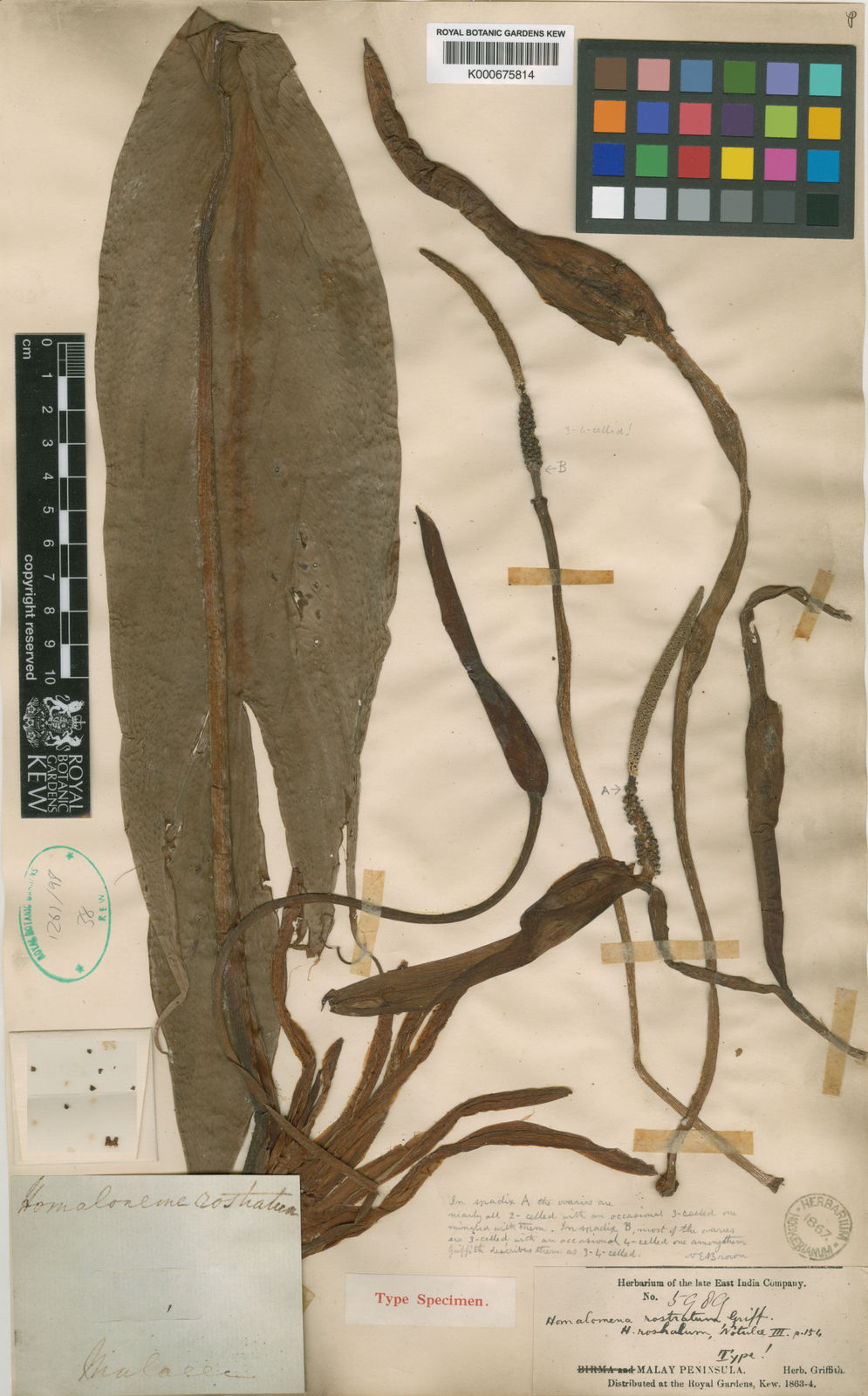
The Lambir Hills plant studied by the Japanese teams through the 2000s was published as Homalomena propinqua. It is Homalomena lambirensis, described under that name in 2017. The name Homalomena propinqua itself belongs to a different plant again — it falls within Homalomena rostrata.
The correction has since been repeated independently, by entomologists, in 2019. This page uses the corrected names, and the Sources block records what each paper prints on its own cover.
Furtadoa is now Homalomena
The small western Malesian genus Furtadoa has been sunk into Homalomena: Furtadoa indrae, Furtadoa mixta and Furtadoa sumatrensis are now Homalomena indrae, Homalomena mixta and Homalomena sumatrensis.
That matters here because the one reproductive study of that group — a fly-pollination account with fruit set in the forty-to-fifty per cent range — was published as a sister-genus contrast to Homalomena. It is not a contrast any more. This page does not use its numbers.
Part I
The Chamber and the Clock: A Room With a Door, and Four Clocks That Disagree
Most of this genus builds its inflorescence as a room with a doorway: a swollen lower spathe enclosing the female flowers, a waist above it, and a hood that opens. How long that room stays open is a question with four published answers, and they do not agree.
The two-part spathe
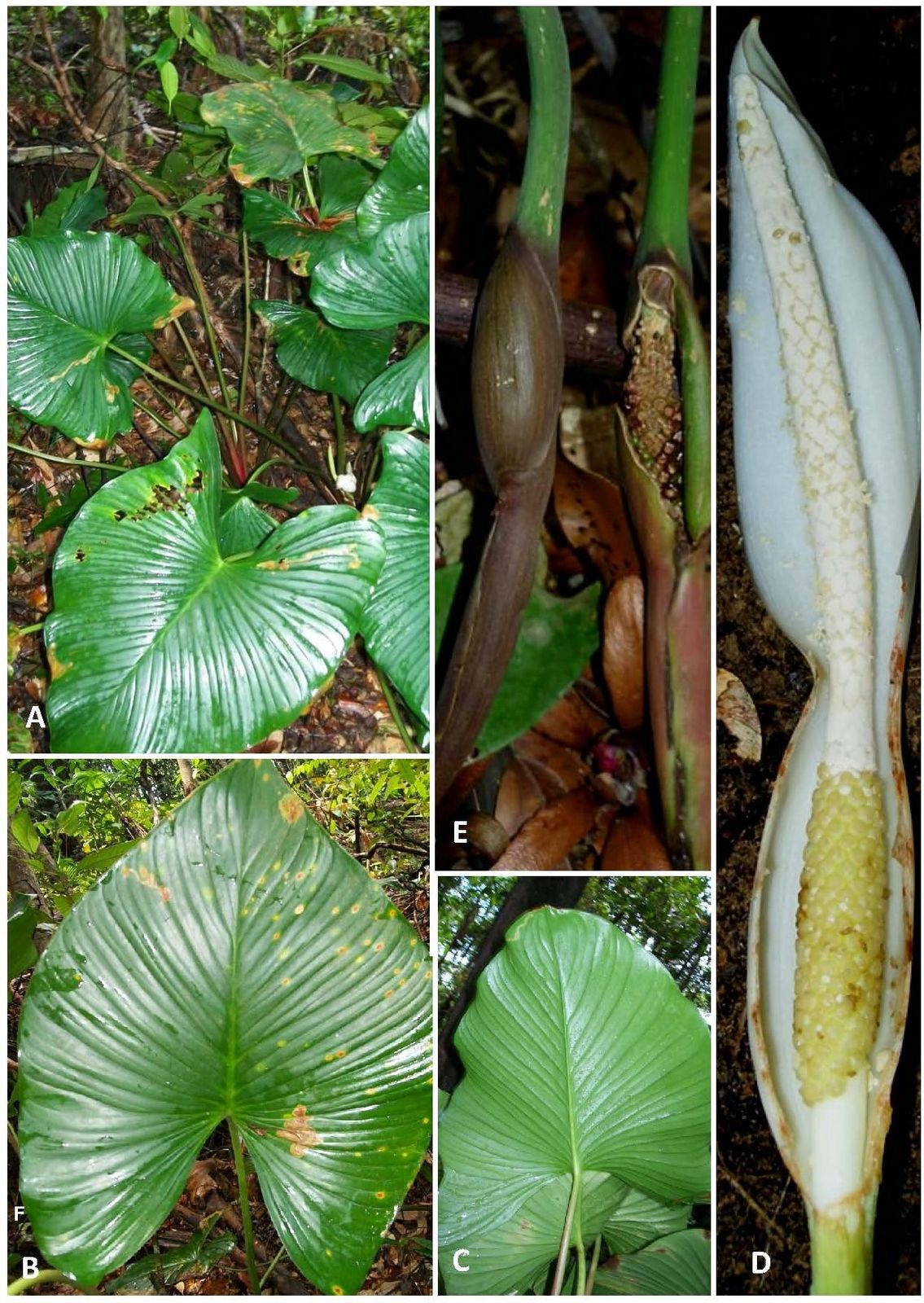
In the larger part of the genus the spathe is divided by a constriction into a lower chamber and an upper limb, and the lower part is the longer of the two. That proportion is a defining character of the group, and it has been read as what it looks like: room for an insect. The ratio of lower spathe to limb has been flagged as possibly tracking the size of the pollinator a given species has to house.
Inside, the spadix is female below and male above. In Homalomena megalophylla, where the proportions have been printed, the upper three-fifths is staminate and the lower two-fifths pistillate. Among the female flowers sit the interpistillar staminodes — sterile flowers that Part IV shows are food.
Female first, then male
Every studied species is protogynous. The stigmas are receptive first; the pollen is shed a day or more later, by which time the animal that arrived for the female phase has been in the chamber the whole time. The scent comes with the female phase, and in part of the genus a second, weaker scent comes again with the pollen.
| Species | Pistillate phase | Staminate phase | Total |
|---|---|---|---|
| Homalomena ardua | 06:00–09:00, day 1 | 06:00–07:00, day 2 | 25 h |
| Homalomena rostrata | 05:50–09:00, day 1 | 04:50–06:10, day 2 | c. 24 h |
| Homalomena sanguineovaginata | 05:30–09:00, day 1 | 05:45–07:00, day 2 | c. 25 h |
Those three are the shortest anthesis recorded anywhere in the genus. They are also from one park, one team and one field season — which is the whole problem with the next chart.
Four clocks
Why the disagreement is not a fault to be corrected
The two single-inflorescence watches are exactly that: one inflorescence each, followed continuously. The complex-level bands cover several species and several plants apiece. The Mulu figures cover three species in a different park.
Anthesis length is very likely a species character in this genus rather than a genus one, and the honest reading is that nobody has yet measured enough species in enough places to say. An average of these five bars would be a number describing nothing.
Morning, not evening
One timing fact holds in the species watched so far: Homalomena opens in the morning. That is worth stating because the family's other great beetle-pollinated genus, Philodendron, opens in the evening.
And the morning start is shared by the beetle-visited and the fly-visited species alike. The clock separates Homalomena from Philodendron; it does not separate the two halves of Homalomena from each other.
That is the pattern in the species that have been timed, not a measured property of the whole genus. In a September 11th, 2010 post to the Aroid-L mailing list, Peter Boyce, advising a grower about a small-spathed plant of the Chamaecladon supergroup, wrote that Homalomena inflorescences open only for a short while, usually late in the evening: the spathe gapes slightly in the pistillate phase, opens wider in the staminate phase, then closes, and the peduncle later bends the inflorescence downward.⁹ He named no species and gave no clock times, so it stands as a specialist's general impression set against the measured series above.
What happens afterwards
The spathe closes back over the spadix. On the third day the peduncle bends downward, leaving the whole closed spathe hanging inverted — a movement recorded in this genus and nowhere else on this shelf. Fruit then ripens in about two months.
Who eats the fruit is not actually known
The one study that records a disperser for Homalomena enters “mammals” in a table. Its text names no mammal, gives no date, no count and no observation — while describing the bird and ant dispersal of other genera in the same park in detail.
Treat mammal dispersal in this genus as unsupported until somebody publishes the sighting.
Part II
Two Systems in One Genus: Beetles on One Side, Flies on the Other, and a Border That Leaks
Split Homalomena in two along its oldest morphological division and the pollinators split with it. One half is worked by beetles, the other by flies. It is the cleanest such division in the family — and it is a tendency, not a law, which the papers that found it are careful to say.
The division, as it was first drawn
A 2013 phylogeny of Asian Homalomena mapped eight morphological characters onto its tree. Four of the eight are reproductive, and they line up into two packages that differ in almost every respect that matters to an insect.
| Character | Chamaecladon supergroup | Cyrtocladon supergroup |
|---|---|---|
| Visitors recorded | only Colocasiomyia flies | a variety of beetles — scarabs, leaf beetles, sap beetles, rove beetles — and Colocasiomyia |
| The authors' reading | fly pollination | most probably beetle pollinated, argued from the damage to staminodes that seem to be food rewards |
| Stamens per male flower | 2 | 4 |
| Connective | not expanded; the anthers are clearly visible | expanded into a rhomboidal plate that overtops the anthers |
| Interpistillar staminodes | present, but usually less than half the height of the pistil | equal to the pistil or slightly exceeding it |
| Spathe constriction | lost | present |
And the same split shows up in the pollinators
Six years later an entomological revision of the flies put the division in one sentence:
The section-level split, as printed
“Species in the Homalomena and the Chamaecladon sections … tend to be pollinated by Colocasiomyia flies, whereas species in the Cyrtocladon section … tend to be pollinated by Scarabaeidae, Chrysomelidae and Hydrophilidae beetles.”
Those two “tend to”s are doing real work
In the same paragraph, the same paper notes that its own two fly-pollinated species sit in the same section as several beetle-pollinated ones. Homalomena megalophylla and Homalomena pendula, the two whose flies it studied, are in section Homalomena — and so are Homalomena lambirensis and Homalomena giamensis, both of which are worked by scarabs.
The sections do not partition cleanly. The split is real and it is the most useful thing anyone has said about this genus; it is not a key.
One tempting shortcut that is wrong
A chambered, constricted spathe is a perfectly normal fly host
It is easy to read the diagram above as “big chamber means beetles, no chamber means flies”, and to conclude that a constricted spathe will not have flies in it. The photographic plates of the fly paper itself show the opposite. Three of its host plates show strongly constricted spathes with inflated basal chambers, and all three are carrying Colocasiomyia.
The constriction tracks the plant's lineage. It does not tell you which insects are inside.
Which way round did it happen
The published reading is that the constricted spathe is the older state and was lost once, and that the loss of the constriction and the shrinking of the chamber followed a shift from large-bodied beetles to small-bodied flies. A separate family-wide analysis independently infers beetle pollination as the ancestral condition for this part of the family.
How that conclusion was reached
By mapping characters onto a tree. No experiment tests it. The supporting pollen argument — that fly-visited species have powdery pollen while beetle-visited ones glue theirs up with resin — is a description of texture, not of pollen structure; nobody examined the grain surface.
It is a good hypothesis with a coherent shape. It is not a result.
And two lineages without a known pollinator
Two groups within the genus have no interpistillar staminodes at all — the Punctulata supergroup, and Homalomena expedita. Since the staminodes are the food that holds a beetle in place, their absence implies some other mechanism entirely.
What that mechanism is remains unknown. The Punctulata supergroup has been photographed at female anthesis, but what pollinates it has not been shown. Homalomena expedita, a colony-forming swamp plant, attracts numerous Colocasiomyia and some leaf beetles, and the paper that recorded them stated plainly that it is not known which, if either, is the effective pollinator.
The question underneath the whole page
Everywhere in this genus that flies have been counted, they are the most numerous visitors — and nowhere have they been shown to pollinate anything. Whether Colocasiomyia is a mutualist or a lodger that pays no rent is, in the words of the people who study it, still unresolved.
Parts III and IV are the beetle case. Part V is what the flies are actually doing in there.
Part III
The Beetles and What the Bags Proved: An Insect Is Required
Tie a mesh bag over a Homalomena inflorescence before it opens and it sets no fruit at all. Three species, two research teams, two national parks, one answer. There is no apomixis in this genus and no self-pollination without help — and the animal that does the work is a scarab.
The beetle
The pollinator across every beetle-visited species anyone has watched is a ruteline scarab of the genus Parastasia — a stout, glossy, thumbnail-sized beetle that arrives during the female phase, walks down into the chamber, and stays there. Counts run from about 1.3 to 7.5 beetles per inflorescence as a species mean.
They arrive fifteen to thirty minutes ahead of the leaf beetles that follow them in. They carry pollen in, onto pistils that are already receptive. They shelter and mate inside the chamber through the intervening hours, and they leave after the pollen is released, glued over with it.
Which Parastasia, and where — because the answer changed
The first two studies, in 2010 and 2011, named the beetle Parastasia bimaculata. When the same two plant species were restudied in 2016 with a scarab specialist making the determinations, the visitors came back as Parastasia gestroi and Parastasia nigripennis, and Parastasia bimaculata does not appear in that paper at all.
The correction is real but it is local. It covers the Kuching-area species. It does not reach Homalomena lambirensis at Lambir, a different site and a different research group — where Parastasia bimaculata was printed again in 2017, and again in 2019, in a photograph caption showing the beetles on the spadix. Two records, kept apart on purpose.
What the bags showed
Two teams ran the same experiment on different plants in different forests. In the first, inflorescences were bagged in mesh with two-millimeter holes — wide enough for a small fly to pass, far too small for a scarab. In the second, whole inflorescences were bagged before opening to exclude every floral visitor.
Neither treatment produced a single fruit.
What one two-millimeter mesh rules out
A bag that keeps beetles out but lets small insects through, and which then sets nothing, disposes of three hypotheses at once: that the plant sets seed without pollen, that it pollinates itself unaided, and that the small insects swarming over it are doing the job.
It is the most economical experiment on this shelf and it has been run twice, independently.
The plant this was proved on, twice over
The scale of the reward
An inflorescence carries between about 136 and 297 female flowers depending on the species, and each fruit holds roughly seventy-three to eighty-three seeds. At ninety per cent fruit set that is a very large return on a single night's beetle traffic.
The one soft spot in the beetle verdict
The best-replicated species in the genus is Homalomena rostrata, with twenty-three inflorescences watched. The scarab was found on eleven of them.
The paper still names Parastasia the primary pollinator of all three species it studied, and the exclusion result says an insect is required. But the beetle was absent from more than half the replicates of the plant it is said to pollinate, and that is printed in the paper's own table. It has not been explained.
Part IV
Abundance Is Not Importance: The Commonest Visitor Is Not the Pollinator
Count the animals on a flowering Homalomena and the flies win by an order of magnitude. Count the fruit and the beetles win outright. On every species where both have been counted, the most numerous visitor is not the one that matters.
Who is actually in there
And this is not a Mulu peculiarity
In the seven-species study further west, Colocasiomyia were likewise the most numerous visitors of all — up to 57 ± 20.5 per inflorescence on Homalomena matangae.
The flies were examined under the microscope and no pollen loads were seen on them. The authors' verdict was that they are probably not efficient pollinators. That verdict is qualitative — the paper reports no per-insect pollen loads, so there is no count standing behind it.
Role, not presence
The sharpest statement on this shelf is not about how many beetles there are. It is about what counts as evidence that an animal is a pollinator at all.
An earlier Japanese study found pollen on the bodies of two beetles at Lambir: the scarab, and a leaf beetle. Two later studies concluded that only the scarab behaves as a possible effective pollinator.
A leaf beetle that carries pollen and is still not a pollinator
The leaf beetle passed the test that qualifies the scarab — it had the plant's pollen on its body — and it was still demoted, on the basis of what it does rather than what it carries. The same animal is recorded elsewhere in this literature as a pollen plunderer.
Carrying pollen is not sufficient. On this genus, pollinator status has to be earned by behavior: arriving while the stigmas are receptive, staying, and leaving at a time when there is somewhere useful to go.
Why the leaf beetle fails, specifically
Two things. The first is damage: on Homalomena debilicrista the leaf beetle ate about a third of the upper staminate zone, and elsewhere it is recorded chewing through interpistillar staminodes, interstice staminodes and male florets alike.
The second is timing, and it is the more interesting of the two. The scarab leaves in the early morning — which is exactly when other inflorescences in the population are entering their female phase. The leaf beetle leaves in the mid-afternoon, when almost nothing is receptive. Whatever pollen it takes with it, there is nowhere for that pollen to go.
The same result, found twice, in two hemispheres
This is the Dieffenbachia lesson arrived at independently. In Costa Rica, the most abundant beetle on Dieffenbachia nitidipetiolata turned out to be a net cost to the plant, chiefly because it loitered past the point where its pollen was still worth anything. In Borneo, the most abundant visitor on Homalomena was not seen carrying pollen, and the second most abundant leaves at the wrong time of day.
Two families of insects, two continents, one conclusion: a visitor list ranked by abundance ranks pollinators wrongly.
The rest of the guild
Stingless bees turn up at both study areas and take pollen — and in one case resin, possibly as nest material — in visits lasting five to ten seconds. Where their behavior was watched closely they were collecting pollen after the spathe had already closed, and they never entered the female zone at all. They cannot reach a stigma.
Sap beetles are named as pollen robbers in one paper's figure captions and were never quantified by anyone. They stay unquantified here. Rove beetles and a hydrophilid genus appear on visitor lists without a role.
One identification that two sources still disagree about
The leaf beetle above was published as Dercetina in 2006, then redetermined as Chaloenus schawalleri in 2017 — after which a 2019 paper printed Dercetina again in a photograph caption. A third study names its leaf beetles only to genus.
The redetermination has not been accepted or rejected in print, and this page does not settle it. Where a source is quoted, the name that source used is the name given.
Part V
The Flies That Breed on the Spadix: Tenants, and Possibly Not Pollinators
The other half of this genus is worked by Colocasiomyia, small drosophilid flies that do not visit an inflorescence so much as move into it. They feed on it, mate on it, lay eggs on it, and their larvae grow up on it. Whether they pollinate it is unresolved. A 2001 study of Homalomena sumatrensis, then named Furtadoa sumatrensis, is reported to have called them its pollinator because visits by a leaf beetle were too few for it to qualify.
What these flies live on
A 2019 revision recognizes six species in the group, and states their host range as narrowly as any insect-plant relationship in the family: they are recorded exclusively on the inflorescences of the genera Homalomena and Aglaonema.
Two details that are easy to get wrong here
The paper's abstract says the group depends exclusively on the tribe Homalomeneae. Its own next page does not — it names two genera, in two different tribes. The page above uses the second formulation, because it is the one that matches the host records.
And the fly the whole group is named after has no host species named in the revision, which lists it only among the flies recorded on Homalomena and Aglaonema. The revision examined only two paratypes of it, one male and one female, taken in the Philippines in 1981 with no plant recorded, and had no DNA for it. The claim that the group breeds only on these aroids is an inference over five species, extended to a sixth.
The morning
Two inflorescences, one of each of two species, were wired with thermocouples and watched straight through. The timetable they gave is almost identical on the two plants, and the shape of it is the point: the flower opens and starts to smell in complete darkness, and the flies do not come until it is light.
How many flies
About 15 in and 12 out on one inflorescence, and 18 in and 18 out on the other.
They arrive over roughly half an hour at dawn and leave, in a body, at dawn the following day.
What they do in there
A fly lands on the spathe or on the male zone and immediately walks down to the female zone, where it stays. The reason appears to be heat: the male zone is running about twelve degrees hotter, and Part VI is about that.
It rests through the day on the inner wall of the spathe behind the female zone. At dusk the inflorescence comes back to life: the flies feed — and they feed exclusively around the boundary between the female and male zones — lay their eggs on the female zone and that same boundary, and mate, all night.
Two flies, one spadix, divided between them
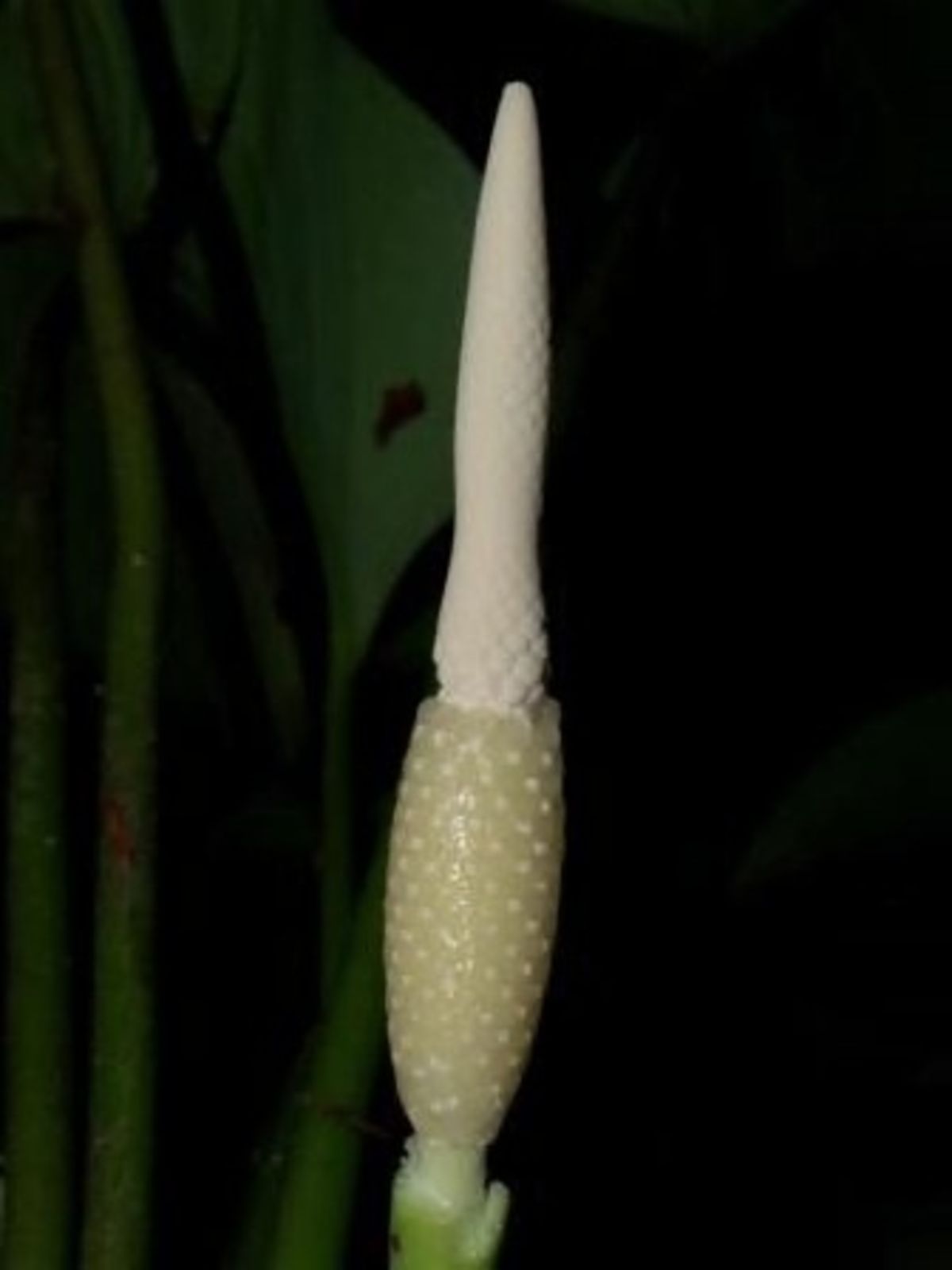
In lowland West Java two of these species share the same inflorescences, and they carve it up. Both lay their eggs mainly in the narrow spaces between the pistils and the staminodes. Then their larvae separate: one feeds on exudates in the female zone, the other on decaying stamens in the male zone above. The literature's own words are that one is more pistil-dwelling and the other more stamen-dwelling.
On a different plant, in Sarawak, a third fly has the spadix to itself: its eggs go on the female zone and on the sterile band of staminodes above it, its first-instar larvae concentrate in the lower third of the female zone, and by the third instar they have spread up onto the male zone. That species is not drawn above. Its host is Homalomena lambirensis, whose protologue gives the proportions: a female zone about a third of a 12–16 cm spadix, and a male zone about two-thirds.
And then the flower shuts on them
The second heating episode arrives with the closing of the spathe and the release of the pollen. Closure drives the flies upward out of the female zone — the paper's reading is that they are avoiding being shut in — and on their way up through the male zone they are dusted with pollen. Then they go.
Because the plants are female-first, a pollen-covered fly leaving at dawn is leaving at exactly the hour that other inflorescences are opening receptive. The mechanism is entirely plausible. That is not the same as its being shown.
What has never been done for any of these plants
No bagging. No exclusion. No pollen counts on the flies. No fruit set. Outside these plants, a fruit-set figure has been reported for Homalomena sumatrensis — studied in 2001 as Furtadoa sumatrensis, in a study that named its flies the pollinator — but it reaches this page second-hand, without a sample size.
The 2019 revision's authors are explicit about the gap: their two candidate flies “seem to be” the most effective and specific pollinators, and their efficiency “should be evaluated by field bagging experiments”. Those experiments have not been run.
What has been shown is that these flies breed on the spadix and leave covered in pollen. Everything past that is a hypothesis, and the people who proposed it say so.
Even the breeding half is thinner than it looks
Immature stages were examined for three of the six species in the group. The paper states outright that no inflorescences were examined for the others. Three of the six have no breeding data at all, including the one the group is named after and the one described as new in that same paper.
Who gets which fly, and where
The geography is unexpectedly tidy. In Vietnam, Homalomena vietnamensis is monopolized by a single fly species. In North Sulawesi one fly has the genus to itself. On Mount Kerinci, a highland Sumatran plant is monopolized by one form of one species. In Sarawak and Sabah two species share, one of them more abundant on every host studied except one.
Sumatra holds the highest diversity: one inflorescence there carried three species of Colocasiomyia at once, and another carried three named forms belonging to two species.
A host record is not an abundance
Several of the host records in that revision rest on a single specimen — one male, or one female, reared or collected from one inflorescence. They establish that a fly uses a plant. They say nothing about how often.
Part VI
The Heat: Two Inflorescences, and the Wrong Half of the Genus
Homalomena heats, twice per flowering, and it heats only its male zone — hot enough that the flies inside will not go near it. The zone-by-zone temperature record is two inflorescences, and both belong to the fly-visited half. Beside them are one cultivated inflorescence of Homalomena rubescens, measured in a separate study, and a scarab-pollinated species, Homalomena lambirensis, whose heat has been tracked in work that reaches this page only second-hand.
What was actually done
Two plants at the Bogor Botanical Garden, one in November 2009 and the other in August 2011. Each had two thermocouples pushed through the spathe — one into the middle of the female zone, one into the middle of the male zone — and both were logged every two minutes for three days against the air temperature.
That is a thorough measurement. It is also one inflorescence per species, and the paper says so.
Twice, not once
Each inflorescence heats two times. The first peak comes with anthesis, in the female phase, and it is the one that carries the scent out. The second comes roughly twenty-four hours later, and it is simultaneous with the spathe closing and the pollen being shed.
That second peak is doing something specific: it is the moment the flower empties. The heat and the closure together push the flies up out of the cool female zone and through the pollen on their way out.
Heat as a wall, not only as a beacon
Most of the thermogenesis literature treats heat as advertising — a volatiliser for scent, or a warm reward. Here it is also doing the opposite job: a twelve-degree gradient that keeps the flies out of the male zone until the plant is ready for them to go through it.
The animals sort themselves along a temperature gradient inside a flower three or four centimeters long.
The plant behind one of the two traces
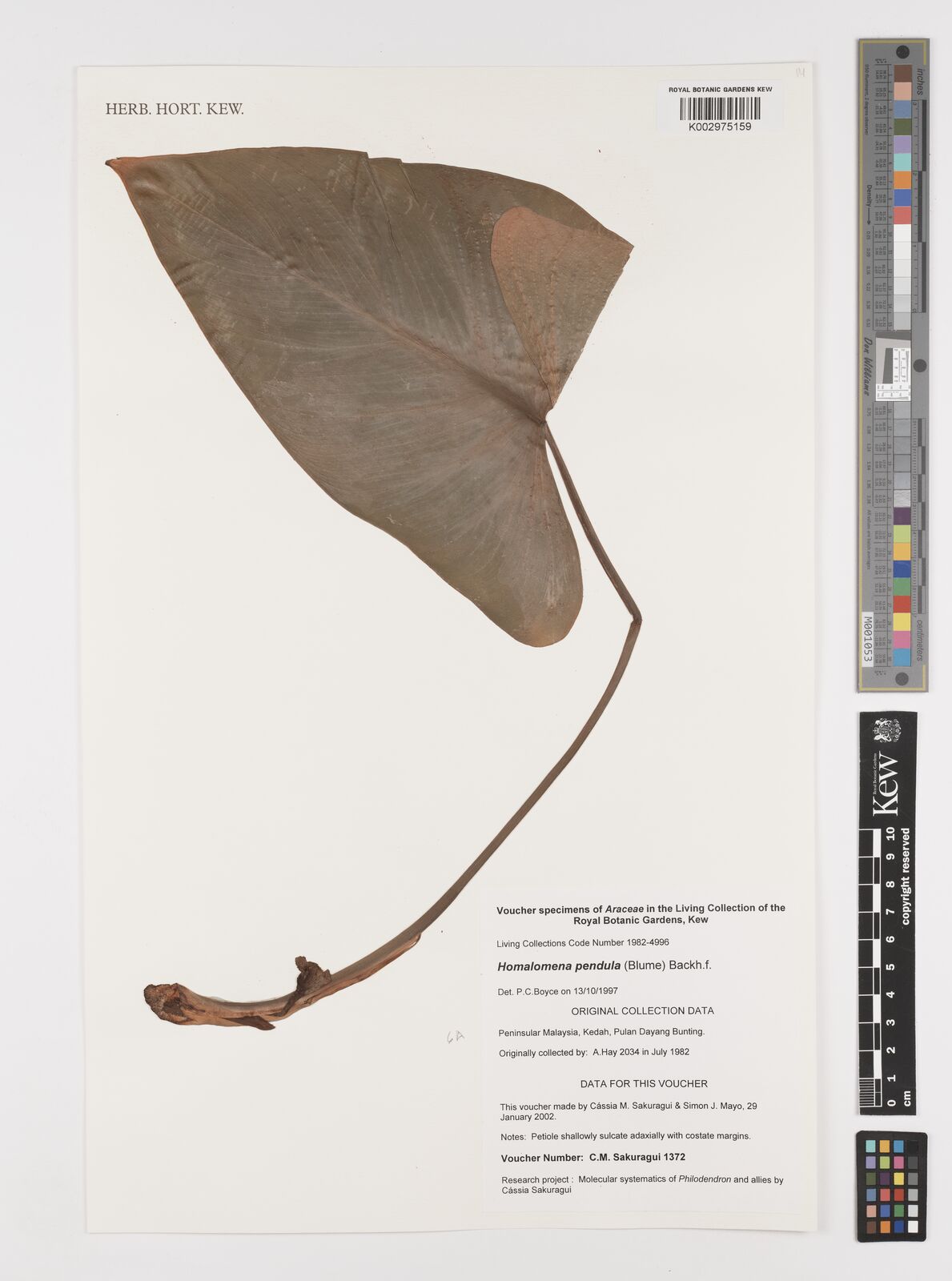
An experiment in this genus on what draws the beetles
At Lambir, a Japanese team took another of the genus's thermogenic plants, Homalomena lambirensis, and asked what the beetles were actually responding to. The answer split the guild in two.
| Beetle | Attracted by |
|---|---|
| The scarab — the pollinator | Heat production and floral odor |
| The leaf beetle — the plunderer | Floral odor alone |
The scent itself was resolved to 18 compounds, of which the main ones were 2-butanol, veratrole and α-pinene. Artificial mixtures combining 2-butanol with veratrole pulled in both beetles — but veratrole on its own attracted only the leaf beetle. As Wong and Boyce 2017 report it, the study's conclusion was that the scarab was the most efficient pollinator.
How firmly to hold that result
Loosely. Everything in the last two paragraphs reaches this page second-hand — through a 2017 taxonomic paper summarizing work published in 2000 and 2006. The primary papers are not the source here, and no temperature figure for Homalomena lambirensis is given anywhere in the summary.
It is the most interesting experiment anyone has run on this genus and it is the one this page can say least about.
The gap worth naming
The zone-by-zone traces above come from fly-visited species, and the one cultivated inflorescence of Homalomena rubescens comes from a study that did not record its pollinator. Among the scarab-pollinated species on this page, heat has been tracked only in Homalomena lambirensis; the rest — the seven of the big synthesis, the two single-inflorescence watches, the three at Mulu — were studied by teams who took no temperatures at all.
So the genus offers this: heat that has been shown to sort Colocasiomyia along a gradient, and a scarab that is reported to need heat to find the plant — two results from different plants, the second reaching this page without a single temperature figure.
Part VII
Resin, Armor and Sacrificial Flowers: Feed the Beetle, and Board Up the Anthers
A beetle big enough to carry pollen is big enough to eat the flower. This genus appears to have solved that twice over: it grows a band of sterile flowers for the beetles to destroy, and it roofs the anthers over with a plate of tissue so they cannot get at what matters.
The flowers that are meant to be eaten
Between and among the pistils sit the interpistillar staminodes. In the beetle-visited species they stand as tall as the pistils or a little taller, and they are the first thing a beetle does anything about: both the scarab and the leaf beetle begin eating them on arrival.
By late in the female phase, in the species where it was followed, every staminode had been eaten. The pistils beside them were untouched. The male flowers above were barely marked.
The beetles eat one thing and leave the rest
Not opportunistic grazing on whatever is nearest — the food bodies go and the reproductive parts stay. One paper found that pistils and staminodes take up a stain differently, the pistils going brown while the staminodes stayed white, and suggested from that the pistils are simply distasteful.
That is an inference from a stain, not an assay. Nobody has tested what is in either tissue.
The cost of hosting is visible afterwards. Photographs published of one species show the staminodes gone and the female zone covered in beetle excrement — and herbarium curators are warned that Homalomena specimens collected after anthesis have usually had the interpistillar staminodes destroyed during pollination before they were ever pressed.
And the part they are kept away from
In the beetle-visited half of the genus each male flower has four stamens, and the connective between them is expanded into a rhomboidal plate that sits over the top of the anthers. In the fly-visited half there are two stamens and the anthers are plainly visible.
The reading, in the authors' own hedged words
The expanded connective “probably provides protection for the anthers from beetles, which are destructive pollinators”.
Put beside the staminodes, it makes a coherent arrangement: the beetle is fed downstairs and locked out upstairs. It is a reading of a taxonomic character, not an experiment — but it is the only functional explanation anyone has offered for why that character exists.
The glue
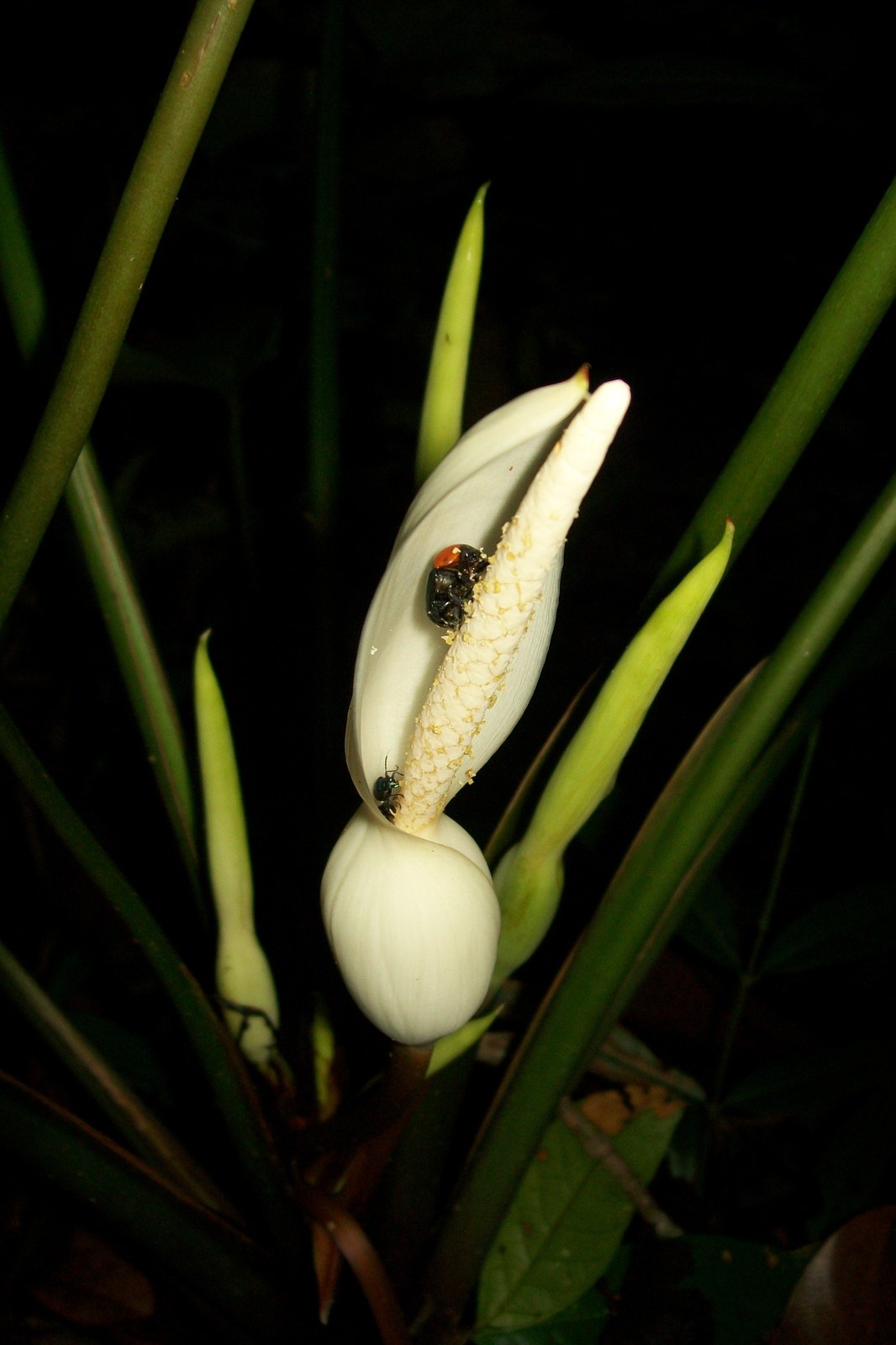
Shortly before the pollen is released — about two hours before, where it was timed — resin appears in the fissures between the male flowers. Then the pollen comes out, not as dust but as short dense white strings, and the two mix into a sticky paste that coats a beetle's legs and underside and does not come off easily.
It is the reason a beetle the size of a thumbnail can carry a useful load from one forest-floor plant to another. The mechanism has now been described independently in four separate sets of species, the most recent calling what the beetles leave with a resin-mitigated pollen paste.
| Species | What its male zone does |
|---|---|
| Homalomena lambirensis | Amber droplets from between the male flowers, before the pollen |
| Homalomena debilicrista | Yellowish-green resin filling the fissures about two hours ahead of the pollen |
| Homalomena giamensis | Amber resin exuding at the changeover from female to male phase |
| Homalomena gastrofructa | Resin stays in the fissures and never forms droplets — the one described species like this, and the character is used to split its complex in a key |
| Homalomena borneensis | No resin at all |
The last row is the interesting one
Homalomena borneensis grows alongside Homalomena giamensis, flowers at the same time as it, and smells of the same thing — and one of the two produces resin while the other does not.
No hybrids have been seen between them. Whatever is keeping those two species apart, resin is one of the few floral characters that differs, and nobody has tested whether it is doing any of the work.
A field mark for failure
One species gives away its own pollination failures. In Homalomena gastrofructa, pistils that were not pollinated turn dark orange early in the male phase, while its relatives' unpollinated pistils simply stay yellowish white.
That is a readable diagnostic in the field, on a plant, without dissection — and as far as this shelf records, nobody has yet used it.
Why the flower and not the leaves
Every compound detected in a survey of this genus's tissues was phenolic, which is the suspected basis of the irritancy Homalomena is notorious for among growers. The same authors note that in the field the vegetative parts were almost never seen to be eaten.
So the picture is of a plant that is chemically unappealing all over except in the one place it wants to be visited, where it puts out sterile flowers, resin, and heat. The leaves are defended; the inflorescence is the concession.
And somebody steals the glue
Stingless bees take the resin as well as the pollen, in visits of five to ten seconds, and it has been suggested — not shown — that they are collecting it as nest material.
A plant that has evolved an adhesive to hold pollen onto beetles has thereby made something a bee wants for its own construction. There is no measurement of how much they take.
Part VIII
The Scent: Where Three Species Smell the Same and Grow in Different Places
The scent is what brings the beetles in, hours before first light, to a plant sitting invisible on a dark forest floor. It has been analyzed for six species — and the most interesting thing it produced was a test that failed to find a difference.
Once or twice, depending on which half you are in
The longer-flowering species emit twice: a strong aniseed smell as the female phase opens, and a weaker one again with the pollen a day or two later. The shorter-flowering ones emit once, at the female phase only — lemon-like in some, aniseed in others.
Where it was pinned down, the smell comes out of the male zone — including during the female phase, when the male flowers will not do anything for another day. That is the same zone that produces the heat.
What the chemistry actually is
33 volatile compounds in one complex and 26 in the other, from six species. One complex is dominated by sec-butyl acetate and a compound usually called DMNT; the other is built on α- and β-pinene, with each species adding its own secondary compounds on top.
Two of those choices are odd enough to be worth noting. sec-Butyl acetate is otherwise known chiefly as a component of a scarab beetle's own aggregation pheromone, and among flowers it had been reported from essentially one other aroid. DMNT is the classic volatile plants release when they are being eaten, and is used commercially as a moth lure.
The test that failed, and why it is the good part
The pistillate-phase blends were compared statistically at three levels: the two complexes against each other, the species within one complex, and the species within the other.
What that leaves unexplained
Those three species do not grow together. Each is a local endemic of its own type locality, and each grows intermingled with a species of a different complex — Homalomena matangae with Homalomena debilicrista, Homalomena baangongensis with Homalomena gastrofructa, Homalomena giamensis with Homalomena cf. borneensis. The species that smell alike grow at different sites.
The question moves to the pairs that do grow together. Each pair flowers together and shares a scarab pollinator; in two of the three the partners belong to complexes whose scents differ significantly, and the third pair was not compared, because Homalomena cf. borneensis was not sampled. The study's own recommendation is to look for isolating barriers that act after pollination. What keeps those pairs apart is the most concrete open question in the genus.
A gap in the same experiment
Six of the seven species were sampled. The seventh was not — and the seventh is the one identified only as a near-match to Homalomena borneensis, the species that also, uniquely, produces no resin.
No interspecific pollen transfer has ever actually been observed between any of these plants either, despite the shared pollinators. It is inferred from the sharing, not seen.
The odd one out
One species in that study has an intermediate blend — some of each complex's signature compounds, plus limonene and veratrole. It is also the only one of the seven that grows on its own, with no close relatives beside it, the only one pollinated by Parastasia nigripennis alone (a scarab that also visits three of the others), the only one that flowers in two separate seasons, and the one with the highest fruit set.
That is a suggestive cluster of facts about a single species and it should be read as exactly that. One species is not a result, and the paper does not claim it as one.
Noses and instruments are not the same record
A good deal of what is written about how these plants smell — aniseed, lemon, pungent lime, pomelo skin, the resin of a wild mango — comes from people standing in front of them, in taxonomic papers, and not from a chromatograph.
Those descriptions are useful and they broadly agree with the chemistry where both exist. They are not interchangeable with it, and this page keeps them labeled separately.
Sources
Sources, and What Kind of Evidence Each One Is
Eight papers carry this page, and they were written by two communities that barely cite each other — Bornean aroid taxonomists on one side, Japanese and Chinese drosophilid systematists on the other. The genus's two pollination systems were found by two different kinds of scientist, and that is part of why it took so long to see them together.
- Hoe, Y. C., Gibernau, M., Maia, A. C. D. & Wong, S. Y. (2016). Flowering mechanisms, pollination strategies and floral scent analyses of syntopically co-flowering Homalomena spp. (Araceae) on Borneo. Plant Biology 18: 563–576. The spine of the page. Seven species in West Sarawak: the mesh-bag exclusion, the fruit-set figures, the flower and seed counts, the scent chemistry, and the beetle redeterminations that supersede the two earlier papers. Grade: field study with a real experiment — and with tiny replication, two to six inflorescences per species, which the authors state plainly because the plants are local endemics. Note that it did not measure thermogenesis, did not sample the scent of its seventh species, ran no hand-pollination or compatibility tests, reported the flies' pollen loads qualitatively rather than counting them per insect, and never observed the interspecific pollen transfer its shared-pollinator result implies.
- Shi, T., Toda, M. J., Takenaka Takano, K., Yafuso, M., Suwito, A., Wong, S. Y., Shang, S.-Q. & Gao, J.-J. (2019). A review of taxonomy and flower-breeding ecology of the Colocasiomyia toshiokai species group (Diptera: Drosophilidae), with description of a new species from Indonesia. European Journal of Entomology 116: 341–361. Open access. The whole fly half of the page, and the zone-by-zone thermogenesis record in Part VI. It is not the genus's only heat measurement: a single cultivated inflorescence of Homalomena rubescens peaked 10.5 °C above the air (Barabé and Gibernau 2000), and heat has been tracked in the scarab-pollinated Homalomena lambirensis. An entomological revision that doubles as the fullest flower-breeding study of Homalomena published. Grade: mixed. The barcoding and the brood-site dissections are substantial; the behavioral watch is one inflorescence per species, two species, and the authors say so. Note that it demonstrates no pollination at all: no bagging, no exclusion, no pollen counts, no fruit set, and its own verdict is that efficiency “should be evaluated by field bagging experiments”. Note also that its abstract and its next page give different host ranges, and that this page follows the page rather than the abstract.
- Chai, S. K. & Wong, S. Y. (2019). Five pollination guilds of aroids (Araceae) at Mulu National Park (Sarawak, Malaysian Borneo). Webbia, published online 2 September 2019. Three Homalomena species at a third site, by a third team: the visitor counts in Part IV, the shortest anthesis series, the fruit set for Homalomena rostrata, and the genus's third exclusion result. Grade: multi-genus field survey, broad rather than deep. Note that it has no volume and no page range — it is online-first, and its own pagination runs 1 to 19. Note that its title promises five pollination guilds which its text never enumerates; that it cross-references its pollinator conclusion to the wrong table; that it prints the leaf-beetle subfamily two different ways five pages apart; and that it identifies no insect below genus, so it neither supports nor contradicts the beetle redeterminations above.
- Wong, S. Y., Boyce, P. C., Othman, A. S. & Pin, L. C. (2013). Phylogeny of Asian Homalomena (Araceae) based on the ITS region combined with morphological and chemical data. Systematic Botany 38(3): 589–599. Where the two-system picture is drawn most cleanly: the supergroup character table in Part II, the reading of the expanded connective as armor against destructive pollinators, the chamber-as-housing argument, and the observation that two lineages have no interpistillar staminodes at all. Grade: phylogeny with characters optimized onto it. Note that the syndrome assignment rests on field observation rather than on any exclusion experiment, and that the Punctulata supergroup within it has no resolved pollinator, though it has been photographed at anthesis.
- Tung, L. S., Wong, S. Y. & Boyce, P. C. (2010). Studies on Homalomeneae (Araceae) of Borneo VI: Homalomena giamensis, a new species from Sarawak, Malaysian Borneo, with observations on its pollination. Aroideana 33: 201–211. The sacrificial staminodes, the amber resin, and the single scarab that sits out the whole inter-anthesis inside the chamber. Grade: one inflorescence, followed continuously through one anthesis. Note that no fruit set and no temperature were taken, and that its beetle identification is superseded for this species by the 2016 study. Note also that its pages 204–205 carry a compact history of tropical-Asian aroid pollination research that is useful in its own right.
- Hoe, Y. C., Wong, S. Y., Boyce, P. C., Wong, M. H. & Chan, M. K. Y. (2011). Studies on Homalomeneae (Araceae) of Borneo VII: Homalomena debilicrista, a new species from Malaysian Borneo, and observations of its pollination mechanics. Plant Diversity and Evolution 129(1): 77–87. Two beetles of unequal value, split by when they leave rather than by what they carry — the result Part IV is built on. Also the resin timing, the false start on the first day, and the two Colocasiomyia that the authors judged “very unlikely” pollinators despite breeding on the plant. Grade: one inflorescence. Note that this is the paper that first exposed the Lambir study species as an undescribed one, a correction finished six years later.
- Wong, S. Y. & Boyce, P. C. (2017). Studies on Homalomeneae (Araceae) of Borneo XX: Homalomena lambirensis, a new species from Sarawak with well-recorded pollination biology. Nordic Journal of Botany. The paper that gives the Lambir plant its name, and with it the whole Japanese thermogenesis and scent literature. It carries the heat-versus-odor attraction result in Part VI and the eighteen-compound scent list. Grade for the pollination content: reported, not measured — the authors are summarizing work published in 2000 and 2006, and no temperature figure appears anywhere in the summary. Note that the copy held is a galley proof whose pages are numbered as electronic-view placeholders, so no page can be cited from it.
- Wong, S. Y., Hoe, Y. C., Tung, L. S. & Boyce, P. C. (2013). Studies on Homalomeneae (Araceae) of Borneo XIII: new species of Homalomena. Aroideana 36: 8–29. The protologue paper for most of the species the 2016 study went on to measure, and the place resin becomes a taxonomic character rather than an observation — it splits a species complex in the key. Also the orange-pistil failure marker in Part VII, and the figure captions that assign the roles. Grade: taxonomy. Note that its sap beetles are named as pollen robbers and were never quantified by anyone, then or since, and this page does not upgrade them.
- Aroid-L mailing list, Peter Boyce, September 11th, 2010 The late-evening opening time set beside the measured morning series in Part I. Grade: a specialist's general remark, not a measurement. A reply to a grower about a small-spathed plant of the Chamaecladon supergroup that was already mainly in fruit when bought; it names no species and gives no clock times.
Two more, for two single facts
The priority for the resin mechanism belongs to Studies on Homalomeneae of Borneo II (2010), which described the droplets mixing with pollen into a sticky paste before any of the papers above. And the statement that Homalomena expedita has no resolved pollinator is made outright in Studies on Homalomeneae of Borneo III (2011).
Where this leaves the genus
Thirteen species watched, out of a hundred and sixty-three. Nearly all the fieldwork is from one island, and most of it from three forests on it. The beetle half and the fly half of the story were assembled by different disciplines. They have met on the same inflorescences — the mesh-bag study in Part III counted flies and scarabs together, inflorescence by inflorescence — but the breeding cycle of the flies is still worked out in a separate literature.
The four gaps that would move this genus furthest
Bag a fly-visited species. Fruit set has been reported for a Homalomena whose Colocasiomyia were named its pollinator — Homalomena sumatrensis, in a 2001 study — but the figure reaches this page second-hand and without a sample size. The single experiment that settled the beetle half has never been run on the fly half.
Put a thermocouple in more scarab-pollinated inflorescences. The scarab is the one reported to need heat to find its host, yet the zone-by-zone temperature record is from fly-visited plants, and the heat of the scarab-pollinated Homalomena lambirensis reaches this page without a temperature figure.
Find out what keeps the syntopic pairs apart. Each pair grows intermingled, flowers together and shares a scarab. Where their scents were compared, the two partners belong to complexes that smell different, and the study that measured them points to barriers acting after pollination as the place to look.
Watch a Punctulata plant, or Homalomena expedita. Two lineages have no food bodies and no resolved pollinator.
Results that reach this page at second hand
Four of the findings above were not read in the paper that produced them. They arrive through later work that cites them, and are marked as second-hand wherever they are used. The 2006 Plant Species Biology study by Kumano and Yamaoka is the original source both of the pollen-on-beetle-bodies test and of the scent measurements showing the attractants rising during heat at Lambir; its 2009 companion in the Journal of Plant Research by Kumano-Nomura and Yamaoka carries the scent-synchrony work. Everything this page says about either reaches it second-hand.
The 2003 and 2005 volatile-attraction experiments by Miyake and Yafuso are what later papers cite for the claim that these flies respond to floral odor. Both were run on Alocasia — Alocasia odora in 2003, Alocasia cucullata in 2005 — not on Homalomena, and so was a 2026 study of Alocasia odora by Yu and colleagues that added field choice tests (30 trials) and paired laboratory choice tests (15 per floral region) on its Colocasiomyia pollinators. This page reports that claim at the strength its citing sources give it, not at the strength of the experiments. The 2001 study by Mori and Okada of Furtadoa sumatrensis — now Homalomena sumatrensis — is the one fly-pollination account with a fruit-set figure attached, and the sinking of that genus has turned it from an outgroup comparison into an in-group record.
And one beetle author. Takizawa, H. (2012), Descriptions of new species of the genus Chaloenus Westwood from Greater Sunda Islands (Coleoptera: Chrysomelidae: Alticinae), Genus 23: 269–330, is the taxonomic work this literature cites for the leaf-beetle half of the guild, and the 2016 study of seven Homalomena species also cites a second Takizawa paper on Chaloenus, from 2013, for the number of described species. The 2012 paper is where the disputed identification in Part IV would have to be settled. Until someone does that, Part IV names both readings and prefers neither.