

Subfamily Monsteroideae·Tribe Monstereae
Monstera
DESCRIPTION
Monstera is a genus of 73 accepted species of root-climbing lianes in the family Araceae, confined to the American tropics. They are the aroids most people can name without knowing it: the perforated leaf of Monstera deliciosa is among the most reproduced plant silhouettes in the world, and has been since the species reached Europe in the 1840s. The Kew checklist stands at 71 — the figure the range map below counts — and two Panamanian giants published in 2025 bring the roster here to 73.
The holes are not damage: they open while the blade is still furled in the bud, when small patches of cells die on cue and the leaf expands around them, and what they are for has never been settled. Nor is a Monstera one plant for life. Most species germinate on the ground, run a pale stolon toward the nearest dark trunk, climb as flat overlapping shingles pressed to the bark, and only then switch to the adult form — so unlike the juvenile that several were once described as species of a dicot. The shoot, telling the species apart and flowering each have a guide of their own.
The four sections of the 1977 revision, and they cut across appearance rather than along it. Sections are defined by how a plant develops, not by what the adult looks like: species whose adults are near-identical sit in different sections when their seedlings differ, and species with very different adult leaves sit together when their early stages match. Section Echinospadix holds Monstera tuberculata, which flowers while still shaped like a shingle juvenile.
Recorded on herbarium labels and in the revisions across the genus's range. Several describe the plant rather than name it: ventanillo is "little window", arpón and calador are the harpoon and the corer, mimbre is wicker — the aerial roots, stripped and dried, are woven. Others are shared with unrelated aroids or with snakes.
DISTRIBUTION
Wholly American, and wholly tropical. The range runs from San Luis Potosí and Veracruz in Mexico south through every Central American country to Panama, down the Pacific and Andean flank into Colombia, Ecuador, Peru and Bolivia, east across Venezuela and the three Guianas into Amazonian and coastal Brazil, and out into the Lesser Antilles and Trinidad.
The center of the genus is narrow and emphatic: Panama holds 41 of the 73 species and Costa Rica 38, most of them on the wet slopes of the Cordillera de Talamanca, and a good part of that total has been described since 2018. Colombia follows at 19 and Peru at 11. The Amazon basin, by contrast, is thin — one small creeper, Monstera obliqua, is the only species abundant there — and the massive monsteras that define wet Central American forest are largely absent from it.
CHROMOSOMES
3 species have been counted.
3 of 73 species have a published 2n count.
Base chromosome number: x = 15 (Mayo et al. 1997).
What chromosome numbers mean for a cross, in the Chromosomes and Crossing guide.
Counted species (3)
- Monstera adansonii60
- Monstera deliciosa24, 56, 60
- Monstera spruceana60
Sources (4)
- Bogner, J.; Petersen, G. 2007. The Chromosome Numbers of the Aroid Genera. Aroideana 30: 82.
- Madison, M. 1977. A revision of Monstera (Araceae). Contributions from the Gray Herbarium of Harvard University 207(207): 3–100.
- Marchant, C. J. 1970. Chromosome variation in Araceae: I. Pothoeae to Stylochitoneae. Kew Bulletin 24(2): 315–322.
- Mayo, S. J.; Bogner, J.; Boyce, P. C. 1997. The Genera of Araceae. Royal Botanic Gardens, Kew.
ECOLOGY
Monstera keeps no calendar. There is no pronounced season to its flowering, and in any region where a species is well collected, plants in flower turn up in every month of the year. What it does need is wet: the genus belongs to tropical wet, premontane rain and lower montane rain forest, and it thins out wherever the dry season lengthens. Species run from sea level to about 2,750 m, but the crowd is between roughly 300 and 1,500 m — the warm, constantly humid belt on the windward slopes, below the cloud forest and above the seasonally dry lowlands. The charts below draw the genus's measured envelope across its whole native range; every one of its 34 native places resolves in the climate data, so nothing is left out of them.
The genus lives on tree trunks, below the canopy and above the ground — germinating in the soil, climbing, and usually keeping a connection to the ground by long feeder roots even after the lower stem has rotted away. Which trunk matters. The largest species reach maturity only on the biggest forest trees, which alone offer enough clear bole; the smallest — Monstera obliqua and its allies, with stems a few millimeters thick — will flower on a sapling or a shrub twig, an abundant habitat but a short-lived one. That trade runs right through the genus, and it sets the pace of a plant's life: tagged in the field, Monstera obliqua put on 2 to 5 m of stem in a year and may flower within about eighteen months of germinating, while Monstera lechleriana managed 12 to 20 cm and appears to need six to eight years. A few species never flower on the climbing shoot at all, only on the pendent one that hangs back down once the stem reaches the branches. Not every support is a trunk: Thomas B. Croat wrote in 2007 that he had seen the large, heavily perforated form of Monstera deliciosa only at Uspanapa in southern Mexico, growing on limestone outcrops.¹¹
Araceae · Form
Morphology
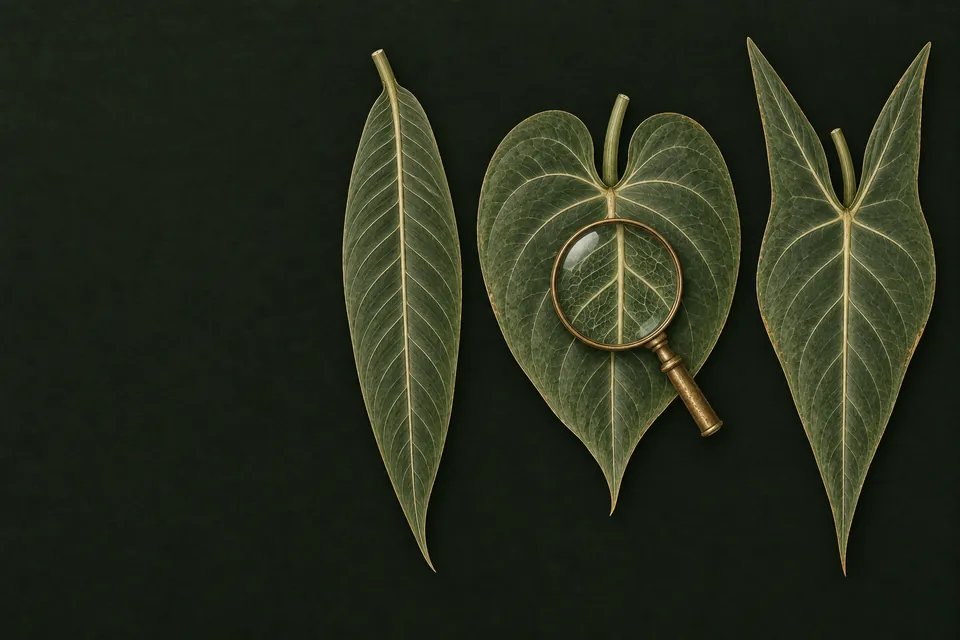
One plant can produce four kinds of shoot in a lifetime, and the confusion this caused ran for two centuries: juvenile monsteras were described as species of a dicot, and adults of the same plant as species of their own.
A flattened stem with a front and a back: roots on the face against the tree, leaves on the face away from it.
The stem
Mature stems run from about 2 mm thick in Monstera obliqua to 8 cm in Monstera deliciosa — a fortyfold range inside one genus. They are distinctly dorsiventral, usually flattened front to back: the side facing the trunk makes the adventitious roots, and the leaves come off the opposite side in two ranks. In some species those two ranks sit nearly opposite each other; in others they diverge at about 120°, and in Monstera membranacea and Monstera gracilis at closer to 90°.
Internode length is remarkably constant within a species, which makes it one of the more reliable characters in a genus where leaf shape is not. So are the shape of the leaf scar and of the axillary bud, which sits in a depression that often runs on along the internode as a groove. Young stems are green; older ones turn brown. In sections Monstera and Tornelia the internodes are smooth, while in sections Marcgraviopsis and Echinospadix they are roughened by hard papillae about a millimeter across, under a thick yellow-brown cuticle that sheds in large flakes when the stem twists.
Vegetative shoots do not branch. Flowering does the branching for them, and does it invisibly: the inflorescence is terminal, but a continuation shoot arises from the axil of the leaf before the one subtending it and pushes the inflorescence aside, so that a structure which is architecturally terminal ends up looking axillary.
Two kinds of root
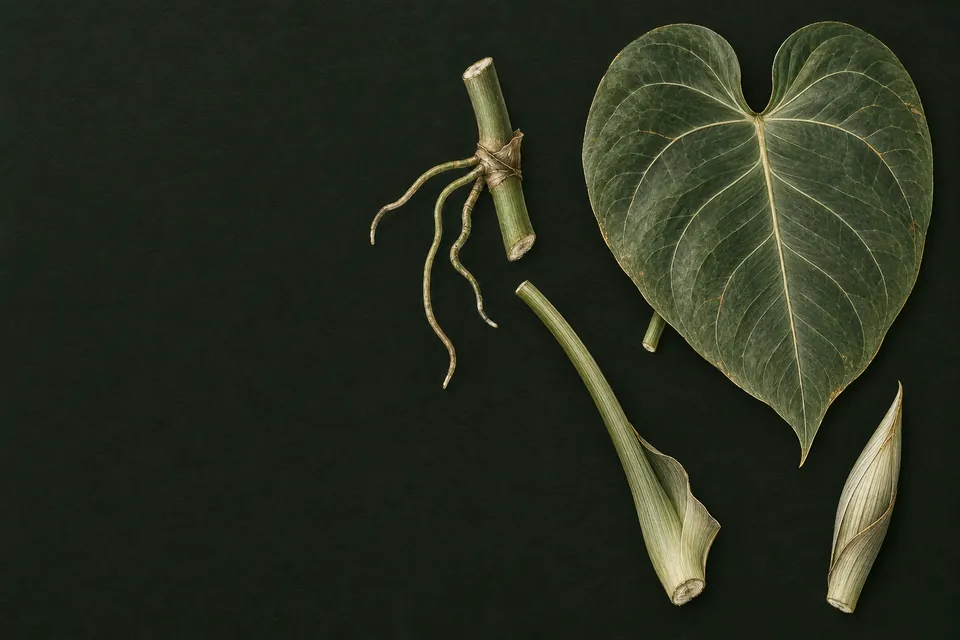
The radicle makes a small, short-lived root system and then gives up; almost everything after that is adventitious. Once a plant is climbing, and usually once it is more than a meter up with a stem 7–10 mm thick, its roots divide into two jobs.
Feeder roots arise at the nodes, roughly one per node, opposite the leaf. They grow straight down — hanging free or pressed to the bark — and stay unbranched for the whole descent, which can be 20 to 30 m, branching profusely only once they reach soil. They are probably the plant's main water conduit rather than the stem: an old plant can lose its stem's connection to the ground through decay or injury and show no sign of water stress, because the roots still reach it.
Anchor roots come off the internodes, are not geotropic, and simply track the surface, following a fissure or an irregularity in the bark. They are usually 10–20 cm long and hold on with root hairs that end in a kind of suctorial disc. They also need contact to keep going: when a climbing stem loses its support — reaching the top of a stump, say — the roots of the following internodes come fewer, harden and stop at about a centimeter. Free-hanging shoots make no feeder roots at all, only a tuft of aborted anchor roots at each node.

Fig · Stem and roots
The holes are made by cells dying on schedule inside a leaf that has not yet unrolled — and nobody has demonstrated what they are for.
Petiole, sheath and geniculum
Aroid usage differs from the rest of the monocots: what is called the petiole here takes in the sheath as well, everything from the stem to the base of the blade. The sheathing part protects the next leaf and the terminal bud, and how it behaves is one of the genus's best characters. It may be confined to the lower petiole or run all the way to the blade; it may end bluntly, or in wide auricles, or be drawn out into a ligule — in Monstera tuberculata the ligule is about as long as the petiole itself. After the next leaf expands, the sheath either stays green and persistent, withers in place, or falls away cleanly, and which of the three it does is often the quickest way to separate two similar species. The petiole is swollen at both ends; the upper swelling, at the base of the blade, is the geniculum, and it is usually conspicuously bent.
Leaves are produced in two ranks but seldom stay in them. They move after unfolding, fanning out so that upper leaves shade lower ones less. A cultivated Monstera deliciosa receiving light from one window was turned through 180°; over the next two weeks the leaves rearranged themselves into a less self-shading array, flexing at the pulvini even in leaves more than two years old.
How a hole is made
The mechanism was worked out in 1854 and has survived every re-examination since. Early in the development of the blade, while it is still furled, small patches of cells discolor and die, and the tissue they would have become never forms. The death starts in the mesophyll; if it starts late enough, the mesophyll dies but both epidermes survive, leaving a window rather than a hole. Anatomical sections published in 1969 already showed a discrete population of cells dying simultaneously while its immediate neighbors carried on dividing; a 2005 study on Monstera obliqua named the process programmed cell death and added that DNA cleavage comes early, the cell walls are left intact, and a small disc of dead tissue detaches as the expanding leaf stretches the opening. Exposed cells at the rim then differentiate into epidermis, which is why a mature hole has a finished edge rather than a torn one.
Timing decides the shape of the leaf. If the holes begin early enough they extend to the margin, and the leaf ends up pinnatifid instead of perforate; a second series started later can leave a blade that is both at once. That single variable accounts for most of the range of adult leaf shapes in the genus.
Why, and the honest answer
Four explanations have been offered and none tested in the field. In 1892 the holes were said to let rain fall through to the roots rather than be shed like an umbrella, an idea the 1977 revision called fanciful. That revision proposed instead that a dissected blade breaks up the still air against the leaf, increasing convection and keeping it cooler in strong sun — reasoning from torn banana leaves, which do run cooler, though banana is a full-sun pioneer and Monstera lives in shade. A 2006 suggestion added camouflage, which does not explain why the juvenile leaves of the same plant are entire. A 2013 model proposed that fenestration reduces the variance in a plant's carbon gain where most of the light arrives as brief unpredictable sunflecks: a perforated crown of the same leaf area intercepts flecks more evenly. It was published as a testable hypothesis, and the test has not been done.

Fig · Leaf and holes
Bisexual flowers, no perianth, a spathe that lasts two or three days — and a female phase that runs longer than the male, which is unusual enough to be worth stating.
Arrangement and the spathe
There is no marked flowering season. In any region where a species is reasonably collected, plants in flower turn up in every month of the year. Records for single species can be narrower, though: the 2024 Central American revision lists flowering for Monstera deliciosa in March, April and May, with fruit present all year, and for Monstera dubia in January, April and May.⁴ When a plant does flower it usually makes several inflorescences in succession, each shoot of the sympodium carrying two cataphylls and one inflorescence: two to four spadices in a cluster is normal, six to eight in Monstera obliqua, and solitary in Monstera lechleriana.
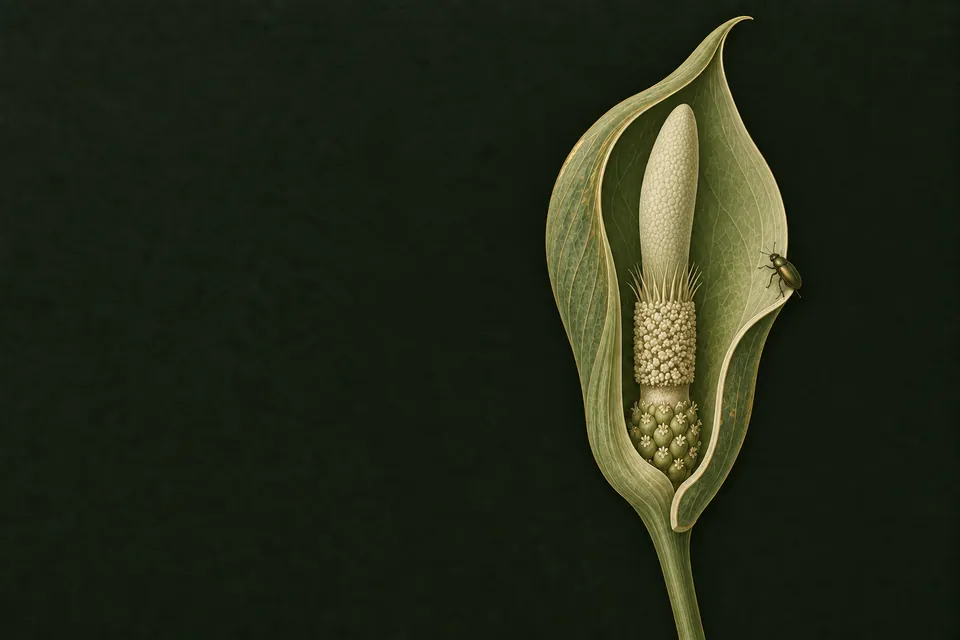
Peduncles are erect in every species but Monstera tuberculata, where peduncle and spadix both hang. They are terete or flattened, 5–45 cm long and 0.2–4.0 cm thick, and they keep growing after flowering — up to half again in length and thickness between anthesis and ripe fruit. The developing spathe is green, wrapped tightly around the spadix and longer than it. At anthesis it unfurls and colors: white, or yellow, or rose, depending on the species. It often shows a constriction about a third of the way up, marking where it had closed over the top of the spadix in bud. Fully open it may be almost globose with only a slit, or hemispherical with the spadix in plain view. Then it abscises, two or three days later.
The flowers
The spadix carries numerous spirally arranged bisexual flowers, each with four stamens and no perianth; those at the base are usually sterile. Flowers are protogynous by a day or two and mature from the base upward. Stigmatic drops have finished before pollen is shed, which works against an inflorescence fertilizing itself. The stamens have a broad flat filament 1.0–1.5 mm wide, the anthers stay hidden until just before anthesis and then push up between the pistils, and the pollen is shed through slits in sticky threads rather than as free grains. The ovary is bilocular with a perforation at the base of the septum and two basal ovules per locule. The stylar region is packed with needle-like trichosclereids 2–3 mm long, aligned with the axis of the pistil — a detail that matters later, when the fruit is handled.
Who pollinates it
For most of the twentieth century the answer was stingless bees, on the strength of an unpublished observation of two Ecuadorian species passed on in the 1977 revision and a 1978 report of Trigona bees taking the stigmatic secretion from Monstera deliciosa. Two field studies have since watched a Monstera through a full cycle — Monstera obliqua in French Guiana and Monstera lentii in Costa Rica — and in both the likely pollinator was a nitidulid beetle held for a night or more in the chamber behind the spathe. Where bees appeared, they were robbing pollen. The heat is modest, two to four degrees above the air, against eleven to nineteen in Philodendron. Only those two species of the genus have been studied this way, and they disagree with each other on almost every quantity, including whether the plant can set seed on its own — which is the subject of the reproduction guide. A message to the Aroid-L mailing list from Sarawak, far from where Monstera deliciosa is native, reports that it sets viable seed there regularly and names a melolonthin scarab, tentatively identified as Apogonia pygidialis Ritsema, as the main visitor and possibly the pollinator; the same beetle visits native aroids, notably Homalomena.¹²

Fig · Inflorescence
A fruit that takes anywhere from two months to over a year, and sheds its own armor when it is ready.
Once pollinated, the spathe falls and the spadix turns green — photosynthetic, and inconspicuous against the foliage while the seeds develop. The better protection is mechanical: the trichosclereids packed into the stylar end of every pistil make a barrier of needles around the seeds. Predation of developing fruit appears not to have been recorded.
Ripening takes 2 to 15 months depending on the species. When it is finished the stylar caps abscise — sometimes over the whole spadix, more often in a band that widens as ripening spreads — exposing the seeds in a sweet pulp, usually gray but in some species brightly colored. Ripe infructescences are white, yellow, orange or moss green by species, and in three species of one group the whole thing turns orange.
Each ovary starts with four ovules and usually finishes with one seed; two-seeded berries are uncommon. Endosperm is laid down early and then consumed, so the mature seed has none and stores its reserves in a swollen cotyledon instead. Cut open, a fresh seed is green or bluish inside. The seed coat is soft, unlike the rest of the tribe, and the seeds behave accordingly: they lose viability quickly if they are allowed to dry, but keep for months if kept moist.
Size varies more than almost anything else in the genus — roughly 5 to 22 mm — and it varies geographically. The largest seeds are in Mexico and they get smaller southward and eastward; every South American species has seeds under 10 mm. Size also tracks how the seedling behaves: species whose seedlings run as stolons have distinctly heavier seeds than those whose seedlings simply grow, which fits, since a stolon travels on what the seed packed for it.
A correction worth keeping
Unripe Monstera fruit is notoriously prickly in the mouth, and this is almost universally attributed to calcium oxalate raphides. The genus does contain raphides, abundantly, including in the fruit and seed coat. But it also contains trichosclereids, and the stylar portion of the fruit is full of them — they visibly penetrate the skin when the fruit is handled. That portion is shed and not normally eaten. The 1977 revision put the matter plainly and it has not moved since: it remains unclear whether the prickly character of unripe fruit is due to raphides or to trichosclereids. Ripe Monstera deliciosa fruit is not trouble-free for everyone, either. Writing to the Aroid-L mailing list in 2008, Leland warned that some people are sensitive to the calcium oxalate even in fully ripe fruit,¹³ and in 2009 D. Christopher Rogers wrote that some people who eat ripe fruit from his plant get a strong tingling, pin-pricking feeling on the lips, while others eating the same plant's fruit do not; he suggested the needle-like crystals.¹⁴ The cause is no more settled for ripe fruit than for unripe.

Fig · Fruit and seed
Araceae · Care
Cultivation
Most of what goes wrong with a Monstera indoors is not a care problem but a developmental one: the plant is being asked to be an adult while it is being grown as a juvenile.
Two root systems, two jobs — and a mix that suits neither is the commonest fault.
A climbing Monstera is not an epiphyte and not a terrestrial. It germinates in the ground, climbs, and then keeps its grip on the soil through feeder roots that may run twenty meters down a trunk. So the pot has to do the work of the forest floor — moisture and nutrients, held but never stagnant — while the stem is somewhere else entirely, in air.
That argues for a coarse, open mix rather than a dense one: bark, coir chunks, perlite or pumice, with enough fine material to hold water between waterings. The finer and heavier the mix, the more of the root run is anaerobic, and the first thing to suffer is the thick feeder root, which in the wild is unbranched, fast and used to air on all sides. Pots should drain freely and should not be oversized; a large volume of wet, fine mix around a young plant is the classic way to lose one.
Where the food is
The case against garden soil starts in the forest. Rain in a lowland rain forest is heavy enough to leach the upper soil of much of what a plant could use, and much of the forest's nutrient supply is held in living tissue and in the litter layer rather than in the mineral soil beneath. Some of it arrives from the sky: satellite measurements from 2007 to 2013 put the African dust settling on the Amazon basin at about 28 million tons a year, carrying an estimated 22,000 tons of phosphorus, roughly what the basin loses each year to rain and flooding (Yu and colleagues 2015). Roots in leaf litter, moss and bark, or pressed against a wet trunk, catch that supply as it passes. The grower Noel Calvert, who runs the Colombian nursery GueCal Colombian Tropicals, draws the practical conclusion for the pot: a dense mix made for annuals slowly kills a climbing aroid, and recurring root rot means the substrate is wrong before it means the watering is.
The support is part of the substrate
The plant is built to root into what it climbs, not merely to lean on it. A bare cane or a plastic pole gives the anchor roots nothing to take: they harden and stop at about a centimeter, exactly as they do in the wild when a stem loses contact with its support. A moss or coir pole that is kept damp is a second root run, and the plant treats it as one.
A grower's method for a young plant, reported on Aroid-L, uses that directly: set the offset deep in the pot until it has made its own roots, then tie it to a coconut-fiber stake below every new leaf and keep the stake moist. The plant roots into the stake as it climbs, and each successive leaf comes larger than the last.
Steady and moderate. There is no dormancy to feed around.
Monstera keeps no season — it flowers in every month of the year across its range and it grows whenever conditions allow — so there is no rest period to withhold feed for, and no flush to force. A balanced fertilizer at a modest rate through the period of active growth, reduced when light and temperature fall, suits the genus better than heavy feeding in bursts.
Two things follow from the plant's architecture. First, a plant climbing a damp pole is feeding through two root systems, and the pole is one of them — liquid feed applied only to the pot reaches only half the plant. Second, growth rate is a species character before it is a care outcome: in the wild the small species put on two to five meters of stem a year, while a large one managed twelve to twenty centimeters. Feeding a slow species harder does not make it a fast one.
Salt accumulation shows first at the leaf margins and tips. In a coarse, sharply drained mix that is easily corrected by flushing, which is another argument for the open substrate.
Bright shade, constant warmth, and — the part usually left out — height.
Light
These are plants of the lower and middle trunk, below the canopy: bright, diffuse light, and no long exposure to direct midday sun, which scorches. Their native light is not dim so much as intermittent — the understory receives much of its daily energy in brief sunflecks, and roughly twice as much light falls at two and a half meters up as at ground level. That vertical gradient is the reason a plant given something to climb behaves differently from one left in a pot.
Warmth and humidity
The genus belongs to tropical wet and premontane rain forest and thins out wherever the dry season lengthens, though not without exceptions. The 2024 Central American revision places both Monstera deliciosa and Monstera dubia in tropical moist forest, a drier life zone, as well as in wet forest,⁴ and Thomas B. Croat of the Missouri Botanical Garden, in his report of a summer 2000 collecting trip to South America, listed Monstera dubia among a few aroids occurring in small islands of vegetation scattered across the savannas of southern Beni, Bolivia.¹⁵ The crowd of species sits between roughly 300 and 1,500 m, in the constantly humid belt. Warmth and steady air moisture are what it is built for. Steady air moisture is not the same as wet leaves: growers including Noel Calvert avoid spraying the foliage, since a leaf that stays wet indoors invites bacterial spot, and water the mix instead.It is not, however, as tender as its origins suggest: Monstera deliciosa and Monstera adansonii grow vigorously, flower and set fruit in central Florida, where they are exposed to frost most years. A grower in Orlando, Florida (USDA zone 9b) recalled that Monstera deliciosa was killed to the ground in the December 1989 freeze, when temperatures dropped to near 20°F, but resprouted and climbed back into the trees.⁸ Cold tolerance varies by species and the montane ones tolerate more of it than the lowland ones.
Height, and why leaves stay small
This is the one that matters. A seedling creeps and a juvenile shingles flat against bark with small entire leaves; height is what moves it past that stage. In Monstera skutchii, climbing shoots switch, over a few nodes, from small round leaves pressed to the trunk to a more long-petioled form once the stem thickens past roughly 10 mm in diameter. A plant kept short is kept juvenile. Growers report the same thing from the other direction: an adult Monstera adansonii mounted on a totem produced every subsequent leaf at half the size of the ones it arrived with, and the usual remedy is simply more pole.
Easy to root, easy to reset. A cutting can carry the adult form forward or throw the plant back to a juvenile, and the difference is not always in the grower's hands.
Cuttings
Stem cuttings root readily — in water, in damp sphagnum, in coarse sand. Each cutting needs a node, since that is where both the bud and the roots come from. Aerial roots already present are useful: they are not simply ornamental, and given the right conditions they convert to functioning roots, which is why a cutting with an aerial root dropped into water often establishes faster than one without. One grower, however, found plants of Monstera punctulata from Panama and Costa Rica impossible to root: juvenile and mature stems, tried repeatedly, sat and then dried or rotted, while pieces of Monstera deliciosa rooted easily.⁹,¹⁰ The grower cautioned against damaging the mother plants of Monstera punctulata until more plants were in circulation.¹⁰
The reversion problem
What is less often said is that a cutting can lose the adult phase. The pattern growers describe repeatedly is that tip cuttings tend to keep the adult form while cuttings from further down the stem revert — long thin internodes, small round entire juvenile leaves — and then stay reverted for years. One grower took a cutting from an adult Monstera tenuis with full adult leaves; it rooted in two weeks and then produced a one-millimeter stem with long internodes and tiny round juvenile leaves, and after years of growth the stems had reached fifteen millimeters while the leaves were still round, entire and juvenile at twenty centimeters. Recovering the adult form takes height, time and conditions, in that order, and it is not always quick. One species is described differently: Thomas B. Croat of the Missouri Botanical Garden wrote in 2007 that Monstera dubia changes from its shingled, mottled juvenile leaves to solid green preadult leaves and never reverts to the juvenile form.¹⁶ He did not say whether that holds for cuttings.
Air layering and seed
Air layering works and avoids the reversion risk by keeping the shoot intact, but with a caveat from practice: only the aerial roots actually enclosed in the wrap tend to develop, so the wrap has to be placed where the roots are.
Seed is straightforward if it is fresh and a poor bet if it is not. Monstera seeds have a soft coat, no endosperm at maturity, and lose viability rapidly on drying; kept moist they store for several months. They germinate on the ground in the wild and the seedlings of many species run as pale stolons before making a leaf, so a flat, humid, dark-margined tray suits them better than a bright open one.
Nothing unusual to the genus; the ordinary indoor set, made worse by dry air and by a pole nobody inspects.
The pests are the standard glasshouse company: thrips, spider mites, mealybugs, armored scales and, in wet mixes, fungus gnats. Mites follow dry air, which is a genuine risk for a plant from a constantly humid belt kept in a heated room. Scale and mealybug both favor the places a large climbing plant offers and a grower rarely looks: the underside of the geniculum, the sheath while it is still wrapped, and the join between stem and moss pole.
Two habits of the plant matter here. The petiole sheath of many species persists or withers in place rather than falling cleanly, and the resulting dry fiber is good cover — worth clearing on inspection. And a damp pole is a second root run, so anything treated as a soil problem has to be treated at the pole as well or it simply returns.
Damage in the wild is not unknown either. Beetles have been found eating the spadix of Monstera titanum with the spathe still intact, and lepidopteran larvae have been recorded boring into the rachis of an inflorescence, so predation on the reproductive parts is real even if fruit predation appears not to have been recorded.
Monstera Timeline
An interactive timeline showing the year each Monstera species was first described as Monstera (species may previously have been classified in other genera)
Monstera Species & Cultivars
Sources
The papers behind the morphology & cultivation tab
- Trécul, A. (1854). Note sur la formation des perforations que présentent les feuilles de quelques Aroïdées. Annales des Sciences Naturelles, Botanique, sér. 4, 1: 37–40.
- Melville, R. & Wrigley, F. A. (1969). Fenestration in the leaves of Monstera and its bearing on the morphogenesis and colour patterns of leaves. Botanical Journal of the Linnean Society 62(1): 1–16.
- Madison, M. (1977). A revision of Monstera (Araceae). Contributions from the Gray Herbarium of Harvard University 207: 3–100.
- Croat, T. B., Cedeño-Fonseca, M. & Ortiz, O. O. (2024). Revision of Monstera (Araceae: Monsteroideae) of Central America. Phytotaxa 656(1): 1–197.
- Gunawardena, A. H. L. A. N., Sault, K., Donnelly, P., Greenwood, J. S. & Dengler, N. G. (2005). Programmed cell death and leaf morphogenesis in Monstera obliqua (Araceae). Planta 221(5): 607–618.
- Muir, C. D. (2013). How did the Swiss cheese plant get its holes? The American Naturalist 181(2): 273–281.
- Yu, H., Chin, M., Yuan, T., Bian, H., Remer, L. A., Prospero, J. M., Omar, A., Winker, D., Yang, Y., Zhang, Y., Zhang, Z. & Zhao, C. (2015). The fertilizing role of African dust in the Amazon rainforest: a first multiyear assessment based on data from Cloud-Aerosol Lidar and Infrared Pathfinder Satellite Observations. Geophysical Research Letters 42(6): 1984–1991.
- Aroid-L mailing list, Eric Schmidt, December 21st, 2004
- Aroid-L mailing list, Leland, June 20th, 2008
- Aroid-L mailing list, Leland, June 23rd, 2008
- Aroid-L mailing list, Tom Croat, February 5th, 2007
- Aroid-L mailing list, Peter, August 11th, 2009
- Aroid-L mailing list, Leland, July 6th, 2008
- Aroid-L mailing list, D. Christopher Rogers, August 6th, 2009
- Aroid-L mailing list, Tom Croat (forwarded by Steve Marak), November 5th, 2000
- Aroid-L mailing list, Tom Croat, January 8th, 2007
Complete Monstera Bibliography
Every source cited across all Monstera species, cultivar and hybrid pages
- iNaturalist inaturalist.org
- Monstera acacoyaguensis Aroidpedia page
- Monstera acuminata Aroidpedia page
- Monstera adansonii Aroidpedia page
- Monstera alcirana Aroidpedia page
- Monstera alfaroi Aroidpedia page
- Monstera anomala Aroidpedia page
- Monstera aureopinnata Aroidpedia page
- Monstera barrieri Aroidpedia page
- Monstera bocatorensis Aroidpedia page
- Monstera boliviana Aroidpedia page
- Monstera buseyi Aroidpedia page
- Monstera cedenoi Aroidpedia page
- Monstera costaricensis Aroidpedia page
- Monstera croatii Aroidpedia page
- Monstera deliciosa Aroidpedia page
- Monstera dissecta Aroidpedia page
- Monstera donosoensis Aroidpedia page
- Monstera dubia Aroidpedia page
- Monstera egregia Aroidpedia page
- Monstera epipremnoides Aroidpedia page
- Monstera filamentosa Aroidpedia page
- Monstera florescanoana Aroidpedia page
- Monstera glaucescens Aroidpedia page
- Monstera gracilis Aroidpedia page
- Monstera guzmanjacobiae Aroidpedia page
- Monstera integrifolia Aroidpedia page
- Monstera juliusii Aroidpedia page
- Monstera kessleri Aroidpedia page
- Monstera kikiae Aroidpedia page
- Monstera lamersiana Aroidpedia page
- Monstera lechleriana Aroidpedia page
- Monstera lentii Aroidpedia page
- Monstera luteynii Aroidpedia page
- Monstera membranacea Aroidpedia page
- Monstera minima Aroidpedia page
- Monstera molinae Aroidpedia page
- Monstera monteverdensis Aroidpedia page
- Monstera obliqua Aroidpedia page
- Monstera oreophila Aroidpedia page
- Monstera pinnatipartita Aroidpedia page
- Monstera pittieri Aroidpedia page
- Monstera planadensis Aroidpedia page
- Monstera punctulata Aroidpedia page
- Monstera siltepecana Aroidpedia page
- Monstera spruceana Aroidpedia page
- Monstera standleyana Aroidpedia page
- Monstera subpinnata Aroidpedia page
- Monstera tablasensis Aroidpedia page
- Monstera tacanaensis Aroidpedia page
- Monstera tarrazuensis Aroidpedia page
- Monstera tenuis Aroidpedia page
- Monstera titanum Aroidpedia page
- Monstera tuberculata Aroidpedia page
- Monstera wilsoniensis Aroidpedia page
- Monstera xanthospatha Aroidpedia page
- Croat, Cedeño-Fonseca & Ortiz 2024. Revision of Monstera (Araceae: Monsteroideae) of Central America. Phytotaxa 656(1): 1–197 doi.org MONSTERA ACACOYAGUENSISMONSTERA ACUMINATAMONSTERA ADANSONIIMONSTERA ALCIRANAMONSTERA ALFAROIMONSTERA ANOMALAMONSTERA BOCATORENSISMONSTERA BUSEYIMONSTERA COCLENSISp. 49MONSTERA COSTARICENSISMONSTERA CROATIIMONSTERA DELICIOSAMONSTERA DISSECTAMONSTERA DONOSOENSISMONSTERA DUBIAMONSTERA EGREGIAMONSTERA EPIPREMNOIDESMONSTERA FILAMENTOSAMONSTERA FLORESCANOANAMONSTERA GAMBENSISMONSTERA GENTRYIMONSTERA GIGASMONSTERA GLAUCESCENSMONSTERA GUZMANJACOBIAEMONSTERA HARRISONIORUMp. 99MONSTERA INTEGRIFOLIAMONSTERA JULIUSIIMONSTERA LENTIIMONSTERA LIMITARISMONSTERA LUTEYNIIMONSTERA MADERAVERDEMONSTERA MEMBRANACEAMONSTERA MINIMAMONSTERA MITTERMEIERIMONSTERA MOLINAEMONSTERA MONTEVERDENSISMONSTERA NGABENSISp. 125MONSTERA OBLIQUAMONSTERA OREOPHILAMONSTERA PINNATIPARTITAMONSTERA PITTIERIMONSTERA PUNCTULATAMONSTERA SILTEPECANAMONSTERA SPRUCEANAMONSTERA STANDLEYANAMONSTERA TABLASENSISMONSTERA TACANAENSISMONSTERA TARRAZUENSISMONSTERA TENUISMONSTERA TITANUMMONSTERA TUBERCULATAMONSTERA WILSONIENSIS
- Cedeño-Fonseca, Hay & Blanco 2022. A taxonomic revision of Monstera Adans. (Araceae: Monsteroideae) in Costa Rica. Aroideana 45(1): 4–198 aroid.org MONSTERA ADANSONIIMONSTERA ALFAROIMONSTERA ANOMALAMONSTERA BUSEYIMONSTERA COSTARICENSISMONSTERA CROATIIMONSTERA DELICIOSAMONSTERA DISSECTAMONSTERA DUBIAMONSTERA EPIPREMNOIDESMONSTERA FILAMENTOSAMONSTERA GAMBENSISMONSTERA GLAUCESCENSMONSTERA INTEGRIFOLIAMONSTERA JULIUSIIMONSTERA LENTIIMONSTERA LIMITARISMONSTERA LUTEYNIIMONSTERA MEMBRANACEAMONSTERA MITTERMEIERIMONSTERA MOLINAEMONSTERA MONTEVERDENSISMONSTERA OBLIQUAMONSTERA OREOPHILAMONSTERA PINNATIPARTITAMONSTERA PITTIERIMONSTERA PUNCTULATAMONSTERA SPRUCEANAMONSTERA STANDLEYANAMONSTERA TABLASENSISp. 162MONSTERA TACANAENSISMONSTERA TARRAZUENSISMONSTERA TENUISMONSTERA TUBERCULATAMONSTERA WILSONIENSIS
- Madison 1977. A revision of Monstera (Araceae). Contributions from the Gray Herbarium of Harvard University 207: 3–100 biodiversitylibrary.org MONSTERA ACACOYAGUENSISMONSTERA ACUMINATAMONSTERA ADANSONIIMONSTERA DELICIOSAMONSTERA DUBIAMONSTERA EPIPREMNOIDESMONSTERA GRACILISMONSTERA LECHLERIANAMONSTERA OBLIQUAMONSTERA PITTIERIMONSTERA PUNCTULATAMONSTERA SILTEPECANAMONSTERA SPRUCEANAMONSTERA STANDLEYANAMONSTERA SUBPINNATAMONSTERA TENUISMONSTERA TUBERCULATA
- Aroid Cultivar Registry aroidcultivars.org
- Monstera ‘rellas jewel’ Aroidpedia page
- Monstera deliciosa ‘key lime pie’ Aroidpedia page
- Monstera deliciosa ‘masterpiece’ Aroidpedia page
- Monstera deliciosa ‘oceana’ Aroidpedia page
- Monstera deliciosa ‘shamrock shake’ Aroidpedia page
- Monstera deliciosa ‘unniiae’ Aroidpedia page
- Monstera sp. ‘burle marx's flame’ Aroidpedia page
- Monstera sp. ‘esqueleto’ Aroidpedia page
- Monstera sp. ‘frisbee’ Aroidpedia page
- Monstera sp. ‘jungle mint’ Aroidpedia page
- Cedeño-Fonseca, Ortiz, Zuluaga, Grayum & Croat 2021. Four new species of Monstera (Araceae) from Panama, including one with the largest leaves and another with the largest inflorescences in the genus. Webbia 76(2): 265–279 doi.org
- Grayum 1997. Nomenclatural and taxonomic notes on Costa Rican Araceae. Phytologia 82(1): 30–57 doi.org
- Cedeño-Fonseca, Ortiz, Zuluaga, Jiménez-Segura & Croat 2020. A new orange-fruited species of Monstera (Araceae: Monsteroideae) from Panama. Webbia 75(2): 251–262 doi.org
- Prieto & Cascante-Marín 2017. Pollination by nitidulid beetles in the hemi-epiphytic aroid Monstera lentii (Araceae: Monsteroideae). Flora 231: 57–64 doi.org
- Boyce 2000. Juvenile monsteroids. Aroid-L, 12 June 2000 hort.net
- Chouteau, McClure & Gibernau 2007. Pollination ecology of Monstera obliqua (Araceae) in French Guiana. Journal of Tropical Ecology 23: 607–610 doi.org
- Journal of Plant Taxonomy and Geography (Webbia) 78 (2023) doi.org
- Nordic Journal of Botany 38-e02970 (2020) doi.org
- Rodriguesia 56 (2005) doi.org
- Zuluaga, Cedeño-Fonseca & Mittermeier 2021. Two new species of Monstera (Araceae: Monsteroideae) from the Pacific slope of the Andes in Colombia. Phytotaxa 527(2): 134–142 doi.org
- Annals of the Missouri Botanical Garden 74: 659 (1987) doi.org
- Gonçalves 2002. Monstera obliqua vs. Monstera adansonii. Aroid-L, 13 February 2002 hort.net
- Index Seminum Horti Botanici Berolinensis, Appendix 1855, App.: 4 (1855) biodiversitylibrary.org
- Odd Spot Plants oddspotplants.com.au
- PhytoKeys 267 (2025) doi.org MONSTERA COLOSSICAp. 116MONSTERA CORANAp. 111
- Phytotaxa 334 (2018) doi.org
- Phytotaxa 461 (2020) doi.org MONSTERA JULIUSIIp. 186MONSTERA MONTEVERDENSISp. 188
- Phytotaxa 514 (2021) doi.org MONSTERA GENTRYIp. 213MONSTERA MITTERMEIERIp. 217
- Strong & Ray 1975. Host tree location behavior of a tropical vine (Monstera gigantea) by skototropism. Science 190: 804–806 doi.org
- Webbia 75 (2020) doi.org MONSTERA CROATIIp. 124MONSTERA GAMBENSISp. 127
- Anales del Instituto de Biología, Universidad Nacional Autónoma de México, Serie Botánica 43, Ser. Bot. (1): 55 (1972) anales.ib.unam.mx
- Aroid-L mailing list, D. Christopher Rogers, August 6th, 2009 hort.net
- Aroid-L mailing list, Leland, July 6th, 2008 hort.net
- Aroid-L mailing list, Peter, August 11th, 2009 hort.net
- Aroid-L mailing list, Tom Croat (forwarded by Steve Marak), November 5th, 2000 hort.net
- Aroid-L mailing list, Tom Croat, February 5th, 2007 hort.net
- Aroid-L mailing list, Tom Croat, January 8th, 2007 hort.net
- Aroid-L mailing list, Tom Croat, May 4th, 2022 hort.net
- Aroideana 27: 113 (2004) aroid.org
- Aroideana 33: 89 (2010) aroid.org
- Baileya 14: 133 (1967) babel.hathitrust.org
- Botanische Jahrbücher für Systematik, Pflanzengeschichte und Pflanzengeographie 37: 116 (1905) biodiversitylibrary.org
- Botanische Jahrbücher für Systematik, Pflanzengeschichte und Pflanzengeographie 37: 118 (1905) biodiversitylibrary.org
- Boyce 2000. Flowering juveniles. Aroid-L, 15 June 2000 hort.net
- Brittonia 56: 72 (2004) doi.org
- Bulletin of the New York Botanical Garden 6: 494 (1910) biodiversitylibrary.org
- Contributions from the Gray Herbarium of Harvard University 207: 54 (1977) biodiversitylibrary.org
- Contributions from the Gray Herbarium of Harvard University 207: 55 (1977) biodiversitylibrary.org
- Contributions from the Gray Herbarium of Harvard University 207: 65 (1977) biodiversitylibrary.org
- Contributions from the Gray Herbarium of Harvard University 207: 72 (1977) biodiversitylibrary.org
- Contributions from the Gray Herbarium of Harvard University 207: 89 (1977) biodiversitylibrary.org
- Das Pflanzenreich IV.23B (Heft 37): 117 (1908) archive.org
- Economic Botany 66: 209 (2012) doi.org
- Flora Brasiliensis 3(2): 115 (1878) biodiversitylibrary.org
- Gunawardena, Sault, Donnelly, Greenwood & Dengler 2005. Programmed cell death and leaf morphogenesis in Monstera obliqua (Araceae). Planta 221: 607–618 doi.org
- International Aroid Society Aroid Cultivar Registry: Monstera deliciosa 'Contorted Fish' aroidcultivars.org
- Journal of Botany, British and Foreign 2: 53 (1864) biodiversitylibrary.org
- Journal of Plant Taxonomy and Geography (Webbia) 79: 306 (2024) doi.org
- Linnaea 18: 79 (1844) biodiversitylibrary.org
- Lloydia 2: 78 (1939) archive.org
- López-Portillo, Ewers, Angeles & Fisher 2000. Hydraulic architecture of Monstera acuminata: evolutionary consequences of the hemiepiphytic growth form. New Phytologist 145: 289–299 doi.org
- Madroño 10: 48 (1949) biodiversitylibrary.org
- Monographiae Phanerogamarum 2: 258 (1879) biodiversitylibrary.org
- Monographiae Phanerogamarum 2: 259 (1879) biodiversitylibrary.org
- Monographiae Phanerogamarum 2: 267 (1879) biodiversitylibrary.org
- Muir 2013. How did the Swiss cheese plant get its holes? The American Naturalist 181: 273–281 doi.org
- Novon 15: 91 (2005) biodiversitylibrary.org
- Oesterreichisches Botanisches Wochenblatt 7: 197 (1857) biodiversitylibrary.org
- Phytotaxa 376: 38 (2018) doi.org
- Phytotaxa 437: 41 (2020) doi.org
- Prodromus Systematis Aroidearum 366 (1860) biodiversitylibrary.org
- Revista de la Sociedad Mexicana de Historia Natural 11: 97 (1950) repositorio.fciencias.unam.mx:8080
- Revista Mexicana de Biodiversidad 81: 225 (2010) doi.org
- Rodriguesia 56: 61 (2005) doi.org
- Videnskabelige Meddelelser fra den Naturhistoriske Forening i Kjøbenhavn 1849: 19 (1849) archive.org
- Vilela & Prieto 2018. A new Costa Rican species of Drosophila visiting inflorescences of the hemi-epiphytic climber Monstera lentii (Araceae). Revista Brasileira de Entomologia 62: 225–231 doi.org
- Wiener Zeitschrift für Kunst, Literatur, Theater und Mode 1830(4): 1028 (1830) anno.onb.ac.at
Chromosome counts
The 4 papers behind the published chromosome numbers on the Monstera pages and in the genus's Chromosomes section.
- Bogner, J.; Petersen, G. 2007. The Chromosome Numbers of the Aroid Genera. Aroideana 30: 82.
- Madison, M. 1977. A revision of Monstera (Araceae). Contributions from the Gray Herbarium of Harvard University 207(207): 3–100.
- Marchant, C. J. 1970. Chromosome variation in Araceae: I. Pothoeae to Stylochitoneae. Kew Bulletin 24(2): 315–322.
- Mayo, S. J.; Bogner, J.; Boyce, P. C. 1997. The Genera of Araceae. Royal Botanic Gardens, Kew.