

Araceae · Morphology
THE
SCHISMATOGLOTTIS SHOOT
A shoot that flowers once and stops — the character that halved the genus in 2024
The Guide
A shoot that flowers once, and stops
Most of the plants in this guide are held together by something you can see across a room — a leaf shape, a stem, a surface. Schismatoglottis is held together by what its shoot does after it flowers. The shoot produces a set number of leaves, puts up its inflorescence, and dies. Growth continues from the next shoot along, and the plant advances as a colony of dead-ended units.
That is a vegetative character, it is visible if you dig, and in 2024 it became the definition of the genus. Schismatoglottis was restricted to plants with hapaxanthic shoots — shoots that flower once and finish — mostly underground, mostly colonial, and shedding the upper spathe whole while it is still fresh1.
- 69 species the genus now holds
- 85 species moved out of it in 2024
- 7 new genera made from them
- 24 further names held provisionally
Read the second figure again
More plants left this genus in one paper than remain in it. The eighty-five that went are now Aia, Ayuantha, Bau, Borneoa, Ibania, Sarawakia and Tweeddalea1. What they had in common was the opposite shoot: pleionanthic — one that keeps growing after it flowers, indefinitely.
Which makes this a page about a moving target
A photograph captioned Schismatoglottis before 2024 has roughly even odds of showing a plant that is now something else. That is not a reason to distrust the photograph — it is a reason to read the shoot before you read the label.
Every character below is given for the genus as it now stands. Where a well-known character left with the plants that carried it, this page says where it went.
How this page is ordered
The shoot module first, because it is the definition. Then the petiolar sheath, which is the character growers actually use and the one that has moved the most plants. Then the leaf itself, and what its smell settles. Then the rock — more than any genus in this guide, these plants are stuck to a particular substrate, and it has shaped both the plants and the number of them. The last part is the one that left.
Schismatoglottis Reproduction is the companion and owns the inflorescence — the chamber, the clock, the visitors and the heat. Where this page needs the bloom it names it and moves on.
Part I
The module, and why it dies
An aroid shoot is built in modules — runs of stem that produce a series of leaves and then terminate. What varies between genera is what happens at the end of a module, and in this tribe that difference turns out to be the deepest one there is.
A hapaxanthic module makes its leaves, flowers, and is finished. The stem does not extend past the inflorescence. Whatever the plant does next it does from a new module, breaking out lower down, and the old one is left behind as a spent length of tissue in the leaf litter.
A pleionanthic shoot does not stop. It flowers and carries on growing from a relay shoot that typically arises just below the inflorescence, year after year, so the stem looks continuous and the old inflorescences are simply points along it.
Both are common in the family. What is unusual here is that one of them was made to carry a genus1.
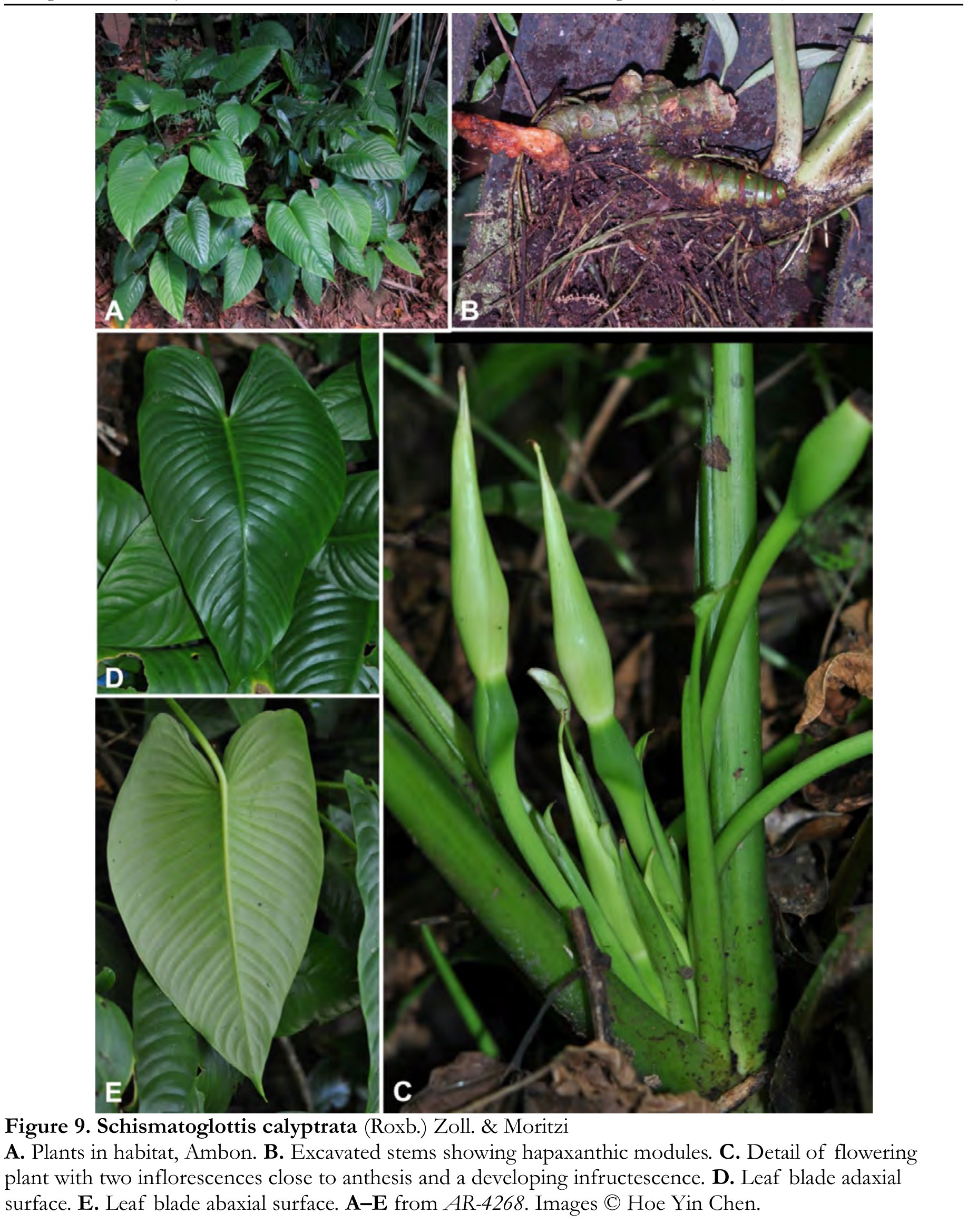
What this looks like above ground
Mostly it looks like a patch. The stems are hypogeal in most species — below the surface, condensed, and around one to two centimeters thick — so what stands above the litter is a crown of a few leaves, repeated, with the connections hidden2. Where a plant is growing on bare rock and has nowhere to bury itself, the same stems sit on the surface and the modular structure is visible without digging2.
Counting leaves is worth the trouble here, because a module carries a fixed few rather than an open-ended series. Descriptions in this group run to one to three, three to five, or about six leaves per crown, species by species2. A crown with a spent inflorescence in it will not add more.
The practical version
If a clump advances by throwing new crowns from below and the old crowns die back after flowering, the plant is behaving like a Schismatoglottis. If a single stem flowers and then keeps extending, it is behaving like one of the seven genera that left.
This is one of the rare cases where a plant in cultivation shows the character better than a herbarium sheet does, because the character is a sequence rather than a shape, and a pressed specimen is a single moment.
The character is older than the genus
Hapaxanthic shoot modules were not invented as a generic character in 2024. They were already the definition of an informal group — the Calyptrata Group — when the genus was monographed in 2000, together with a fully attached persistent petiolar sheath and a spathe limb that falls away entire2.
Molecular work then recovered that group as a clade centered on the generic type, and the 2024 paper made the clade the genus1. The sequence is worth noticing: a character read off living plants in the field defined a group first, and the DNA agreed with it afterward.
Part II
The sheath, and whether it lets go
Every aroid petiole is sheathing at the base. The question that matters in this tribe is how far up the sheath stays welded to the petiole — and whether, above that point, it continues as a free flap of its own.
That free flap is a ligule. It is the single most useful thing to look at on a plant of this tribe with no flower on it, and it is checked in seconds: run a thumbnail up the back of the petiole from the base and feel where the wing stops being attached.
| The sheath | Where that plant now sits |
|---|---|
| Fully attached to the petiole for its whole length, tapering, persistent — at most a short ligulate tip | Schismatoglottis as now defined. Every species in the group around the type is described this way2. |
| Attached only at the base, the rest standing free as a long ligule | The former Multiflora Group, on that character alone — now the genus Tweeddalea1, 3. |
A key written for the group in Sarawak opens on exactly this couplet: sheath fully attached, or sheath attached at the base with the rest a free ligule. Nothing else is asked first3.
So a familiar description has quietly changed hands
Schismatoglottis has often been summarized as the genus with the long apical ligule on the sheath. That was fair of the wider genus, because the plants that carry the most conspicuous ligules were in it.
They are not now. The long, persistent, leathery free ligule is a character of Tweeddalea and of several other segregates; the genus that kept the name is the one whose sheath stays attached1, 3.
And the sheath is doing something, not just marking something
The plants with free ligules are not scattered at random. Every species of the former Multiflora Group is geologically obligated — tied to limestone or to shale — and grows on vertical or very steep ground, often with water running over it3. A sheath that stands away from the petiole belongs to plants clamped to a wet rock face.
That association runs through the whole tribe and Part IV returns to it. It is the reason the sheath is worth more than five seconds of attention: it is a habit character as much as an ornament.
Part III
The leaf, and what it smells of
The leaf is the least decisive thing on the plant, and it is worth saying so early. Blades in this genus are typically cordato-sagittate — heart-shaped to arrow-shaped, on a plain petiole — and that description covers a great many aroids that are not related to it at all1.
Within the genus the blade does vary, and the descriptions of individual species are precise about it: elliptic to ovato-sagittate, narrowly hasto-sagittate, oblong-lanceolate to narrowly obovate, narrowly ovate. Texture ranges from rather tough to thinly sub-succulent and rubbery, and the surface from semi-glossy mid-green to brilliant green or deep green, always paler beneath2.
Read the list again and notice what it is: a set of ranges that overlap each other. It separates species once you already know you are in the right genus. It will not put you there.
One leaf character does help against some of those unrelated aroids, and it concerns venation. Colocasia, Xanthosoma and most Alocasia have colocasioid venation, in which secondary veins arising from the primaries unite into sinuous interprimary collective veins running between them. Peter Boyce wrote that no Schismatoglottis has such venation, though Schismatoglottis colocasioidea approaches it. Because not every Alocasia has colocasioid venation either, he gave a more reliable test: Alocasia typically carries glands, often waxy, in the axils of the primary veins on the underside of the blade, and such glands are never present in Schismatoglottis5.
The petiole carries more than the blade does
The stalk is the more informative half. Species descriptions record whether it is smooth or asperous, D-shaped in section or weakly channelled, and whether it carries longitudinal striations — and whether those striations are darker than the ground color or merely prominent2. Elsewhere in the tribe the petiole is scabrid, or longitudinally ribbed, and those textures are diagnostic at the level of whole groups3.
Add the sheath from Part II and the petiole is doing most of the work that growers assume the blade is doing.
And then there is the test with no instrument
Crush a leaf. If it is aromatic, it is not a Schismatoglottis.
Homalomena and Schismatoglottis are the classic confusion in this part of the family — superficially the same plant, the same habit, the same forest floor. The character that separates them is not visual at all: Homalomena tissue is aromatic, smelling of terpenoids when broken, and Schismatoglottis tissue is not4.
Why a chemical character is a fair one
It is repeatable, it costs nothing, it works on a sterile plant, and it works in cultivation. Very few characters in this guide manage all four.
It is also a reminder that a diagnostic character does not have to be something you can photograph. The most reliable thing about these two genera is a thing a camera cannot record.
Where the genus grows
The range is much wider than the taxonomic work on it suggests. The genus runs from south-western Myanmar through continental tropical and subtropical Asia into south-western China, Hainan and southern Taiwan, down the Malay Peninsula through the whole Indonesian archipelago, and on through New Guinea and the Bismarck Archipelago to the Solomon Islands, with centers of diversity in Sumatra, Borneo and the Philippines1.
It has not been found in Australia, which is worth a moment given how close New Guinea is and how readily Alocasia made the crossing1.
Part IV
The rock, and what it did to the plants
Most genera in this guide are described by their organs. This tribe is described, over and over, by its substrate. Species accounts routinely give the geology before they give the habit — shale, limestone, sandstone, granite — and the phrase that recurs is geologically obligated: the plant does not merely prefer that rock, it is confined to it3.
On Borneo, where the tribe is concentrated, the pattern is close to universal. Bornean species are mostly local endemics and almost all are geologically obligated3.
Not every substrate is a single clean rock type. Schismatoglottis clivemarshii, endemic to the Danum Valley Conservation Area in Sabah, grows on mélange outcrops of basalt, granite, deep-water sediments and nickel-rich ultrabasic rock in a semi-hard clay matrix, and its two closest relatives are both limestone obligates6, 7.
Which is a mechanism, not a coincidence
A plant restricted to limestone in a landscape where limestone occurs as scattered outcrops is a plant living on islands. The outcrops are separated by ground it cannot cross, and populations on separate outcrops stop exchanging anything. There is compelling evidence for exactly that here — vicariance, with spatially isolated limestone outcrops carrying their own local endemics3.
That is the reason a tribe this size needed more than sixty papers to sort out. The rock has been making species faster than anyone could describe them, and the products are narrow-range, look-alike, and numerous.
The second habitat is moving water
The other recurring substrate is a stream. Rheophytes — plants of fast-flowing water, built to be submerged and dragged when the river rises — occur all through this tribe, and species accounts separate the obligate ones from the facultative ones that merely withstand spate flooding1, 3.
The habit that goes with it is consistent: small, tufted or clump- forming, with congested internodes and stems rooting along their length into mud or into the rock itself, and tough narrow blades. Within Schismatoglottis as now defined, Schismatoglottis ahmadii is described as a small rheophytic clump-forming herb of about twenty centimeters, with a rather tough blade — the whole plant built low and hard2.
A caution for anyone growing these
Substrate obligation is a statement about where a species is found in the wild, and about what has driven speciation. It is not a recipe. A limestone-obligated plant is not asking for limestone in a pot — what the rock supplies in the field is drainage, a particular water chemistry, and above all isolation.
The useful part for a grower is the inverse: a wild-collected plant of this tribe with no locality is a plant with a large part of its identity missing, because in this group locality is very nearly a character.
Part V
What left, and what it took with it
This section exists because the interesting characters are not evenly distributed between the genus and its segregates. Several of the things most worth knowing about Schismatoglottis are now, strictly, things about something else — and a page that quietly left them in would be teaching a plant that no longer answers to the name.
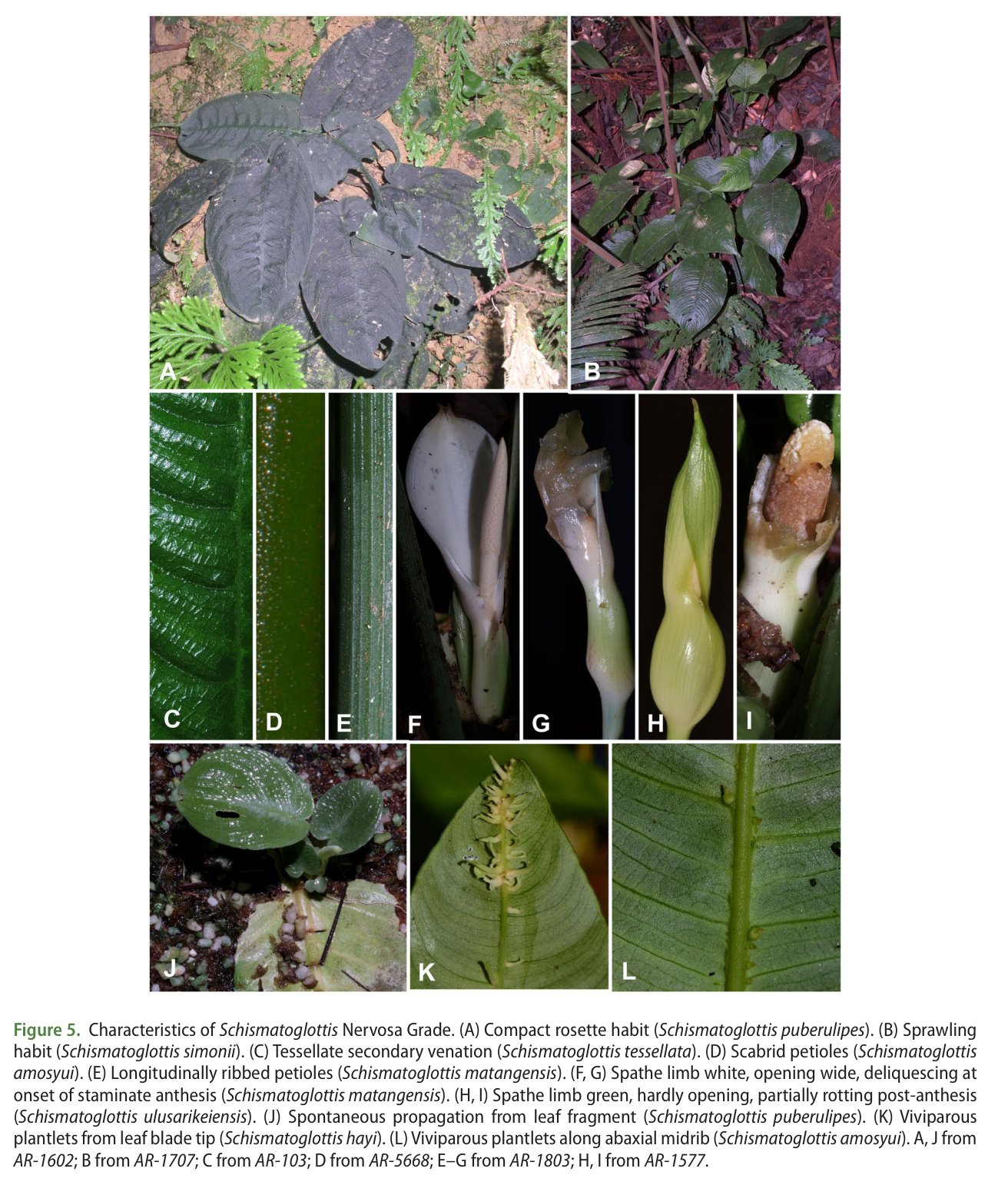
Vivipary went to Bau
Producing plantlets directly on a leaf is about as striking as a vegetative character gets, and it is well documented in the group formerly called the Nervosa Grade — from a leaf fragment, from the blade tip, and along the abaxial midrib3. That entire grade became the genus Bau in 2024, and the 2024 account keeps the character with it, citing the blade tip of Bau hayi1.
So the leaf that grows plants is real, it is Bornean, and it is mostly not a Schismatoglottis character. One exception has been reported: Schismatoglottis heterodoxa, a rheophyte in the otherwise mainly colonial-terrestrial Calyptrata Group, is said to develop plantlets on damaged leaf blades8.
The cane went too
The erect, cane-like understorey habit that this genus has often been grouped with Aglaonema, Dieffenbachia and Homalomena for belongs to the pleionanthic shoot — a stem that keeps extending. Those are the plants now in Bau, Borneoa, Ibania and their allies, with stems described as creeping, ascending, decumbent, elongate, rooting along their length1.
What kept the name is the low, colonial, mostly-buried plant of Part I.
And the free ligule went to Tweeddalea
Part II covered this one. It is listed again here because it is the character most likely to be quoted at you from an older source, and the correction is easy to state: fully attached sheath, this genus; free ligule, one of the segregates1, 3.
What is still open
Three species — Schismatoglottis conoidea, Schismatoglottis convolvula and Schismatoglottis priapica — are held in the genus provisionally, on doubtful affinity, pending further study. A further group of species with pleionanthic elongated stems is retained in the genus while its authors record that they almost certainly do not belong there1.
Twenty-four more names, nearly all from New Guinea and its islands and all allied to the type species, wait on field study1. The genus is settled at its center and unsettled at both edges.
One last thing the vegetative plant will not tell you
Nothing above resolves a species. The characters on this page place a plant in a genus, and in this tribe that is a genuinely hard problem worth solving — but the descriptions that separate one species from the next run on the spadix: the sterile interstice, the shape of the appendix, the interpistillar staminodes2.
Which is the ordinary situation in the family, and the reason Schismatoglottis Reproduction is worth reading next. The bloom is where the names are.
Sources
The papers behind this page
Eight sources: four papers, then four messages from the Aroid-L mailing list. One paper draws the genus as it now stands; one revises the group around its type species and supplies almost every measurement quoted here; one redelimits the whole tribe and is where the substrate argument is made; and one settles the character that separates this genus from its commonest lookalike. Each message is cited only for the point named beside it.
- Wong, S. Y. & Boyce, P. C. (2024). Schismatoglottideae (Araceae) of Borneo LXXVII — Circumscribing Schismatoglottis sensu stricto, and seven new genera. Webbia 79(2): 255–289. doi:10.36253/jopt-16015 The shape of this page. Restricts the genus to plants with hapaxanthic shoots, a mostly colonial habit and a caducous spathe limb shed in one piece, and moves eighty-five species with pleionanthic shoots into Aia, Ayuantha, Bau, Borneoa, Ibania, Sarawakia and Tweeddalea. Also the source of the range, of the three species of doubtful affinity, and of the twenty-four provisional names.
- Wong, S. Y., Hoe, Y. C. & Boyce, P. C. (2016). Studies on Schismatoglottideae (Araceae) of Borneo LIX — the Schismatoglottis Calyptrata Clade for Sarawak. Aroideana 39(2): 71–100. The group around the type species, revised and photographed from living plants. Nearly every vegetative measurement on this page comes from its descriptions — stem diameters, leaves per crown, how far the petiole sheathes, blade texture and color. Its Figure 9 is the excavated stem in Part I. Also the source for the informal Calyptrata Group having been defined on hapaxanthic shoot modules in 2000, sixteen years before the molecular work agreed.
- Low, S. L., Wong, S. Y. & Boyce, P. C. (2018). Naming the chaos: generic redelimitation in Schismatoglottideae (Araceae). Webbia 72(2): 1–100. doi:10.1080/00837792.2017.1409940 A hundred pages on the tribe, and the reason Part IV exists: the statement that Bornean species are mostly local endemics and almost all geologically obligated, the vicariance evidence from isolated limestone outcrops, and the free-ligule definition of the Multiflora group. Its Figure 5 is the viviparous plate in Part V.
- Li, H. et al. (2010). Araceae. In: Flora of China 23: 3–79. Science Press, Beijing & Missouri Botanical Garden Press, St. Louis. Cited for one thing, in Part III: the aromatic and non-aromatic split between Homalomena and Schismatoglottis. The same source carries this character on Aroid Morphology.
- Aroid-L mailing list, Peter Boyce, June 23rd, 2008 The source for the venation and gland test in Part III: colocasioid venation in Colocasia, Xanthosoma and most Alocasia, absent from Schismatoglottis, and the glands in the primary-vein axils of Alocasia, never present in Schismatoglottis. Written in 2008, when the genus was wider than it is now; a character absent from the whole of the wider genus is absent from the part that remains.
- Aroid-L mailing list, Peter Boyce, August 8th, 2018 The substrate of Schismatoglottis clivemarshii in Part IV: mélange outcrops of basalt, granite, deep-water sediments and nickel-rich ultrabasic rock in a semi-hard clay matrix, and the limestone-obligate habit of its two closest relatives.
- Aroid-L mailing list, Peter Boyce, August 8th, 2018 Another message the same day, in the same thread: Schismatoglottis clivemarshii is endemic to the Danum Valley Conservation Area, Sabah, and is named for Clive Marsh.
- Aroid-L mailing list, a member, May 18th, 2015 The report in Part V that Schismatoglottis heterodoxa, a rheophyte of the Calyptrata Group, develops plantlets on damaged leaf blades. The message is unsigned.
Named on this page, not listed
Hay & Yuzammi's 2000 account of the genus and Hay's 1996 treatment of shoot architecture are both named above, because the papers listed here name them: the informal species groups come from the 2000 account and the hapaxanthic module from the 1996 treatment, and are credited to them by the authors who built on them.