
Araceae · Reproductive Biology
THE ANTHURIUM INFLORESCENCE
The largest genus in the family, and nobody agrees what it offers
Anthurium
What Is on This Page
This is the largest genus in the family, and the one where the simplest question has no settled answer: what the flower is actually offering the animal that visits it.
Take it to the plant
Not here for the botany, and just want to make a cross? The printable field card is the whole method on one sheet — the clock, the steps in order, and four photographs of what a receptive spadix, a male-phase spadix and ripe fruit actually look like, so you can tell the state of your own plant at a glance — with a second side carrying the warning this genus needs and no other in the family does: a spadix full of berries is not proof that your cross worked.
Every other genus in this cluster works the same broad way. A chamber, a smell, an insect that goes in and cannot immediately get out, and a transaction that can be described. Anthurium does none of that. There is no trap anywhere in the genus — the spadix stands in the open, the spathe is a backing sheet rather than a room, and nothing is ever held. Three separate studies say so independently, each having looked for a chamber and found none.
What replaces it is an argument. One body of work holds that the flowers give nothing at all — that Anthurium is nectarless and its visitors are collecting perfume, or being fooled. Another holds that the plant secretes sugar from two different organs, at two different times, and that the second one has simply been overlooked. Both positions are on this page, in the part where they belong, and neither is presented as settled.
Read this before the rest
Almost nothing here is genus-wide. The genus holds well over a thousand species. Pollination has been studied properly in perhaps a dozen, and the answers those dozen give do not agree with each other — different animals, different rewards, different clocks, in some cases different times of day.
So every claim below carries the species it was shown on. Where a finding is from one plant in one forest, the page says so. Reading a result across to your own plant is a guess, and this page tries to be clear about when you are making one.
The order, and why
Parts I to III are what the flower is and how it runs — the structure, the size of the genus, and the sequence a single spadix goes through. Read these once; they make the rest legible.
Parts IV to VII are the argument and the evidence — what the plant may or may not be offering, what it smells like, and every animal anyone has caught doing the job, graded by how good the evidence actually is. Part VII is the one to read if you only read one.
Parts VIII to XII are the operation — reading your own plant, collecting and keeping pollen, making the cross, what happens to the fruit, and what is known about which species will cross with which. That last one is shorter than it should be.
Then the sources, with what kind of evidence each one is.
The one thing worth knowing before you start
9 of 20
Two studies have bagged Anthurium inflorescences to shut insects out and watched what happened. They got opposite answers.
In one, across 20 species, nine produced seeds anyway and were recorded as able to self-pollinate. In the other, across 7 different species — ten inflorescences each at two sites — not one set fruit.
So whether an Anthurium can pollinate itself depends on which Anthurium it is, and for most species nobody has checked. Part XI adds a third possibility: four species are described as apparently naturally self-pollinating, and Anthurium bakeri is also reported to set a full spadix of berries without pollination.
Practically: assume yours cannot, and do not treat fruit as proof that your cross worked.
Part I
The Flower, and Why Nothing Transfers
If you have come from the Alocasia, Amorphophallus or Philodendron pages, put them down. This flower is built on a different plan, and most of what you learned there does not apply.
Every flower is bisexual, and the whole spadix is fertile
In the other three genera the spadix is divided into zones: female at the bottom, sterile in the middle, male above, and often a sterile appendix on top doing the smelling. An Anthurium spadix has none of those divisions. It is covered, base to tip, in small bisexual flowers — each with its own tepals, its own stamens and its own pistil.
The consequence matters more than the anatomy. There is no sterile zone to feed an insect with, no appendix to run a furnace in, and no chamber to hold anything inside. Everything those genera do with architecture, this one has to do some other way.
The sequence a single flower runs
A flower is usually protogynous — its stigma receptive first, its own stamens shedding pollen later, after that stigma has finished. The spadix usually works through this from the base upwards, so at any moment a band of the spadix is in one state and the band above it in another. Usually is doing real work in both halves of that sentence, and Part III is where it is unpicked: at least one species overlaps its phases, and the direction of travel is tied to the shape of the spadix rather than fixed.
This is the whole mechanism. There is no trap holding an insect through the switch; there is only timing.
No trap, and this is not a small point
Three independent studies — on weevils, on oil bees and on gall midges — each looked for a trapping mechanism in the species they were working on, and each reported that there is none. Nothing is enclosed, nothing is held, and no visitor is ever prevented from leaving.
Which means the plant has no way of making a visitor stay long enough to be useful. Whatever brings an animal to an Anthurium and keeps it there has to be worth its time — or has to look as though it is. That is the question Part IV is about.
The spathe is not doing what you think
The colored spathe that sells these plants is a backing sheet, not a room. It does not close, it does not constrict around the spadix, and in most species it reflexes away from it entirely. In the genus's own literature it is treated as a display and orientation surface — a landing board and a background — rather than as part of any mechanism.
What is safe to carry from the other pages, and what is not
Safe: protogyny; that a cross has to be timed rather than attempted whenever convenient.
Not safe, and this one is a genuine difference: that a plant needs a second plant. In the other genera that is structural. In Anthurium it varies by species — nine of twenty tested set seed when bagged away from every insect, while seven others set none at all. See Part III.
Not safe: anything about heat, appendices, sterile flowers, floral chambers, trapping, or the two-night cycle. None of those exist here.
Not safe, and worse: thermogenesis. It is the organizing fact of three of the other four pages. In Anthurium it has not been demonstrated at all, and this page does not claim it.
Part II
A Genus Nobody Has Finished
Three facts about Anthurium as a whole shape everything a grower can do with it: its size, the state of its classification, and how narrow the cultivated gene pool is.
The size, and why the number keeps moving
This site counts 1,460 accepted species, from Plants of the World Online. Recent literature gives a lower figure for formally described species — a 2026 paper gives about 1,300 — while estimates of the total can be higher. These are not corrections of one another. Each is a different authority on a different date, and the gap between them is mostly a disagreement about what counts as a species.
| Source | Species | Sections |
|---|---|---|
| Schott, 1860 | 183 | 28 |
| Rudolph, 1898 — horticultural | ca. 160 | — |
| Engler, 1905 | 486 | 18 |
| Croat, 1995 | perhaps 1,000 | — |
| Croat & Sheffer, 1983 | — | 19 |
| Recent literature, 2026 | ca. 1,300 | 20 |
| Plants of the World Online | 1,460 | — |
The important line in that table is the second one. Engler's 1905 treatment is the last time anybody revised the whole genus. Everything since has been sectional, regional or partial. A genus of well over a thousand species has been running for a hundred and twenty years on a framework built when fewer than five hundred were known.
The sections are mostly not natural
Those sections are how the genus is navigated — how a species gets placed, and how a breeder guesses what might cross with what. Molecular work has not been kind to them.
Stated plainly in the current literature
Of the 20 sections now recognized, “only a minority… are monophyletic” — that is, most of them are groupings of species that are not each other’s closest relatives.
The clearest case is section Pachyneurium, one of the largest at about 120 species. Sequencing across 68 nuclear loci found it not monophyletic as traditionally circumscribed, and the three morphological characters used to diagnose it turned out to be homoplastic — arrived at more than once, independently.
So a shared section is weak evidence of relatedness, and should not be leaned on when choosing parents.
Even the 1983 sectional treatment said as much about one of its own groups, dropping it from the key with the note that it is “a seemingly unnatural group” for which no defining characters could be found. The problem is old and openly acknowledged.
And the plants in the trade are close relatives
Set against a wild genus of over a thousand species, the ornamental material is startlingly uniform.
Eighteen commercial accessions
3 haplotypes
Eighteen commercial Anthurium andraeanum accessions from four provinces produced three haplotypes between them, with genetic distances between accessions close to zero. The authors' own summary: “genetic polymorphism among Anthurium accessions remained relatively low.”
Scope, and it matters: both markers are plastid, which is inherited down the maternal line. This bounds how many mothers the sampled trade material descends from — it is not a measure of total genetic diversity, and it should not be read as “the trade has three genotypes”.
Read with the sections above, the practical shape of the genus is this. Enormous wild diversity, an unfinished classification that cannot reliably tell you what is related to what, and a cultivated pool whose breadth is not yet settled. Any cross you make is being made without a map.
Part III
The Clock, and Why There Are Three of Them
An Anthurium usually runs female first, then male — usually, not always, and not always working up the spadix from the base. How long that takes depends entirely on which species you have — and the published answers differ by a factor of three.
| Species studied | Female phase | Gap | Male phase |
|---|---|---|---|
| Anthurium formosum | 2–3 days | an inactive interphase | 3–5 days |
| the oil-bee species | ca. 4 days | stated only as no overlap | up to 2 weeks |
| the gall-midge species | 4–6 days | about 24 hours | 12–14 nights |
Do not average these. They are three different species on three continents' worth of forest, measured by three groups to three different standards. Taken together the only safe statement is that an Anthurium inflorescence is in business for somewhere between one and three weeks, and that the male phase is usually the longer half.
How good is each row
The Anthurium formosum figures are quoted from an internet reference by the paper that reports them, not measured in it.
The oil-bee row is measured — 11 inflorescences on 4 plants across two seasons.
The gall-midge row is the most tightly resolved clock anyone has published for this genus, and it is the one to trust for that species.
Where it has been watched closely, the phases do not overlap
In the study that watched most closely, “the two sexual phases never overlapped.” The stigmas finish before the first anther opens.
That is the reason most of this genus needs two plants. By the time such an inflorescence has pollen, its own stigmas are done — and unlike the other genera on this site, there is no chamber holding an insect through the changeover to carry pollen from one to the other.
Not every species is on that clock
That is the usual pattern, not a rule. A revision that treats 122 species of Mexico and Central America gives the genus “flowers perfect, usually protogynous” — usually. In one of its species, Anthurium pluricostatum, the stigmatic droplets persist “until all anthers are open,” which the revision calls “only weakly protogynous and might best be considered homogamous” and reads as “a clear possibility for self fertilization.” A second species, Anthurium cotobrusii, is described in the same work with its droplets still there as the first stamens open, and no conclusion drawn from it.
Weigh those two for what they are: single observations by one botanist, most of them made on cultivated plants, with no count of inflorescences behind them and no pollination trial in the same work to test whether the overlap actually yields seed.
Can a plant rescue itself? The two studies disagree
One route is closed for certain. A large plant cannot pollinate across its own inflorescences, because “each individual… produces several inflorescences during the flowering period; however, only one inflorescence is open at one time” — measured across seven species.
Whether a single inflorescence can pollinate itself is a different question, and here the literature splits.
| Bagged to exclude insects | Species | Set seed anyway |
|---|---|---|
| Study of 20 species | 20 | 9 |
| Study of 7 species, two sites | 7 | 0 |
In the first, bagging at bud stage across twenty species left nine producing seed, which the authors recorded as a capacity to self-pollinate. In the second, ten bagged inflorescences of each of seven species at each of two sites gave “none… produced infructescence, which indicates that seed production depends on pollinators”.
Both are right, and that is the finding
These are different species. No species appears in both lists, so neither result overturns the other. Selfing capacity in Anthurium is a species-level trait, and for the overwhelming majority of the genus nobody has tested it.
It also sits against the no-overlap clocks above. If the phases never overlap, a self needs some other route — and Part XI names four species recorded as setting seed with no pollinator at all — one of them, Anthurium bakeri, a full spadix of berries.
What to do with that: assume your plant cannot self, and work as though it needs a partner — collect pollen from one plant in male phase, keep it, and put it on a different plant in female phase. Parts VIII and IX are about doing that well.
But do not read fruit as proof the cross took, because on this evidence it might not be. Part XII.
One detail worth watching for
Usually the flowers open from the base of the spadix upwards, in what the same revision calls “a slow or rapid progression” — but its description of the genus also allows a spadix “sometimes beginning from the middle and developing rapidly throughout the spadix.” The direction has been tied to the shape: long, tapered spadices starting at the base and working toward the tip, cylindroid or clavate ones scattered, or starting at the apex or the middle. Anthurium caperatum is described with “stamens emerging scattered throughout the spadix” though its own spadix is a tapered one.
Whichever way it runs, a spadix is not in one state, it is in a gradient: on a long spadix the flowers at one end can be finished while the others have not started. When Part VII talks about a receptive stigma, it means a receptive band — and on a spadix that opens scattered, a patchwork rather than a band.
Part IV
What the Flower Is Offering
This is the open question in the genus. Five different answers are in print, and one of them is “nothing at all”.
The strong claim: aroids pay nobody
A 2002 study of scent across the genus states it for the whole family, and states it flatly:
The nectarless position
“Out of nearly 3000 species in 101 genera, not a single one offers nectar as a reward. No nectaries are developed to produce a sweet energy supply for high-energy demanding pollinators, and the stigmatic exudate is a poor substitute that may be licked only by small Diptera with low energetic requirements.”
The same paper dismisses pollen too, as “seldom, if ever, produced in sufficient amount” to support a pollen-collecting bee.
If that is right, then an Anthurium visitor is either collecting something that is not food, or being deceived. It is a family-wide assertion, and it is the most contradicted sentence in this whole literature.
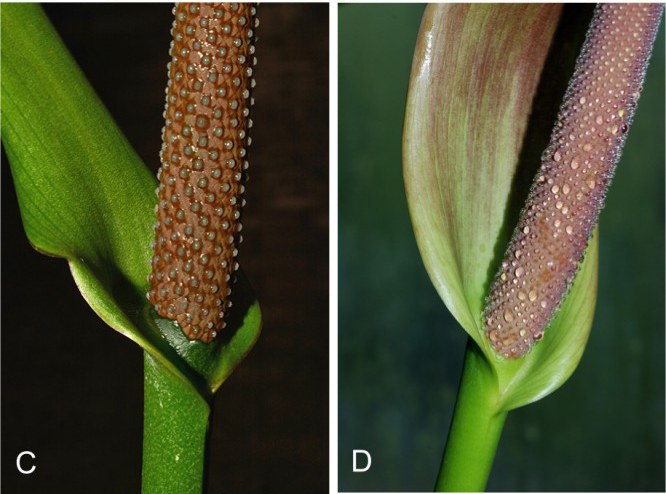
Against it: somebody measured the sugar
Two species have had their secretions actually tested, and both came back sweet. In Anthurium seibertii the stigmatic fluid ran at 8% sugar — sucrose, glucose and fructose. For comparison, the phloem sap of a related aroid sits at about the same concentration.
The second is older and stranger, and it is the reason this part exists.
A second secretion, from the tepals, and it is sweeter
Working on Anthurium digitatum in 1930, Daumann found sugars in the stigmatic fluid — and then found more sugar somewhere else:
“The liquid droplets, which appear towards the end of the female phase, and especially during the male phase… on the free portion of each tepal, also contain monoses (fructose and glucose) and bioses (sucrose). The sugar content… is higher than in the stigma secretion.”
And it does not stop when the stigmas do: “This secretion still increases, and continues throughout the male phase… at a time when the stigma hairs have already dried up, and pollen… has already been found in various sites between the diverging tepals.”
And it is not a one-off from 1930
Working through his own fresh collections decades later and for entirely unrelated reasons, Croat recorded droplets on the tepals in six Anthurium taxa — and in one of them, Anthurium smithii, described them outright as “a few scattered nectar drops”.
He was writing species descriptions, not testing anything. Which makes it a better kind of evidence than it looks: an observation recorded by somebody who had no argument to win with it.
— But he is describing, not measuring. The word is not confined to that one entry. In his revision of the Mexican and Central American species it stands in the formal description of the genus itself — the tepal surface “glossy to matte, sometimes with nectar droplets, especially while anthers are emerging” — and it returns under individual species, among them Anthurium michelii and Anthurium microspadix. So the tepal secretion has a name at genus level. What it does not have is a number: that revision carries no sugar assay, no measured volume and no section through a gland. A droplet is a thing you can see; nectar is a claim about what is in it, and this page keeps that distinction.
Eight years later, in a revision of one section of the genus, he goes further in three directions. The word stands in the formal description of the section — tepals “sometimes with nectar droplets”. In Anthurium concolor the tepal droplets are part of what diagnoses the species, which is distinguished in part “by its tendency to form globular droplets on the tepals”. And in Anthurium upalaense the two secretions are separated by organ and by phase in one description: stigmatic droplets appearing 12–22 days before the stamens emerge, and tepal droplets “appearing usually after 2 or more anthers emerge”. Anthurium ottonis does the same thing more briefly, its tepals carrying “few droplets appearing as stamens emerge”. That is the sequence this part is built on, written out by a taxonomist who was not arguing for it.
It is the same describer, though, and not a second witness — and in that revision he also applies the word to the stigmatic droplets, for the whole section, one page after calling the same fluid “stigmatic fluid” in the formal description of the organ. Which is a good reason to read the word as a describer's convention rather than a finding. Nothing was measured in that revision either: no sugar, no volume, no section through a gland.
So there is a second reward window, opening as the first one closes, from an organ almost nobody inspects. If it is real and at all general, the genus is not nectarless — it is paying twice, and the second payment is timed to the moment the plant has pollen to move.
How common is any of this
The only broad survey is a look at 30 selected species during the day, weighted toward plants that flower frequently under greenhouse conditions and have relatively long stigmatic phases:
| Stigmatic secretion | Species |
|---|---|
| Large or runny drops, over 1 mm | 5 |
| Small droplets, under 1 mm | 11 |
| Minute drops, needing magnification | 8 |
| Glistening only | 6 |
So every species looked at was secreting something, and about half were producing drops visible to the naked eye. But that is a survey of appearance, not of sugar. Beyond the two species above, the chemistry has been done on one more, in the structural study below.
Five answers, and which to trust
| The reward is… | Shown how | Weight |
|---|---|---|
| Nothing — no nectar anywhere in the family | Asserted from a scent study | An assertion, family-wide |
| Pollen and floral tissue | Weevils watched feeding | Observed, one system |
| Perfume the visitor collects | Bee behavior photographed | Hypothesis — the authors' own title ends in a question mark |
| Pollen and stigmatic exudate | Midges watched feeding on both | Measured, one system |
| Sugar, from stigmas and tepals | Sugars chemically tested | Measured, three species, one of them in 1930 |
And then somebody looked properly
The question above — asked in print in 2017, and left at “further efforts are needed” — was answered in 2021, by a structural study that cut sections instead of arguing from chemistry. It found the thing everyone had been looking for in the wrong place.
There are nectaries. They are on the tepals.
“Our results showed for the first time a nectary presence on tepals and true nectar secretion for Anthurium andraeanum.”
They are non-vascularized nectaries at the apex of the tepals, built the way secretory tissue is built — cytoplasm dense with organelles, modified stomata to release through, and a high content of calcium oxalate crystals.
So the genus is not nectarless. The claim in the panel above, made for the whole family, is wrong for at least this species.
And Daumann was right in 1930. He said the sweet secretion was on the tepals rather than the stigmas, and that it ran on into the male phase. Ninety-one years later, sections found the glands exactly where he said the fluid was.
The part that cuts the other way — and it undercuts the numbers above
“Stigmatic secretion appears to be a distinct substance, and its often-reported sugar content seems to be a result of sample contamination.”
The two fluids are produced by different tissue for different reasons, and on a flower this small they mix. Which means the sugar measured in stigmatic fluid — including the 8% figure quoted earlier on this page — may have been nectar that ran into the sample.
The authors say as much: nectar and stigmatic secretion “have been often mistaken in other Anthurium species”.
Where that leaves the argument
The nectarless claim is dead, and the stigmatic-sugar claim is wounded. What survives is stranger and more useful than either: this genus has two different secretions, from two different organs, doing two different jobs — and the sweet one is the one almost nobody was watching.
One caveat that matters at the bench
The nectar is not reliable. In cultivation it was “occasional and unpredictable” — the same plant produced conspicuous nectar at one flowering and then none at all for several flowerings afterwards.
So the absence of nectar on your plant tells you nothing, and neither does its presence. It is not a receptivity signal. The wet spadix is still the cue — Part VII — whatever the fluid on it turns out to be made of.
What it means at the bench: when your plant is in female phase and the spadix looks wet, that fluid is the receptive signal — Part VII — whatever else it turns out to be. And keep looking at the tepals after the stigmas dry. If Daumann was right, something is still happening there — and the structural study that found the tepal nectaries worked on a single species, Anthurium andraeanum, so on most others the question is still open.
Part V
The Smell, and What It Tells You
Unusually for this site, there is something here you can use immediately and without equipment: in this genus, what the flower smells of predicts what sort of animal it is for.
The scent work found that odor type tracks pollinator type closely enough to be judged by nose. Sweet and perfumed points one way; sour, fermenting or fruity points another; nothing at all points a third.
| If it smells of… | Recorded in | Points toward |
|---|---|---|
| Caraway | three species | perfume-collecting bees |
| Sweet, benzyl-acetate-like | two species | perfume-collecting bees |
| Over-ripe banana, fermenting fruit | Anthurium salvadorense | fermentation-seeking insects |
| Fusel oil | Anthurium hookeri | fermentation-seeking insects |
| Cut cucumber, at night | the gall-midge species | gall midges |
| Rotten fruit, at night, in both phases | Anthurium caperatum | night-flying moths |
| Minty | Anthurium antioquiense | a key character, see below |
| Spicy, but not minty | Anthurium amnicola | a key character, see below |
| Nothing you can detect | several species | midges, or something unstudied |
How thin this evidence is
The survey behind most of that table used one sample per species, from one clone per species, with no replication at all. Every entry is a single measurement of a single plant.
How much that matters showed up inside the study itself: one species produced two completely different chemical profiles from different collections, and the authors declined to split it into two species on that basis. If one species can smell two ways, a single sample cannot characterize a species.
And where the record says to put your nose: the pollen
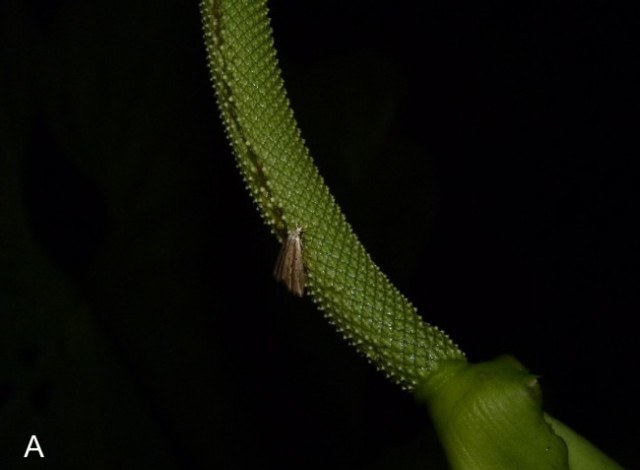
A revision of one section of the genus carries scent records for 26 species, taken by nose rather than by instrument — and 23 of them are attached to the pollen, not to the spathe or the spadix. Yeasty, sweet, spicy, cinnamon, cut grass, fruity. Only three sit on the flowers, among them Anthurium crenatum, whose flowers are “scented like rotting fruit prior to anthesis”, and Anthurium llewelynii, “strongly scented like rotting fruit”.
That is a practical instruction hiding in a taxonomic revision. If you are trying to smell your own plant, the male phase and the pollen itself are where somebody found the smell. But these are one nose in a greenhouse — no chemistry, no sample size, no time of day recorded — so they can place a species in an odor class and can never name a compound.
The finding that should change how you read any scent claim
In the gall-midge species the scent was analyzed, the dominant compound identified, and then — unusually — tested on the insects themselves. The result was not the obvious one.
The dominant compound is not the signal
The midges were attracted by a minor component — the aldehyde responsible for the cucumber note. The dominant compound in the blend attracted nothing, and adding it to the attractive compound did not improve the response.
So the biggest peak in a scent analysis need not be the message. Almost every scent claim in aroid literature — including some on this site — rests on abundance rather than on a bioassay. This is the one case where somebody checked, and abundance was the wrong guide.
Timing is part of the signal
Scent is not emitted continuously, and when it is released tells you when to expect the visitor. The perfume species scent in the morning, and that is exactly when the bees arrive — a tight window, roughly 08:30 to 12:00. The cucumber-scented species is strictly nocturnal, in both scent and visitation. Anthurium caperatum smells at night, in both sexual phases.
That last detail is worth pausing on. A scent that continues into the male phase is not recruiting for pollination of that inflorescence — its stigmas are finished. It is either moving pollen out, or advertising something the plant is still supplying. Which returns to Part IV.
If your plant has no smell
That is not evidence of nothing. Several species recorded as scentless to a human nose were also never sampled instrumentally, some of them visited by gall midges — and when another gall-midge species, Anthurium acutangulum, was later sampled at night (five plants), it was strongly scented, like freshly cut cucumber.
Smell it at night as well as by day, and close up. Several of the species above give nothing at all at the wrong hour.
Anthurium regale shows how long a plant can stay silent. One cultivated plant gave no scent that three people could detect through day 32 of its spadix, although the exudate was already visible.³⁴ A light, sweet perfume appeared on day 50, while the spadix was turning from green through yellow to ivory and before any stamens showed. On day 51 the scent was absent at 07:30, extremely faint from 09:00 to 10:30, and quite apparent at 11:00, the hour at which it had first been noticed the day before.³⁵ Pollen was first visible on day 56, six days after the scent appeared.³⁶ The grower's own summary was that the plant gives off scent only once male anthesis begins, as far as he could observe.³⁷ One plant, one spadix, and the observer used his nose alone.
Part VI
Who Actually Comes, and What Was Actually Shown
Bees, ants, beetles, flies, midges, moths, butterflies and birds have all been recorded on Anthurium. Being recorded on a flower is not the same as pollinating it, and in this genus the gap between the two is unusually wide.
What it takes to actually show pollination
Three things, in order of difficulty. That the animal carries the pollen. That it touches a receptive stigma. And that it moves between inflorescences, because an animal that does the first two without the third is just rearranging one plant's pollen.
Only two studies in this genus have all three.
| Visitor | Carries pollen | Touches stigma | Moves between plants |
|---|---|---|---|
| Oil bees, males only | yes | yes | yes, and marked bees returned |
| Gall midges, females only | yes, photographed | yes | not filmed — but fruit set |
| Weevils | yes, visible packages | yes | one flight, ever |
| Ants | not shown | not shown | not shown |
| Hummingbirds and a flowerpiercer | yes | never seen | not shown |
| A butterfly | yes | not shown | not shown |
| Moths | not shown | not shown | not shown |
| Fruit flies | not shown | not shown | not shown |
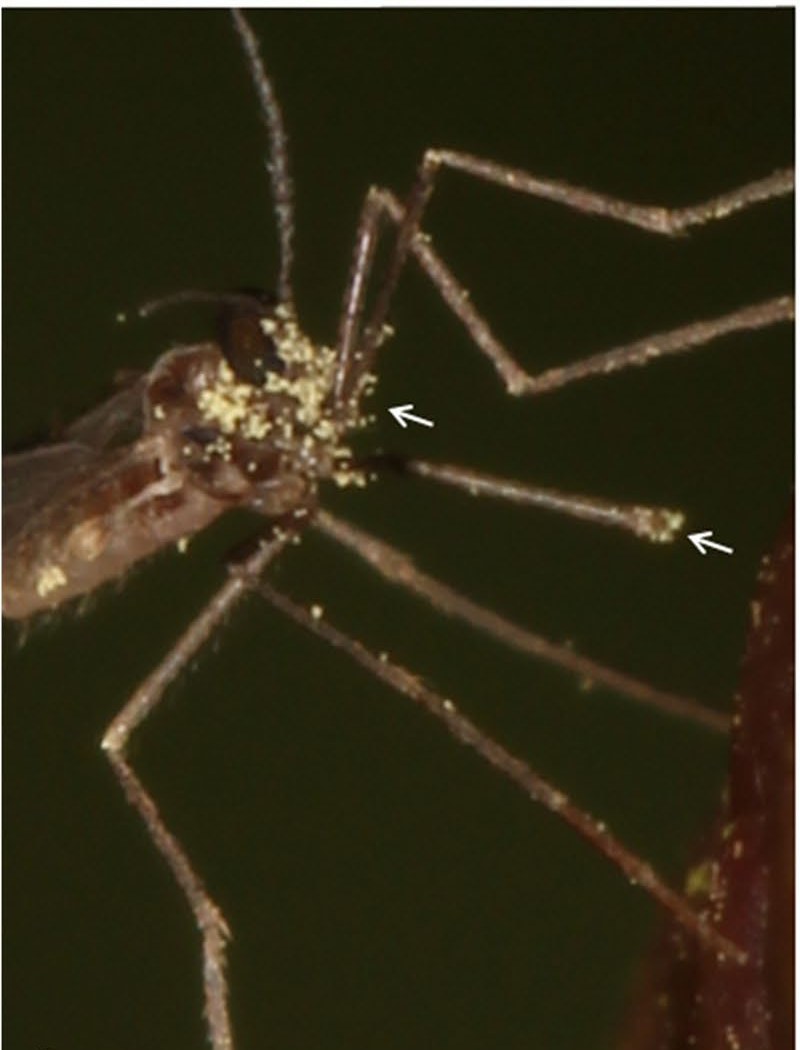
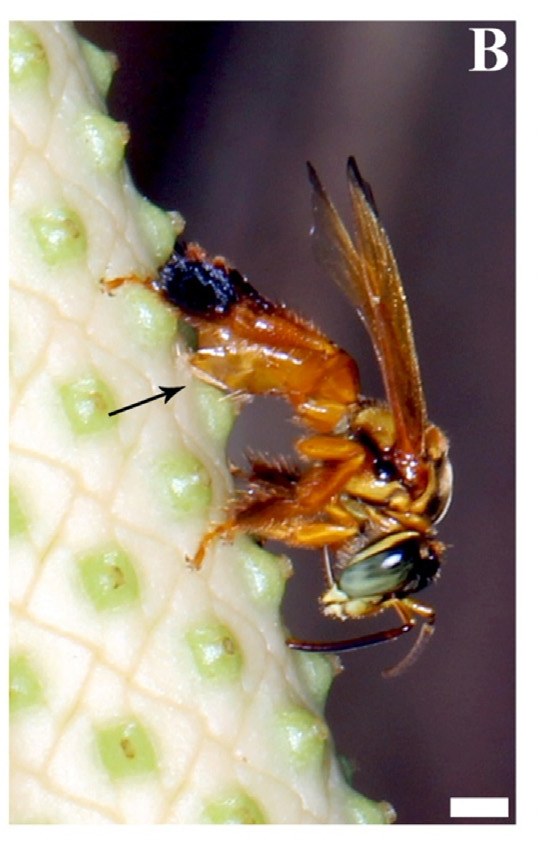
The two strong cases
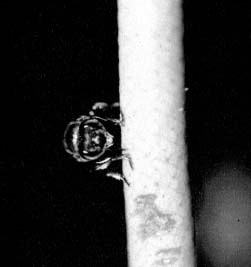
Male oil bees. Across two seasons they were effectively the sole visitor — carrying heavy pollen loads, contacting stigmas, moving between spadices, and marked individuals came back. This is the best pollination evidence anywhere in the genus.
What makes it strange is the payment. There is no oil, no nectar, no oil-secreting tissue and no trap, and the bees ignored the pollen entirely — a stingless bee collected it while the oil bees would not. The authors' proposal is that the bees come for the scent itself, mopping it up with an oil-filmed brush on the abdomen. Their own title ends in a question mark, and this page keeps it there.
Female gall midges. Named as “the only effective pollinators of the studied plant population” — pollen loads photographed, stigmas contacted, both phases visited, an attractant identified by field bioassay, and fruit set in three of five inflorescences. Here the reward is not mysterious: the midges were watched feeding on stigmatic exudate in the female phase and on pollen in the male phase. Two meals, two visits, one insect.
And notably, no brood site — the midges were never seen laying eggs, which is what gall midges usually do in flowers.
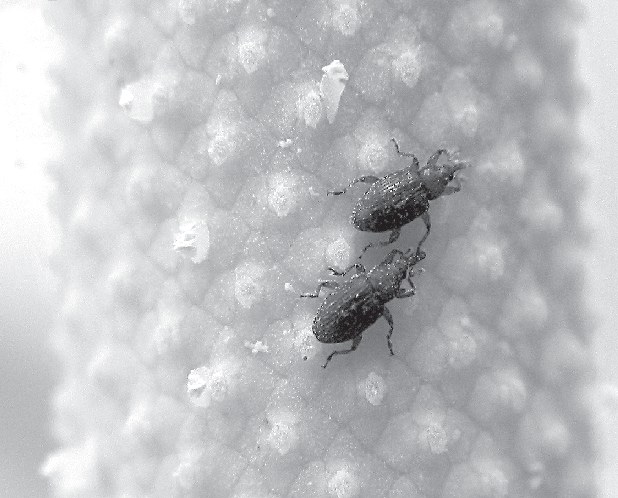
The birds, and why they may not be helping
At 2,700 m in eastern Ecuador, five bird species were watched picking up pollen from a male-phase inflorescence — four hummingbirds and a flowerpiercer — arriving with clean bills and leaving loaded. They were feeding on the fluid.
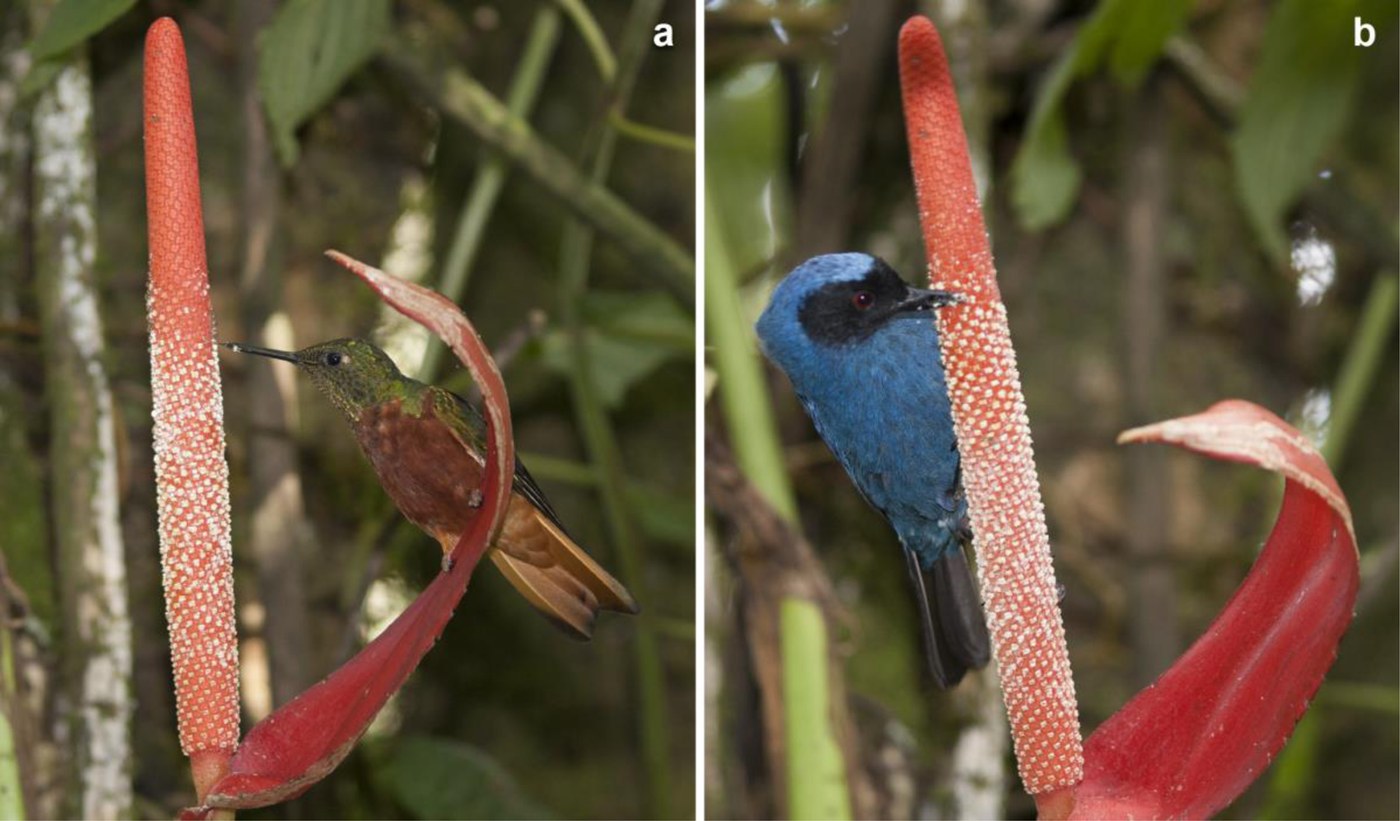
The authors' own caveat, which is the interesting part
“An important caveat… is that pollination requires that birds loaded with pollen also visit female-phase inflorescences; otherwise what we observed could be interpreted as floral parasitism and a reduction in fitness of male-phase flowers through loss of reproductive effort (pollen, nutritive fluids).”
No female-phase visit was ever seen. So these birds are either the pollinators or they are robbing the plant, and thirty-five hours of watching could not tell the difference.
Two details worth keeping. The visits were structured by a dominance hierarchy — one hummingbird held the inflorescence as territory and won every contest — and the birds were feeding on fluid secretions, which returns to Part IV. Whatever the plant is producing, something with a high energy demand was drinking it.
Everything else is weaker, and some of it is very weak
Ants have turned up often enough that they are no longer noise. On Anthurium upalaense in Caribbean Costa Rica, Ectatomma ruidum patrolled every one of six female-phase spadices, feeding on a secretion (the text names the tepals, the figure caption the stigmas), and fed on pollen on three of four male-phase ones. The authors call it a possible pollinator and say plainly that they did not confirm pollen transfer. A genus-wide review of the interaction literature adds further ant visits from lowland forests in Costa Rica, Peru and Brazil — though those are counts compiled partly from herbarium labels and photographs, floors rather than totals, not a survey.
A butterfly on one species carried a pollen load, and the same butterfly species had visited the same plant in female phase two weeks earlier — suggestive, but the two observations are not linked. Moths on another species are identified only to family, and the authors call them visitors twice, in their own words.
Male euglossine bees were reported in numbers on Anthurium huixtlense by a grower in the tropics: many dozens of male Eulaema bees, possibly Eulaema cingulata (velvet-black, bumble-bee-sized, with shiny gold abdomens), massed on four or five receptive spadices across three mature garden plants. The same grower's Anthurium armeniense and Anthurium chiapasense, also in flower, did not seem to draw these bees but a Trigona species instead.³⁸ The report describes visitation and does not say whether any pollen moved.
Then the weakest link in the chain, which is also the most cited:
Seven species called bee-pollinated without a bee
In the scent survey, seven of ten species were assigned to perfume-collecting bees on the basis of their scent chemistry alone. No bee was watched on any of them.
Meanwhile the weevil study, working where those bees live, demoted euglossine bees from pollinators to unreliable visitors for the species it watched.
“Euglossine-pollinated Anthurium” is, for most species, an inference from a smell. It may well be right. It has not been shown.
One species that will not behave
The sharpest illustration that this genus resists generalization: two populations of a single species, in two parts of Colombia, with two different smells and two different visitor guilds. One is foul-smelling and fly-visited; the other is scentless and bee-visited.
The authors considered splitting them and deliberately did not, judging the plants “so overwhelmingly similar in appearance” that it would be unwise “without further, more detailed information on their pollination biology”. So one name currently covers two pollination systems — and that is the honest position, not an oversight.
What this means for your plant
None of these animals is in your growroom. Not the oil bees, not the midges, not the weevils, not the hummingbirds.
Which is simpler than it sounds: you are the pollinator, and Parts VIII to X are the job description. What this part is for is knowing what the plant is set up to expect — a visitor that arrives on a schedule, feeds on something wet, and leaves.
Part VII
Reading Your Own Plant
This is the one part of the page where the sources agree. A receptive Anthurium tells you so, plainly, and you can see it across the room.
The cue: the spadix goes wet
Two independent accounts describe the same thing. Up close, “the stigma will exude a drop of fluid which will sit at the apex of each individual flower on the spadix”. From further back, the whole spadix takes on a “velvety and shiny structure… due to wetness”.
When the droplets are there, the flower is ready. That is the entire signal, and it is more legible than anything the other four genera on this site offer.
And the signal has an off switch
“After the completion of the female phase, the stigmas dehydrate and turn to brown.”
Wet and glistening means go. Dry and browning means that band of the spadix is finished, and no amount of pollen will change it.
A commercial breeding bulletin makes the same observation an operating rule for an industry — the stigmatic surfaces “become dry and brown before pollen is dehisced”. It also leads with the shine rather than the drop: receptivity “is indicated by a glistening shine of stigmatic surfaces and stickiness to the touch”, with exudate only “sometimes present”. So if the spadix looks wet and you cannot see beads, touch it — sticky counts. That bulletin names no species and gives no sample size.
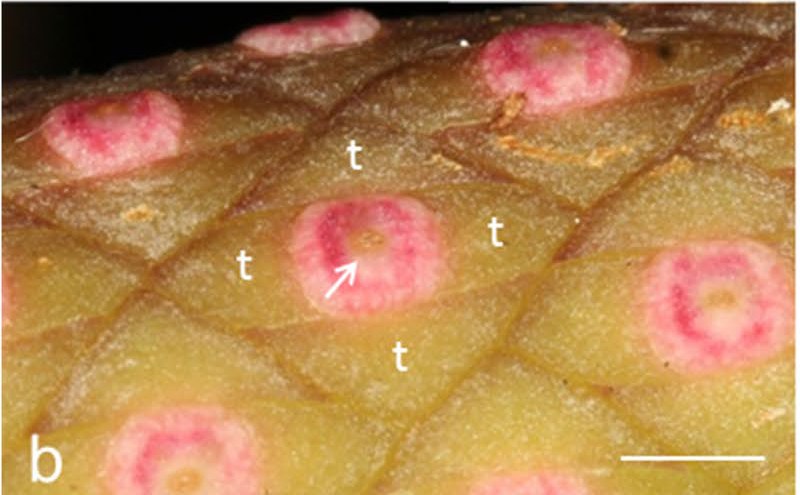
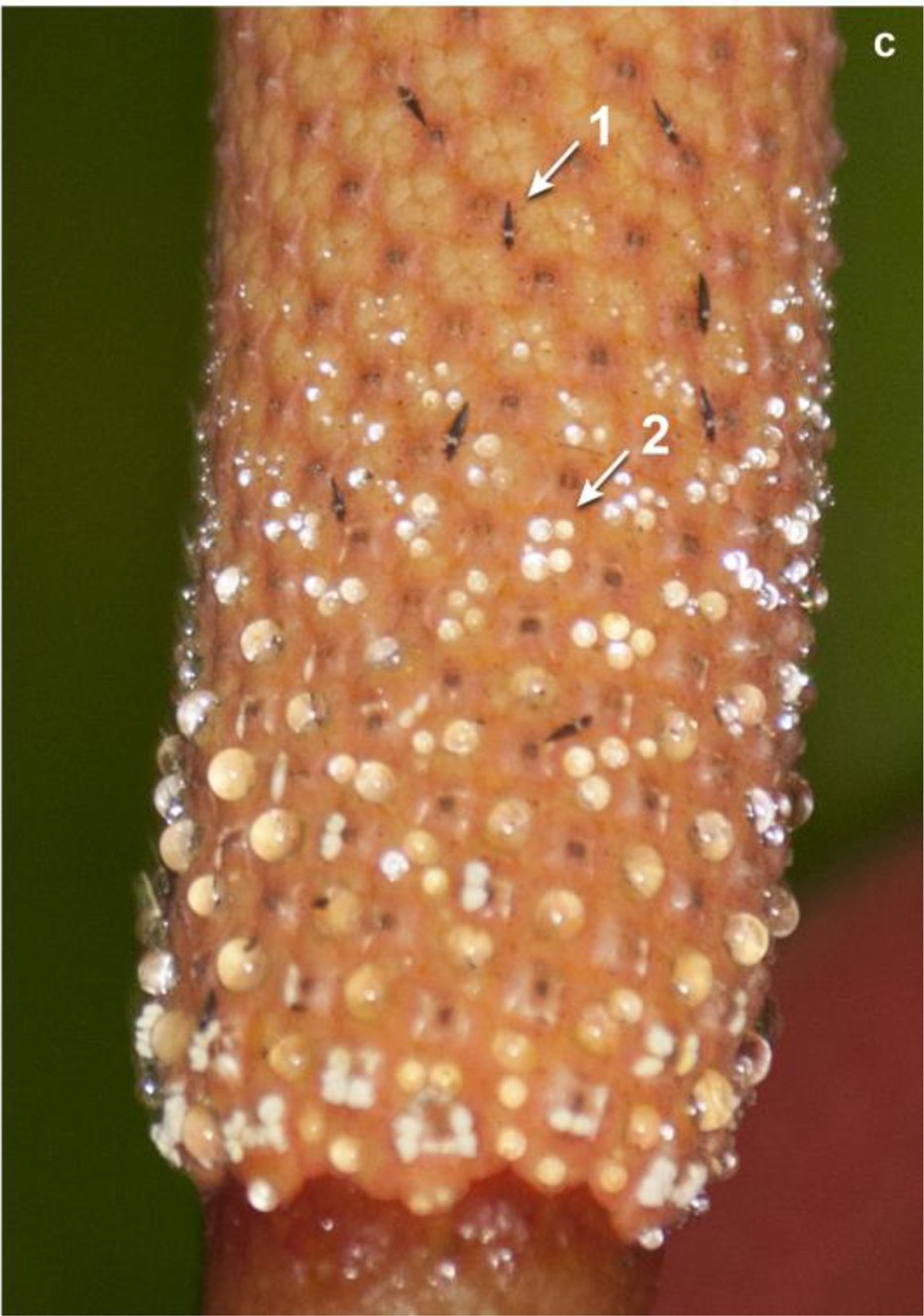
When to look
The droplets appear in the early morning. Some species present them on every flower at once; others work up the spadix in succession, which is the base-to-apex progression from Part III seen close up.
Practically: look first thing, and look again the next morning. A spadix that showed nothing at noon may have been wet at seven.
How long the window lasts — and the number nobody has sourced
One breeding chapter states that “each pistil on the spadix remains receptive (can be pollinate) for only 1 day”. It gives no source and no sample size, and the same chapter elsewhere describes a female phase lasting about a week.
Those two can both be true, and probably are: the spadix stays receptive for days while any individual flower is receptive briefly, because the flowers come into phase in sequence rather than together. That fits the base-to-apex progression and the field clocks in Part III.
But it is a reconciliation, not a measurement. Treat it as a reason to pollinate repeatedly over several mornings rather than once — which is what every practical account recommends anyway.
A second account puts a length on the spadix half of it. A commercial breeding bulletin has new flowers becoming receptive each day, “beginning at the spadix base and advancing gradually towards the tip over a two-week period”, and says plainly that “flowers may remain receptive for more than one day”. That is the same reconciliation reached from the other end — and it arrives with no species, no sample size and no source of its own.
Droplets first, stamens later — where somebody timed the gap
In Anthurium smithii, the stigmas carry droplets three to four days before the first anthers emerge, and it was recorded from fresh material.
A taxonomic revision of the Mexican and Central American species times that same gap species by species, inside the description of each one. Three of those readings: Anthurium microspadix, stigmatic droplets one to three days before the anthers emerge; Anthurium pluricostatum, droplets about a week before the first stamens, then persisting until the anthers are open; Anthurium michelii, conspicuous droplets for about ten days, going dry and brown about a week before the first stamens emerge.
Each of those is one observation of one species. No sample size is given for any of them and none was repeated, and the author says of that revision that most of its observations were made on cultivated plants — where, with no pollinator to carry the fluid away, how much of it stands on a stigma may not be what it would be in the wild.
None of them settles the one-day question above — a spadix wet for days is entirely compatible with any single flower being receptive briefly. What they give you is a working window: once droplets appear, expect days rather than hours, and use all of them. How many days is a question about your species, not about the genus.
Two more things worth watching
The stamens come out in a usual order, and usual is as far as it goes. Across the genus, “usually the lateral pair of stamens emerg[es] first, followed by the anterior then the posterior stamen” — and the filaments are described as “promptly shrinking and withdrawing the anther to the surface of the tepals” once they have done their work. The generic description in that Mexican and Central American revision is looser again, and leaves the last two unranked: the lateral pair usually first, one at a time, followed by the anterior and posterior ones.
And it is departed from. In Anthurium caperatum the stamens emerge “scattered throughout the spadix, sometimes with the alternate stamens preceding the lateral ones” — the lateral-first sequence running backwards, on a long tapered spadix, which is the shape that is otherwise said to open from the base upward. That progression is keyed to the shape rather than fixed: long tapered spadices tend to begin at the base and work toward the apex, while cylindroid or clavate ones are less orderly, scattered, or beginning at the middle or the apex. Both notes carry the same caveat as the intervals above — the plants behind them were mostly in cultivation.
So a flower part-way through its male phase has some stamens out and some still in, and a spadix in mid-changeover is showing you its position in the sequence, not a malfunction. In one species the order was tracked up the spadix as well: the apex had its lateral stamens exserted while the bottom third had not yet finished emerging.
The withdrawal cuts the other way too. Because the filaments pull the spent anthers back down to the tepals, a spadix that has finished its male phase can look as though it never started one. No stamens showing is not evidence that pollen is still to come — check the stigmas: wet means the male phase is still ahead, browned and dry means it may already be behind you.
Some species change color as they open
Recorded in species descriptions, one species at a time: one spadix is “dark yellow-green to pink, usually becoming purple at anthesis”; another spathe is “medium green to pale green, becoming whitish or yellowish at anthesis”. A third species' spadix goes whitish green, then violet as the seeds ripen.
If your plant does this, it is a free calendar. A 2024 breeding review does write it down as a cue, in a single general line with no species named and nothing measured — “a shift in spadix color corresponds with receptivity” — and the change itself appears often enough in descriptions to be worth watching for on your own species.
What you will almost never see
Fluid and pollen on the same spadix at the same time. The field study that watched most closely reported that the phases never overlapped; the grower literature is slightly softer — “rarely will the same plant have stigmatic fluid and pollen at the same time, although it does happen in some species on occasion”.
If you do see both at once, you have something worth recording — but overlap is on record, with at least one species described that way. In Anthurium pluricostatum the two phases run together: it is only weakly protogynous, near enough homogamous, and its stigmatic droplets persist while the stamens emerge. That is a trait of the species, not of the genus, and it comes from a description written largely on cultivated plants — so whether your own plant overlaps is a question about your species.
The gap, and what to do in it
Between the stigmas drying and the anthers opening on the same spadix is roughly a week. That gap is not dead time — it is when you line up the other half of the cross. Either a second plant is coming into female phase, or you are about to have pollen and need somewhere to put it. Part VIII is about keeping it until then.
Part VIII
Pollen, and Whether It Keeps
For a single plant, because the phases do not overlap, almost every Anthurium cross depends on pollen that was collected earlier and kept. How well it keeps is the weakest-evidenced thing on this page.
When it is ready
“Pollen is ready to be collected and/or used when it is visible on the surface of the spadix. The timing of this event is always after the last of the stigmatic fluid is dried up and no longer visible.”
So the sequence on any one spadix is fixed and you cannot rush it: wet, then dry, then later pollen. If you can see pollen, that spadix's own stigmas are already past.
Collecting it
Straightforward, and no equipment worth the name: take it off with a finger or a brush, or tap it into a paper envelope, and keep it cool and dry.
How long it lasts — one number, and it is thin
a week or two
“The pollen will not last more than a week or two.” That is the only estimate of how long it lasts in any of the breeding literature this page reports, and it comes with no sample size and no storage temperature attached.
Plan around it as a working assumption, not a fact. If you have a choice, use pollen fresh.
Where to keep it — genuinely unsettled
The grower literature does not agree with itself, and the honest presentation is to say so.
| Method | Reported by |
|---|---|
| Airtight container, with or without desiccant | some growers |
| Refrigerated | some growers — others report mold |
| Aluminum foil, room temperature | one breeder, specifically to avoid the fridge |
The refrigerator is the disputed variable. One account says pollen kept cold “often becomes moldy”; the primer reports both camps and tells the reader outright to “experiment with various methods to find out which fits their species requirements”.
That is unusual and worth respecting. A practical literature that declines to give one answer is normally telling you the answer depends on something nobody has isolated. Try both, on the same pollen, and write down what happened.
One workaround, with a trap in it
The primer suggests using pollen from an earlier inflorescence on the same plant for a later one, since the plant makes them in succession. Mechanically that works.
But that is a self, and Part XI explains why a self in this genus is the hardest possible result to interpret: four Anthurium species are recorded as setting seed with no pollinator at all. If the goal is seed, it may be fine. If the goal is knowing what you made, use a second plant.
The better workaround is the one the same source gives next: grow more than one clone of anything you intend to breed, so that a wet spadix and a shedding spadix exist at the same time somewhere in the collection.
Part IX
Making the Cross
After all the argument in Parts IV to VI, the operation itself is almost disappointingly simple. The published protocol is one sentence long.
The whole method, as published
“Simply take the pollen and place in on the spadix and with a brush or your finger smear it up and down and around the spadix. Do this for several mornings in a row or as long as you have fluid and pollen available. Make out a tag with your pollination information on it and wait for the berries to form.”
The four things that actually matter
1. Wet spadix. Not a colored spathe, not a plant that looks ready — visible droplets, or that shiny wet look across the whole spadix. Part VII.
2. Cover the whole spadix, not a spot. The instruction is to smear up and down and around. The flowers are in a gradient, not a state — some bands are receptive and others are not, and you cannot tell which by looking.
3. Repeat, on consecutive mornings. Every practical source says it, and it is also the right hedge against the possibility that any individual flower is receptive only briefly. One application is a gamble; four mornings is a method.
A commercial breeding bulletin gives the rule a reason rooted in the spadix itself: “To achieve maximum seed production, an Anthurium spadix needs to be pollinated more than once.” Its contrast is what makes the point — one pollination will fertilize an entire Spathiphyllum spadix, because every flower on one of those matures at the same moment, while an Anthurium spadix comes into phase in a wave two weeks long. You are not repeating because the first attempt may have failed. You are repeating because most of the spadix was not open yet. No number of repeats is given, no interval, and no seed counts.
4. Tag it immediately. Fruit can take anywhere from one month to two years to ripen (Part X). Nothing you remember will survive that. Parents, date, direction of the cross.
Emasculation has an answer, and the answer is contested
A commercial extension bulletin takes the question head on: “The stigmatic surfaces of both Anthurium and Spathiphyllum become dry and brown before pollen is dehisced, so floral emasculation is not required.” That is a ruling out of a large ornamental-aroid breeding program, and it is bare — no species, no sample size, no trial behind it. The bulletin has also been archived and withdrawn from current recommendation.
Three things sit against the reason it gives. The same bulletin, five sentences earlier, has receptivity climbing the spadix over two weeks, with pollen following in a second wave of the same length — which puts shedding flowers at the base of a spadix while flowers at the top are still wet. The 1976 crossing program in Part XI emasculated as a matter of routine, and named four species it could not emasculate: Anthurium bakeri, Anthurium scandens, Anthurium scolopendrinum and Anthurium trinerve. And the revision of the Mexican and Central American species names two whose phases overlap, Anthurium cotobrusii and Anthurium pluricostatum. Read “not required” as what one program did by default, not as a property of the genus.
Bagging and isolating the inflorescence are a different matter — the practical accounts go straight from pollen to tag and raise neither. That matters here more than it would elsewhere. Part VI shows real insects do visit these inflorescences, including in cultivation, and Part XI shows that four Anthurium species are described as apparently naturally self-pollinating. Between those two, an untagged, unbagged spadix that sets fruit has told you almost nothing about what fathered it.
If the cross matters — if you intend to name or distribute what comes out of it — bag it, and say in your records that you did.
Then wait, and expect to wait badly
There is no early confirmation. No color change, no swelling you can trust in the first weeks. The spadix either begins to develop berries or it does not, and in the slowest species you will not know for the better part of a year.
And there is nothing to do to it in the meantime. The same commercial bulletin is explicit: “To ensure seed set for Anthurium or Spathiphyllum, no special environmental manipulation — such as controlling relative humidity — is needed after pollen transfer.” That is worth saying only because the same three authors demand 100% relative humidity and a wet-toweling wrap for Dieffenbachia the following year — so a reader arriving from aroid breeding advice generally has a real reason to think humidity matters here. For this genus their answer is that it does not, stated flat, with nothing measured on either side of it.
Which is the practical argument for making several crosses in a season rather than one careful one, and for keeping the records that let you learn something from the failures. Part XII is about what the failures mean.
Part X
Fruit, Seed, and the Wait
The cross worked. Now the timescale stops being measured in days.
How long the fruit takes — and this varies more than anything else here
| Species | Pollination to ripe berry |
|---|---|
| Anthurium caucanum | 1 month |
| Anthurium scandens | 1–4 months |
| Anthurium effusilobum | under 3 months |
| Anthurium panduriforme | 4 months |
| Anthurium caucavallense | 3–6 months |
| Anthurium buganum | 5–7 months |
| Anthurium andraeanum, commercially | 6–8 months |
| Anthurium kunthii | 2–8 months |
| Anthurium clarinervium | over a year |
| Anthurium berriozabalense | up to 2 years |
More than an order of magnitude, within one genus — the slowest of these takes twenty-four times as long as the fastest. There is a tendency inside it, small scandent species fast and large species slow, and a tendency is not a schedule. Do not average these into a rule — find out what your species does, and until you know, assume the long end. It is the reason Part IX insists on a tag.
Knowing your species is not enough either
The revision of section Pachyneurium printed fruit maturation times for fifteen species grown under glass, with the number of infructescences behind almost every figure. Across that table the span runs from 3 months (Anthurium llewelynii, 1 infructescence) to 15 months (Anthurium salvadorense, 1) — which is the same story the table above tells.
The useful part is what happens inside a single species. Anthurium schlechtendalii took 4.5 months on one infructescence and 11 on another. Anthurium upalaense ran 6, 7 and 13 months across three. Anthurium halmoorei ran 8.5 to 12 across five. Same species, same greenhouse, and the second fruit can take twice as long as the first.
Two things limit these numbers. They are greenhouse figures and say nothing about a plant in the forest; and most of the rows rest on a single infructescence, so a species with one entry has been watched once. The revision also disagrees with itself on the slowest species, giving Anthurium salvadorense as 13 months in its text and 15 in its table.
Knowing when it is ripe
The cue is mechanical rather than visual, and it is unusually definite: berries are ready when they “literally ‘pop out’ of the spadix”. Some species release the lot at once; others let go over several days as they ripen in succession.
Ripe-looking and viable are not the same moment, and for a collector the difference runs the useful way. The seeds inside are “usually… capable of germination somewhat before the berry becomes fleshy, loose, and obviously mature”, and berries “are also capable of maturing to some extent even on severed inflorescences” — so an infructescence cut early is not necessarily a loss. Both statements come from one monographer's experience of growing the section, with no germination trial, no interval in days and no count behind them. Treat them as a reason to try a berry that looks unready, not as a schedule for picking one.
Most berries hold two seeds, one per locule. But some species regularly carry four, and rarely a species runs to as many as ten, at two to five seeds per locule. The account that records that range names no species for the four- and ten-seeded cases. There is a lookup one level up, though. The revision of the Mexican and Central American species puts more than one seed per locule in sections Tetraspermium, Gymnopodium and Porphyrochitonium, and usually one per locule in the remaining sections. Find your plant's section and you have a prediction — open a berry and you have the answer.
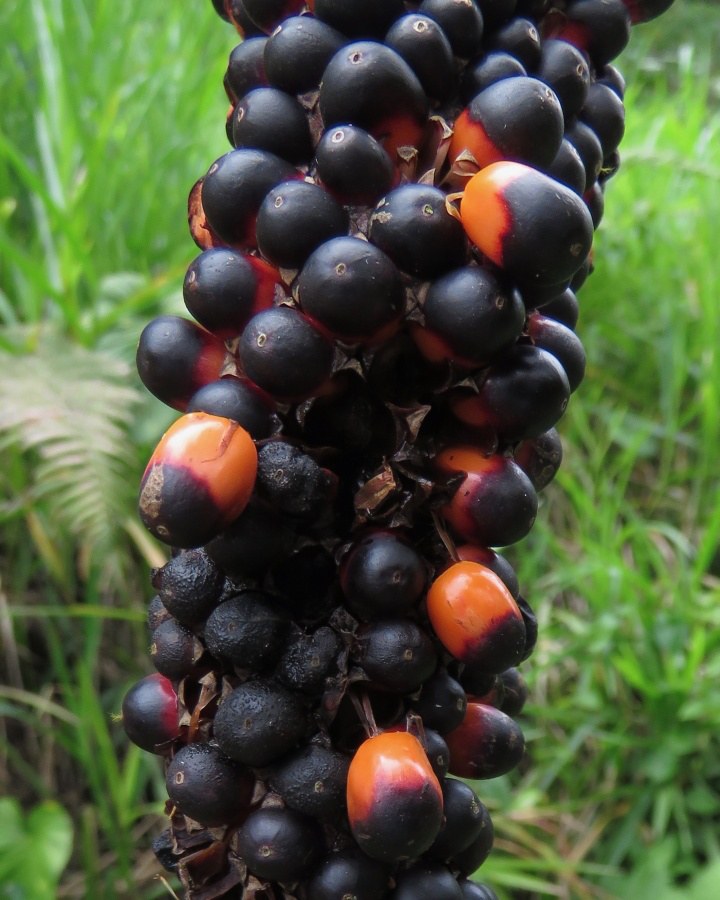
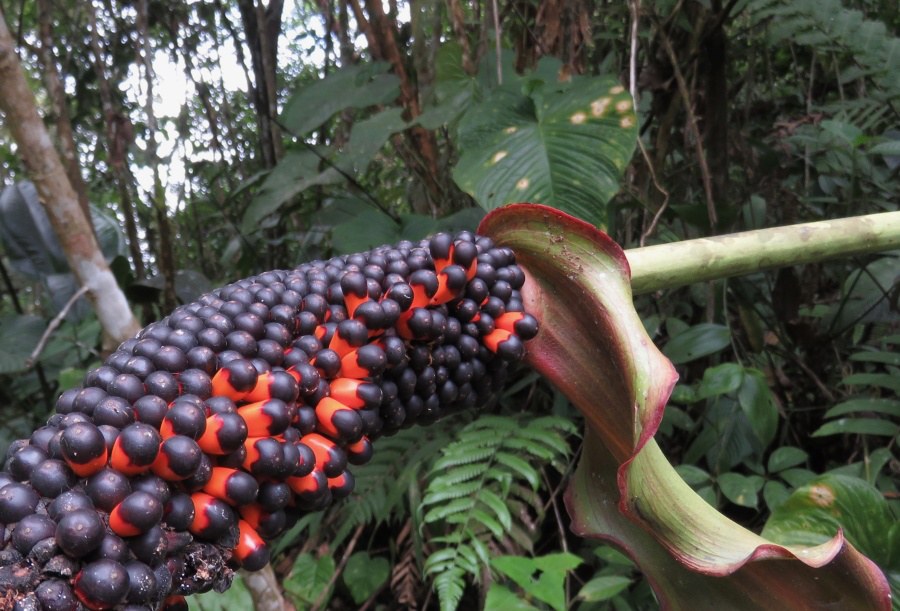
Sowing
Sow it now
“The seed should be sown immediately as it desiccates easily and is not viable for very long. Storage of seed is of little value.”
Squeeze the seed out of the berry between your fingers and sow it. In many cases it has already started without you — the source notes a small green radicle frequently visible at harvest.
Seed sent by mail does not always arrive dried out. Thomas B. Croat of the Missouri Botanical Garden reported that seed of most aroid species may survive a month or more in the mail when it is prepared with care. For Anthurium, the seed is washed free of the sugary pericarp and mesocarp, which invite fungal attack, then folded into a square of dry newspaper (his example was about 20 fresh seed to a square 15 cm, or about 6 in., wide) and sealed in a small plastic bag with padding against crushing, the packet kept moist but not wet. He had used the method for 25 years with great success.³⁹ In a later post he described reasonably successful mailings as far as Australia, with shipments of several weeks not seeming to affect the seed.⁴⁰ Other growers were firmer that Anthurium seed is short-lived: Dewey E. Fisk wrote that seed of most Araceae, Anthurium especially, usually stays viable no more than three or four days,⁴¹ and Don Burns wrote that Anthurium seed allowed to dry germinates poorly.⁴²
And what to do when it arrives dry anyway
Seed that has spent a fortnight in the post without that packing arrives severely desiccated, and the standing line on dried aroid seed is that viability is low to non-existent. One monographer treats such seed rather than throwing it out: a soak of several hours, up to 24, in a mild dish-detergent solution, after which it swells and looks fresh. “I have had success with germinating such dried-up seeds which may have spent up to two weeks in the mail.”
He hedges it in the same breath — “perhaps if they were desiccated too severely, they will not survive” — and there is no rate, no sample size, no untreated batch alongside it and no species named. Read it as salvage, not as an alternative to sowing fresh. The two instructions answer different questions: what to do with seed you squeezed out this morning, and what to do with seed somebody mailed you.
Germination takes one to three weeks in most cases, longer in some species. Use a well-drained soilless mix and watch for fungal and bacterial problems, which are the usual cause of loss at this stage. The commercial equivalent is sowing into cells under 75–80% shade, with plantlets moved on at 4–6 months.
One species inside that band, with dates on it
A grower in the Philippines sowed seed of Anthurium cachabianum on 19 May 2024 and wrote down what happened. First green radicles at 16 days, which is inside the one-to-three-week band above. Hypocotyl elongating at 24, first plumules at 43, and cordate-leaved plantlets at 62 days. The seed was sown on the surface of a moist mix under a clear lid, so light reached it, and the box ran at 26–32 °C and 70–90% humidity.
And the berries had never ripened. They stayed pale peach instead of turning red and glossy, and the seed inside them germinated anyway — “almost all seeds germinated successfully within 62 days”. That is the useful part, because a spadix that never colors up looks exactly like a cross that failed.
Read it as one grower, one plant, one seed lot. No seed count is printed and no percentage; the author says outright that “germination onset time, rate, and viability percentages were not quantified”. It is a dated record of one named species, and it is not a trial.
One thing this page will not tell you
Germination percentages exist, from a controlled trial. A crossing program published in 1976, working on species of the University of Hawaii collection, made 1,592 hand cross- and self-pollinations among 56 species, and scored germination on 25 seeds per cross laid on filter paper in a petri dish. The percentages are averaged per cross within six morphological groups the authors sorted those species into, and none of them is attached to a named species. So there is a protocol and there are numbers, and you still cannot look up what your own species does.
Nor does that trial touch the rule above. It reports a germination percentage; it never varies how long the seed waited before sowing, so it cannot say what waiting costs. The instruction to sow immediately is experience, repeated confidently, and untested. It is very probably right. But if you ever sow half a batch fresh and half a fortnight later and count both, you will have tested it.
What the seed is actually like
Two details from the genus description that no other source here mentions. The berry is two-celled with usually one seed per cell, and the flesh around the seed is “usually translucent, sweet” — which is presumably the point, for whatever eats it.
A first-hand taste report qualifies that. Asked on the Aroid-L mailing list whether Anthurium berries are poisonous, Thomas B. Croat answered that the seeds are not, if the plant is an Anthurium, because he ate the mesocarp all the time. He found it sweet at first but soon acrid, enough to make him spit it out, and suspected that it might do the same to birds.⁴³ It is one informal remark, not a toxicity test. For Anthurium scandens, Julius Boos, replying to a grower who had tasted one greenhouse berry and found it very sweet, called the fruits edible but a poor reward: little beyond flavor, with much skin and many seeds.⁴⁴
And the seeds are “usually with a sticky appendage on at least one end” — usually, and the exception has a geography on it. The revision of the Mexican and Central American species records that “many of the Mexican species of Anthurium lack a sticky appendage on the seeds”. No count and no list goes with that, so it is a warning rather than a lookup: if your plant is Mexican and the seed is not sticky, that is on record, and not something you did to the berry.
That is read as a dispersal structure — and read is the word. The revision that supplies the sectional lookup above says the sticky appendages “seem ideally suited” to bird beaks, and behind that careful phrasing sits no bird watched, no gut passage traced and no seed recovered. The stickiness is described; the bird, in that account, is inferred from it. A separate field note on Anthurium upalaense in Caribbean Costa Rica photographed a manakin (Manacus candei) and a euphonia (Euphonia gouldi) taking berries from four infructescences; no gut passage was traced and no seed recovered there either, so dispersal remains inferred. It explains something practical either way: if the seed sticks to your fingers, that is the plant working as designed, not pulp you failed to clean off.
Then the long part
From sowing to first flower, in commercial Anthurium andraeanum: fifteen months at the earliest, thirty to thirty-six months typically — call it three years from seed to bloom.
Add the fruiting time and a cross made today may not be assessable until 2029. That is the real reason to keep records, make several crosses at once, and label everything twice.
Part XI
What Crosses With What
Very little is known, and one thing that is known makes everything else harder to interpret.
Start here: some of these plants make seed without you
Four species recorded as self-pollinating
A University of Hawaii crossing program did not use four species as mothers, because they were difficult to emasculate: Anthurium bakeri, Anthurium scandens, Anthurium scolopendrinum and Anthurium trinerve, all “apparently naturally self-pollinating”. A grower primer says the same of Anthurium bakeri: “This species regularly sets a full spadix of bright red berries without pollination.”
Read that as selfing, not as seed without fertilization. Apomixis has been suggested — a 1983 sectional treatment calls Anthurium scandens and Anthurium trinerve “apparently self-pollinating or apomictic”, and the same grower primer calls Anthurium bakeri apomictic — but nothing was tested: in the crossing program the four are an exclusion from a methods section, with no bagging, no seed count and no n behind them. “Apparently” is the authors' own hedge, and it is doing work.
The consequence for you is the same either way: a spadix full of berries is not proof that your cross took. In most of this site's genera, fruit is the answer. In Anthurium, for at least these four species, it is not evidence at all.
Which means: if you are working with any of them, the seedlings are the only test, and they will take three years to sit it. And if you are working with an untested species, you do not know which situation you are in.
This is also why Part VIII warns against using a plant's own earlier pollen. A spadix that pollinated itself and a spadix that took your pollen look identical.
What the compatibility record holds
Anthurium clarinervium will not cross with its own section. Attempts with other members of section Cardiolonchium failed so consistently that the species' sectional placement itself is now doubted — it is thought instead to be closer to Anthurium berriozabalense, and its section is described as unknown.
That is worth reading twice. A breeding failure was strong enough to overturn a taxonomic placement — which tells you both how weak the sections are (Part II) and how much information a failed cross carries.
Anthurium radicans hybrids are a dead end. The species has produced several attractive foliage hybrids, and “these hybrids all seem to be sterile and will not produce a successive generation”. You can make the first cross; you cannot build a line on it.
And one result that goes both ways at once
One much-quoted compatibility result comes from breeding work reported second-hand in a taxonomic paper. Anthurium amnicola was crossed against two different sections, with opposite outcomes:
One species, two sections, two answers
“Anthurium amnicola will not cross with members of section Porphyrochitonium, but it does cross readily with members of section Calomystrium.”
And it is not alone: Anthurium antioquiense and Anthurium amnicola both “readily interbreed” with Anthurium andraeanum and its section.
It is the useful shape for a compatibility record — a species tested against two groups, working with one and failing with the other. It is also of practical consequence: Anthurium amnicola has played an important role in providing lavender-colored spathes in hybrids.
Note what it does to the sections argument. Here, section membership predicted the outcome correctly — the crosses worked within Calomystrium and failed outside it. In the Anthurium clarinervium case it predicted exactly wrong.
So the sections are neither useless nor reliable. They are a hypothesis that is sometimes right, and the only way to find out which kind of case you have is to make the cross.
A longer list, and a first-hand one
The other set is longer, and unlike the one above it is first hand. A grower-naturalist growing the Anthurium dressleri complex in Guatemala City published what he had crossed it with. Eight took: Anthurium crystallinum, Anthurium forgetii, Anthurium magnificum, Anthurium papillilaminum, Anthurium regale, Anthurium luxurians, Anthurium warocqueanum, and Anthurium radicans, which sits in a different section altogether. Two did not: Anthurium balaoanum, tried repeatedly, and Anthurium lappoanum.
It is the longest list of partners on this page, and it is one grower's plants — no counts, no protocol, no controls. Read it as a place to start, not as a compatibility table.
And one of the eight shows why a full spadix still is not proof
The Anthurium warocqueanum cross set an infructescence “successfully pollinated along its length” — and most of that fruit turned out to be parthenocarpic. The whole infructescence gave about 15 viable seeds.
That is a second reason berries lie, and it has nothing to do with the four self-pollinating species above. Here the cross did take, and the fruit still overstated it. Fruit set is not seed set.
A shorter first-hand record is a single pair. Neil Carroll pollinated Anthurium veitchii with pollen of Anthurium tilaranense. By February 28th, 1999 berries were forming, though he could not yet say whether the cross had taken;⁴⁵ by May 8th, 2000 he reported very good seed set and that the seed had germinated.⁴⁶ It has the shape of the records above, a named pair and an outcome without counts, and it stops at germinated seed, short of seedlings that could confirm the cross.
A program that did put numbers to this
The records above share a shape: a named pair, an outcome, and no counts. None of them states how many attempts were made, and most are reported at second hand. Two published programs are built the other way, and the older of the two is the larger. At the University of Hawaii, 1,592 hand cross- and self-pollinations were made among 56 species, and the results were published in 1976. The species were sorted into six morphological groups on Englerian characters — ovules per locule, berry color and shape, inflorescence shape, leaf shape and texture — and then crossed within and between those groups.
| Crosses between species, 1976 | Pollinations | Progenies that flowered |
|---|---|---|
| Within a morphological group | 633 | 128 (20.2%) |
| Between groups | 886 | 9 (1.0%) |
Those two rows are the comparison the authors drew, and they called the difference significant at the 1% level. The whole program was larger than the rows above: 1,592 pollinations in total, counting 21 selfs and 52 crosses within a species, for 280 fruiting spadices and 181 flowering progenies. One caution on the smaller number: the printed total of nine between-group progenies does not match its own column, which lists 1 and 7 and otherwise zeroes — a sum of eight. Nine is what the paper prints, and only two between-group progenies are ever named.
That is a map, and a coarse one. Crossing inside a morphological group produced flowering seedlings often enough to be worth the labor; crossing between groups almost never did — 9 flowering progenies out of 886 attempts. Those six groups are not the sections. They were built for this purpose, out of characters a breeder can see on the plant.
The six groups, and how each one behaved
The map is worth printing, because the groups are not equally willing and the differences are large.
| Group | Pollinations | Fruiting spadices | Flowering hybrids | Germination, mean (range) |
|---|---|---|---|---|
| I | 159 | 37 (23%) | 30 (19%) | 64.5 (0–100) |
| II | 28 | 13 (46%) | 11 (39%) | 64.1 (0–100) |
| III | 26 | 13 (50%) | 8 (31%) | 32.9 (0–100) |
| IV | 22 | 6 (27%) | 3 (14%) | 21.0 (0–78) |
| V | 131 | 59 (45%) | 38 (29%) | 48.8 (0–100) |
| VI | 267 | 50 (19%) | 38 (14%) | 45.3 (0–100) |
Which group is your plant in
The groups are not the sections, and they were not meant to be. They are a working key built from characters a grower can see, and the first cut is the berry: three or more seeds in a berry puts a plant in Group I, whatever else it looks like. Everything with two seeds or fewer is then split by leaf shape, and finally by leaf texture — velvety into Group V, leathery into Group VI. Open a group to see who is in it.
The section printed beside each name is the one that program used, out of Engler's 1905 arrangement, and at least one has moved since: the 1991 revision of section Pachyneurium treats Anthurium hacumense as a member of section Porphyrochitonium instead. Read the sections here to follow the program, not to place your own plant.
Group I — Berries with three or more seeds, usually depressed-globose12 species
Anthurium acutangulum · Leptanthurium · 2n = 30
Anthurium allenii · Urospadix · 2n = 30
Anthurium chiriquense · Urospadix · 2n = 30
Anthurium gladiifolium · Urospadix · 2n = 30
Anthurium gracile · Leptanthurium · 2n = 30 in 1976, a count that a 1983 study⁴⁹ assigns to Anthurium friedrichsthalii; the same study reports Anthurium gracile at 2n = 20, 40, 60
Anthurium littorale · Urospadix · 2n = 28
Anthurium ramonense · section not given · 2n = 30
Anthurium scandens · Tetraspermium · 2n = 24, 48, 84
Anthurium scherzerianum · Porphyrochitonium · 2n = 30
Anthurium trianae · Urospadix · 2n = 28, 29 + 1B
Anthurium trinerve · Tetraspermium · 2n = 24, 30
Anthurium wendlingeri · Episeiostenium · 2n = 30
Group II — Berries with two seeds or fewer; leaves lanceolate, plants small, 60 cm or less5 species
Anthurium aureum · Urospadix · 2n = 30, 31
Anthurium bakeri · Episeiostenium · 2n = 30
Anthurium pittieri · Oxycarpium · 2n = 30
Anthurium scolopendrinum · Leptanthurium · 2n = 20, 40
Anthurium turrialbense · Urospadix · 2n = 30
Group III — As II, but plants large and coarse, leaves 70 cm or greater4 species
Anthurium ellipticum · Pachyneurium · 2n = 30
Anthurium hacumense · Pachyneurium · 2n = 30
Anthurium hookeri · Pachyneurium · 2n = 30, 60
Anthurium joseanum · Pachyneurium · 2n = 30
Group IV — Leaves palmately lobed or pedately parted3 species
Anthurium aemulum · Schizoplacium (Dactylophyllium) · 2n = 30, 60
Anthurium digitatum · Schizoplacium (Dactylophyllium) · 2n = 30
Anthurium pentaphyllum · Schizoplacium (Dactylophyllium) · 2n = 60
Group V — Leaves cordate or hastate-trilobed and usually velvety; berry apiculate or obovoid, apex dark purple; spadix attenuate16 species
Anthurium clarinervium · Cardiolonchium · 2n = 30
Anthurium crystallinum · Cardiolonchium · 2n = 30 + 1B
Anthurium denudatum · Belolonchium · 2n = 30
Anthurium forgetii · Cardiolonchium · 2n = 30
Anthurium grande · Cardiolonchium · 2n = 30
Anthurium grandifolium · Pachyneurium · 2n = 30
Anthurium magnificum · Cardiolonchium · 2n = ca. 60
Anthurium regale · Cardiolonchium · 2n = 30 + 1B
Anthurium splendidum · Cardiolonchium · 2n = 30 + 2B
Anthurium subsignatum · Semaeophyllum · 2n = 30
Anthurium velutinum · Cardiolonchium · 2n = 30
Anthurium venosum · Cardiolonchium · 2n = 30
Anthurium wallisii · Polyneurium · 2n = 30 + 2B
Anthurium walujewii · Cardiolonchium · 2n = 30 + 2B
Anthurium warocqueanum · Cardiolonchium · 2n = 30 + 3B
Anthurium wullschlaegelii · Cardiolonchium · 2n = 30
Group VI — Leaves cordate or hastate-trilobed and leathery; berries red or orange; spadix cylindrical or slightly attenuate16 species
Anthurium andreanum · Belolonchium · 2n = 30
Anthurium baileyi · section not given · 2n = 60
Anthurium concinnatum · Belolonchium · 2n = 30
Anthurium flavo-viride · Belolonchium · 2n = 30
Anthurium hoffmannii · Calomystrium · 2n = 30
Anthurium lindenianum · Calomystrium · 2n = 30
Anthurium micromystrium · Belolonchium · 2n = 30
Anthurium nymphaeifolium · Calomystrium · 2n = 30
Anthurium pichinchae · Calomystrium · 2n = 30
Anthurium procerum · Belolonchium · 2n = 30
Anthurium ranchoanum · Calomystrium · 2n = 30
Anthurium rhodostachyum · Melastomifolia · 2n = 28, 29, 30, 31
Anthurium roraimense · Calomystrium · 2n = 30
Anthurium subhastatum · Cardiolonchium · 2n = 30
Anthurium supianum · Belolonchium · 2n = ca. 90
Anthurium triangulum · Xialophyllium · 2n = 30
What was actually crossed with what
This was not one big matrix of every species against every other. Inside a group, all possible cross-pollinations were attempted, as far as receptive spadices and pollen allowed — so a within-group result rests on something close to a full grid. Between groups, only a representative sample of each group was crossed with each other group, and no attempt was made to cross every species of one group with every other.
That asymmetry matters for how you read a zero. A group that failed to cross within itself was properly tried. A group-pair with no hybrid was sampled, not exhausted — and thirteen of the fifteen pairs are zeroes of that second kind.
Group V is the most willing — nearly a third of its within-group pollinations ended in a flowering hybrid. Group VI took the most work for the least return: 267 pollinations, the largest effort in the program, for the same 38 hybrids Group V got from half as many attempts. The authors put that down to Group VI being the most morphologically diverse of the six, and Group I's low yield down to its chromosome range — 2n = 24, 28, 30, 48 and 84 inside one group. They also suggest Group V would have scored higher still but for B chromosomes affecting viability. Both of those are readings, not tests — no comparison of B-carrying against B-free plants is presented.
And read the germination column with care
Every mean but one spans 0 to 100 percent. A group average of 64.5 with that range underneath it is not a figure you can plan a sowing around; it says some crosses in the group germinated fully and others not at all, which is what you would expect of an average taken across different species pairs.
Only two pairings ever crossed the barrier
Fifteen group-pairs were attempted between groups. Thirteen produced nothing that flowered. The two that did:
The whole of the between-group result
Group V × Group VI — 198 pollinations, 22 fruiting spadices, 7 flowering progenies (4%). Six are named: Anthurium grandifolium × Anthurium nymphaeifolium, Anthurium grandifolium × Anthurium pichinchae, Anthurium grandifolium × Anthurium subhastatum, Anthurium lindenianum × Anthurium walujewii, Anthurium subsignatum × Anthurium lindenianum, and Anthurium walujewii × Anthurium concinnatum. Only three Group V species take part at all — Anthurium grandifolium, Anthurium subsignatum and Anthurium walujewii, all leathery-leaved like Group VI but with Group V berries and inflorescences. The text counts six of these and names six; the table counts seven, and a seventh is never named.
Group IV × Group VI — 56 pollinations, 5 fruiting spadices, 1 flowering progeny (2%): Anthurium triangulum × Anthurium digitatum.
That last one is the most useful single result in the program, because it was tried both ways. One direction gave a vigorous but sterile hybrid; the reciprocal gave weak seedlings that died early. Which parent carries the seed is not a detail. The authors read the cross as suggesting Anthurium triangulum may be misplaced in Group VI, since it made no flowering hybrid with any other species there — their suggestion, offered as a possibility.
Where germination is concerned the barrier is starker than the hybrid counts make it look. Between Groups I and II, 116 pollinations gave six fruiting spadices and a mean germination of 0.3%. Four other pairings germinated nothing at all.
Two species tested hard, with the attempt counts printed
Anthurium andraeanum, the clone ‘Uniwai’: 51 different interspecific pollinations, against every species available to the program except Anthurium grande hort., Anthurium littorale, Anthurium roraimense, Anthurium splendidum hort. and Anthurium trianae. Hybrids came from six species, all inside one group: Anthurium concinnatum, Anthurium hoffmannii, Anthurium lindenianum, Anthurium micromystrium, Anthurium nymphaeifolium and Anthurium pichinchae.
Anthurium scherzerianum: 39 different interspecific pollinations, 0 hybrids. A clean negative with an n on it — for that program, with those plants.
And three hybrids on the Victorian lists did not repeat. Crosses of Anthurium andraeanum with Anthurium magnificum, Anthurium warocqueanum and Anthurium walujewii had all been recorded earlier; none of the three succeeded here. A hybrid on an old list is not a cross you can count on making.
What that program still does not give you
Nearly all of it is group averages. Of the cross-combinations attempted, roughly a dozen named species pairs are reported by outcome; the rest are pooled into group rows — six of them for crosses within a group, fifteen for the pairings between groups. So there is a map of the groups and still not a table of the species.
Fruit set was estimated rather than counted, because repeat pollinations were not always practical. Germination percentages were measured on a stated protocol — 25 seeds on filter paper in a petri dish — and they too are reported by group, not one of them against a named species. The species total is 56 in the abstract and 57 in the body, and the paper never settles which.
Set against a genus of over a thousand species in twenty sections, most of which are not natural groupings, six rows are a place to start and not a key.
And a second program, counted by section
The other one was published in 1991, inside a revision of section Pachyneurium, and it asks a different question: not whether morphological groups predict a cross, but whether a section does. The crosses were made by R. D. Sheffer at Indiana University Northwest and by Thomas Croat at the Missouri Botanical Garden. No growing conditions are stated for any of it.
| Cross-pollinations, 1991 | Attempts | Fruit set | What came of it |
|---|---|---|---|
| Section Pachyneurium against five other sections | 433 | 33 | 28 set seed |
| Within section Pachyneurium | 747 | 116 (15.5%) | 88 (12%) viable seedlings |
Between sections, almost nothing came through. The five sections crossed against were Belolonchium, Cardiolonchium, Dactylophyllium, Porphyrochitonium and Urospadix, and nearly all of the seed that formed was abortive and failed to germinate. Two crosses in the whole between-section record broke through: Anthurium standleyi × Anthurium lilacinum, and Anthurium hacumense × Anthurium glaucospadix.
Inside the section there is a second barrier, and it is geographic. Most of the pollinations that gave viable seedlings were Central American with Central American, or South American with South American, and not between the two. Three pairings are named as the exceptions: Anthurium barclayanum with Anthurium cotobrusii, Anthurium crassinervium with Anthurium bradeanum, and Anthurium halmoorei with Anthurium fendleri, which gave two viable crosses. So if a within-section cross will not take, look at where the two plants come from before you conclude anything about the section.
That paper prints 21 successful crosses by name, out of 226 attempts summarized across 58 taxa, of which 27 produced viable plants. Counted a second way in the same paper, those 27 are 36% of the 74 species that were tested at all.
Two programs, and not two independent witnesses
R. D. Sheffer made the crosses in both of them. The pollinations are different ones, at different institutions, on a different design — but the hand and the judgment are the same, so the two do not corroborate each other the way two unrelated programs would.
And for the between-section row, use the counts and not the rates. The printed percentages do not divide out of the printed number of attempts — 33 of 433 is 7.6%, not the 7.4% the paper gives — which reads as a rate and a total figured off different tallies. The within-section pair divides correctly.
What the sections can and cannot tell you
The obvious strategy — cross within a section, because those species should be relatives — is weaker than it sounds. As Part II sets out, most sections are not monophyletic, and the diagnostic characters of at least one large section turned out to have evolved more than once independently.
So a shared section means the two plants look alike in ways somebody thought were important in 1905. It is a reasonable place to start and a poor thing to rely on. The Anthurium clarinervium case is exactly this failure caught in the act.
And a breeding record that is Victorian
A French glasshouse manual from 1898 lists roughly twenty-five named hybrids with the cross direction, the breeder and the year, running from 1881 to 1896 — including the first hybrid ever raised from Anthurium andraeanum, made by Bergman in 1881.
And they tested reciprocals
“Les produits d’une fécondation intervertie sont semblables, c’est-à-dire que la plante qui a servi de mère peut servir de père indifféremment et réciproquement.”
The offspring of a reversed cross are alike — the plant that served as mother can serve as father, and the other way round. Attributed to two named breeders' programs.
If it holds, it means the direction of your cross does not matter for the result, only for the record — which is worth knowing before you agonize over which plant to use as the seed parent.
One later cross says it does not always hold. The 1976 program counted reciprocals into its combinations, and reported the outcome of one such pair: Anthurium triangulum × Anthurium digitatum gave “a vigorous, sterile hybrid, but the reciprocal resulted in weak seedlings which died early”. One pair, tried both ways, with no count given for either. That is not enough to retire the 1898 rule, and it is enough to stop you treating the rule as tested.
Two other things from the same source, both practitioners' rules rather than experiments. Outcrossing beat selfing: pistillate flowers “set seed better with pollen from another plant of the same species”, and to get any seed at all you needed several identical plants in the house. And bigeneric crosses were doubted even as interspecific ones were called easy.
The first of those two is contested. In the 1976 program, 21 self-pollinations gave 17 fruiting spadices (81.0%) and 14 flowering progenies (66.7%), against 52 crosses within a species giving 34 fruiting spadices (65.4%) and 30 flowering progenies (57.7%). The authors read that as “no significant differences in the production of offspring between self- and cross-pollination within a species”.
Do not read the selfs' higher percentages as a win for selfing either. With 21 selfs against 52 crosses the authors declined to call the gap a difference — and no species is named against a self. The 21 are pooled across the six groups, so the figures describe one collection of plants and not any species in it.
How to use a 128-year-old pedigree list
As breeding history, not as a parentage reference. No counts, no controls, horticultural names throughout, and several of the parents are now synonyms of something else. The value is that somebody was systematically recording direction, breeder and year in 1898 — which is more than most of the modern trade manages.
The author saw the problem coming. He wrote that the ease with which these plants cross “will one day drag us into extreme confusion from which there will be no way out”. He was right.
Chromosomes
Anthurium has been counted more thoroughly than most aroid genera, and what those counts show — the common number, the polyploid series, and the extra chromosomes carried in one section — sits on the page that deals with the whole family: Why Some Crosses Fail. It is not repeated here, deliberately, so the two pages cannot drift apart.
The short version: the counts exist, and they have been tied to particular crosses only a few times — unique chromosome counts offered as reasons Anthurium scandens and Anthurium trinerve were not expected to hybridize with other Anthurium species, and fifteen regular chromosome pairs recorded in the hybrids of Anthurium amnicola, though their pollen stained at only 3.3–27.8% with aceto-carmine (fourteen hybrid plants, one spadix each), against 87.5% in Anthurium amnicola itself (two spadices). They tell you the genus has room for ploidy barriers. They locate very few of them.
Part XII
When It Fails
Ordered by how likely each is, which is roughly the reverse of how interesting they are. The exotic explanation is almost never the right one.
1. The spadix was not receptive
Far and away the commonest. A colored spathe is not a signal — the spathe can be open and perfect for weeks while the spadix is doing nothing. Wet, glistening, droplets at the flower tips. Nothing else counts (Part VII).
And check in the early morning. A spadix inspected at midday may have been receptive at dawn and dry by the time you looked.
2. You only did it once
Every practical source says the same thing: several mornings in a row. Flowers come into phase in sequence up the spadix, and there is a claim — unsourced, but consistent with the rest — that any individual flower is receptive for about a day. A single application catches whichever band happened to be ready.
3. The pollen was dead
The primer's figure is a week or two, with no temperature attached, and the storage advice openly contradicts itself (Part VIII). A 1981 note on Anthurium araliifolium adds one data point: pollen kept five days at 10 °C and brushed onto a later spadix of the same plant set six fruits, and nine of their eleven seeds germinated. Fresh pollen removes the variable entirely — which is the real argument for growing several clones.
A test worth borrowing
Staining tests have been published for Anthurium pollen, in chromosome studies. Pollen of Anthurium amnicola was 87.5% stainable with aceto-carmine (two spadices, 1,000 grains each), and that of its hybrids 3.3–27.8% (fourteen hybrid plants, one spadix each); four species sampled in southern Brazil ran from 81.9% in Anthurium andraeanum to 100% in Anthurium scandens (600 grains per species). Both studies used a stain and a microscope. For a germination test, the family-level page carries one that has been used on another aroid: pollen in 3% sucrose solution, checked for tubes after a few hours. Why Some Crosses Fail has the detail and the caveats.
It is untested in this genus. But a negative — no tubes at all — would still be worth knowing before you blame the plant.
Or there was none to collect. Denis of Silver Krome Gardens in Florida reported in 2011 that Anthurium andraeanum varieties produce no pollen until nights drop consistently into the low 60s °F (about 16 to 17 °C) while the flowers are in early development.⁴⁷ In 2013 he limited this to the large-flowered, high-Andean type of Anthurium andraeanum and gave the figure as nights of 55 to 60 °F (about 13 to 16 °C), when pollen starts in the tiny flower buds; in Florida, he wrote, that confines breeding of these plants to mid to late winter. He noted that other members of section Calomystrium may be male-fertile even in the warm summer heat.⁴⁸ The two figures differ, which marks this as a grower's rule of thumb and not a measured threshold.
4. It worked, and you are early
One month to two years from pollination to ripe berry, depending on species (Part X). Before you conclude anything, check what your species does. More than one grower has thrown out a working cross on a schedule borrowed from a faster plant.
5. The cross genuinely will not go
Last, because it is the least likely and the hardest to establish. Clearly documented cases are scarce (Part XI) — and one of them was strong enough to move a species out of its section.
Before concluding incompatibility, rule out one to four. And if you do conclude it, write it down with the numbers: parents, dates, how many attempts, what the spadix looked like each time. That record would be a genuine addition to what is known, which is a sentence this site can write about very few things.
And the failure that looks like a success
Berries are not proof. Four Anthurium species are recorded as setting seed with no pollinator, and nothing from you — apparently self-pollinating — and one of them, Anthurium bakeri, is described setting a full spadix of berries unpollinated (Part XI).
If your species is one of them — or if you do not know whether it is — then fruit set tells you the plant is healthy, not that your cross took. The seedlings are the only test, and they are three years away.
This is the single biggest difference between breeding Anthurium and breeding anything else on this site. Everywhere else, berries mean you succeeded. Here they mean you have to wait and see.
Sources
Sources, and What Kind of Evidence Each One Is
This genus has more published pollination work than Alocasia and less agreement than any of them. The list below is short for a genus of over a thousand species, and that is the point.
Peer-reviewed literature
- Franz, N. M. (2007). Pollination of Anthurium (Araceae) by derelomine flower weevils (Coleoptera: Curculionidae). Revista de Biología Tropical 55(1): 269–277. The weevil system in Part VI, and the “pollen and floral tissue” answer in Part IV. Pollen packages visible on the weevils and stigma contact both shown; only one inter-inflorescence flight was ever witnessed, so transfer is inferred. The author states plainly that he did not study anthesis properly, and the Anthurium formosum timings in Part III are quoted by him from an internet source, not measured.
- Schwerdtfeger, M., Gerlach, G. & Kaiser, R. (2002). Anthecology in the Neotropical genus Anthurium (Araceae): a preliminary report. Selbyana 23(2). The scent chemistry in Part V and the nectarless claim that Part IV is built around. Its central assertion is family-wide and is contradicted by four other papers on this list. Scope is the real limit: one sample per species, one clone per species, no replication, and seven of ten species are called bee-pollinated on scent chemistry alone, with no bee ever observed.
- Etl, F., Francke, W., Schönenberger, J. and colleagues. Chemical attraction of gall midge pollinators (Cecidomyiidae: Cecidomyiinae) to Anthurium acutangulum (Araceae). The strongest reward evidence on the page, and the source of the bioassay in Part V. Pollen loads photographed, stigma contact shown, both phases visited, fruit set recorded, and the midges watched feeding on stigmatic exudate and on pollen. Also the one study anywhere in the genus that tested its scent compounds on the insects — and found the dominant compound was not the attractant.
- A perfume-collecting male oil bee? Evidences of a novel pollination system involving Anthurium acutifolium (Araceae) and Paratetrapedia chocoensis (Apidae). The best-evidenced pollination in the genus: heavy pollen loads, stigma contact, transfer between spadices, and marked bees returning. Also the source of the no-overlap clock in Part III. The reward remains a hypothesis and the authors' own title ends in a question mark — this page keeps it there.
- Hartley, N., Krömer, T. & Gibernau, M. (2017). Lepidopteran visitors of Anthurium inflorescences. Aroideana 40(1): 84–96. The counterweight to the nectarless position, and the most important paper in Part IV. It revives Daumann's 1930 finding that the tepals secrete sugar, more of it than the stigmas, continuing into the male phase, and reports Croat's 1980 survey of 30 species. Its own lepidopteran records are visitors only — the authors say so twice — and the moths are identified only to family. It leaves its central question open in print: “Are these spadix secretions nectar?”
- Hartley, N. & Gibernau, M. (2019). High diversity of biotic interactions in the megagenus Anthurium Schott (Araceae). Aroideana 42(1): 138–192. The first synthesis of who interacts with this genus at all — 316 interactions, of which only 48 of 214 floral records were even claimed as pollination. The source of the ant records in Part VI and of the compiled fruit-maturation rows in Part X, which is where the genus's one-month floor comes from. It is a compilation, built from 47 published references plus herbarium labels and photographs, and the authors state that its counts are floors, not totals.
- Cedeño-Fonseca, M., Calderón Rivera, M. & Croat, T. B. (2019). Notes on the natural history of Anthurium upalaense (Araceae) from Caribbean Costa Rica. Aroideana 42(1): 24–34. The ant record in Part VI: Ectatomma ruidum on all six female-phase spadices and on three of four male-phase ones, with the authors' own “could be a pollinator, though we have not confirmed pollen transfer”. Also, by the authors' account, the first photographs of birds eating the berries of Anthurium upalaense, a manakin and a euphonia. Wild plants at two Caribbean Costa Rican sites: six spadices in female phase, four in male phase and four infructescences.
- Bleiweiss, R., Sornoza Molina, F., Freire, E. & Croat, T. B. (2019). Bird visitation to a high Andean Anthurium (Araceae) in Eastern Ecuador. Flora 255: 80–85. Five bird species — four hummingbirds and a flowerpiercer — measured picking up pollen while feeding on floral fluid, with a dominance hierarchy structuring who fed where. Listed partly for its caveat, which this page quotes: no female-phase visit was ever seen, so the observations “could be interpreted as floral parasitism” rather than pollination. A carriage record, not a pollination record.
- Bleiweiss, R., Nogales Trujillo, A. S., Croat, T. B. & Garzón-Santomaro, C. (2019). First observations of butterfly (Pedaliodes: Satyrinae: Nymphalidae) visits to a wild Anthurium (Araceae). A butterfly carrying an Anthurium pollen load — the first lepidopteran record for the family. Pollination is not shown, and the paper does not claim it. Same plant and site as the bird paper above.
- Beltrán Cano, M. F. & Cuartas Hernández, S. E. (2024). Flowering phenology patterns promotes pollination facilitation in coexisting Anthurium species from a mountain forest in Colombia. Arthropod-Plant Interactions 18: 1085–1098. The two measured facts the page leans on hardest: only one inflorescence is open per plant at a time, and bagged inflorescences of seven species set no fruit at all — ten per species at each of two sites. That is the basis for the flat statement in Part I that your plant will not pollinate itself. A year of fortnightly observation, 288 hours.
- Croat, T. B. & Sheffer, R. D. (1983). The sectional groupings of Anthurium (Araceae). Aroideana 6(3): 85–123. The sectional framework in Part II, and the historical counts — Schott's 183 species in 28 sections, Engler's 486 in 18. The authors describe their own system as a modification of Engler's, deferred its justification to a paper that did not follow, and dropped one section from their own key as “a seemingly unnatural group”.
- Camelo, M. C., Pappas, G. J. Jr., Silva, M. C., Temponi, L. G., Coelho, M. A. N., Baumgratz, J. F. A. & Carlsen, M. M. (2026). Applying target capture sequencing to unravel the Anthurium section Pachyneurium (Araceae), with emphasis on Brazilian species. Plants 15(6): 866. The molecular verdict on the sections in Part II. Section Pachyneurium is not monophyletic, its three diagnostic characters are homoplastic, and the paper states that of the 20 recognized sections “only a minority… are monophyletic”. 68 nuclear loci; 18 of about 120 section members sampled.
- Trinh, S. T., Ho, N. T. H., Ho, H. N. & Truong, H. T. H. (2025). Genetic diversity of the ornamental plant Anthurium andraeanum in Vietnam. Research Journal of Biotechnology 20(9): 159–165. Eighteen commercial accessions, three haplotypes, genetic distances between accessions close to zero. Both markers are plastid, so it bounds maternal-lineage diversity and not total diversity — Part II says so, and a later edit should not quietly upgrade it.
- Şen, E. Y., Düzgören, B., Karabıyık, Ş. & Yalçın Mendi, Y. (2022). Anthurium breeding by classical and biotechnological methods. Book chapter. The receptivity cue in Part VII — the “velvety and shiny” wet spadix and the browning that ends it — and the seed-to-flower timings in Part X. Its statement that each pistil is receptive for only one day is unsourced, carries no sample size, and sits awkwardly against its own week-long female phase; Part VII flags all of that rather than repeating the number flat.
- Hay, A. & Cedeño, M. Anthurium decipiens, a gigantic new and apparently sapromyophilous species from western Colombia. The unresolved case at the end of Part VI: two populations of one species with two smells and two visitor guilds, one foul-smelling and fly-visited, one scentless and bee-visited. The authors considered splitting them and deliberately did not. Also states plainly that pollen transfer has never been shown for the species.
- Chouteau, M., Barabé, D. & Gibernau, M. (2006). A comparative study of inflorescence characters and pollen-ovule ratios among the genera Philodendron and Anthurium (Araceae). International Journal of Plant Sciences 167(4): 817–829. The self-pollination result in Parts I and III. Inflorescences were bagged at bud stage and scored as able to self if any fructified: of 20 Anthurium species, nine produced seeds. Read alongside the seven-species study above, which got zero — the two share no species, so both stand and selfing is a species-level trait. Caution for anyone re-reading this paper from extracted text: its Table 1 covers 23 Philodendron species, every one of which was unable to self, and in a text-layer extraction that column of “No” runs straight into the Anthurium table heading. Reading the Philodendron column as the Anthurium column inverts the finding.
- Sheffer, R. D. & Kamemoto, H. (1976). Cross compatibility in the genus Anthurium. Journal of the American Society for Horticultural Science 101(6): 709–713. The crossing program in Part XI: 1,592 hand cross- and self-pollinations among 56 species of the University of Hawaii collection, sorted into six morphological groups and crossed within and between them, for 280 fruiting spadices and 181 flowering progenies. Its tables print pollinations, fruiting spadices, average germination and flowering progenies for every group pairing, and it is the source of the two attempt counts in Part XI — 51 interspecific pollinations on the clone Anthurium andraeanum ‘Uniwai’, and 39, for no hybrid, on Anthurium scherzerianum — of the self-versus-outcross comparison there, and of the three Victorian hybrids that would not repeat. It also excludes four species from use as maternal parents, as “apparently naturally self-pollinating” and difficult to emasculate: Anthurium bakeri, Anthurium scandens, Anthurium scolopendrinum and Anthurium trinerve. That is a line in the methods, not a result — no sample size, no bagging, no seed count — and it is selfing, not apomixis, which the paper proposes for nothing. Grade: hand pollination with counts and a stated protocol, reported group by group. Fruit set is estimated rather than counted, the species total is 56 in the abstract and 57 in the body, and outside a short list of named pairs every figure in the tables is a group average.
- Croat, T. B., Whitehill, J. & Yates, E. (2007). A new subsection of Anthurium section Calomystrium (Araceae) and five new species from Colombia and Ecuador. Aroideana 30. A compatibility result reported species by species, in Part XI: Anthurium amnicola will not cross with section Porphyrochitonium but crosses readily with section Calomystrium, and both it and Anthurium antioquiense interbreed with Anthurium andraeanum. Also the source of the minty-versus-spicy scent couplet in Part V. The crossing results are reported second hand, from a breeder and from breeding programs, with no counts and no protocol.
- Croat, T. B. (1983). A revision of the genus Anthurium (Araceae) of Mexico and Central America. Part I: Mexico and Middle America. Annals of the Missouri Botanical Garden 70(2): 211–420. A revision of 122 species that records reproductive detail species by species, with the 152 Panamanian species held over for a second part. Its formal generic description gives the flowers as “perfect, usually protogynous” and the tepal surface as “glossy to matte, sometimes with nectar droplets, especially while anthers are emerging” — so the tepal secretion is called nectar at genus level here (Part IV), and it is kept separate from the stigmatic droplets described a few lines later. It also times the droplet against the first stamens, species by species: Anthurium michelii, conspicuous droplets for about ten days, drying about a week before the first stamens; Anthurium microspadix, one to three days; Anthurium pluricostatum, about a week (Part VII). Anthurium pluricostatum is also the species whose phases overlap — only weakly protogynous, effectively homogamous — from which Croat draws a stated “possibility” of self fertilization and no experiment (Part III). Stamen emergence is two patterns keyed to spadix shape, long-tapered spadices starting at the base and working toward the apex, cylindroid and clavate ones behaving differently, with Anthurium caperatum reversing both at once (Part VII); the spadices of Anthurium huixtlense and Anthurium formosum darken after anthesis; and seeds per locule is a sectional character — sections Tetraspermium, Gymnopodium and Porphyrochitonium carry more than one, the remaining sections usually one (Part X). The same page records that many of the Mexican species lack the sticky seed appendage the genus is otherwise described with. Its own count of the genus, more than 700 species, is a 1983 figure and not a current one. Grade: a monographer's own observation, recorded as taxonomic description, under his own scope caveat: “Most observations reported here are based on the study of cultivated material.” No sample size is given for any of the timings, and there is no sugar assay, no volume and no gland section in the whole revision. The bird dispersal in Part X is his inference and he marks it as one — the sticky appendages “seem ideally suited” to bird beaks, and no bird in it is observed taking a berry. The “markedly protogynous” phrasing this literature repeats is not from here either: Croat attributes it to his own earlier survey, Flowering behavior of the Neotropical genus Anthurium (Araceae), American Journal of Botany 67: 888–904 (1980). And where this revision and the 1991 sectional one print the same observation in the same words — they do, down to a stigma measurement — that is one observation, not two. Same author, same plants, same descriptive apparatus; this page counts such a figure once.
- Croat, T. B. (1991). A revision of Anthurium section Pachyneurium (Araceae). Annals of the Missouri Botanical Garden 78(3): 539–855. A revision of one section of 114 species, and the source of the second crossing program in Part XI: 433 cross-pollinations between sections for 33 fruit set and 28 setting seed, and 747 within the section for 116 fruit set and 88 viable seedlings, with 21 successful crosses printed by name and no growing conditions stated for any of it. Also the source of the continental barrier inside that section, and of the sectional reassignment of Anthurium hacumense noted there. In Part IV it carries “nectar” into the formal sectional description and into the diagnosis of Anthurium concolor, and separates the two secretions by organ and phase in Anthurium upalaense and Anthurium ottonis — while also applying the same word to the stigmatic droplets for the whole section, one page after calling that fluid “stigmatic fluid” in the description of the organ. Part V takes its 26 species-level scent records, 23 of them on the pollen. Grade: a monographer's own observation, recorded as taxonomic description — no sugar assay, no volume, no gland section, no sample size behind any timing, and no pollinator observed in 317 pages. Two cautions. R. D. Sheffer made the crosses in this program and in the 1976 one, so the two are not independent of each other. And its between-section percentages do not divide out of its own printed totals, which is why Part XI quotes the counts.
- Croat, T. B. (1985). The Anthurium bredemeyeri complex (Araceae) of Venezuela and Colombia. Aroideana 8(4): 118–137. The 3–4 day interval between stigmatic droplets and the first anthers in Part VII, tying the visible droplet to the protogyny timetable — one of the four such intervals that part now carries, and the only one outside the Mexican and Central American revision. Also records “a few scattered nectar drops” on the tepals of Anthurium smithii — the tepal secretion named as nectar for a single species (Part IV), as the Mexican and Central American revision names it for the genus — and the stamen emergence sequence used in Part VII. Observed from fresh material while writing a taxonomic revision, which is why it is worth more than its grade suggests: the author had no argument to win.
- Croat, T. B. & Rodríguez de Salvador, J. (1995). Contributions to the Araceae flora in northwestern Pichincha Province, Ecuador. Part 1: Anthurium of ENDESA Reserve. Aroideana 18. The genus-level reproductive morphology in Parts VII and X: the stamen emergence order, and berries “2-celled, usually with one seed per cell” with the mesocarp “translucent, sweet” and seeds “usually with a sticky appendage on at least one end” — read as a dispersal structure, and hedged by the revision of the Mexican and Central American species, which records that many of the Mexican species lack it altogether. Also the 1995 estimate of perhaps 1,000 species. Contains no pollination, scent, nectar or breeding-system content whatever, which is itself worth recording: floristic revisions are not a source of pollination data.
- Rudolph, J. (1898). Caladium, anthurium, alocasia et autres aroïdées de serre: description et culture. Librairie Agricole de la Maison Rustique, Paris. (In French.) A body of Anthurium crossing data that is 128 years old, written with the breeder and the year against each cross. Roughly 25 named hybrids with cross direction, breeder and year, 1881–1896; the reciprocal-cross result in Part XI; the practitioner's rule that outcrossing beats selfing; and a horticultural count of about 160 species for Part II's drift table. Grade: breeder-reported practice, no counts and no controls, and several parents in the pedigree list are now synonyms of something else — it is breeding history, not a parentage reference. Scanned from Gallica and heavily OCR-corrupted; every numeral in it should be checked against the page image before printing.
- Croat, T. B., Brossart, L. & Kostelac, C. V. (2008). A revision of the 3-segmented species of Anthurium sect. Dactylophyllium (Araceae). Aroideana 31. The color changes at anthesis in Part VII — spadices becoming purple, spathes becoming whitish or yellowish as the inflorescence opens. Recorded species by species in a taxonomic revision, never as a general rule and never timed, which is how the page presents it.
- Etl, F., Franschitz, A., Aguiar, A. J. C., Schönenberger, J. & Dötterl, S. (2017). A perfume-collecting male oil bee? Evidences of a novel pollination system involving Anthurium acutifolium (Araceae) and Paratetrapedia chocoensis (Apidae, Tapinotaspidini). Flora 232: 7–15. doi:10.1016/j.flora.2017.02.020 Source of the photograph in Part VI of a visitor pressed against a receptive stigma.
- Etl, F., Francke, W., Schönenberger, J. & Dötterl, S. (2022). Chemical attraction of gall midge pollinators (Cecidomyiidae: Cecidomyiinae) to Anthurium acutangulum (Araceae). Journal of Chemical Ecology 48(3): 263–269. doi:10.1007/s10886-022-01349-3 Source of the photographs in Parts VI and VII (CC BY 4.0).
- Hay, A. & Cedeño-Fonseca, M. (2019). Anthurium decipiens, a gigantic new and apparently sapromyophilous species from western Colombia, with notes on the related and often confused Anthurium salgarense. Aroideana 42(1): 4–23. Source of the fruit and seed photographs in Part X (photographs A. Hay).
Grower and breeder accounts
- Carroll, N. (2007, last reviewed 2025). The Anthurium Primer. Includes Croat & Bunting (1979), Standardization of Anthurium descriptions, and an article by John Banta. A full home-grower protocol for this genus, and the backbone of Parts VII to XI: the droplet cue, the smear-and-repeat method, pollen viable “a week or two”, the contradictory storage advice, berries that “pop out”, sow-immediately, and the three-months-to-two-years ripening spread. It is also the source for the Anthurium bakeri observation in Part XI — a full spadix of berries set without a pollinator — which rests on this one document, and which the 1976 program reaches independently by naming the same species as one of its four that could not be emasculated. Part XI reads both as selfing; the primer itself calls Anthurium bakeri apomictic, and no published account tests either reading. Grade it as experience, carefully recorded, without counts or controls.
- Vannini, J. P. (2010). Notes on the distribution, ecology and cultivation of the Anthurium dressleri Croat complex. Aroideana 33: 168–177. A crossing list for a single species, in Part XI: eight species that took and two that did not, from one collection in Guatemala City. Also the source of the parthenocarpy warning there — an infructescence pollinated along its whole length that set mostly seedless fruit and about 15 viable seeds. Grade: a grower-naturalist's account of his own plants, with no counts, no protocol and no controls. Its one replicated figure is fruit maturation in Anthurium dressleri, 152–168 days, n = 13.
- Croat, T. B. (1979). Germination of seeds of Anthurium. Aroideana 2: 78–81. Practice from a monographer's greenhouse, and the paper contains no germination percentage at all — no rate, no time to germinate, no sample size, despite its title. What it does carry is first-hand and specific: the two-to-ten seeds per berry range in Part X, the water-swirl cleaning method, and the soak that rehydrates desiccated mailed seed. Grade: a method note, which the author says it is — he closes by inviting other growers to publish theirs. Its rehydration claim runs against the standing line that dried aroid seed has low to non-existent viability; Part X carries both and settles neither.
- Henny, R. J., Chen, J. & Mellich, T. A. (2008). Tropical foliage plant development: breeding techniques for Anthurium and Spathiphyllum. EDIS ENH1102, University of Florida Institute of Food and Agricultural Sciences. Four pages. The commercial protocol in Part IX: the ruling that floral emasculation is not required, the statement that no humidity control is needed after pollen transfer, and the reason an Anthurium spadix has to be pollinated more than once. Also the receptivity cue in Part VII, which leads with the glisten and the stickiness and makes the droplet only “sometimes present”, and the two-week base-to-tip receptivity wave. Nothing in it is measured — no table, no sample size, no observation period — and in four pages it names not one species, for either genus. Its emasculation ruling sits against its own two-week wave five sentences earlier, which Part IX says. It is an archived document, withdrawn from current recommendation. Grade: a retired extension recommendation, stated bare.
- Brillo, S. C. (2024). Notes on the seed germination of underdeveloped berries of Anthurium cachabianum Hook. The IAS Newsletter 46(4): 22–26. The dated germination timeline in Part X — radicles at 16 days and cordate-leaved plantlets at 62, from a sowing on 19 May 2024, with the medium, the temperature and the humidity all stated, and the berries never having colored. One grower, one plant, one seed lot, and the author states that “germination onset time, rate, and viability percentages were not quantified” — so it carries no rate and no seed count. Its plant was bought already in fruit, so the word “self-pollinated” in its opening line is a seller's and not an observation: it is not a fifth species for Part XI's list. Its berry and seed measurements are quoted from a taxonomic source and are not the author's own. Grade: a first-hand grower record of a named species, with dates and without counts, in a newsletter that is not peer reviewed.
- Paiva, E. A. S., Ballego-Campos, I. & Gibernau, M. (2021). True nectar or stigmatic secretion? Structural evidence elucidates a long-standing question on nectar secretion in Araceae. American Journal of Botany 108(1): 37–50. The structural study Part IV is built around — the one that answered the 2017 question by cutting sections instead of arguing from chemistry, and found nectaries on the tepals of Anthurium andraeanum. It is also the source of the position taken here, that the genus is NOT nectarless, against the 2002 family-wide claim two entries above. Scope: the sectioning is Anthurium andraeanum, one species — the finding vindicates Daumann's 1930 tepal observation but does not license a genus-wide nectar claim. Note also what it found absent: no detectable sugar in the stigmatic secretion, which is why “stigmatic nectar” is a proscribed term on this site.
- Aroid-L mailing list, Steve Lucas, January 22nd, 2007 Part V. Day 32 of one Anthurium regale spadix: no scent for three people, exudate visible. First-hand; one plant, one spadix.
- Aroid-L mailing list, Steve Lucas, February 7th, 2007 Part V. Day 51 of the same spadix: the perfume first noticed the day before, and its course through the morning of day 51.
- Aroid-L mailing list, Steve Lucas, February 12th, 2007 Part V. First visible pollen, day 56.
- Aroid-L mailing list, Steve Lucas, February 28th, 2007 Part V. The grower's closing summary, hedged: scent, but not until male anthesis begins as far as he could observe.
- Aroid-L mailing list, Jay, May 1st, 2000 Part VI. One morning's sighting by a grower in the tropics, who marks his Eulaema species identification with a question mark. Visitation only.
- Aroid-L mailing list, Thomas B. Croat, January 23rd, 1997 Part X. A mailing method for washed aroid seed, given in a thread on Philodendron seed with Anthurium as the example; 25 years of use, no counts.
- Aroid-L mailing list, Thomas B. Croat, February 17th, 1997 Part X. The same method in a reply about Anthurium seed: mailings as far as Australia, shipments of several weeks.
- Aroid-L mailing list, Dewey E. Fisk, March 5th, 2000 Part X. A nurseryman's rule of thumb that Araceae seed usually lasts no more than three or four days, with Anthurium singled out. No trial behind it.
- Aroid-L mailing list, Don Burns, September 1st, 2000 Part X. A south Florida grower: dried Anthurium seed germinates poorly, so it goes into the medium at once.
- Aroid-L mailing list, Thomas B. Croat, September 2nd, 1997 Part X. A first-hand taste of the Anthurium mesocarp, in reply to a question about poisonous berries. One informal remark.
- Aroid-L mailing list, Julius Boos, March 11th, 2006 Part X. A reply, forwarded to the list, on whether Anthurium scandens fruits are edible. The sweet greenhouse berry is the forwarding grower's.
- Aroid-L mailing list, Neil Carroll, February 28th, 1999 Part XI. A cross between Anthurium veitchii and Anthurium tilaranense, berries forming and the outcome not yet known. The message spells the species “tilarenense”.
- Aroid-L mailing list, Neil, May 8th, 2000 Part XI. Signed only “Neil”; the same cross, which he says he attempted on Anthurium veitchii only once: very good seed set, seed germinated.
- Aroid-L mailing list, Denis, March 25th, 2011 Part XII. Silver Krome Gardens, Florida: Anthurium andraeanum varieties give no pollen until nights fall into the low 60s °F.
- Aroid-L mailing list, Denis, June 12th, 2013 Part XII. Silver Krome Gardens, Florida: the 55 to 60 °F night figure for the large-flowered, high-Andean type, and its limits.
Chromosome counts
- Sheffer, R. D. & Croat, T. B. (1983). Chromosome numbers in the genus Anthurium (Araceae) II. American Journal of Botany 70(6): 858–871. The Anthurium gracile entry in Part XI. Counts for 86 Anthurium species, 51 of them new, from living collections of the Missouri Botanical Garden, with a list of 43 name changes to earlier counts. It assigns the count the 1976 table prints under Anthurium gracile (2n = 30) to Anthurium friedrichsthalii, and reports Anthurium gracile at 2n = 20, 40 and 60, the hexaploid newly.
What kind of evidence this page is
Two pollination systems are properly demonstrated — the oil bees and the gall midges — each on a single species. One more is close (the weevils). Everything else on Part VI's list is a carriage record, a visitor record, or an inference from a smell.
The reward argument in Part IV rests on three species whose secretions have been chemically tested, one of them in 1930 and one only second-hand. The 30-species survey behind it recorded appearance, not sugar.
The whole operational half of the page — Parts VII to XII — rests substantially on one grower document, with a retired extension bulletin beside it. The first is careful and internally consistent; the second leaves a tension standing on its own page. Neither is a controlled trial.
What is missing
1. Whether the secretions are nectar. For one species it has been answered: in Anthurium andraeanum a 2021 study found sugars in the tepal secretion and none in the stigmatic fluid. Since 1930 the only other published sugar figure is a second-hand report for the stigmatic fluid of Anthurium seibertii, and for the rest of the genus the question is open.
2. What the tepal secretion is. It was described in 1930, it is sweeter than the stigmatic fluid, it continues into the male phase, and since then it has been sectioned and sugar-tested in one species, Anthurium andraeanum, where it comes from nectaries on the tepals; elsewhere it has been recorded as droplets in species descriptions, but not analyzed.
3. A germination percentage you can attach to a species. The 1976 crossing program sowed 25 seeds per cross on filter paper in a petri dish and published an average germination percentage for each of its group pairings, across the 56 species it worked with — but the unit of report is the morphological group, so no figure in it belongs to a named plant. No viability curve goes with them.
4. A pollen viability test a grower can run. Staining tests have been published for a few species, in chromosome studies, and they need a microscope. The “week or two” figure has no temperature attached and no sample size.
5. Whether any Anthurium is apomictic at all. Four species are recorded as self-pollinating and one is described setting a full spadix unpollinated. Apomixis has been proposed — a 1983 sectional treatment calls Anthurium scandens and Anthurium trinerve “apparently self-pollinating or apomictic”, and the grower primer calls Anthurium bakeri apomictic — but not tested: no published study has bagged an emasculated spadix and counted what came. Until somebody does, it is unknown whether fruit set without a visible pollinator means selfing or something else.
6. A compatibility matrix at species level. The 1976 program published one for its six morphological groups — pollinations, fruiting spadices, average germination and flowering progenies in every pairing, over 1,592 pollinations among 56 species — and the 1991 program published counts for one section against five others, with 21 successful crosses named. Below the group and the section, what is on record is a scatter of separate crossing lists rather than a table you can look a pair up in.
If you keep records, they are the missing data
Four of those six gaps could be closed by a grower with a notebook. Sow half a batch fresh and half a fortnight later, and count both. Split a pollen sample between the fridge and a foil packet at room temperature, and use each on a known-receptive spadix. Bag an inflorescence of an untested species and see whether it fruits anyway.
Each of those would be the first number of its kind. Aroidpedia would like to publish them.