
Subfamily Aroideae·Tribe Colocasieae
Alocasia
DESCRIPTION
Alocasia is a genus of 120 species, 97 of them accepted by Kew’s World Checklist of Vascular Plants, of rhizomatous or tuberous herbs in the family Araceae, native from the eastern Himalaya and southern China through Indo-China and the Malay Archipelago to New Guinea, the Solomon Islands and eastern Australia. They run from small forest-floor herbs to the trunked giants called elephant ears, and are known by arrow- or shield-shaped leaves with glands in the vein axils beneath, a spathe pinched into a persistent lower chamber and a falling limb, inflorescences in pairs, and orange to red berries.
New species are still named almost every year: in 2026 Asih and colleagues described two from Sulawesi, Alocasia crispa and Alocasia kolakaensis. The plants run from small forest-floor herbs to trunked giants of riverbanks and clearings, and their leaves carry most of the genus’s character: a blade usually arrow- or shield-shaped on a long petiole, its primary veins running pinnately off the midrib of the front lobe and pedately into the back lobes, its finer veins leaving them almost at right angles and arching toward the margin in the pattern botanists call colocasioid, with small glands in the vein axils beneath. The flowers are unisexual and naked. They are crowded on a spadix inside a spathe that is pinched in two: a persistent lower chamber around the female flowers and an upper limb that opens for a day or two and falls. Above the female flowers sits a band of sterile male flowers, then the fertile male flowers, their stamens fused into button-like synandria, and at the top a sterile appendix. The inflorescences come in pairs, and the fruits are orange to red berries, each with one to a few seeds.
Schott first named the group in 1832, as a section of Colocasia, and George Don raised it to a genus in 1839; Hay gives Alocasia cucullata as its type. In 2012 Nauheimer, Boyce and Renner sequenced most of the genus and found it a natural group once Alocasia hypnosa, a limestone plant of Thailand, Laos and southwestern China, was taken out of it; that species now stands in its own genus, Englerarum. Their tree traced 11 to 13 of the genus’s 18 or 19 inferred dispersals out of Borneo, and four or five colonizations of the Philippines from there. Hay and Prameswara placed the genus in its own tribe, Alocasieae, in 2023, part of the grade of genera long lumped together as the Old World colocasioids.
The familiar name is elephant ear. Two species are best known as crops rather than as wild plants. Boyce calls giant taro, Alocasia macrorrhizos, and Alocasia cucullata almost certainly ancient cultigens, never met away from human settlement and evidently spread in prehistory as subsistence plants; Hay thought giant taro reached New Guinea that way, and again with Europeans as an ornamental. Gardens took up the genus in the nineteenth century, and its species cross freely in cultivation and now and then in the wild, so that named hybrids now outnumber the species. The identification guide explains how to tell a species from a hybrid or a cultivar, and the morphology guide reads the leaf vein by vein.
Hay’s 1990 account of the aroids of Papua New Guinea explains why Xenophya and Schizocasia did not last. Nicolson had kept Xenophya apart on the orientation of its ovules and a persistent spathe limb, but newly found species combined those characters in every way; Schizocasia proved a mixture, its type the same species as the later Xenophya.
These are working groups, not formal sections, and they overlap: the Princeps Complex sits inside the Scabriuscula Group, and the species pages here carry each group as a tag. Hay named the Scabriuscula Group in his 1998 revision of the genus in West Malesia and Sulawesi, where the enclosed male zone also turns up in the Puber, Princeps and Cuprea groups. Wong and Boyce set out the characters of the Princeps Complex in 2020, Hamzah, Salleh and Boyce added the first Peninsular Malaysian member, Alocasia farisii, from limestone in Kelantan in 2017, and Wong and Boyce placed Alocasia azlanii among the small peltate herbs of the Cuprea alliance in 2016. Asih and colleagues assigned their two 2026 species to the Longiloba and Puber groups.
Boyce told Colocasia from Alocasia on Aroid-L on July 31st, 2000, by the inflorescences: generally one or two to a leaf in Alocasia, held parallel to the leaf. On January 8th, 2006, he described the plant then called Alocasia hypnosa in humus-filled pockets of limestone cliffs in northern Thailand and Laos, colonizing neighboring pockets by long stolons and dying back in the May–October dry season. Hay contrasted the fruits in 1998. Those of Alocasia are orange to red and, as far as is known, odorless, exposing a few seeds when the fruiting spathe splits, like arillate seeds in a capsule, which suggests birds; those of Colocasia suggest mammals. In 2004 Chen and colleagues fingerprinted cultivated Alocasia and found one plant, ‘Hilo Beauty’, outside the genus altogether; Hetterscheid, Bogner and Boos described it as a new Caladium in 2009.
DISTRIBUTION
Wholly Indomalayan and Australasian. The range data behind the lists below place the genus in 34 places, from the western and eastern Himalaya, Assam, Bangladesh, India and Sri Lanka through Myanmar, Thailand and Indo-China to southern China, Hainan, Taiwan and the Nansei-shoto of southern Japan, down the Malay Peninsula to Sumatra, Java, Borneo and the Lesser Sunda Islands, and east through the Philippines, Sulawesi and the Moluccas to New Guinea, the Bismarck Archipelago, the Solomon Islands, Queensland and New South Wales. Borneo holds the most species, 27 on those records, then Indo-China with 20, the Philippines with 15 and New Guinea with 14; Sulawesi and southern China have 7 each, Sumatra 6, and Java and the Malay Peninsula 5 each.
The centers of diversity are islands, and most species keep to one. Hay’s 1999 revision of the Philippine species treated 14, every one endemic but Alocasia macrorrhizos; his 1998 revision of West Malesia and Sulawesi treated 31, ten of them new. The Nauheimer tree makes Borneo the source rather than only the store: reached by the genus just three or four times, it sent out most of the lineages found elsewhere. The wide-ranging species are the cultivated ones. Hay found giant taro nowhere wild in New Guinea and absent from Australia altogether, the name having been repeatedly misapplied to the native Alocasia brisbanensis, and Kurniawan and colleagues call it cultivated or feral and certainly not native in the Lesser Sunda Islands.
CHROMOSOMES
2n = 28 in 18 of the 20 species counted (90%).
+ 1 rarer count
Shares add up to more than 100% because some species have been counted at more than one number, usually diploid and polyploid forms of the same species (e.g. Alocasia fornicata at 28 and 42).
20 of 120 species have a published 2n count.
Base chromosome number: x = 7 (Marchant 1970; Saensouk et al. 2023).
What chromosome numbers mean for a cross, in the Chromosomes and Crossing guide.
Counted species (20)
- Alocasia cucullata28
- Alocasia cuprea28
- Alocasia fallax28
- Alocasia fornicata28, 42
- Alocasia hararganjensis30
- Alocasia heterophylla28
- Alocasia hypoleuca28
- Alocasia indica28
- Alocasia lauterbachiana28
- Alocasia longiloba28, 56
- Alocasia macrorrhizos26, 28, 42
- Alocasia micholitziana28
- Alocasia navicularis28
- Alocasia nebula26
- Alocasia odora28, 56
- Alocasia portei28
- Alocasia princeps28
- Alocasia salarkhanii28
- Alocasia sanderiana28
- Alocasia zebrina28
Sources (12)
- Afroz, M.; Sultana, S. S.; Alam, S. S. 2013. Karyotype and RAPD Analysis of Three Morphological Forms of Alocasia fornicata (Roxb.) Schott. Cytologia 78(3): 269–275.
- Ara, H.; Hassan, M. A. 2018. Three new species of Araceae from Bangladesh. Bangladesh Journal of Plant Taxonomy 25(2): 227–239.
- Das, D.; Neog, B.; Dutta, S.; Raidongia, L.; Das, A. B.; Hatimuriya, R. 2020. Karyomorphological analysis of some edible aroids of Upper Brahmaputra Valley of Assam. Journal of Cytology and Genetics 21(NS): 27–39.
- Ishida, G. 2001. Karyomorphological observations on some aroids cultivated in the Hiroshima Botanical Garden I. Alocasia. Bulletin of the Hiroshima Botanical Garden 20: 1–33.
- Itô, T. 1942. Chromosomen und Sexualität von der Araceae. Cytologia 12(2-3): 313–325.
- Marchant, C. J. 1970. Chromosome variation in Araceae: I. Pothoeae to Stylochitoneae. Kew Bulletin 24(2): 315–322.
- Marchant, C. J. 1971. Chromosome variation in Araceae: II. Richardieae to Colocasieae. Kew Bulletin 25(1): 47–56.
- Nguyen, V. X.; Yoshino, H.; Tahara, M. 1998. Karyotype analyses on diploid and tetraploid of Alocasia odora (Roxb.) K. Koch. Aroideana 21.
- Ramachandran, K. 1978. Cytological Studies on South Indian Araceae. Cytologia 43(2): 289–303.
- Saensouk, P.; Senavongse, R.; Saensouk, S. 2023. Cytogenetics of Four Rare Species of the Genus Alocasia in Thailand. Cytologia 88(1): 21–25.
- Sultana, S. S.; Ara, H.; Alam, S. S. 2011. Karyotype analysis with orcein and CMA in two species of Alocasia (Schott) G. Don (Araceae). Bangladesh Journal of Botany 40(1): 53–56.
- Warasy, A. A. 2021. Orcein and DAPI-stained karyotype analysis of Alocasia macrorrhizos (L.) G. Don. Journal of Bangladesh Academy of Sciences 45(1): 27–35.
ECOLOGY
Alocasia is a genus of the wet tropics at heart: most species live under perhumid to everwet climates, with rain through most or all of the year and air close to saturation, in subtropical and tropical broadleaf forest. In West Malesia, Hay found it predominantly a lowland genus, with few species above about 1,200 m and none above 2,000 m; Alocasia perakensis and Alocasia kerinciensis are among the exceptions, plants of montane forest. Only a few species tolerate strong seasonality, and the genus thins out toward its margins in the eastern Himalayan foothills, southern Japan and eastern Australia, where cooler winters set its limits. Even in the everwet core a dry spell shows: Alocasia melo grows in Sabah under a wet season from October to May and a drier one from June to October. The charts below draw the genus’s measured envelope from its native range.
Size divides the genus: the giants are plants of canopy gaps, riverbanks and ditches, and the small species live on the forest floor. Many of the small ones are bound to rock, limestone above all, in Borneo especially, and Alocasia melo to ultramafic rock in Sabah; giant taro, at the other extreme, lives only with people. Small flies pollinate the flowers, and birds eat the berries.
Size divides the genus. In Hay’s account the gigantic species, Alocasia robusta, Alocasia sarawakensis, Alocasia alba and Alocasia puber, are plants of open sites, and the small species live within the forest, mostly on the floor, rooted in leaf litter and humus. Hay put it more plainly on Aroid-L on August 14th, 1998: the giants habitually take high-light canopy gaps, riverbanks, roadside ditches, open marshes, plantations and landslips, not the dim forest floor. The genus’s most distinctive habit is on stone. In Borneo Alocasia reversa and Alocasia ridleyi grow in forest on limestone, Alocasia principiculus on and among limestone boulders, Alocasia puteri in soil pockets on limestone outcrops and Alocasia venusta as a lithophyte on limestone in swamp forest, and in Kelantan Alocasia farisii grows in soil and humus pockets on limestone outcrops on seasonally dry karst. Many are known from a single outcrop. Peter Boyce wrote on Aroid-L on January 25th, 2009, that Alocasia reginula, described from cultivated plants and long known only in cultivation, had only recently been found in the wild, on the Tabin limestones of eastern Sabah. In northern Vietnam Nguyen and Matthews found a single population of about a hundred plants of Alocasia decumbens on karst beside a lake, and Alocasia melo is a plant of ultramafic rock in Sabah, on thin soil along steep banks of fast streams at 120–400 m. At the opposite extreme, the most familiar species of all, Alocasia macrorrhizos, occurs across its vast range only with human disturbance, a plant of villages, ditches and roadsides rather than of forest. Small flies pollinate the species studied, in most of them drosophilids of the genus Colocasiomyia, and birds take the ripe berries: a Regent Bowerbird swallowed 20 from two heads of Alocasia brisbanensis at Mount Glorious in Queensland in March 1985.
Araceae · Form
Morphology
The genus Alocasia ranges from small herbs to massive arborescent plants. A stem that makes leaves, stops to flower in pairs of inflorescences and makes leaves again; a blade read by its veins rather than its outline; a spathe pinched into a chamber that opens and shuts on a schedule; and a head of orange to red berries, each with a few seeds.
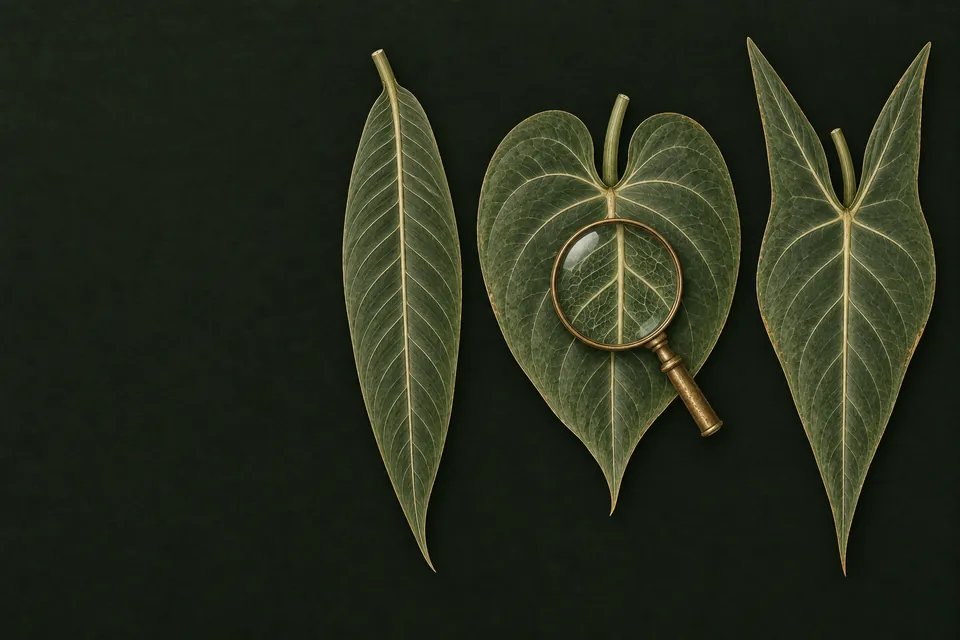
Large sagittate to hastate blades on long petioles. Their veins, their glands and the way the back lobes join carry most of the identification work; the outline alone carries very little.
Hay’s 1998 lettered diagram is the standard map of the blade: a front lobe and two back lobes, each with its own midrib, primary veins running pinnately off the front midrib and pedately into the back lobes, and finer veins that leave them almost at right angles and arch toward the margin. Small glands sit in the vein axils beneath. Those veins, the glands and how far the back lobes are joined tell species apart far better than the outline does, and a trade label tells less still.
The map of the blade
The standard description of the Alocasia leaf is the lettered diagram in Alistair Hay’s 1998 revision of the genus in West Malesia and Sulawesi. The blade is a forward, anterior lobe and two posterior lobes behind the petiole insertion. The anterior lobe has its own midrib, the anterior costa, and each posterior lobe has one too, the posterior costa, its structural axis rather than an extra side vein. The primary lateral veins run pinnately off both sides of the anterior costa, but off the outer side only of each posterior costa, pedately, a different arrangement. Between the primaries, Hay separates subsidiary veins, which follow the course of the finer venation but are distinctly thicker, from the secondary veins proper. Whether a species makes subsidiary veins at all can help to characterize it. At the large end, John Mood wrote on Aroid-L on September 11th, 1997, that he had measured the blade of one specimen of Alocasia robusta at Quoin Hill, Sabah, Malaysia, at 263 × 162 cm (about 8 feet 8 inches by 5 feet 4 inches), on a petiole two meters (about 6½ feet) long.
Colocasioid venation
The secondary veins leave the primaries at a wide angle and are then deflected toward the margin, the pattern that Mayo, Bogner and Boyce call colocasioid venation, which the genus shares with Colocasia, Caladium and their relatives. Between two primaries they may meet and unite into an interprimary collective vein, or run on separately; one blade can show both, and whether those veins form, and whether they run smoothly, undulate or zig-zag, separates real species. Near the edge the Flora of China describes a submarginal collective vein with one or two marginal veins beside it. In Alocasia azlanii, Wong and Boyce found an intramarginal vein 2–4 mm inside the margin, one of the characters that separate it from Alocasia beccarii. A character can also be plain on the living leaf and nearly lost on a herbarium sheet: in Alocasia chaii, Boyce found the interprimary collective veins well defined when fresh and decidedly obscure when dried.
Glands, peltate blades and surfaces
In the axils of the primary veins, on the underside, Alocasia typically carries small glands. Hay and Wise, revising the Australasian species in 1991, called them wax-secreting and found them also in the axils of secondary veins and scattered on the petiole; Hay’s 1998 revision calls their function unknown. Their development varies within a species, from plentiful to none in the specimens of Alocasia nicolsonii that Hay and Wise tabulated, but keys still use them: deep red in Alocasia chaii, inconspicuous and pale green in Alocasia beccarii, prominent and purple in Alocasia suhirmaniana, conspicuous and creamy in Alocasia crispa, described from Sulawesi in 2026. In peltate leaves the posterior lobes are joined across the sinus, in Alocasia azlanii all but a 4–8 mm incision at the base. In the Philippines, Hay found seedling leaves almost always peltate and the adult leaves of most species not, and adult Alocasia heterophylla carrying both kinds at once. The surface runs from entirely glabrous to thickly pubescent across the genus.
What a leaf cannot settle
A long, narrow blade is not automatically Alocasia longiloba: Hay called the Longiloba complex taxonomically intractable, and Yuzammi and Hay separated Alocasia suhirmaniana from it by its undulating rather than strongly zig-zag collective veins and its straight rather than pedately in-curved posterior costae. Wild Alocasia macrorrhizos in Vanuatu, Quero García and colleagues found, is uniform within a population and different from one population to the next, and Alocasia odora exists as diploid and tetraploid plants that look almost identical. A trade name is weaker evidence still, because one name can be put on more than one plant. Gabe Thomas wrote on Aroid-L on August 26th, 1997, that he had seen Alocasia micholitziana labeled ‘African Mask’, and Dewey Fisk wrote there on April 2nd, 1998, that Alocasia ‘Amazonica’ had been sold under that name for years. Peter Boyce wrote there on March 27th, 2004, that nearly everything he had seen for sale in the United States as ‘Borneo Giant’ was a very robust form of Alocasia macrorrhizos, although the original introduction seemed to have been genuine Alocasia robusta.
Go deeper: Alocasia morphology guide · Alocasia identification guide
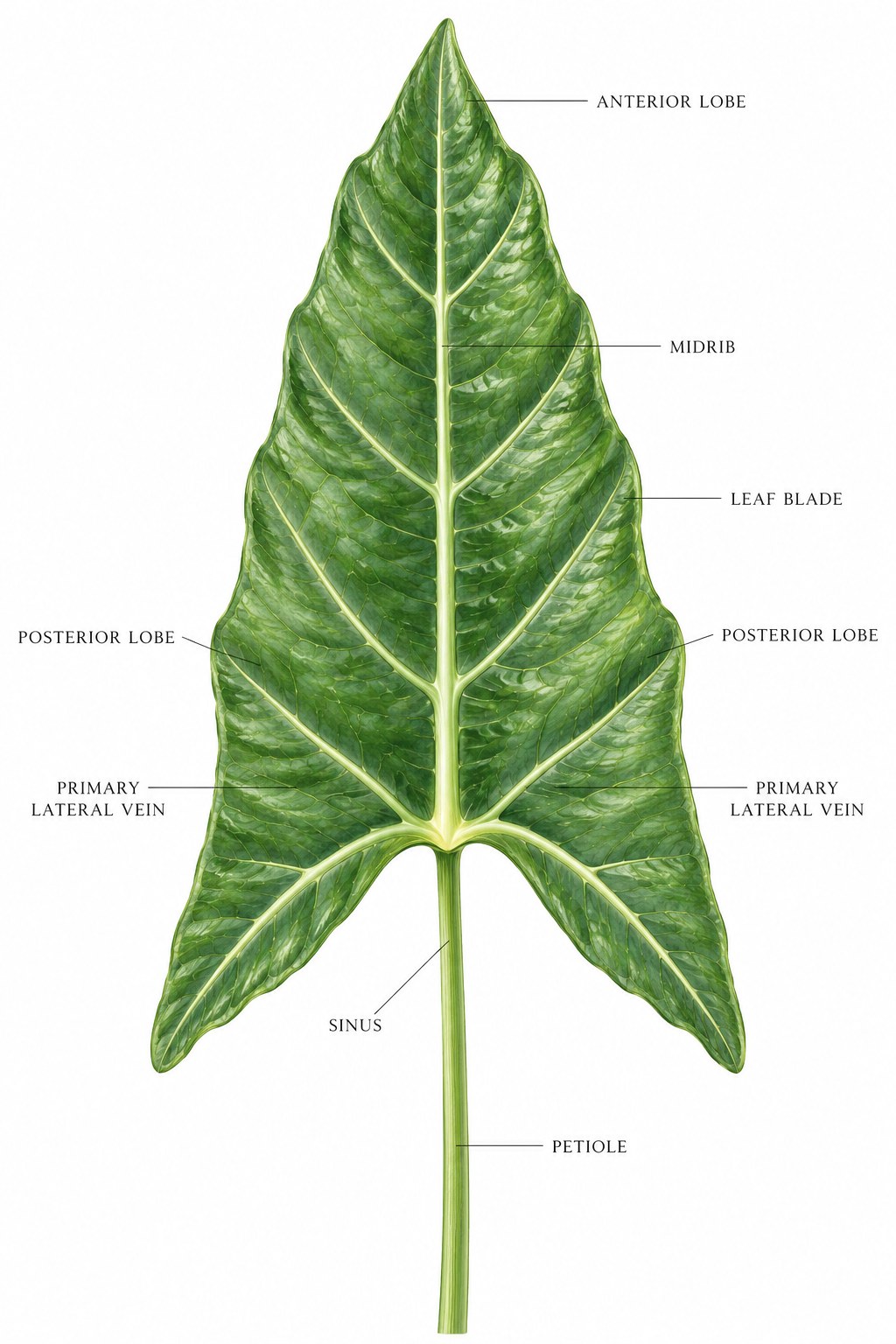
Fig · Leaf architecture
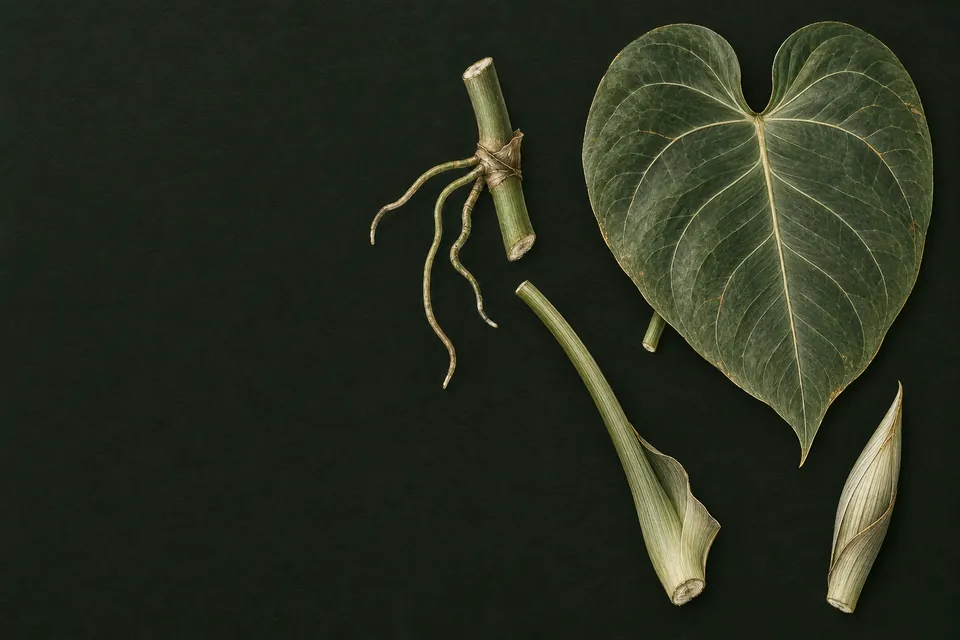
From short rhizomes to tree-like trunks. Each stem builds a crown, stops to flower in pairs, carries on from a bud beside the spent tip, and banks cormels underground.
Stems run from short rhizomes to trunks of several feet, each building a crown of leaves. Flowering comes in pairs of inflorescences, each pair ending a shoot, and growth carries on from a bud beside it, so the stack of sheaths on a flowering stem is not a count of leaves. Wild rhizomes “walk,” rooting forward as their old parts rot, and many species bank cormels at the ends of stolons or offset freely.
The stem
Alocasia stems range from short, rhizomatous structures in smaller species to robust, tall stems in arborescent species like Alocasia robusta. The stem produces foliage and flowers in sequence, building a characteristic crown at the top of the plant. Eric, a grower in Orlando, Florida, reported on Aroid-L on June 23rd, 2008, a single Alocasia ‘Calidora’ about 7 feet tall, with about 5 feet of that height an above-ground pseudotrunk formed by the tuber. Peter Boyce wrote on Aroid-L on November 22nd, 2006, that wild Alocasia “walk”: the rhizome extends and roots as it goes while its older, lower parts rot away. In pots, he added, this poses problems: older rhizome sections senesce and their roots die, newer portions fail to root, and the weakened plant eventually topples.
Flowering in pairs
Alongside its foliage leaves the stem makes two kinds of bladeless sheath: cataphylls, leaves reduced to their base, and prophylls, the first organ of each branch, which in Alocasia carry two keels. Except in the smallest species, where the inflorescence is solitary, as in Alocasia minuscula, Hay found the flowering unit always a pair, four organs in a fixed order: a cataphyll and the inflorescence that ends the shoot, then, from that cataphyll’s axil, a branch that begins with a two-keeled prophyll and ends in a second inflorescence. Because the first inflorescence ends its axis, growth carries on from a relay shoot in the axil of the leaf below. Usually that shoot makes a foliage leaf, so the pairs end up spaced out among the leaves, as in Alocasia macrorrhizos. In robust species it may instead make another pair, and another, each from the axil of the last cataphyll, to about 20 pairs in Alocasia sarawakensis, before a foliage leaf returns the plant to growth. After a large flowering the stem can carry a ring of fruiting heads below the new crown, as in Alocasia robusta: each was terminal when it formed and was pushed aside as the relay shoots carried growth past it. So the stack of sheaths at the top of a flowering stem is not a count of leaves.
Stolons, cormels and offsets
In some species the stem or rhizome sends out stolons that end in cormels, small underground tubers that root and grow into new plants, allowing a clump to colonize new ground when conditions are favorable. Others offset from the base or along a fallen stem; Steve Lucas, growing Alocasia odora, wrote on Aroid-L on April 2nd, 2009, that a plant lying over on the ground grew 2 meters (about 6½ feet) sideways with new plants coming up along the way.
Go deeper: Alocasia morphology guide
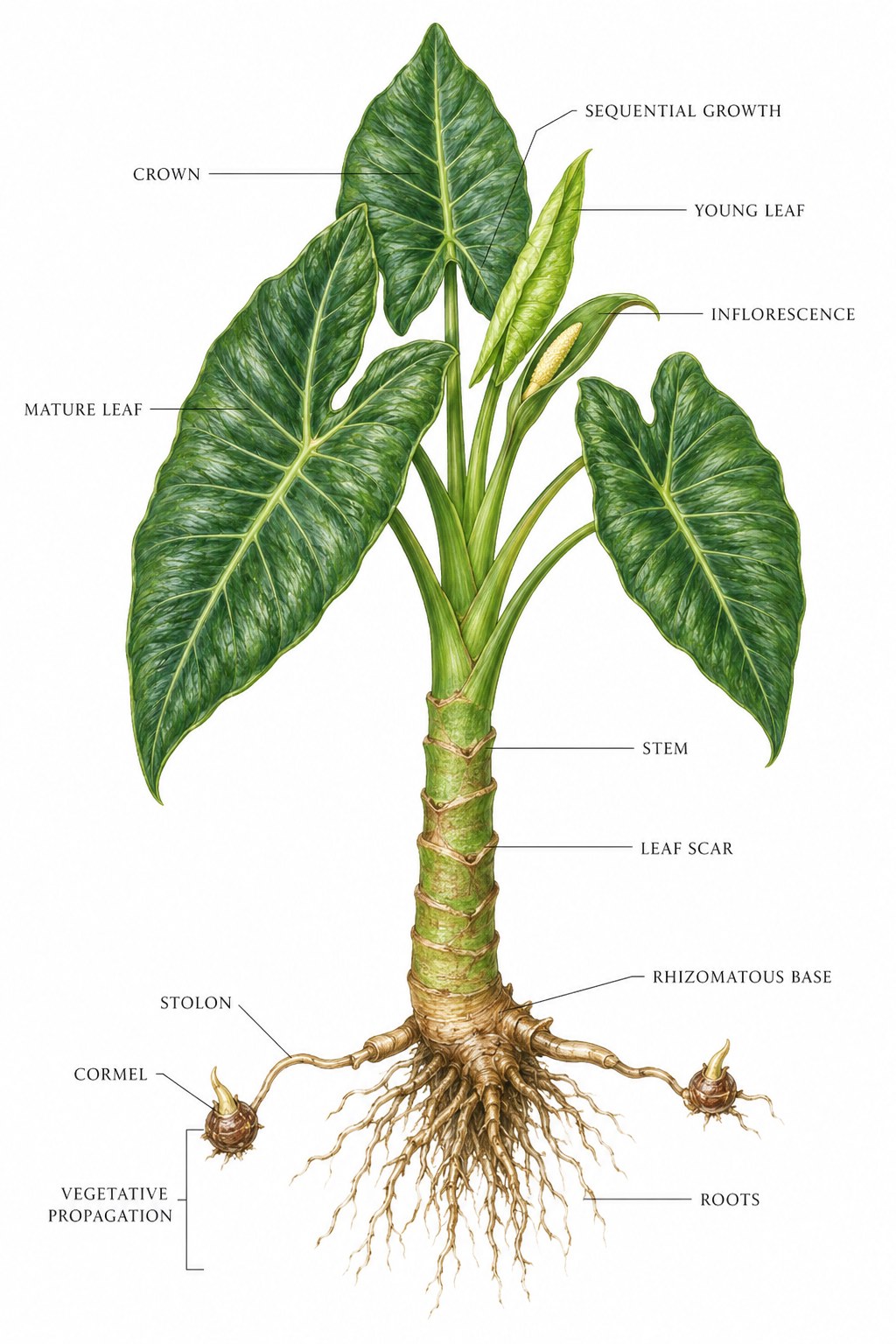
Fig · Growth habit
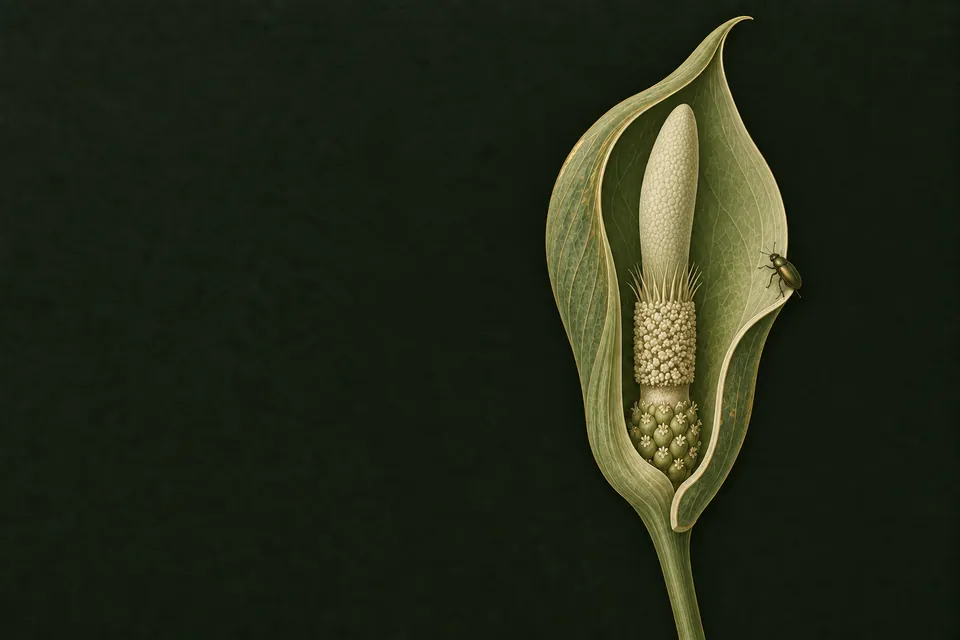
A spadix of four zones in a spathe pinched in two. The lower chamber persists around the female flowers while the upper limb falls, and the constriction between them opens for the female phase and grips the spadix shut for the male.
The spadix has four zones: female flowers at the bottom, inside the closed lower chamber of the spathe, then a band of sterile flowers, the male flowers and a flowerless appendix. The flowers are female first. The constriction in the spathe opens for the female phase and grips the spadix shut for the male, and small flies, in most species studied Colocasiomyia, breed in the inflorescence and carry the pollen, drawn by its scent and by an appendix that heats itself, in giant taro to a mean maximum of 43.9 °C (111 °F).
Four zones and a door
The flowers are unisexual, and the plant is monoecious. From the bottom of the spadix up: the female zone, a close grid of pistils, each an ovary under a stigma, inside the closed base of the spathe; a sterile interstice of synandrodes, male flowers reduced to sterile organs; the male zone, each flower’s stamens fused into a button-like synandrium, the anthers opening by pores at the top; and the appendix, which carries no flowers at all. In 51 inflorescences of Alocasia macrorrhizos in Vanuatu, Ivancic and colleagues found the appendix 60.2% of the spadix, the male zone 24.9% and the female zone just 8.1%. The spathe is one bract in two parts, divided by a constriction: below, a thick, closed, persistent chamber around the female flowers; above, a thin limb that opens at anthesis and soon decays. In Alocasia macrorrhizos the constriction averages 0.83 cm across, against 1.50 cm for the male zone above it. Spathe color varies even within a species: in Alocasia macrorrhizos, Peter Boyce noted on Aroid-L on August 11th, 2009, it runs from white through pinkish and purplish to what is called yellow but is really somewhat cream.
The constriction does not always sit at the sterile band. Hay records whole groups in which it sits higher, so that part or all of the male zone is shut inside the lower chamber with the female flowers. It defines his Scabriuscula Group and turns up in the Puber, Princeps and Cuprea groups too; in Alocasia scabriuscula the share enclosed varies from about a quarter to two thirds, and in Alocasia melo both fertile zones are sealed in.
Female first
The flowers are protogynous. At female anthesis, Hay found, the constriction loosens to admit insects, the limb stands erect and scent begins; at the end of the female phase the constriction closes and grips the spadix, scent stops, and the male phase follows, the mealy pollen collecting between the lip of the limb and the spadix. In Sabah, Takenaka Takano and colleagues followed the flies of Alocasia macrorrhizos: two undescribed Colocasiomyia species arrive in the early morning of the first day, drawn by the scent of the female-phase inflorescence, feed, mate and lay their eggs inside it, and leave on the second morning dusted with pollen; their larvae develop in the head without damaging the fruit. Not every pollinator is a Colocasiomyia: in Java, van der Pijl recorded flies of the genus Atherigona breeding in the sweet-smelling inflorescences of Alocasia puber.
Heat and scent
The inflorescence heats itself. In Vanuatu, Ivancic and colleagues measured a mean maximum of 43.9 °C (111 °F) in the appendix of Alocasia macrorrhizos, peaking between 5:45 and 6:00 in the morning, exactly when the odor peaks; the male zone warmed in two peaks, and the female zone did not warm at all. In Alocasia odora, Miyake and Yafuso found the appendix the attractant, but the scent does not come from the same organ in every species: in Alocasia alba and Alocasia robusta, Hay found the odor produced from the inside of the lower spathe, not the spadix, and he noticed that plants of Alocasia robusta in Sarawak smelled of decomposing beef extract while those in Sabah were sweetly fragrant. In Alocasia brisbanensis, Shaw counted 21,201 pollen grains and found 6.4% of them small, starchless and inviable.
Go deeper: Alocasia reproduction guide · Alocasia morphology guide

Fig · Inflorescence, cutaway
A head of berries ripening inside the lower spathe, which splits back to show them orange to red, in a few species cream or white. Each holds none to a few seeds, which germinate quickly when sown fresh.
The lower spathe stays on around a head of berries, which ripen orange to red in most species and cream or white in a few, and then splits back to show them to the birds that eat them. Each berry holds none to a few seeds, which germinate in two to three weeks when sown fresh and warm. The fruit is not edible.
The fruiting head
After pollen release the upper spadix and the spathe limb wither and fall, and only the lower spathe and the female zone go on. Each fertilized ovary becomes a berry, and the berries, packed as tightly as the pistils were, form the infructescence. The ovary holds several ovules on a basal placenta, in one chamber or partly divided above, and not all of them become seed: Shaw counted 0–10 ovules to an ovary in Alocasia brisbanensis, and in Vanuatu, Quero García and colleagues found none to four seeds in a berry of Alocasia macrorrhizos. An infructescence on an old, large wild plant usually carries more than a hundred berries, and their best hand-pollinated heads gave up to 236 seeds, ready to harvest 9–11 weeks after the cross. A head can also swell without seed: Shaw found that unfertilized florets beside real berries in Alocasia brisbanensis enlarge and deepen in color while staying empty.
Color and opening
Hay describes the fruits as orange to red, fleshy and, as far as is known, odorless. Most ripen in the orange range, Alocasia macrorrhizos, Alocasia zebrina, Alocasia reversa and Alocasia cucullata among them; Alocasia odora, Alocasia portei and Alocasia lauterbachiana ripen red; and Alocasia scalprum ripens pale cream and Alocasia azlanii white. In most species the lower spathe stays wrapped around the head as it ripens and then splits and bends back to expose the berries; in Alocasia puncakborneensis, Wong and Boyce describe it splitting lengthwise into about three segments that stay erect around scarlet berries, the peduncle doubling in length in fruit. In many species a hole opens at the apex first, as the tip of the spadix axis decays; in Alocasia macrorrhizos the axis persists and the head stays sealed until it splits.
Who eats them
Birds do. In Queensland, Shaw, Hiller and Hiller watched a Regent Bowerbird swallow 20 berries from two heads of Alocasia brisbanensis and a Lewin’s Honeyeater return to the same heads, which were empty two days later; ten people who smelled the berries found them odorless, as Hay expected of a fruit for birds. Inside the head, meanwhile, the larvae of the pollinating flies develop in the secretion that bathes it, then pupate between the fruits, and in Sabah the adults emerge together when the head splits.
The seed
The seed holds an embryo and endosperm inside its coat. Boyce gives germination in two to three weeks at 21–29 °C (70–84 °F), with the seed kept in the berry until sowing, cleaned of all pulp and covered no deeper than its own size, and he warns that metallic copper fungicides are fatal to aroid seedlings. Sowing fresh is the usual advice, but the one controlled trial points elsewhere: Abdulhafiz and colleagues found seed of Alocasia longiloba still 89% viable after two weeks of drying at room temperature, germinating at 25% in about 30 days untreated and 87.5% in 19 days after 15 minutes in 30% sulfuric acid, which they read as a hard seed coat rather than an intolerance of drying. The fruit is not to be eaten. In Sri Lanka in 1993, Goonasekera and colleagues reported two children who died after eating the ripe orange fruit of Alocasia cucullata; the cause was never identified.
Go deeper: Alocasia reproduction guide
One genus, many niches: montane forest, swamp, limestone, ultramafic rock and the roadside ditch.
The morphological diversity of Alocasia follows its habitats. Alocasia perakensis and Alocasia kerinciensis grow in montane forest; Alocasia sarawakensis is common in open swampy places and roadside ditches, met in swampy forest as a hairy juvenile; and Alocasia princeps grows on well-drained slopes and ridgetops over substrates from basalt to limestone. In Hay’s account the giants are plants of open sites and the small species live within the forest.
Some species are bound to one rock. Alocasia melo grows on ultramafic rock in Sabah, and six of the at least nine species of the Princeps Complex are lowland limestone obligates, such as Alocasia reversa in southwestern Sarawak. Others are flexible: Alocasia cuprea grows over several substrates, including limestone and sandstone. The most widespread species, Alocasia macrorrhizos, has no wild habitat at all that anyone has found: it lives with people.
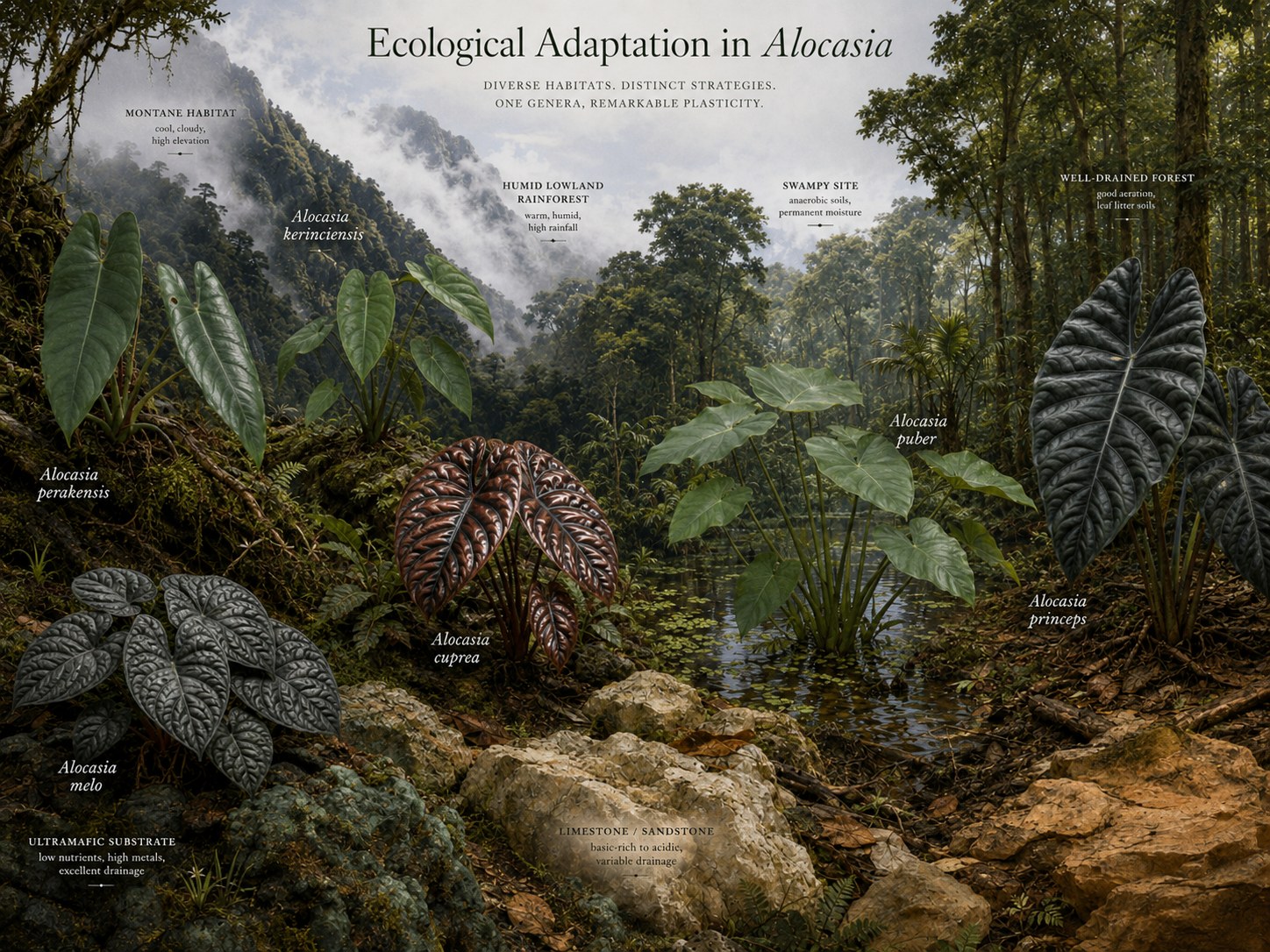
Fig · Habitats of the genus
Araceae · Care
Cultivation
Alocasia are a striking addition to any plant collection, offering some of the most distinctive ornamental foliage in the Araceae family. They thrive under specific conditions, warm roots, steady moisture, bright shade and a tight pot, and are generally easy and rewarding to cultivate if those conditions are met. Most of their troubles come from cold and wet together, and a plant that drops its leaves is often resting, not dying.
Moisture-retentive but never waterlogged: a chunky, airy mix is the whole secret, and a few species want mineral soil or lime.
Product links on this page go to Amazon. As an Amazon Associate, Aroidpedia earns from qualifying purchases.
Alocasia prefer a rich substrate that retains moisture while not getting excessively water-logged and anoxic. A mix of peat moss/coco peat, perlite, pine fines or rice hulls, orchid bark and worm castings will work excellently for most growers.
Advanced growers may see success with semi-hydroponic growing media as well (LECA, PON, etc.). Additives like humic acid, systemic BONIDE granules or dolomitic lime can also benefit Alocasia, depending on species and individual growing conditions.
Published advice runs the same way: Bown asks for a humus-rich medium, and the RHS for houseplant compost with about one part horticultural grit to three of compost. What none of them wants is a medium that stays wet and airless around the rhizome, the condition behind most of the rots on the Pests & Diseases tab.
The habitats suggest where those additives matter. Many of the jewel species of Borneo grow in soil and humus pockets on limestone, such as Alocasia reversa and Alocasia puteri, and Alocasia melo on thin soil over ultramafic rock rather than in deep forest humus. Alocasia robusta is a reported exception in the other direction: Peter Boyce wrote on Aroid-L on July 15th, 2009, that it is definitely a plant for a mineral soil, and that in the wild, where it is a gap-phase plant, the largest plants are always on the local “terat series” red soils under a light cover of leaf litter.
Heavy feeders on a light schedule: weakly, weekly, with every watering, and not at all while dormant.
Alocasia are heavy feeders and benefit from fertilization with every watering (the mantra weakly weekly works excellently). This can be done either externally, with fertilizer added to the watering solution (General Hydroponics Flora Series), or internally, with slow-release forms of fertilizer added to the substrate (Nutricote, bone meal & blood meal).
The published schedules are more cautious. Bown feeds every two to three weeks, and the RHS gives a general liquid fertilizer from April to October only, at the rate on the pack. Both stop with the season, and a dormant plant, with no leaves to use it, is not fed at all. In dry air feed more lightly still, as the humidity note on the Growing Conditions tab explains.
Warm roots, steady moisture, bright shade, and a pot that always looks one size too small.
Temperature
Like many other tropical genera, Alocasia prefer warm to hot temperatures, but substrate (root zone) temperatures are most critical for healthy growth: ideally you would sprout corms at 77–86°F (25–30°C) and switch to 72–79°F (22–26°C) for vegetative growth. Anything below 50°F (10°C) is detrimental, while temperatures below 40°F (4°C) are injurious and may cause irreversible damage.
Humidity
60–80% RH is recommended for optimal growth and maintaining an acceptable VPD (Vapor Pressure Deficit), though many growers have reported Alocasia will adapt to ambient humidity as low as 30% if needed (this results in very high VPDs and nutrient burn is possible, so lighter fertilization is recommended).
Watering
Substrate should be kept consistently moist and should never be allowed to dry out during growth.
Light
When grown outdoors, shade cloth blocking 70–80% of sunlight is recommended. For plants grown indoors under artificial lighting, this is equivalent to about 2000–3000 FC (400–600 µmol) and is ideal for growth and flowering. A minimum of 200 FC (40 µmol) is required for maintenance, though no growth will take place at such low light densities. While still considered low light, Alocasia will grow, albeit slowly, starting at 400 FC (80 µmol).
Potting
It is of the utmost importance not to use pots that are too large for Alocasia. While other Araceae genera prefer or tolerate over-potting, Alocasia will readily rot and die off if the roots and rhizome are surrounded by too much wet substrate. This has to do with the way Alocasia grow their roots: in the corm or bare rhizome state, roots form horizontally to anchor the plant, then extend downwards rather than filling the pot radially.
Many growers are misled by the size of the foliage and let it decide the size of the pot, but the rule of thumb is to use the smallest/tightest pot that fits the rhizome and existing root system, plus perhaps 20–30% substrate. A longer, narrower pot is preferable to a shorter, wider one.
Temperature
The RHS sets the same floor: above 16°C (60°F) through the growing season, and never below 10°C (50°F). Bown found many species going dormant below 7°C (45°F), and a grower called Dan reported on Aroid-L on May 25th, 2001, that two or three weeks of nights in the low 50s°F in the San Francisco Bay area sent most of his plants dormant, some to become leafless, slowly decaying rhizomes.
Humidity
The RHS ties browning leaf edges, and red spider mite, to dry air.
Watering
Cold is when water does harm: Denis of Silver Krome Gardens in Florida wrote on Aroid-L on July 12th, 2005, that stem rot is avoided by keeping excess water off in the rainy season and above all in the cool winter, when the plants are not growing, and the RHS names overwatering in winter, and while dormant, as the cause of root rot.
Light
Alocasia robusta is a reported exception: Peter Boyce wrote on Aroid-L on July 15th, 2009, that in cultivation it needs nearly full sun or very light shade, as befits a giant of canopy gaps.
Potting
The RHS likewise moves up only about 5 cm (2 inches) in diameter at a time, and Boyce warns against burying the base of the stem, which invariably leads to fungal or bacterial rot. For the species whose rhizome walks upward, Boyce described on Aroid-L on November 22nd, 2006, a system that keeps the new rhizome rooted: plant low in a deep pot, leaving about 15 cm (5 inches) free above the mix, top-dress with loose mix as the rhizome rises, and repot once the mix reaches the rim. Alocasia robusta is a reported exception to this rule: Peter Boyce wrote on Aroid-L on July 15th, 2009, that it is not easy and invariably reacts very badly to transplanting, and that the only way found to grow it successfully was to plant ex vitro plants directly into the final-size pot, or to sow three or four seeds directly into the final-size pot or final growing place.
Alocasia have no obligate dormancy. Cold or dry conditions can push a plant to drop its leaves and rest on its corm or rhizome, and given warmth and moisture again it grows back.
A plant that loses its leaves after a cold spell or a drying-out is usually resting, not dead. If the corm or rhizome is firm, keep it warm and barely moist, unfed, and wait for the new shoot; if it is soft, collapsing or foul-smelling, it is rotting. Bare rhizomes also travel well: without leaves or roots they ship without harm, and have arrived sound from Asia after 47 days held in transit.
Induced, not obligate
Nothing in the genus requires a rest. What brings one on is cold or drought: Bown found many species going dormant below about 7°C (45°F), and the Growing Conditions tab has a grower’s plants going dormant after weeks of nights in the low 50s°F. In a cool home the RHS expects the same each winter: in cooler, drier conditions, still above 10°C (50°F), the plant may lose some foliage, which is nothing to worry about, and fresh leaves appear when growth resumes in spring. Kept warm and moist the year round, the plants simply go on growing. Some growers find a plant resting for no reason they can name: Neal R. Foster wrote on Aroid-L on April 3rd, 1997, that his sometimes sulked and went dormant with no pattern he could find, the oldest outer leaves drooping first, and advised patience, less water and waiting for the sprouts.
Telling rest from rot
The difference is in the storage organ. A resting plant keeps a firm corm or rhizome with a live bud, however bare it looks above ground; a dying one goes soft, collapses or smells, usually from the base, and the rot spreads. If the leaves have gone, press the corm or rhizome gently at the soil line, or lift it and look. A sudden collapse of a plant in full leaf, with a mushy stem at ground level, is not dormancy but the bacterial rot described on the Pests & Diseases tab, and even then Denis of Silver Krome Gardens advised on Aroid-L on July 12th, 2005, not to throw the plant out at once, since small satellite rhizomes separated from the main stem may still regrow.
Care while resting
Keep the plant warm, never below 50°F (10°C), in its pot, and water only enough to keep the substrate from drying out completely; do not feed it. The RHS reduces watering to a minimum and names overwatering while dormant as the cause of root rot, and a grower called Russ wrote on Aroid-L on November 21st, 1999, that larger plants that had dropped to a bulb after a chill needed drier conditions, because the tubers rot if they are kept too damp. When the new shoot shows, return the plant to warmth, light and its normal watering and feeding.
Out of the ground
Corms and rhizomes are not kept out of the ground for long, but they tolerate a spell without leaves or roots, which is how they are shipped. Pot them on arrival, warm and lightly moist, as for the cormels on the Propagation tab.
Offsets and cormels arrive almost unasked; hybridizing is where the craft begins.
Offsets, cormels and division
Alocasia are easily propagated asexually. Healthy plants rapidly create offsets (also referred to as off-shoots, or more colloquially pups), as well as propagative elements like terminal cormels (also referred to as corms). A larger rhizome can also be divided and propagated, similarly to how Monstera and Philodendron are propagated.
Seed and hybrids
Sexual propagation (hybridization) in Alocasia has a rich history, dating as far back as the 1850s. While it takes a little more skill and luck to successfully hybridize two Alocasia species or cultivars (intra-species hybridization is rarely worthwhile), it is a great way to select desirable qualities and create new and exciting plants.
Offsets, cormels and division
The RHS separates offsets with as much root as possible in spring, and Lecoufle divided rhizomes at the end of the rest season and recovered the bulblets from the old compost at repotting. Marek wrote on Aroid-L on April 8th, 2011, that the bulblets of Alocasia infernalis, about 5–10 mm (0.2–0.4 inch), generally began growth within weeks when potted and watered immediately after detachment, provided they had not dried, and that plants raised from them in his cultivation then grew slowly, with one or two leaves a year. Older offsets can sit for months: Michael Pascall wrote there on April 11th, 2011, that an old offset may have a tough skin that should be carefully broken, not removed, to make it sprout. One grower’s account shows how much a single plant can multiply: Steve Lucas wrote on Aroid-L on April 2nd, 2009, that a single small Alocasia odora he was given in 1996 multiplied until plants had to be dug up and discarded every summer, with about ten large plants given away the previous summer and as many discarded. In his experience they grow like weeds if kept humid and somewhat damp.
Tissue culture
Tissue culture rescued Alocasia scabriuscula var. imperialis (published as Alocasia guttata) when it was known from a single collection. Hyndman cautions that micropropagated plants are free of a disease only if tested for that pathogen, and that variation arising in culture is more likely to be worse than the parent than better. Abdulhafiz and colleagues published a full route for Alocasia longiloba, with 97% of plantlets surviving acclimatization.
Seed and hybrids
Alistair Hay wrote on Aroid-L on April 1st, 1999, that the genus hybridizes freely in cultivation and occasionally in the wild, even between distantly related species, and that some hybrids are fertile; in Vanuatu, Quero García and colleagues found wild Alocasia macrorrhizos largely self-incompatible, setting no fruit from 20 single self-pollinations but fruit from 79 of 88 outcrosses. Seedlings of such hybrids can vary widely: Ron Weeks wrote on Aroid-L on April 3rd, 2000, that the many Alocasia ‘Portora’ and Alocasia ‘Calidora’ seedlings he bought and grew out ranged from lance-leaved miniatures to broad-leaved giants. With the help of Jim Georgusis he selected a red and a green form of Alocasia ‘Portora’ and one form of Alocasia ‘Calidora’ for tissue-culture production, and the green form was dropped from that production because landscapers either preferred the red form or did not care. The interactive dashboard at the bottom of this page lists every known hybrid.
Go deeper: Alocasia reproduction guide · Alocasia identification guide
Spider mites and thrips lead the pests; rots of the corm, rhizome and roots lead the diseases, and nearly all of them start with cold, wet substrate. Catch the mites before the colony does.
Spider mites and thrips
As with most tropical plants, Alocasia are prone to infestations by a multitude of pests, particularly spider mites and thrips. Outdoors the plants are tough: UF/IFAS Extension’s landscape sheet finds no major pest problems in Florida gardens. Indoors the RHS ties red spider mite to dry air. Against thrips the house practice is a systemic: systemic BONIDE granules worked into the substrate. Against spider mites it is a miticide, rotated between chemistries because the mites breed fast enough to build resistance, or biological control with predatory mites such as Phytoseiulus persimilis. For any pest, regular showers of the leaves, and sprays of insecticidal soap or alcohol, knock numbers down, though they are less effective and less lasting than a systemic, a miticide or predators.
The diseases are mostly rots of the corm, rhizome and roots, and nearly all of them follow cold, wet substrate: keep the mix open, the pot tight and the water down in cool weather. A plant in full leaf that suddenly falls over on a mushy stem has bacterial soft rot.
Other pests
Mealybugs turn up too, and outdoors in Florida scale can recur: Debbie Swartz described on Aroid-L on October 1st, 2000, a black scale on outdoor plants in Fort Lauderdale. The EPPO database records the thrips Chaetanaphothrips signipennis on Alocasia ×amazonica. And in North Carolina, Petra wrote on Aroid-L on October 30th, 2002, that a shiny black caterpillar eating out the core of a stem was identified as the larva of a Bellura moth, a borer that had been found on other aroids.
Rots of the corm, rhizome and roots
Root rot from overwatering, particularly in winter, is the one disease the RHS names. Bacterial soft rot is the fastest. Denis of Silver Krome Gardens wrote on Aroid-L on July 12th, 2005, that Alocasia, particularly the ‘Amazonica’ types, are prone to bacterial infection, usually Erwinia, at the base of the rhizome; a plant can show nothing until it falls over on a mushy stem at ground level, and more fungicide did not solve it in his experience. The bacteria once called Erwinia chrysanthemi are now Dickeya, and Nelson’s University of Hawaiʻi fact sheet lists Alocasia among the interior plants it commonly affects: it rots fleshy organs, leaves, roots, tubers and stems, can run through the plant’s vessels, and gives a mushy, foul-smelling rot. Sprays do little against it. The defense is cultural: clean stock, new or sterilized pots and mix, no overhead watering, which splashes the bacteria from leaf to leaf and plant to plant, removal and destruction of infected plants, and avoiding the stresses of irregular watering, poor drainage, fluctuating temperatures and pots too small or too large. In 2025, Marin and colleagues reported the southern blight fungus, Agroathelia rolfsii, for the first time on Alocasia, in a Florida field of ‘Calidora’ with about 10% of plants stunted and yellowing, their bulbs rotting under white mycelium and sclerotia; the field had grown caladiums before, and the sclerotia persist in soil for years.
Virus
Dasheen mosaic virus infects aroids widely, Alocasia among them: Greber and Shaw found it in wild and cultivated plants in coastal Queensland, and Zettler and Hartman list Alocasia among the cultivated aroids it infects. It is spread by aphids and in sap on cutting tools and is carried into offsets, so infected stock cannot give clean divisions; tissue culture from tested stock is the control, and has been used commercially since about 1980.
Handle with care
The tissues carry raphides, bundles of needle-shaped calcium oxalate crystals, which Osuji and Ihenko found in cells along the latex vessels of Alocasia macrorrhizos. The RHS advises gloves when handling, since the sap can irritate the skin, and in Japan, Yanagawa and Nagasawa reported five suspected cases of poisoning by Alocasia odora eaten in mistake for edible plants. Keep plants, and above all the orange fruit, out of reach of children and pets.
Go deeper: Pest Management Guide · Spider mites · Thrips
Alocasia Timeline
An interactive timeline showing the year each Alocasia species was first described as Alocasia (species may previously have been classified in other genera)
Alocasia Species & Cultivars
Taxa not yet formally described, or whose status is unresolved. Informal names appear in single quotes.
Alocasia Hybrids and Hybrid Cultivars
From the parentage and hybridizer recorded on each hybrid’s page; sports and selections hang off the hybrid they came from. Old names appear under their current name. ⇄ marks a cross made both ways; ? marks one with no recorded result. Click a name for its record; “Start here” re-centres the graph on it.
Named cultivars selected from hybrid parentage. Counted separately from the hybrids above.
Sources
The papers behind the morphology & cultivation tab
- Hay, A. (1998). The genus Alocasia (Araceae–Colocasieae) in West Malesia and Sulawesi. Gardens' Bulletin Singapore 50(2): 221–334.
- Hay, A. (1999). The genus Alocasia (Araceae–Colocasieae) in the Philippines. Gardens' Bulletin Singapore 51(1): 1–41.
- Mayo, S. J., Bogner, J. & Boyce, P. C. (1997). The Genera of Araceae. Royal Botanic Gardens, Kew.
- Aroid-L mailing list, John Mood, September 11th, 1997
- Li, H. et al. (2010). Araceae. In: Flora of China 23: 3–79. Science Press, Beijing & Missouri Botanical Garden Press, St. Louis.
- Wong, K. M. & Boyce, P. C. (2016). Novitates Bruneienses, 6. Alocasia azlanii (Araceae), a new species from Brunei. Acta Phytotaxonomica et Geobotanica 67(3): 185–189.
- Boyce, P. C. (2007). Studies on the Alocasia Schott (Araceae–Colocasieae) of Borneo: I. Two new species from Sarawak, Malaysian Borneo. Gardens' Bulletin Singapore 58(2): 141–154.
- Hay, A. & Wise, R. (1991). The genus Alocasia (Araceae) in Australasia. Blumea 35: 499–545.
- Yuzammi & Hay, A. (1998). Alocasia suhirmaniana (Araceae–Colocasieae) — a spectacular new aroid from Sulawesi, Indonesia. Telopea 7(4): 303–306.
- Asih, N. P. S., Kurniawan, A., Warseno, T. & Wibowo, A. R. U. (2026). Studies on the Araceae of Sulawesi II: Two new species of Alocasia (Araceae–Alocasieae) from South and Southeast Sulawesi. Taiwania 71(3): 559–565.
- Quero García, J., Ivancic, A. & Lebot, V. (2008). Morphological variation and reproductive characteristics of wild giant taro (Alocasia macrorrhizos, Araceae) populations in Vanuatu. New Zealand Journal of Botany 46: 189–203.
- Nguyen, V. X., Yoshino, H. & Tahara, M. (1998). Karyotype analyses on diploid and tetraploid of Alocasia odora (Roxb.) K. Koch. Aroideana 21: 8–.
- Aroid-L mailing list, Gabe Thomas, August 26th, 1997
- Aroid-L mailing list, Dewey Fisk, April 2nd, 1998
- Aroid-L mailing list, Peter Boyce, March 27th, 2004
- Aroid-L mailing list, Eric, June 23rd, 2008
- Aroid-L mailing list, Peter Boyce, November 22nd, 2006
- Aroid-L mailing list, Steve Lucas, April 2nd, 2009
- Ivancic, A., Roupsard, O., Quero García, J., Lebot, V., Pochyla, V. & Okpul, T. (2005). Thermogenic flowering of the giant taro (Alocasia macrorrhizos, Araceae). Canadian Journal of Botany 83: 647–655.
- Aroid-L mailing list, Peter Boyce, August 11th, 2009
- Takenaka Takano, K., Repin, R., Mohamed, M. B. & Toda, M. J. (2012). Pollination mutualism between Alocasia macrorrhizos (Araceae) and two taxonomically undescribed Colocasiomyia species (Diptera: Drosophilidae) in Sabah, Borneo. Plant Biology 14: 555–564.
- van der Pijl, L. (1933). Welriekende vliegenbloemen bij Alocasia pubera. De Tropische Natuur 22: 210–214.
- Miyake, T. & Yafuso, M. (2003). Floral scents affect reproductive success in fly-pollinated Alocasia odora (Araceae). American Journal of Botany 90(3): 370–376.
- Shaw, D. E. (2003). Dimorphic pollen of Alocasia brisbanensis (Araceae) in Queensland. Aroideana 26: 96–105.
- Shaw, D. E. (2001). Fertile florets, stigmatic lobes and ovules of Alocasia brisbanensis (F. M. Bailey) Domin (Araceae) in Queensland. Aroideana 24: 56–65.
- Shaw, D. E. (2001). The natural stimulation of some unfertilized female florets of Alocasia brisbanensis (Araceae) in Queensland. Aroideana 24: 66–68.
- Wong, S. Y. & Boyce, P. C. (2020). Studies on the Alocasia Schott (Araceae) of Borneo III: Alocasia puncakborneensis, a new species belonging to the Princeps Complex. Webbia 75(1): 111–115.
- Shaw, D. E., Hiller, A. & Hiller, K. A. (1985). Alocasia macrorrhiza and birds in Australia. Aroideana 8(3): 89–93.
- Boyce, P. C. (2007). Germinating aroid seeds — some observations. Aroideana 30: 145–161.
- Abdulhafiz, F., Mohammed, A., Kayat, F., Zakaria, S., Hamzah, Z., Pamuru, R. R., Gundala, P. B. & Reduan, M. F. H. (2020). Micropropagation of Alocasia longiloba Miq and comparative antioxidant properties of ethanolic extracts of the field-grown plant, in vitro propagated and in vitro-derived callus. Plants 9(7): 816.
- Goonasekera, C. D. A., Vasanthathilake, V. W. J. K., Ratnatunga, N. & Seneviratne, C. A. S. (1993). Is Nai Habarala (Alocasia cucullata) a poisonous plant? Toxicon 31(6): 813–816.
- Bown, D. (2000). Aroids: Plants of the Arum Family, 2nd ed. Timber Press, Portland.
- Royal Horticultural Society. How to grow alocasia. RHS growing guide.
- Aroid-L mailing list, Peter Boyce, July 15th, 2009
- Aroid-L mailing list, Dan, May 25th, 2001
- Aroid-L mailing list, Denis, July 12th, 2005
- Aroid-L mailing list, Neal R. Foster, April 3rd, 1997
- Aroid-L mailing list, Russ, November 21st, 1999
- Lecoufle, M. (1982). Propagation of Caladiums, Alocasias and similar genera. Aroideana 5.
- Aroid-L mailing list, Marek, April 8th, 2011
- Aroid-L mailing list, Michael Pascall, April 11th, 2011
- Hyndman, S. E. & Bickell, A. (n.d.). Micropropagation of Aroids. International Aroid Society.
- Aroid-L mailing list, Alistair Hay, April 1st, 1999
- Aroid-L mailing list, Ron Weeks, April 3rd, 2000
- Gilman, E. F., Klein, R. W. & Hansen, G. (2018). Alocasia spp. Elephant's Ear. FPS 33, UF/IFAS Extension, Gainesville.
- Aroid-L mailing list, Debbie Swartz, October 1st, 2000
- EPPO Global Database. Alocasia × amazonica: pests.
- Aroid-L mailing list, Petra, October 30th, 2002
- Nelson, S. (2009). Bacterial Leaf Blight of Aglaonema. Plant Disease PD-64, College of Tropical Agriculture and Human Resources, University of Hawaiʻi at Mānoa.
- Marin, M. V., Sollazzo, C., Seijo, T. & Peres, N. A. (2025). First report of Agroathelia rolfsii causing southern blight of Alocasia in Florida. Plant Disease 109: 1180.
- Greber, R. S. & Shaw, D. E. (1986). Dasheen mosaic virus in Queensland. Australasian Plant Pathology 15(2): 29.
- Zettler, F. W. & Hartman, R. D. (1987). Dasheen mosaic virus as a pathogen of cultivated aroids and control of the virus by tissue culture. Plant Disease 71(11): 958–963.
- Osuji, J. O. & Ihenko, S. C. (2023). Comparative morphology, anatomy and phytochemistry of Cyrtosperma senegalense (Schott) Engl. and Alocasia macrorrhizos L. (Araceae). International Journal of Environment and Climate Change 13(10): 3862–3872.
- Yanagawa, Y. & Nagasawa, H. (2024). Alocasia odora poisoning due to calcium oxalate needle crystals in Japan. Journal of Rural Medicine 19(3): 126–130.
Complete Alocasia Bibliography
Every source cited across all Alocasia species, cultivar and hybrid pages
- Burnett, D. 1984. The cultivated Alocasia. Aroideana 7(3–4): 68–162 aroid.org
- Alocasia boa, Alocasia cuprea, Alocasia heterophylla, Alocasia hollrungii, Alocasia longiloba, Alocasia odora ‘california’, Alocasia reginae, Alocasia reversa, Alocasia sanderiana, Alocasia scalprum, Alocasia zebrina ‘tigrina’, Alocasia ‘argyrea’, Alocasia ‘galahad’ p. 78p. 99 Aroidpedia pageAroidpedia pageAroidpedia pageAroidpedia pageAroidpedia pageAroidpedia pageAroidpedia pageAroidpedia pageAroidpedia pageAroidpedia pageAroidpedia pageAroidpedia pageAroidpedia page
- Alocasia longiloba ‘watsoniana’ Aroidpedia page
- Vertical Garden by Patrick Blanc verticalgardenpatrickblanc.com
- Hay, A. 1998. The genus Alocasia (Araceae–Colocasieae) in West Malesia and Sulawesi. The Gardens' Bulletin, Singapore 50: 221–334 biodiversitylibrary.org
- Hay, A. & Wise, R. (1991). “The genus Alocasia (Araceae) in Australasia.” Blumea 35: 499–545 repository.naturalis.nl
- A. Hay & R. Wise: The genus Alocasia in Australasia repository.naturalis.nl
- Aroids Papua New Guinea: 29 (1990) (name first used) researchgate.net
- Das Pflanzenreich IV.23E (Heft 71) (1920) bibdigital.rjb.csic.es
- Philippine Alocasia Resource Center sites.google.com
- Acta Phytotax. Geobot. 22 (1967) jstage.jst.go.jp
- Agricultural Bulletin of the Straits and Federated Malay States, n.s. 4: 261–262 (1905) biodiversitylibrary.org
- Bonplandia. Zeitschrift für die gesammte Botanik 7 (1859) biodiversitylibrary.org
- Phytotaxa 460: 278 (2020): Taxonomic notes on the Alocasia-Colocasia Clade (Araceae) in China I: Alocasia yunqiana, a new species from Tongbiguan Nature Reserve, Yunnan Province researchgate.net
- Zonneveld, B.J.M. Aroid-L, 11 March 2002 hort.net
- Aroid-L mailing list, LariAnn Garner, March 31st, 2005 hort.net
- Aroid-L mailing list, Peter Boyce, January 25th, 2009 hort.net
- Blumea 16: 116 (1968) repository.naturalis.nl
- Boyce, P.C. 2008. A review of Alocasia (Araceae: Colocasieae) for Thailand including a novel species and new species records from south-west Thailand. Thai Forest Bulletin (Botany) 36: 1–17 li01.tci-thaijo.org
- Die Gartenwelt J.15 (1911) biodiversitylibrary.org
- Exotic Rainforest exoticrainforest.com
- Flore des Serres et des Jardins de l'Europe 17: 168 (1867–1868) biodiversitylibrary.org
- Flore générale de l'Indo-Chine 6: 1148 (1942) biodiversitylibrary.org
- Hibberd, S. 1870. New and Rare Beautiful-Leaved Plants: 49, pl. XIX biodiversitylibrary.org
- PhytoKeys 249: 223–229 (2024) sciencedirect.com
- Schott, H.W. 1863. Alocasia korthalsii. Annales Musei Botanici Lugduno-Batavi 1: 124–125 biodiversitylibrary.org
- Taiwania 71(3): 559–565 (2026) doi.org
- The Flora of British India 6: 527 (1894) biodiversitylibrary.org
- The Gardeners' Chronicle, ser. 3, 13 (1893) biodiversitylibrary.org ALOCASIA LONGILOBAp. 613ALOCASIA LONGILOBA ‘WATSONIANA’p. 569, fig. 83
- The Gardens' Bulletin, Singapore 50: 273 (1998) biodiversitylibrary.org
- Three new species of Araceae from Bangladesh | Bangladesh Journal of Plant Taxonomy 25(2):227-239 researchgate.net
- Wochenschrift des Vereines zur Beförderung des Gartenbaues in den Königlich Preussischen Staaten 7 (1864) archive.org
- A Flora of Manila: 132 (1912) biodiversitylibrary.org
- Agricultural Bulletin of the Straits and Federated Malay States, n.s. 4 (1905) archive.org
- Alocasia alba (Araceae) in Southern Sumatra: further distribution recorded researchgate.net
- Alocasia alba. Curtis's Botanical Magazine 17(4): 216–220 (2000) jstor.org
- Alocasia Amazonica (Steve Lucas, 2009) exoticrainforest.com
- Alocasia intermedia. The Florist and Pomologist, 1869: 79-80, with illustration archive.org
- Alocasia tandurusa Prameswara & A.Hay, A new (bi)pinnatifid-leaved species from Sulawesi [Araceae, tribe Alocasieae (Schott) A.Hay], with notes on tribal classification for the paraphyletic grade of ‘Old World Colocasioids’. Aroideana 46(2): 388–405. 2023. researchgate.net
- Annales botanices systematicae 5: 875 (1848) biodiversitylibrary.org
- Annals of the Missouri Botanical Garden 77: 667 (1990) biodiversitylibrary.org
- Antioxidant activity in the extracts of two edible aroids ijpsonline.com
- Armitage’s Manual of Annuals, Biennials, and Half-Hardy Perennials amazon.com
- Aroid-L hort.net
- Aroid-L mailing list, a member, September 29th, 2007 hort.net
- Aroid-L mailing list, Alistair Hay, August 14th, 1998 hort.net
- Aroid-L mailing list, April 8th, 2011 hort.net
- Aroid-L mailing list, Ben J.M. Zonneveld, March 14th, 2002 hort.net
- Aroid-L mailing list, Dewey Fisk, April 2nd, 1998 hort.net
- Aroid-L mailing list, Eric, June 23rd, 2008 hort.net
- Aroid-L mailing list, Gabe Thomas, August 26th, 1997 hort.net
- Aroid-L mailing list, Je Hi, March 24th, 2021 hort.net
- Aroid-L mailing list, John Mood, September 11th, 1997 hort.net
- Aroid-L mailing list, Julius Boos, April 1st, 2004 hort.net
- Aroid-L mailing list, Krzysztof Kozminski, August 14th, 1998 hort.net
- Aroid-L mailing list, Marek, April 8th, 2011 hort.net
- Aroid-L mailing list, Peter Boyce, August 11th, 2009 hort.net
- Aroid-L mailing list, Peter Boyce, July 15th, 2009 hort.net
- Aroid-L mailing list, Peter Boyce, June 21st, 2009 hort.net
- Aroid-L mailing list, Peter Boyce, March 27th, 2004 hort.net
- Aroid-L mailing list, Peter Boyce, March 2nd, 2009 hort.net
- Aroid-L mailing list, Peter Boyce, November 7th, 2003 hort.net
- Aroid-L mailing list, Ron Weeks, April 3rd, 2000 hort.net
- Aroid-L mailing list, Scott Hyndman, July 6th, 1998 hort.net
- Aroid-L mailing list, Steve Lucas, April 2nd, 2009 hort.net
- Aroid-L mailing list, Steve Lucas, November 19th, 2009 hort.net
- Aroid-L mailing list, Tony Avent, June 1st, 2001 hort.net
- Aroid-L mailing list, Wilbert Hetterscheid, October 21st, 1998 hort.net
- Aroid-L, 12 April 2000 hort.net
- Aroideana 12: 26–31 (1989) aroid.org
- Aroideana 21: 13–21 (1998) aroid.org
- Aroideana 24: 66–68 (2001) aroid.org
- Aroideana 25: 70 aroid.org
- Aroideana 28: 101–103 (2005) aroid.org
- Aroideana 6(3) aroid.org
- Aroidia Research aroidiaresearch.org
- Aroidia Research - Alocasia robusta aroidiaresearch.org
- Aroidia Research - Alocasia robusta and Nephrolepsis ferns aroidiaresearch.org
- Aroidpictures.fr aroidpictures.fr
- Bibliotheca Botanica 20: 504 (1915) biodiversitylibrary.org
- biodiversitylibrary.org/page/40134189 biodiversitylibrary.org
- Blumea 35: 519 (1991) citeseerx.ist.psu.edu
- Blumea 38(2): 331–333 (1994) repository.naturalis.nl
- Blumea Supplement 8 researchgate.net
- Bonplandia. Zeitschrift für die gesammte Botanik (Hannover) 10: 148 (1862) biodiversitylibrary.org
- Botanische Jahrbücher für Systematik, Pflanzengeschichte und Pflanzengeographie 25: 24 biodiversitylibrary.org
- Botanische Jahrbücher für Systematik, Pflanzengeschichte und Pflanzengeographie 25: 26 (1898) biodiversitylibrary.org
- Botanische Jahrbücher für Systematik, Pflanzengeschichte und Pflanzengeographie 37: 135 (1905) biodiversitylibrary.org
- Botanische Jahrbücher für Systematik, Pflanzengeschichte und Pflanzengeographie 54: 89 (1917) biodiversitylibrary.org
- Botanische Jahrbücher für Systematik, Pflanzengeschichte und Pflanzengeographie 54: 90 (1916–1917) biodiversitylibrary.org
- Brown, N.E. 1881. Alocasia Thibautiana. L'Illustration Horticole 28: 72, pl. 419 archive.org
- Brown, N.E. 1882. Alocasia Putzeysi. L'Illustration Horticole 29: 11, with plate archive.org
- Brown, N.E. 1887. Alocasia eminens. The Gardeners' Chronicle, ser. 3, 1: 105 (22 January 1887) archive.org
- Bulletin de l'Herbier Boissier, ser. 2, 1: 670 (1900–1901) biodiversitylibrary.org
- Bulletin du Muséum national d'histoire naturelle, ser. 2, 11: 417 (1939) biodiversitylibrary.org
- Bulletin du Muséum national d'histoire naturelle, ser. 2, 12: 456 (1940) biodiversitylibrary.org
- Bulletin of Miscellaneous Information, Kew 1895: 119 biodiversitylibrary.org
- Bulletino della Società Toscana di Orticultura 4: 300 (1879) babel.hathitrust.org
- Clibrans Ltd, catalogue of ornamental foliage plants archive.org
- Curtis' Botanical Magazine 17:16 (2000) jstor.org
- Curtis's Botanical Magazine 122, ser. 3, 52 (1896) biodiversitylibrary.org
- Curtis's Botanical Magazine 139 (1913) biodiversitylibrary.org
- Curtis's Botanical Magazine 14: 84 (1997) jstor.org
- Curtis's Botanical Magazine 89: t. 5376 (1863) biodiversitylibrary.org
- Das Pflanzenreich (Heft 70–71): 116 (1919–1920) biodiversitylibrary.org
- Das Pflanzenreich (Heft 70–71): 88 (1919–1920) biodiversitylibrary.org
- Das Pflanzenreich (Heft 70–71): 90 (1919–1920) biodiversitylibrary.org
- Das Pflanzenreich (Heft 70–71): 91 (1919–1920) biodiversitylibrary.org
- Das Pflanzenreich (Heft 70–71): 93 (1919–1920) biodiversitylibrary.org
- Das Pflanzenreich IV.23E (Heft 71): 132, addendum (1920) biodiversitylibrary.org
- David Burnett: The Cultivated Alocasia aroid.org
- Die Gartenwelt 15: 342. 1911 archive.org
- Die Gartenwelt 18. 1914 archive.org
- eFlora of India efloraofindia.com
- Engler, A. & K. Krause. 1920. Das Pflanzenreich IV.23E (Araceae–Colocasioideae) archive.org
- Enumeratio plantarum omnium hucusque cognitarum 3: 41 (1841) biodiversitylibrary.org
- Flora cochinchinensis 2: 536 (1790) biodiversitylibrary.org
- Flora Hongkongensis: 343 (1861) biodiversitylibrary.org
- Flora van Nederlandsch Indie 3: 207 (1856) biodiversitylibrary.org
- Flore générale de l'Indo-Chine 6: 1150 (1942) biodiversitylibrary.org
- Flore générale de l'Indo-Chine 6: 1151 biodiversitylibrary.org
- Gard. Bull. Singapore 50: 270 (1998) biodiversitylibrary.org
- Gard. Bull. Singapore 50: 292 (1998) biodiversitylibrary.org
- Gard. Bull. Singapore 58: 142 (2007) biodiversitylibrary.org
- Gardens’ Bulletin Singapore 50 (322) (1998) biodiversitylibrary.org
- Gardens' Bulletin Singapore 50:286 (1998) biodiversitylibrary.org
- Gardens' Bulletin Singapore 58: 145 (2007) biodiversitylibrary.org
- Gardens’ Bulletin Singapore 62 (1): 121-126 (2010) biodiversitylibrary.org
- Global history of the ancient monocot family Araceae nph.onlinelibrary.wiley.com
- Hallier, H. 1898. Neue und bemerkenswerte Pflanzen. Bulletin de l'Herbier Boissier 6: 609 archive.org
- Hay, A. 1998. The genus Alocasia (Araceae–Colocasieae) in West Malesia and Sulawesi. The Gardens' Bulletin Singapore 50: 221–334 biodiversitylibrary.org
- Hay, A. 1998. The genus Alocasia (Araceae–Colocasieae) in West Malesia and Sulawesi. The Gardens' Bulletin Singapore 50: 221–334. biodiversitylibrary.org
- Hay, A. Aroid-L, 7 February 1999. hort.net
- Hay, A., P.C. Boyce & K.Z. Hein. 2022. On the identity of Arum montanum Roxb. and Alocasia gageana Engl. & K.Krause—two earlier names pertaining to Englerarum Nauheimer & P.C.Boyce (Araceae). Aroideana 45(3): 138–147. researchgate.net
- Herbarium Specimen: Alocasia lecomtei science.mnhn.fr
- Histoire naturelle des végétaux 12: 46 (1846) biodiversitylibrary.org
- Histoire naturelle des végétaux 12: 47 (1846) biodiversitylibrary.org
- Hooker, J.D. 1865. Alocasia Lowii var. picta. Curtis's Botanical Magazine 91: t.5497 archive.org
- Hooker, W.J. 1863. Alocasia Lowii. Curtis's Botanical Magazine 89: t.5376 archive.org
- Hyndman, S. Aroid-L, 6 February 1999 (reporting John Banta's cross) hort.net
- IAS Archives aroid.org
- IAS Aroid Cultivar Registry aroidcultivars.org
- Icones Plantarum Indiae Orientalis 3: t. 792 (1846) biodiversitylibrary.org
- Icones Plantarum Indiae Orientalis 3: t. 794 (1846) biodiversitylibrary.org
- Illustrations of useful plants of the southern region: 613 (1944–1945) archive.org
- Illustrations of useful plants of the southern region: 614 (1944–1945) archive.org
- Index Londinensis 1: (Alocasia). archive.org
- Index seminum in horto botanico Berolinensi: 6 (1854) seedlists.naturalis.nl
- International Aroid Society Aroid Cultivar Registry: Alocasia 'Dark Matter' aroidcultivars.org
- International Code of Nomenclature for Cultivated Plants (ICNCP) crassulaceae.ch
- Irsyam, Hariri, Dewi & Irwanto 2023. First Report on The Naturalized Alocasia cucullata (Araceae) in Java, Indonesia. Journal of Tropical Biodiversity and Biotechnology 8(2): jtbb73456. doi.org
- Japanese Agriculture in the early 19th century (Seikei Zusetsu) digitalcollections.universiteitleiden.nl
- Jardinerong Sunog jardinerongsunog.blogspot.com
- Jardinerong Sunog’s Blog jardinerongsunog.blogspot.com
- John Saul's Descriptive Catalogue no. 6 for 1894, Supplement: 2. Washington, D.C. biodiversitylibrary.org
- Journal of Botany, British and Foreign 25: 205 (1887) biodiversitylibrary.org
- L'Illustration Horticole 27: 75. 1880 biodiversitylibrary.org
- L'Illustration Horticole 29: 11 (1882) biodiversitylibrary.org
- L'Illustration horticole 33: 97 (1886) biodiversitylibrary.org
- L'Illustration horticole 43: 267 (1896) biodiversitylibrary.org
- Le Jardin: 153 (1898) biodiversitylibrary.org
- Lemaire, C. 1863. Caladium? lowii. L'Illustration Horticole 10: t.360 biodiversitylibrary.org
- Lester Kallus Personal Website kallus.com
- Lindley, J. 1859. New Plants: Caladium (?) Veitchii. The Gardeners' Chronicle and Agricultural Gazette 1859: 740; Floral Committee awards, ibid archive.org
- Marina Skotnikova plantarium.ru
- Marius Porte: short biography bernard.lagrelle.pagesperso-orange.fr
- Masters, M.T. 1878. New garden plants: Alocasia Thibautiana. The Gardeners' Chronicle, n.s. 9: 527 (27 April 1878) archive.org
- Masters, M.T. 1893. New or noteworthy plants: Alocasia Watsoniana, Hort. Sander. The Gardeners' Chronicle, ser. 3, 13: 442 biodiversitylibrary.org
- Medecilo, M.P., G.C. Yao & D.A. Madulid. “A New Species of Alocasia (Araceae: Colocasieae) from Panay Island, Philippines.” Journal of the Botanical Research Institute of Texas 1(2): 815–818, December 12th, 2007. jstor.org
- Meded. Lands Plantentuin 19: 299 (1898) books.googleusercontent.com
- Mededeelingen van's Rijks Herbarium 26:7 (1915) biodiversitylibrary.org
- Möllers Deutsche Gärtner-Zeitung 26 (No. 12): 135–137. 1911. archive.org
- Morphological and Anatomical variations among Alocasia alba accessions in Bali Botanical Garden | Journal of Tropical Biodiversity and Biotechnology (2022) researchgate.net
- Nguyen V. D., Croat T. B., Luu H. T., Lee C. Y., Lee J. & de Kok R.: Two new species of Alocasia (Araceae, Colocasieae) from Vietnam. – Willdenowia 43: 293 – 299. December 2013. – ISSN 0511-9618; © 2013 BGBM Berlin-Dahlem. dx.doi.org
- Nguyen, V.D. & P.J. Matthews. 2018. Rediscovery of Alocasia decumbens, a rare endemic species in northern Vietnam, and its conservation status. Aroideana 41(1): 127–138. aroid.org
- Nova Guinea 8: 807 (1912) biodiversitylibrary.org
- Nova Guinea 8(3): 584 (1907–1909) biodiversitylibrary.org
- Novitates Bruneienses, 6. Alocasia azlanii (Araceae), a New Species from Brunei researchgate.net
- Oesterreichisches botanisches Wochenblatt 2: 59 (1852) biodiversitylibrary.org
- Oesterreichisches botanisches Wochenblatt 4: 410 (1854) biodiversitylibrary.org
- Pascall, M. Aroid-L, 26 April 2010. hort.net
- Pharmacographia indica 3: 544 (1892) biodiversitylibrary.org
- Photos by Patrick Blanc verticalgardenpatrickblanc.com
- Phylogenetics of the plant family Araceae sciencedirect.com
- Phytotaxa 436 (2): 097–103 biotaxa.org
- Pollination mutualism between Alocasia macrorrhizos (Araceae) and two taxonomically undescribed Colocasiomyia species (Diptera: Drosophilidae) in Sabah, Borneo, Kohei Takenaka Takano, Rimi Repin, Maryati Mohamed, Masanori J. Toda researchgate.net
- Proceedings of the Royal Horticultural Society London 1: 77 (1859) biodiversitylibrary.org
- Proceedings of the Royal Horticultural Society of London 3–5 (1863–1865) archive.org
- Rare Plant List. Fantastic Gardens, South Miami. 1953: 4 biodiversitylibrary.org
- Revue de l'Horticulture Belge et Étrangère 19: 115, 168–169, fig. 36. 1893. bibliotheque-numerique.hortalia.org
- Revue Horticole (Paris), n.s., 26: 326 (1939) bibliotheque-numerique.hortalia.org
- Revue Horticole 40: 380. 1868 biodiversitylibrary.org
- Revue Horticole: 104–105 (1920) biodiversitylibrary.org
- Robert Sweet, Hortus Britannicus, 3rd edition: 631 (1839) archive.org
- Royal Gardens, Kew. 1894. New garden plants of the year 1893. Bulletin of Miscellaneous Information, Appendix. biodiversitylibrary.org
- Studies on the Alocasia clade (Araceae) of Peninsular Malaysia I: Alocasia farisii sp. nov. from limestone in Kelantan | Nordic Journal of Botany - April 2017 researchgate.net
- Studies on the Alocasia Schott (Araceae-Colocasieae) of Borneo II: Alocasia baginda, a New Species from Eastern Kalimantan, Indonesian Borneo researchgate.net
- Studies on the Alocasia Schott (Araceae) of Borneo III: Alocasia puncakborneensis, a new species belonging to the Princeps Complex (2020) researchgate.net
- Studies on the Araceae of the Lesser Sunda Islands I: New distribution records for Alocasia alba | Agung Kurniawan1, Ni Putu Sri Asih, Yuzammi, and Peter C. Boyce | Gardens’ Bulletin Singapore 65(2): 157–162. 2013 aroid.org
- Sweet’s Hortus Britannicus: 631 (1839) archive.org
- Synopsis Aroidearum complectens enumerationem systematicam generum et specierum: 47 (1856) books.google.co.uk
- Telopea: Journal of Plant Systematics 7(4): 303 (1998) biodiversitylibrary.org
- Thai Forest Bull., Bot. 36: 9 (2008) li01.tci-thaijo.org
- The American Florist 8: 1279. 1893 archive.org
- The American Florist: a weekly journal 7: 209 (1891–1892) biodiversitylibrary.org
- The Flora of British India 6: 526 (1894) biodiversitylibrary.org
- The Garden 16: 216 (1879) biodiversitylibrary.org
- The Garden 63 (1903) archive.org
- The Garden: an illustrated weekly journal of gardening in all its branches 16: 232 (1879) biodiversitylibrary.org
- The Garden's Bulleting Singapore 51: 29 (1999) biodiversitylibrary.org
- The Garden's Bulleting Singapore 51: 9 (1999) archive.org
- The Gardeners' Chronicle 12: 296 (1879) biodiversitylibrary.org
- The Gardeners' Chronicle 24: 183 (1885) biodiversitylibrary.org
- The Gardeners' Chronicle 24: 678 (1885) biodiversitylibrary.org
- The Gardeners' chronicle and agricultural gazette (1862) biodiversitylibrary.org
- The Gardeners' Chronicle and Agricultural Gazette, 1867. Royal Horticultural Society, Floral Committee awards: Messrs. J. Veitch & Sons, for Alocasia (hybrida) intermedia archive.org
- The Gardeners' Chronicle and Agricultural Gazette, 1868, report of the best six new plants sent out in 1868 archive.org
- The Gardeners' Chronicle, n.s. 11: 10 (4 January 1879) archive.org
- The Gardeners' Chronicle, n.s. 12: 82 (19 July 1879) archive.org
- The Gardeners' Chronicle, n.s. 13: 518 (24 April 1880) biodiversitylibrary.org
- The Gardeners' Chronicle, ser. 3, 17: 485, fig. 68 (20 April 1895) archive.org
- The Gardeners' Chronicle, ser. 3, 23: 243 (1891) biodiversitylibrary.org
- The Gardeners' Chronicle, ser. 3, 51: Supplement XVI (1912) biodiversitylibrary.org
- The Gardeners' Chronicle, ser. 3, 8: 38 (1890) biodiversitylibrary.org
- The Gardeners' chronicle: a weekly illustrated journal of horticulture and allied subjects 21: 711 (1884) biodiversitylibrary.org
- The gardening world illustrated 1: 341 (1885) biodiversitylibrary.org
- The gardening world illustrated 10: 405 (1893–1894) biodiversitylibrary.org
- The Gardening World Illustrated 12: 26. 1895 archive.org
- The Gardening World Illustrated 13 (1896–97). archive.org
- The Gardens' Bulletin Singapore 51: 12 (1999) archive.org
- The Gardens' bulletin Singapore: Alocasia in West Malesia and Sulawesi biodiversitylibrary.org
- The Gardens' Bulletin, Singapore 50: 242 (1998) biodiversitylibrary.org
- The Gardens' Bulletin, Singapore 50: 247 (1998) biodiversitylibrary.org
- The Gardens' Bulletin, Singapore 50: 249 (1998) biodiversitylibrary.org
- The Gardens' Bulletin, Singapore 50: 257 (1998) biodiversitylibrary.org
- The Gardens' Bulletin, Singapore 50: 258 (1998) biodiversitylibrary.org
- The Gardens' Bulletin, Singapore 50: 260 (1998) biodiversitylibrary.org
- The Gardens' Bulletin, Singapore 50: 263 (1998) biodiversitylibrary.org
- The Gardens' Bulletin, Singapore 50: 266 (1998) biodiversitylibrary.org
- The Gardens' Bulletin, Singapore 50: 275 (1998) biodiversitylibrary.org
- The Gardens' Bulletin, Singapore 50: 277 (1998) biodiversitylibrary.org
- The Gardens' Bulletin, Singapore 50: 279 (1998) biodiversitylibrary.org
- The Gardens' Bulletin, Singapore 50: 281 (1998) biodiversitylibrary.org
- The Gardens' Bulletin, Singapore 50: 291 (1998) biodiversitylibrary.org
- The Gardens' Bulletin, Singapore 50: 299 (1998) biodiversitylibrary.org
- The Gardens' Bulletin, Singapore 50: 314 (1998) biodiversitylibrary.org
- The Gardens' Bulletin, Singapore 50: 316 (1998) biodiversitylibrary.org
- The Gardens' Bulletin, Singapore 50: 318 (1998) biodiversitylibrary.org
- The Gardens' Bulletin, Singapore 50: 320 (1998) biodiversitylibrary.org
- The Gardens' Bulletin, Singapore 50: 325 (1998) biodiversitylibrary.org
- The Gardens' Bulletin, Singapore 51 biodiversitylibrary.org
- The Gardens' Bulletin, Singapore 51: 24 (1999) biodiversitylibrary.org
- The Gardens' Bulletin, Singapore 51: 26 (1999) biodiversitylibrary.org
- The Gardens' Bulletin, Singapore 51: 27 (1999) biodiversitylibrary.org
- The Gardens' Bulletin, Singapore 51: 30 (1999) biodiversitylibrary.org
- The Gardens' Bulletin, Singapore 51: 33 (1999) biodiversitylibrary.org
- The journal of horticulture, cottage gardener and home farmer, ser. 3, 26 (1893) biodiversitylibrary.org
- The Journal of the Linnean Society Botany v36:183 biodiversitylibrary.org
- The Philippine Journal of Science 13: 3 (1918) biodiversitylibrary.org
- The Philippine journal of science, C 3: 220 (1908) biodiversitylibrary.org
- The standard encyclopedia of horticulture 1: 255 (1917) biodiversitylibrary.org
- Threads threads.com
- United States Department of Agriculture. Plant Inventory No. 168: PI 265914. Received June 2, 1960 archive.org
- Update on Alocasia Cuprea - Distribution in North Kalimantan, Ni Putu Sri Asih et al (2022) researchgate.net
- USDA GRIN Taxonomy ars-grin.gov
- Van Houtte, L. 1868. Alocasia intermedia (Veitch). Flore des Serres et des Jardins de l'Europe 17: 168, fig. 1650 biodiversitylibrary.org
- Vegetations-Ansichten von Küstenländern und Inseln des Stillen Ozeans (1844-1846) digital.staatsbibliothek-berlin.de
- Veitch, J.H. 1906. Hortus Veitchii: 225. London biodiversitylibrary.org
- Vietnam. J. Sci. Technol. 59(2): 80 (2017) vietnamscience.vjst.vn
- Willdenowia 43: 298 (2013) academia.edu
- William Bull Catalogue (1864-1865) biodiversitylibrary.org
- William Bull Catalogue: 11 (1884) biodiversitylibrary.org
- William Bull Nursery Catalogue (1888) biodiversitylibrary.org
- Wochenschrift des Vereines zur Beförderung des Gartenbaues in den Königlich Preussischen Staaten für Gärtnerei und Pflanzenkunde v4:141 (1861) biodiversitylibrary.org
Chromosome counts
The 15 papers behind the published chromosome numbers on the Alocasia pages and in the genus's Chromosomes section.
- Afroz, M.; Sultana, S. S.; Alam, S. S. 2013. Karyotype and RAPD Analysis of Three Morphological Forms of Alocasia fornicata (Roxb.) Schott. Cytologia 78(3): 269–275.
- Ara, H.; Hassan, M. A. 2018. Three new species of Araceae from Bangladesh. Bangladesh Journal of Plant Taxonomy 25(2): 227–239.
- Das, D.; Neog, B.; Dutta, S.; Raidongia, L.; Das, A. B.; Hatimuriya, R. 2020. Karyomorphological analysis of some edible aroids of Upper Brahmaputra Valley of Assam. Journal of Cytology and Genetics 21(NS): 27–39.
- Ishida, G. 2001. Karyomorphological observations on some aroids cultivated in the Hiroshima Botanical Garden I. Alocasia. Bulletin of the Hiroshima Botanical Garden 20: 1–33.
- Itô, T. 1942. Chromosomen und Sexualität von der Araceae. Cytologia 12(2-3): 313–325.
- Marchant, C. J. 1970. Chromosome variation in Araceae: I. Pothoeae to Stylochitoneae. Kew Bulletin 24(2): 315–322.
- Marchant, C. J. 1971. Chromosome variation in Araceae: II. Richardieae to Colocasieae. Kew Bulletin 25(1): 47–56.
- Nguyen, V. X.; Yoshino, H.; Tahara, M. 1998. Karyotype analyses on diploid and tetraploid of Alocasia odora (Roxb.) K. Koch. Aroideana 21.
- Ramachandran, K. 1978. Cytological Studies on South Indian Araceae. Cytologia 43(2): 289–303.
- Saensouk, P.; Senavongse, R.; Saensouk, S. 2023. Cytogenetics of Four Rare Species of the Genus Alocasia in Thailand. Cytologia 88(1): 21–25.
- Subramanian, D.; Munian, M. 1988. Cytotaxonomical Studies in South Indian Araceae. Cytologia 53(1): 59–66.
- Sultana, S. S.; Ara, H.; Alam, S. S. 2011. Karyotype analysis with orcein and CMA in two species of Alocasia (Schott) G. Don (Araceae). Bangladesh Journal of Botany 40(1): 53–56.
- Thao, N. T. P.; Miyajima, I.; Ureshino, K.; Ozaki, Y.; Okubo, H. 2003. Para-fluorophenylalanine-induced Aneuploidy in Alocasia. Journal of the Japanese Society for Horticultural Science 72(4): 299–305.
- Thao, N. T. P.; Ozaki, Y.; Okubo, H. 2004. Colchicine- and Oryzalin-induced Tetraploids in Ornamental Alocasia ×amazonica hort. Journal of the Japanese Society for Horticultural Science 73(1): 63–65.
- Warasy, A. A. 2021. Orcein and DAPI-stained karyotype analysis of Alocasia macrorrhizos (L.) G. Don. Journal of Bangladesh Academy of Sciences 45(1): 27–35.