

Araceae · Identification
IDENTIFYING AMORPHOPHALLUS
Four subgenera — and how little of one you can actually see
Most genera get harder to identify because the plants look alike. Amorphophallus is harder for a different reason: its modern classification is largely invisible. The genus was sorted into four subgenera by a molecular analysis, and for two of those four the paper that named them does not list a single character you could check on a plant.
- 246 species in the genus
- 4 subgenera recognized
- 2 of them with a morphological diagnosis
- 124 Amorphophallus entries the Archive lists
That is not a complaint about the paper. It is how botanical naming works: a new name has to be published with a diagnosis, and an old name or an automatic one does not. Two of these four subgenera were new in 2017 and carry full descriptions. The other two already existed, so they arrived with a distribution and nothing else1.
The practical result is that half the top-level structure of this genus cannot be keyed. You can place a plant in it, but only by knowing where the plant sits on a tree built from DNA.
And the character that works best is not a shape
There is one striking exception, and it is what this guide is really about. The single character that lines up most convincingly with one of these molecular groups is not something you look at. It is a question about what the plant did over a whole season — and it was already sitting in a key published twenty-one years before the DNA work that vindicated it.
Part I sets out the four groups. Part II is about the two that have no description. Part III is that character. Part IV is the short list of things you genuinely can look at, and Part V is what remains unsettled.
Part I
The four groups, and where they are
Before 2017 this genus had exactly one subgenus to its name. Everything else was a set of sections — ten of the eleven Engler had accepted in 1911, unrevised since — and molecular studies, sampling about three in ten of its species, had already found one of them, section Rhaphiophallus, not to be a natural group1. Then a team sequenced 157 species — about seven in ten of the genus as it was then counted — and recovered the four major groups an earlier 69-species study had found1.
What was actually done
One nuclear marker and two plastid ones: ITS1, rbcL and part of matK, analyzed by both Bayesian inference and maximum likelihood. The genus itself came out monophyletic at the highest support either method offers — 1.0 posterior probability and 100% bootstrap. Within it, four clades recurred in both analyses, and the authors formally raised all four to subgenus. Two of the names already existed. Two were new here, and one of those, Scutandrium, absorbed the whole of what used to be the separate genus Pseudodracontium1.
| Subgenus | Status in 2017 | Where it is |
|---|---|---|
| Amorphophallus (the SEA clade) |
The autonym — it takes the name automatically, because the genus type Amorphophallus paeoniifolius falls in it1. | All over Southeast Asia, from India eastward through the mainland and Indonesia to the Philippines and Australia1. |
| Metandrium (the CA-I clade) |
Already existed — Stapf, 1924, and until this paper the only subgenus the genus had ever had1. | India and mainland Southeast Asia to southern Japan, the Philippines and Indonesia1. |
| Scutandrium (the CA-II clade) |
New in 2017. Named for its shield-like staminodes; takes in the former Pseudodracontium1. | Southern India and mainland Southeast Asia1. |
| Afrophallus (the AFR clade) |
New in 2017. Named for being exclusively African1. | Tropical and subtropical Africa, and Madagascar1. |
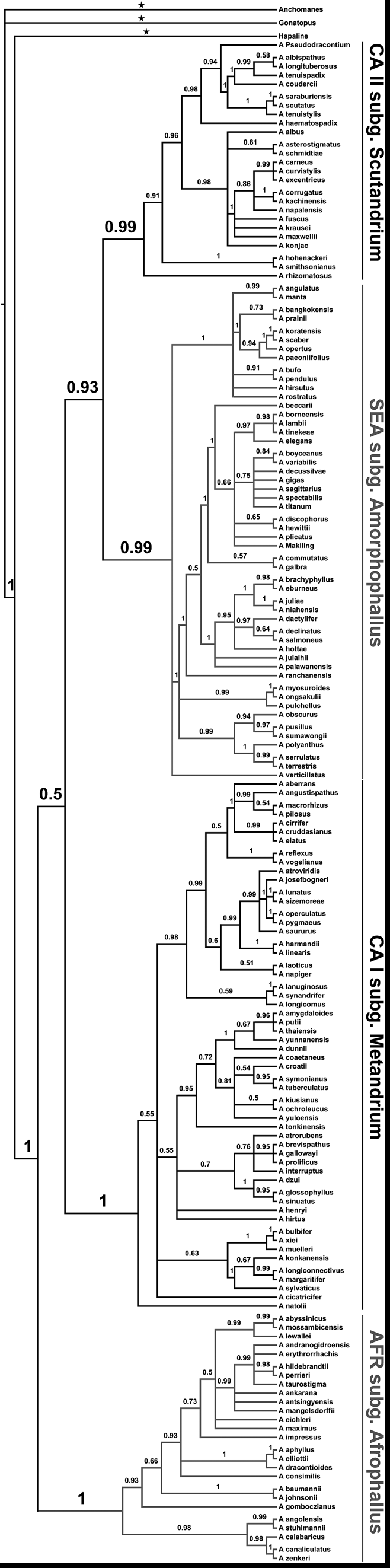
One of these you get for free
The paper states it flatly: “No species of any of the other three subgenera occur in Africa.”1
So for every African and Madagascan Amorphophallus, the subgenus is settled by the collecting locality alone. No character needs checking. That is roughly forty species placed by a map.
The locality settles the subgenus only for a plant that is an Amorphophallus to begin with. On June 23rd, 2000, Wilbert Hetterscheid wrote that Gonatopus in Africa is often misidentified as Amorphophallus, and added a rule of thumb from the tuber: an Amorphophallus tuber, by his estimate nine times in ten, has a noticeable depression on top in which the bud rests, while Gonatopus is more pyramidal7. The thread concerned tubers bought in California as Amorphophallus abyssinicus, which two buyers in it judged to be Gonatopus8, 9.
And the other three do not work that way
They all occur in mainland Southeast Asia and they overlap there heavily. A plant from Thailand or Laos or Vietnam could belong to any of the three, and its locality tells you nothing about which1. For those, you need characters — which poses the problem.
Part II
The two subgenera with no description
Open the taxonomic treatment in that paper and read the four entries in order. Two of them contain a heading that reads Diagnosis, followed by tubers, spathes, staminodes, styles and berries. Two of them contain a sentence explaining the name and then a distribution1.
Which two, and why
Scutandrium and Afrophallus were new names in 2017. A new name has to be published with a diagnosis, so both carry one. Metandrium had existed since 1924, and subgenus Amorphophallus is an autonym — it exists automatically because the genus type falls inside that clade. Neither needed a description, and neither was given one1.
This is not a fault in the paper
It is how the rules work. The authors did what naming requires and said openly that the deeper job is still outstanding: a thorough revision of the sectional taxonomy, in their words, “is pending, it is too complex and extensive to be satisfactorily treated here”1.
The point is not that something was done wrong. It is that a reader who wants to place a plant needs to know that for two of these four groups there is nothing published to place it against.
What that means when you have a plant
If your plant is African, Part I already settled it. If it is Asian, you are choosing between three subgenera, and only one of the three — Scutandrium — has a character list you can hold it up against. For the other two, membership is a position on a tree. It was established by sequencing, and in the general case it is confirmed the same way.
That is worth stating plainly rather than hiding, because the alternative is a reader concluding they have failed at something that cannot currently be done. You cannot key an Amorphophallus to subgenus Metandrium from a description, because no description has been published.
What you can do instead is Part IV. But first, the one character that turned out to carry more weight than anybody expected.
Part III
The character that is a calendar
In 1996, two decades before the DNA study that sorted it into four subgenera, Hetterscheid and Ittenbach published a key to it. Couplet 41 of that key does not ask what any part of the plant looks like. It asks what season things happened in.
Couplet 41
41a — leaf and inflorescence in the same season, inflorescence always preceding the leaf. (African, Madagascan species.)2
41b — leaf and inflorescence usually appearing in separate seasons; when they do appear in the same season, the leaf always precedes the inflorescence. (Asian species.)2
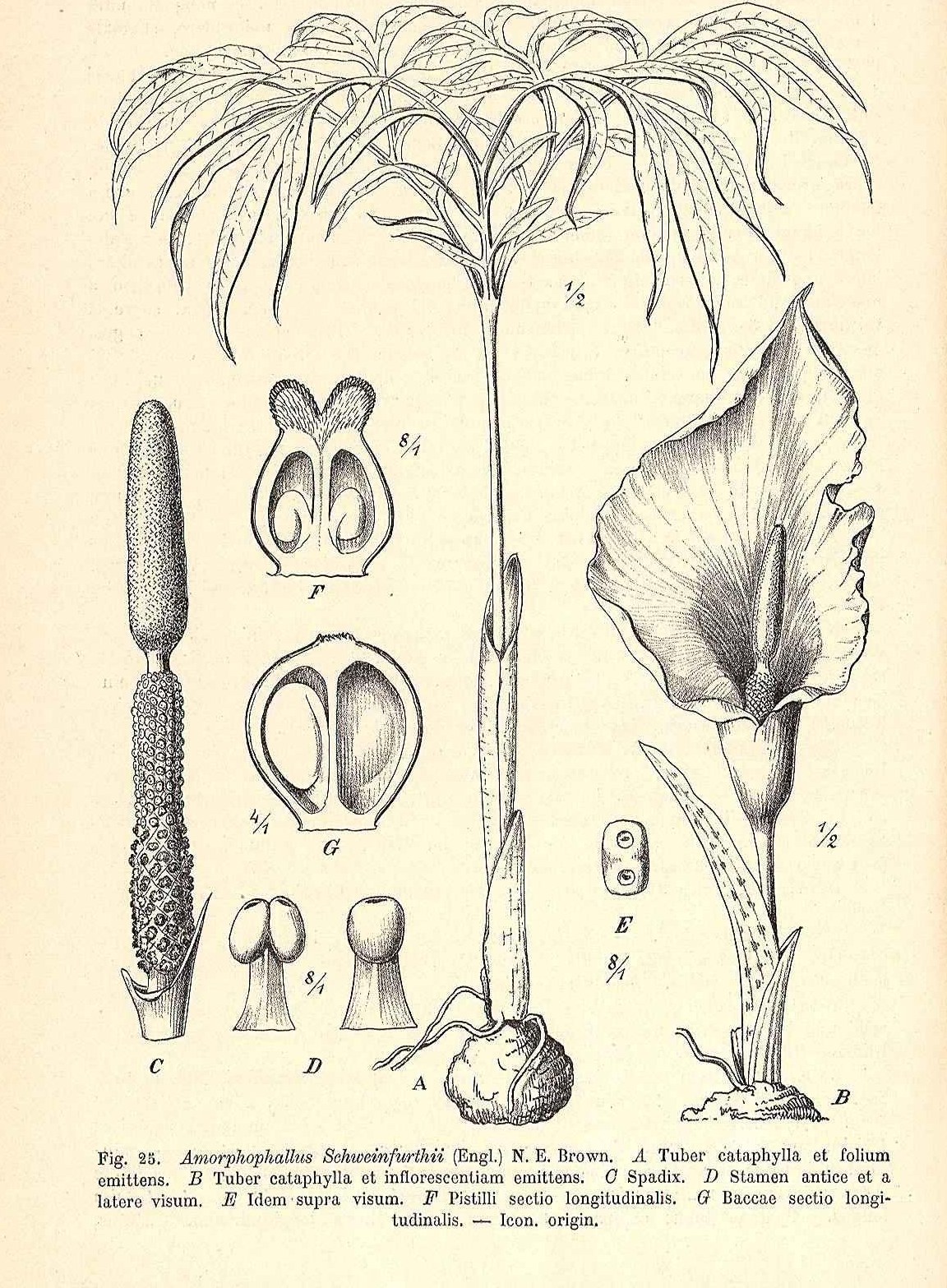
The same paper puts it in prose as well. African species “all develop a leaf in the same season as flowering, with or without pollination and fruit set”; the Asian non-evergreen species, in the wild, refuse to make a leaf after flowering and effective pollination, so “fruiting plants are never found with leaves”2.
Then the DNA arrived, and agreed
Twenty-one years later the molecular analysis erected subgenus Afrophallus for the African clade — and when it came to say what distinguishes that subgenus, the character it reached for was the growth cycle. Each year, both flowering and leafing occur in mature tubers; that cycle, the paper says, supports the molecular monophyly of the subgenus, and it is its most prominent apomorphy1.
And the credit is explicit
The 2017 paper does not present this as a new observation. It introduces it with “as described by Hetterscheid & Ittenbach (1996)”1.
So the connection is not something read into the two papers from outside. The molecular study points at the old key itself. The character that best marks one of the four subgenera is the one couplet 41 was already using to split the genus in half.
It is not the only one
Scutandrium's diagnosis runs on time too. Its inflorescence is described as appearing every second year, alternating with a solitary leaf in the next — with a named exception, Amorphophallus rhizomatosus, which carries leaf and inflorescence together1. That is a two-year observation written into a subgenus description.
Which is the hard part
A character like this cannot be checked. It can only be remembered. Nothing about the plant standing in front of you today answers couplet 41 — not a photograph, not a herbarium sheet, and not a careful hour with a hand lens. You answer it by having watched, or by having written it down.
Which is why the useful thing to keep for this genus is not a better photograph. It is a dated note.
The mechanics of that cycle — why the tuber can fund only one structure at a time, and what the two calendars cost the plant — are Part II of Amorphophallus Morphology. Here it matters only as evidence.
And it assumes a plant that rests
An evergreen species complicates the calendar. On December 29th, 2006, Wilbert Hetterscheid described Amorphophallus coaetaneus as an evergreen whose leaves may stay on for three to five years10. In Mobile, Alabama (USDA zone 8b), Russell Coker’s two plants of that species had their foliage cut back by frost in the fall of 2009; the next spring the first came up with a flower, and leaves on both followed almost two months later11. That is a flower ahead of the leaf, the reverse of the order couplet 41b gives for an Asian species that does both in one season. It comes from two plants after one hard winter, and the report does not say whether the order was the species’ own or a response to that winter.
Part IV
What you can look at
Two of the four subgenera do have published character lists. Here they are, side by side, as close to the original wording as prose allows. This is the whole of what the literature offers for keying an Amorphophallus above the level of species1.
| Character | Scutandrium | Afrophallus |
|---|---|---|
| Staminodes | When present, broadly shield-like — the subgenus is named for them1. | Absent1. |
| Tuber | Globose, subglobose, elongate, or rarely a rhizome1. | Depressed to disciform, rarely globose1. |
| Spathe | Erect, rarely constricted; base inside smooth or verrucate1. | Erect, often strongly constricted; base inside smooth, verrucate, or with hair-like papillae1. |
| Styles | Short, rarely very long — the exception being Amorphophallus maxwellii1. | Absent or short, rarely long — the exception being Amorphophallus gallaensis1. |
| Season | Inflorescence every second year, alternating with a leaf the next1. | Flowering and leafing both, every year1. |
| Berries | Red or orange1. | Orange or red1. |
Read the last row again
Scutandrium: berries red or orange. Afrophallus: berries orange or red. The same two colors, in the opposite order1.
It is in both diagnoses and it separates nothing. It is here because leaving it out would make the table look more decisive than the literature is — and because knowing which characters are dead ends saves you from staring at fruit.
So the short version
Of six characters, one does real work: the staminodes. Shield-like and broad, or not there at all. Two more help — a strongly constricted spathe and a flattened, disc-shaped tuber both point African. One is a calendar. One is a pair of named exceptions. One is noise.
And notice where they all are
Staminodes, spathe, styles, berries: every one of them is on the inflorescence. The remaining two are the tuber and the growth cycle. Nothing in either diagnosis is a leaf character.
That is the same result the morphology guide reaches from the other direction, where the leaf blade has no entry among the sixty-three characters in Ittenbach's 2003 table of key characters for the African species. Two independent routes, one answer: in this genus the crown alone is poor evidence, although Ittenbach notes characteristic leaflet and rhachis forms in individual African species. See Amorphophallus Morphology.
Part V
What is still open
The four groups are solid. How they relate to each other was not, and the 2017 paper is candid about it.
The backbone
The four clades held up under both methods. The branching order between them did not. In the authors' words, the relationships between the clades “remain poorly supported and would require further molecular investigations”, and the arrangement was “not at all resolved in previous studies” and still unclear1.
That gap was later addressed with far more data — a phylogenomic study using plastid genome sequences, aimed squarely at resolving the subgeneric backbone3. It is worth being precise about what that means: it filled a hole the 2017 paper had explicitly left open. It did not overturn a result, because on this question there was no supported result to overturn.
And a limit worth carrying
The analysis sampled 157 species of the 219 then recognized — so about sixty were never in it1. The genus has grown since, which means the unsampled share is larger now than it was.
So a subgenus assignment for any given species is safe if that species was in the matrix, and an expectation if it was not. Those are different things, and for most growers' plants it is worth knowing which one you have.
What to do with all this
Three things, in order of how much they will actually help.
Record the season. Note the date the inflorescence opened, and note whether a leaf came up that same year, before, after, or not at all. That single habit answers couplet 41, which is the character that carries the most weight in this genus and the one that no photograph can recover later. Note too whether old leaves were still on the plant when it flowered. On February 22nd, 2010, Wilbert Hetterscheid wrote that Amorphophallus polyanthus has a strong tendency to flower immediately after leaf senescence sets in, sometimes while old leaves are still more or less present12.
Photograph the inflorescence, not the crown. Every character in both published diagnoses is on the inflorescence or the tuber. When one opens, get the inside of the spathe base, the spadix, and — if the plant has them — the staminodes. Those few days are the only time the evidence exists. The leaf is a poor substitute. Michael Pascall of Whyanbeel Arboretum, in Far North Queensland, wrote on August 16th, 2001 that seed of a spotted-petiole form of Amorphophallus galbra, collected at Mount Amos near Cooktown, gave him only one seedling with a spotted petiole and all the rest green, and that the only true way to identify these variable plants is by the flower13.
Note the provenance. For an African or Madagascan plant the subgenus follows from the locality alone. For an Asian one the locality will not settle it, but it still narrows the species. Wilbert Hetterscheid reasoned this way on August 7th, 1997. In the vegetative state, he wrote, Amorphophallus bulbifer is difficult to separate from Amorphophallus muelleri. He had no reports of Amorphophallus bulbifer from Burma, where Amorphophallus muelleri is known, so for a plant from there Amorphophallus muelleri was a likely candidate14. The tuber might help: smooth in Amorphophallus bulbifer, and covered all over with distinct, raised, annulate root scars in Amorphophallus muelleri14, 15.
The rest of this genus on the site
Amorphophallus Morphology — the tuber, the single leaf, and why its blade is so little help in naming a species.
Amorphophallus Reproduction — the inflorescence itself: heat, scent chemistry, who comes to it, and how to cross one. The smell is a real character in this genus, and it is worked there rather than here.
Sources
The papers behind this page
Fifteen sources. Six are papers. One molecular analysis supplies the classification and both of the published diagnoses; one key from twenty-one years earlier supplies the character that turned out to matter most; one phylogenomic study addresses the question the first one left open; and two more carry the figures — a 1911 monograph plate and a 2023 set of regional keys. The sixth, a 2003 revision of the African species, supplies the character table discussed in Part IV. The other nine, numbered 7 to 15, are messages to the Aroid-L mailing list: statements made in correspondence, not published determinations.
- Claudel, C., Buerki, S., Chatrou, L. W., Antonelli, A., Alvarez, N. & Hetterscheid, W. (2017). Large-scale phylogenetic analysis of Amorphophallus (Araceae) derived from nuclear and plastid sequences reveals new subgeneric delineation. Botanical Journal of the Linnean Society 184: 32–45. doi:10.1093/botlinnean/box013 Most of this page. The first well-sampled molecular phylogeny of the genus — 157 species, ITS1 with rbcL and matK — and the paper that erected the four subgenera, two of them new. It is the source of both published diagnoses in Part IV, of the statement that no species of the other three subgenera occurs in Africa, and of the candid admission in Part V that the relationships between the four clades were not resolved. It is also where the species of Pseudodracontium, sunk into Amorphophallus by Hetterscheid and Claudel in 2012, are placed in subgenus Scutandrium.
- Hetterscheid, W. & Ittenbach, S. (1996). Everything you Always Wanted to Know about Amorphophallus, but Were Afraid To Stick Your Nose Into!!!!! Aroideana 19: 7–131. The genus-wide account, and the source of couplet 41 — the point in its key where the genus divides on a question of season rather than shape. A hundred and twenty-five pages, and worth the title. Part III is built on it, and so is the claim it supports: that when a molecular study came to characterize subgenus Afrophallus two decades later, the character it reached for was this one, credited to this paper by name.
- Pouchon, C., Gauthier, J., Pitteloud, C., Claudel, C. & Alvarez, N. (2023). Phylogenomic study of Amorphophallus (Alismatales; Araceae): When plastid DNA gene sequences help to resolve the backbone subgeneric delineation. Journal of Systematics and Evolution 61: 64–79. doi:10.1111/jse.12910 Cited once, in Part V, for one fact: that the backbone question the 2017 analysis left unresolved was later taken up with plastid genome data. ⚠ The copy held here is a scan without a usable text layer, so nothing is quoted from it and no topology or support value is stated from it on this page.
- Engler, A. (1911). Araceae-Lasioideae. In: Engler, A. (ed.), Das Pflanzenreich IV.23C. Wilhelm Engelmann, Leipzig. The plate in Part III — Fig. 25, p. 70, Amorphophallus schweinfurthii, drawn for the monograph rather than copied into it. Its legend labels the two states plainly: A Tuber cataphylla et folium emittens. B Tuber cataphylla et inflorescentiam emittens. ⚠ Engler draws both states and does not comment on their season or their order, so the plate is cited here as an illustration of what couplet 41 asks about, never as a source for the couplet itself.
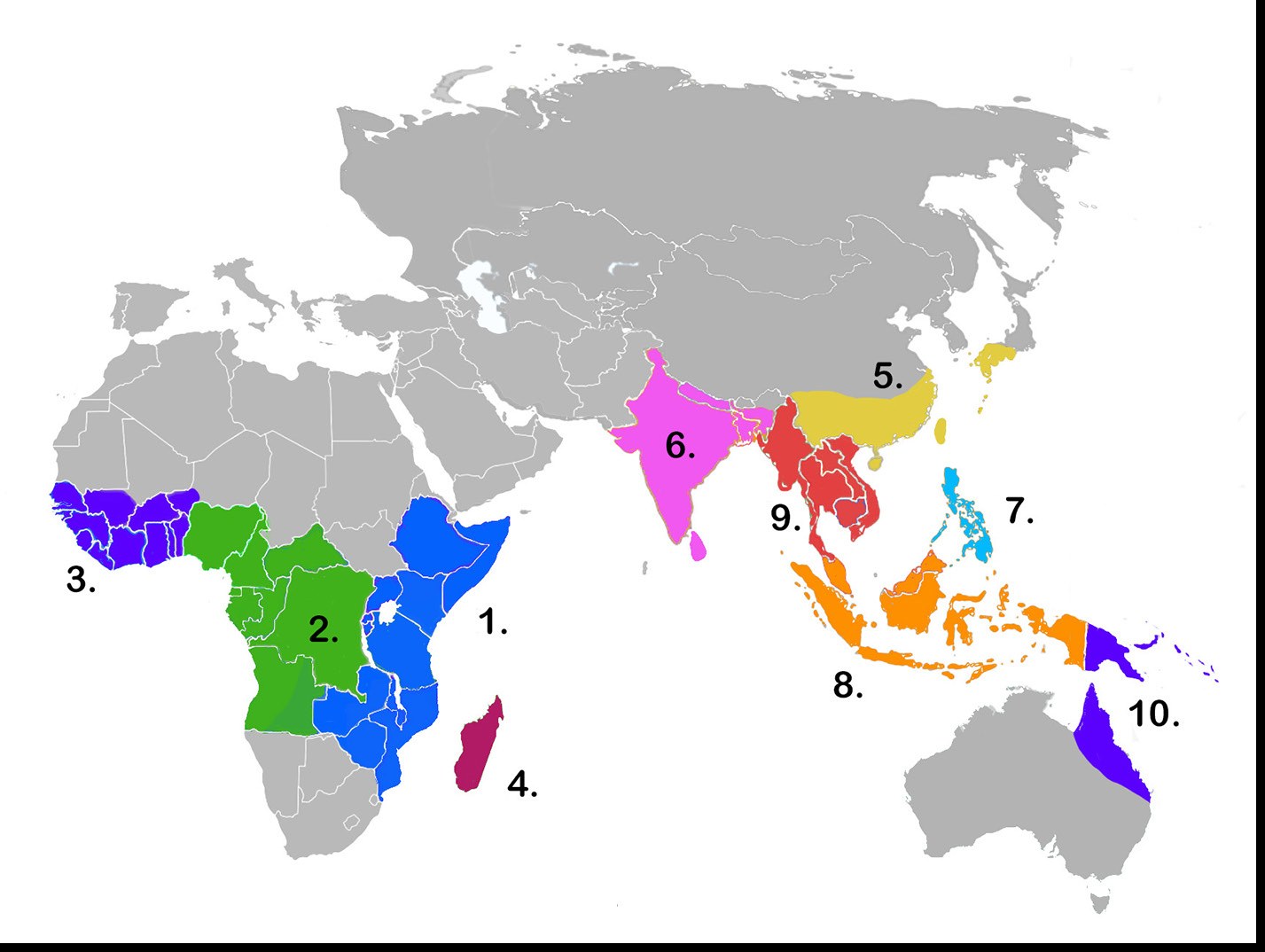
- Scholten, J. (2023). An updated identification guide to the species of Amorphophallus (Araceae): new synonyms and a set of global dichotomous keys. Blumea 68(2): 139–161. doi:10.3767/blumea.2023.68.02.03 The regional map in Part IV, which is this paper's Fig. 2: ten geographical subkeys, assigned by where the plant was collected. It counts 239 accepted species, against the 219 the 2017 analysis worked from — a useful measure of how far the genus has moved underneath its own classification.
- Ittenbach, S. (2003). Revision der afrikanischen Arten der Gattung Amorphophallus (Araceae). Englera 25: 2–263. The character table of sixty-three characters discussed in Part IV.
- Aroid-L mailing list, Wilbert Hetterscheid, June 23rd, 2000
- Aroid-L mailing list, Don Bittel, June 22nd, 2000
- Aroid-L mailing list, Elizabeth Peters, June 24th, 2000
- Aroid-L mailing list, Wilbert Hetterscheid, December 29th, 2006
- Aroid-L mailing list, Russell Coker, June 28th, 2010
- Aroid-L mailing list, Wilbert Hetterscheid, February 22nd, 2010
- Aroid-L mailing list, Michael Pascall, August 16th, 2001
- Aroid-L mailing list, Wilbert Hetterscheid, August 7th, 1997
- Aroid-L mailing list, Wilbert Hetterscheid, March 20th, 2004