

Araceae · Reproductive Biology
THE
DUMB CANE
One of the best-measured pollination systems in the family — and the same beetle is a partner at low numbers and a pest at high ones
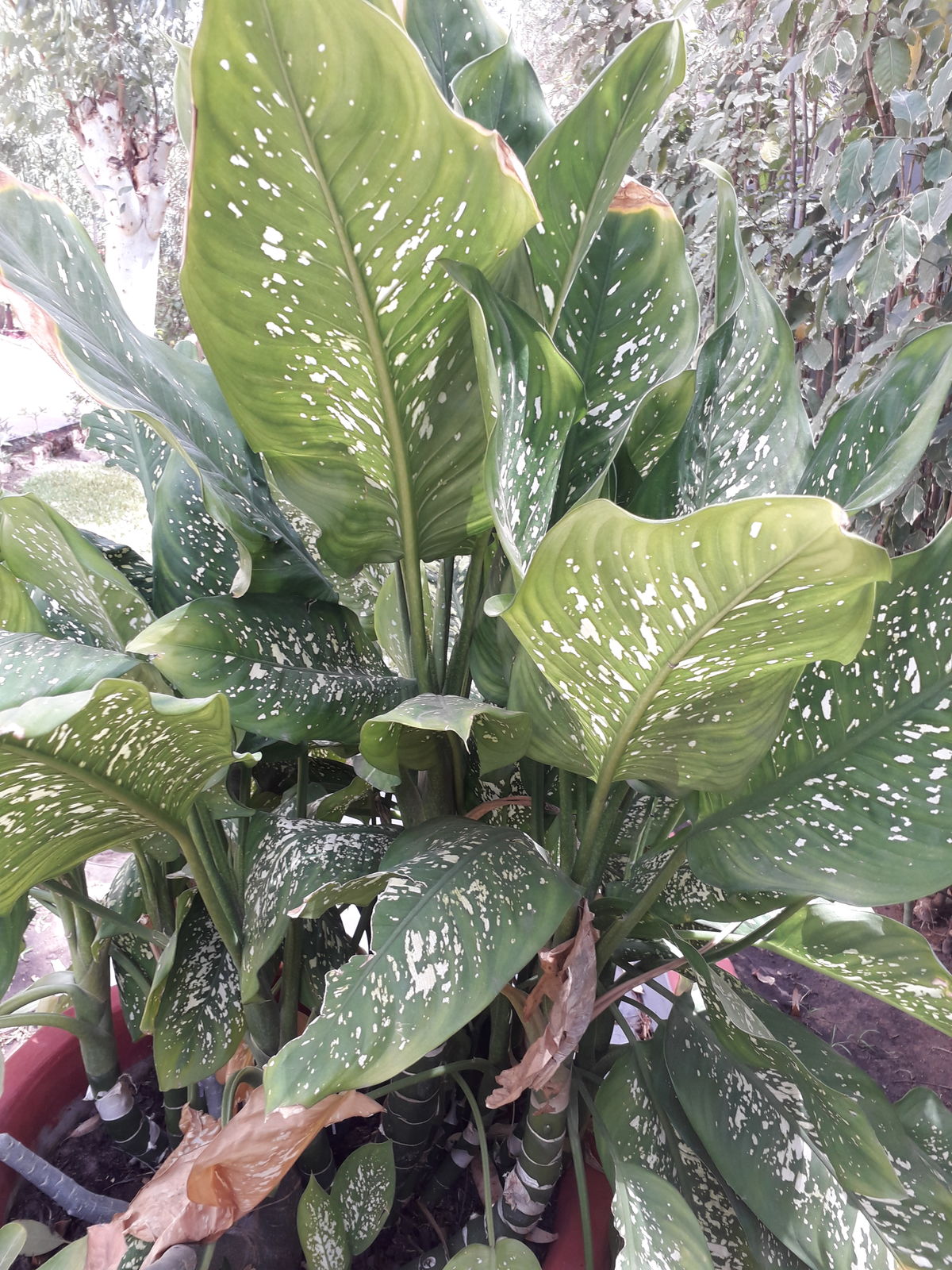
The dumb cane is on more windowsills than any other aroid except the pothos, and almost nobody who owns one has seen it flower. In the wild it runs one of the most thoroughly measured pollination systems in the family — over a thousand marked plants, nearly five thousand marked beetles, and three field seasons.
Dieffenbachia is a Central and South American genus of soft-stemmed forest-floor herbs. It sits at the base of a tribe that is otherwise made up of geophytes, and it is the only member of that tribe to reach Central America, Mexico and the West Indies. What people grow indoors is mostly one species, Dieffenbachia seguine, in a great many variegated selections.
How thin the evidence base actually is
The genus has 57 described species and perhaps 140 in reality. Pollination or reproduction data exist for five of them, across six populations.
Everything on this page comes from that handful, and most of it from a single Costa Rican forest.
What is known is known well
Every studied species is pollinated by cyclocephaline scarab beetles, and in the one study that checked, only the scarabs carried any pollen at all. Flies, true bugs and sap beetles were caught leaving the inflorescences and examined: not a single grain between them.
The inflorescence runs a three-day program in which the first twenty-four hours are sexually dead. It heats once, not twice. Its staminodes are a protein-and-carbohydrate food body that double as the thing holding the beetles in place. And a beetle leaving it may be carrying more than a thousand pollen grains, or none.
The result that makes this genus worth a page
An inflorescence's chance of setting fruit rises with the number of beetles in it, peaks at about eight to twelve, and then falls.
In a year when beetles were four times as abundant, the commonest beetle species loaded negatively on fruit set while a scarcer one loaded positively. In a lean year, no species differed from any other. The same insect is a mutualist at low density and something closer to a parasite at high density — and abundance turns out to be a poor guide to which visitor matters.
One naming problem, stated once
The plant studied at La Selva through the 1980s was published as Dieffenbachia longispatha. It was later redetermined as Dieffenbachia nitidipetiolata. A 1999 study then compared the true Dieffenbachia longispatha, in Panama, against that same La Selva plant.
So two bodies of work carry the same name on their covers and are about different species. This page uses the corrected names throughout, and the Sources block records what each paper actually says on its title page.
Part I
The Plant and the Clock: Three Days, and the First One Does Nothing
A dumb cane inflorescence is open for three days. For the first twenty-four hours of that it is not receptive to anything — a finding that contradicted two earlier accounts which had assumed the opposite.
The three days
| When | What the inflorescence is doing |
|---|---|
| Day 1, early evening | The spathe opens. Nothing is receptive. No stigma will take pollen and no anther will shed it for about a day |
| Day 2, about 17:30 | Stigmas become receptive. The single heating episode and the scent belong here — the female stage. Beetles arrive and go into the chamber |
| Day 3, about 17:00–17:30 | Pollen is released while the stigmas are still receptive — which leaves a window in which the inflorescence can pollinate itself |
| Then, for 8–11 months | In the plant studied at La Selva, the spathe closes over the fruit and stays shut while it ripens, green to white to yellow to orange-red |
The plant cannot easily pollinate itself from a neighboring flower
A single shoot carries two to seven inflorescences, about 4.8 on average — and they open three to twelve days apart, never two at once.
So pollen moving between inflorescences on the same shoot is effectively prevented, and on that shoot the route to selfing is inside a single inflorescence, in that day-three overlap. The timing does not cover a neighboring shoot of the same clone, which is why the crossing experiments took their pollen from plants at least fifty meters away.
The heat
One heating episode, in the female stage, of about 3.3 and 4.1 degrees above ambient, just before seven in the evening.
Two inflorescences, two evenings
Those figures come from n = 2, on two evenings in one season. They are a demonstration that this plant heats, and they are not a species value. The only Dieffenbachia thermometry with usable replication is from French Guiana — Dieffenbachia seguine at 14 inflorescences and Dieffenbachia paludicola at 5 — and those were taken by a different method in a different setting, so the amplitudes do not stand beside these.
What is worth noting is the shape: one peak, in the female stage only. That is unlike the two-peak pattern of Philodendron and it is shared with the one other genus in this tribe that has been measured.
The scale of the thing
A Dieffenbachia nitidipetiolata inflorescence at La Selva carries about 77 female flowers and roughly 440 male units above them. Those are one species' numbers, not the genus's — the two species measured in French Guiana run far smaller, Dieffenbachia seguine at about 44 female flowers and 213 male units, and Dieffenbachia paludicola at about 10 and 167. Between the two zones sits a band of sterile flowers. Each female flower is surrounded by staminodes, which are the beetles' food and, as Part IV shows, the reason the beetles stay.
And the name problem, stated once
Two research programs, one name, two species
The plant studied at La Selva in Costa Rica through the 1980s was published as Dieffenbachia longispatha. It has since been redetermined as Dieffenbachia nitidipetiolata.
A 1999 study then compared the true Dieffenbachia longispatha, on Barro Colorado Island in Panama, against that same La Selva plant — and found different principal pollinators at the two sites.
The rest of this page uses the corrected names. The papers themselves still say longispatha on their covers, and a citation that follows them is not wrong — it is just about a different plant than it appears to be.
Part II
Only the Scarabs Carry Pollen: Everything Else Is a Passenger
Plenty of insects turn up at a flowering dumb cane. Sixty- three of the non-scarabs were caught and examined grain by grain. Not one of them was carrying any pollen at all.
The measured zero
Three groups were sampled off the inflorescences and checked: 13 Drosophila, 29 plant bugs and 21 sap beetles. Every one of them came back with zero grains.
This is not an absence of looking. It is the result of looking. The cyclocephaline scarabs are the only animals moving this plant's pollen, and that is true for every species of Dieffenbachia anyone has studied.
A departing beetle can be carrying more than a thousand grains
Across thirteen departing Cyclocephala, the mean load was 1,649 grains. That is a substantial cargo for an animal that will fly, on average, eighty-three meters to the next open inflorescence.
And it does not keep
The pollen is trinucleate and short-lived: about a quarter is still viable at twenty-four hours, and a sixth at forty-eight. A beetle that sits in the same inflorescence for a day is not carrying much of use by the time it leaves.
That fact is doing more work than it looks, and Part III is about what it costs the plant.
What the loads do not tell you
Carrying pollen is not the same as delivering it. When single visits by each of the three main beetles were compared directly, the difference in how often they produced fruit was not significant — sixty-five, fifty-two and fifty-three per cent of inflorescences aborted after one visit, regardless of which species had visited.
So the beetle with a dozen grains and the beetle with nine hundred looked about equally effective on a single visit. The difference only appears when you count what happens over a season, which is the next part.
Part III
Abundance Is Not Importance: The Same Beetle, Twice Over
Three beetle species visit this plant in numbers. On a single visit they are equally good at setting fruit. Over a season they are not remotely equivalent, and the most abundant one is the worst.
The trap in the obvious method
The standard way to rank pollinators is to multiply how effective a visit is by how often the animal visits. Do that here and the answer is clear: Erioscelis columbica is the most abundant beetle by a wide margin, its single visits are as productive as anyone's, so it must be the most important pollinator.
The season-long fruit-set data say the opposite.
Success is a hump, not a slope
The probability that an inflorescence sets fruit rises with the number of beetles inside it, peaks at about eight to twelve, and then falls.
In the year beetles were abundant, fruit set rose only to about four beetles before declining. Comparing like with like — restricting to inflorescences with fewer than fifteen beetles — the peak in that year sat at six.
What a four-fold beetle year looks like
| 1982 | 1983 | 1984 | |
|---|---|---|---|
| Beetles collected | 487 | 3,077 | 1,131 |
| Mean beetles per inflorescence | 1.77 | 7.27 | 1.96 |
| Most in one inflorescence | 15 | 39 | — |
And in the crowded year the species pulled in opposite directions
Once the effect of sheer numbers was accounted for, the proportion of Cyclocephala gravis in an inflorescence loaded positively on fruit set, and the proportion of Erioscelis columbica loaded negatively. Cyclocephala amblyopsis had no effect either way.
In the lean year, no species differed from any other.
So the same insect is a useful partner when there are few of them and a net cost when there are many. That is not a statement about beetle species. It is a statement about density — and it means a pollinator's value cannot be read off a visitor list.
Why Erioscelis specifically
Two behaviors, and they pull against each other. It is the flighty one — significantly more of them leave within half an hour of arriving. It is also the loiterer: a third of all Erioscelis recaptures were in the same inflorescence on consecutive days, eating the male flowers or chewing out through the spathe, against 2.6 per cent for Cyclocephala gravis and 4.3 per cent for Cyclocephala amblyopsis.
With pollen only a quarter viable after a day, a beetle that stays put is carrying nothing worth carrying by the time it goes.
Two limits, and the second is the more important
Beetles explain very little of it. Every one of the fruit-set regressions has an r-squared between 0.02 and 0.08. Whatever is driving fruit set in this plant, the number and identity of beetles is a small part of it — how many mates are within flying range, and how much the plant can afford, carry the rest.
And nobody has seen the damage. The decline above a dozen beetles is an inference from the curve. In three field seasons, exactly one instance of ovary damage was observed. Dislodged pollen, accumulating waste, and foreign pollen blocking the stigmas are all offered as possible explanations, and none of them has been tested. The hump is real; the reason for its right-hand side is not established.
Part IV
The Tether and the Cost: What Holds the Beetles, and What Selfing Buys
Between the female and male zones sits a band of sterile flowers. Each female flower is surrounded by staminodes, which are the beetles' food and the only thing keeping the beetles on the plant — which was shown by cutting them off.
The staminodes
They are a food body, and a rich one: about a quarter protein, over half carbohydrate, with some fat, at around four hundred calories per hundred grams. A beetle that walks into the chamber has somewhere to be for a day and a reason to stay.
Remove them and the retention collapses to nothing. The plant is not trapping its pollinators — it is paying them to stay put for the twenty-four hours between the stigmas becoming receptive and the pollen being released — and the stigmas are still receptive when the pollen comes, which is exactly why the day-three selfing window exists.
What selfing costs
The plant can pollinate itself. Its own pollen works, and in the day-three overlap it has the opportunity. But every measure says it is a poor substitute.
| Treatment | Result |
|---|---|
| Self-pollinated by hand | 3 of 14 inflorescences succeeded; 4.64 fruits each |
| Cross-pollinated by hand | 13 of 28 succeeded; 13.21 fruits each |
| Bagged, no beetles got in | 55 of 57 aborted |
| Bagged, but beetles chewed their way in | only 6 of 20 aborted |
| Male flowers removed | 12 of 12 aborted — no seed without pollen, so no apomixis |
Selfed fruit also took longer to ripen — about 297 days against 271 — on a plant that is already carrying its fruit inside a closed spathe for the better part of a year.
And it is not getting enough pollen as it is
Seven inflorescences given extra pollen by hand all set fruit, at 65.9 per cent, against 40.5 per cent for a hundred and sixty-nine left to the beetles.
On the standard definition, this plant's fruit set is pollinator-limited. Whatever the beetles are doing, they are not saturating it.
One tension the sources leave open
Bagged and unvisited inflorescences aborted 55 times out of 57, which reads as almost no spontaneous selfing. But the later analysis found that bagged unvisited inflorescences gave about 29 per cent fruit set, and its regressions predict sixteen to twenty per cent even with no beetles at all.
Both figures are printed here and neither is dropped. Some self-pollination happens without visitors; how much is not settled.
Sources
Sources, and What Kind of Evidence Each One Is
Six papers carry this page, and two of them are one researcher's work on one Costa Rican forest. That concentration is the single most important thing to know about the evidence.
- Young, H. J. (1986). Beetle pollination of Dieffenbachia longispatha (Araceae). American Journal of Botany 73(6): 931–944. The foundation of the page. The three-day clock, the thermogenesis, the flower counts, the breeding system, the staminode-removal experiment, the pollinator-limitation test and the zero-pollen result are all here. Grade: field experiment at scale — 1,017 marked plants, 4,843 marked beetles, three seasons, 129 bagged inflorescences. Note: the species is Dieffenbachia nitidipetiolata (Croat 2004), not longispatha. The thermogenesis figures are the weakest thing in it: n = 2, on two evenings.
- Young, H. J. (1988). Differential importance of beetle species pollinating Dieffenbachia longispatha (Araceae). Ecology 69(3): 832–844. All of Part III, and the per-species pollen loads in Part II. Grade: three-season observational study with regression analysis, and unusually honest about its own explanatory power — every fruit-set regression has an r-squared between 0.02 and 0.08. Same species and site as above. Its headline — that pollinator importance is density-dependent and non-monotonic — is the reason this genus is worth a page. Its damage mechanism is explicitly not shown: one observed instance of ovary damage in three years, and three untested hypotheses.
- Gibernau, M. (2015). Floral biology, pollination ecology and genetics of Dieffenbachia (Araceae) — a review. Aroideana 38: 19–28. The genus frame in the Opening and Part I: the species totals, the five-species evidence base, the tribal placement, the staminode composition and the pollinator roster across all studied species. Grade: review synthesis — it argues and compiles, it does not measure. Useful precisely because it makes the thinness of the evidence explicit. Note that its rendering of one two-site comparison is the reviewer's own computation of means and ranges; cite the primary for those numbers.
- Gibernau, M. (2015). Pollination ecology of two Dieffenbachia in French Guiana. Aroideana 38E(2): 38–66. The second Gibernau paper of the same year, and the one that measures. A field study at the Nouragues station, fieldwork in July 2006 and June 2009, with 182 Dieffenbachia seguine plants and 31 Dieffenbachia paludicola plants marked in two populations about sixty meters apart — and the first data ever published for Dieffenbachia paludicola. Grade: field study with breeding experiments. Visitation on 80 Dieffenbachia seguine inflorescences, 151 beetles identified; thermogenesis on 14 and on 5; 34 infructescences dissected for 518 berries and 298 weighed seeds. Two limits travel with its crossing numbers: the hand-pollination results are fruit initiation only — every experimental infructescence was collected immature and seed number and viability were never assessed — and the crossing work was done on Dieffenbachia seguine alone.
- Beath, D. N. (1999). Dynastine scarab beetle pollination in Dieffenbachia longispatha (Araceae) on Barro Colorado Island (Panama) compared with La Selva Biological Station (Costa Rica). Aroideana 22: 63–71. Used on this page for one thing: it is the study that puts true Dieffenbachia longispatha beside the La Selva plant and finds different principal pollinators at the two sites, even though a shared beetle species occurs at both. Grade: two-site observational comparison — 9 inflorescences on Barro Colorado and 13 at La Selva, 28 beetles and 60 beetles, one field season each and one observer. Site and month are completely confounded: Barro Colorado was watched in July 1997 and La Selva in September 1997, and neither site was ever visited in the other's month. Note that its own concluding interpretation is superseded and is not repeated here; and its chi-squared tests cannot be reconstructed from what it prints, and one of them is commonly misread.
- Cuartas-Hernández, S., Núñez-Farfán, J. & Smouse, P. E. (2010). Restricted pollen flow of Dieffenbachia seguine populations in fragmented and continuous tropical forest. Heredity 105: 197–204. The genetics, and the only Mexican fieldwork here. Four 0.1-hectare plots at Los Tuxtlas, Veracruz — two inside continuous forest, two in fragments of 3 and 37 hectares — marked in November 2002, with infructescences collected the following April and May. Grade: population genetics — 209 flowering adults mapped, 65 maternal families, 531 seedlings, nine polymorphic allozyme loci. It reaches something no amount of watching can: one to two fathers stand behind a whole infructescence (effective pollen donors 1.01 to 2.42 across the four plots), so the seeds in one fruiting spike are close to a full-sib family. Outcrossing is near-total in three plots and partial in the fourth. Three limits travel with it: it is one season; it watched no beetle, scored no fruit set and recorded no floral biology of its own; and its pollination-neighborhood areas rest on an assumed donor density borrowed from an unrelated woodland herb, so every one of those figures moves inversely with an assumption that has never been tested in a Dieffenbachia.
Where this leaves the genus
Five species out of perhaps a hundred and forty. Two of the six papers above are the same researcher, on the same plant, in the same forest, in the early 1980s. The most recent first-hand fieldwork is from 2009 — the Mexican genetics reads later than it was gathered, its plots marked in 2002 and picked in 2003.
What is missing, and it is a lot
Almost no scent chemistry. Two sites have different principal pollinators and the presumed reason is a difference in floral odor — which has not been analyzed for either plant. The scent of another species has been: Dieffenbachia aurantiaca in southwestern Costa Rica, six inflorescences from five plants, nine compounds with cis-jasmone 49 percent of the blend (Etl and colleagues 2016, Journal of Chemical Ecology 42: 300–304). That study was about the plant bugs that feed and mate on the inflorescences; one cyclocephaline scarab came to a cis-jasmone lure, and whether the compound draws the pollinators was left open.
Thermometry that cannot be compared. Four heat records exist, and only the French Guiana pair has usable replication — Dieffenbachia seguine at 14 inflorescences and Dieffenbachia paludicola at 5. The rest of the genus's heat record is two inflorescences on two evenings. The amplitudes were taken by different methods in different settings and do not stand beside each other.
The cultivation record has no insect in it. Dieffenbachia seguine is grown by the million, and every population studied properly is a wild one — Guianan plants on stream boulders, and four forest populations at Los Tuxtlas in Veracruz, where the work was chiefly genetic but a 12-day check of 271 open inflorescences found scarab visits scarce: 12 Cyclocephala occurrences, of three species, and fewer in the forest fragments. Cultivated plants have been watched flowering — a Florida breeding collection of 50–60 cultivars and species, over three years, chiefly Dieffenbachia seguine 'Perfection', gives a spathe that usually unfurls at night, stigmas receptive that day and possibly the next, pollen 2–3 days after unfurling, 40–80 female flowers on an inflorescence, and fruit ripe about 4–5 months after pollination (Henny and Rasmussen 1980, Aroideana 3(2): 65–68, a horticultural paper outside the five sources above). But that is a brush-pollination protocol, and the gap it records between the two sexes runs wider than any wild interval on this page. The paper publishes its plants under the name Dieffenbachia maculata, now treated as a synonym of Dieffenbachia seguine. A separate 1980 paper by R. J. Henny reported that gibberellic acid (GA3) induced flowering in Dieffenbachia maculata 'Perfection' (Henny 1980, HortScience 15(5): 613), the plant now called Dieffenbachia seguine 'Perfection'.