


Subfamily Aroideae·Tribe Areae
Arum
Field guidesArum
DESCRIPTION
Arum is a genus of 27 species of tuberous, seasonally dormant perennial herbs in the family Araceae — the genus that gives the family its name, and the one from which a good many other aroid genera were carved. It ranges from the Azores and the Canary Islands east to western China, and from southern Scandinavia and the British Isles south into North Africa and the Levant.
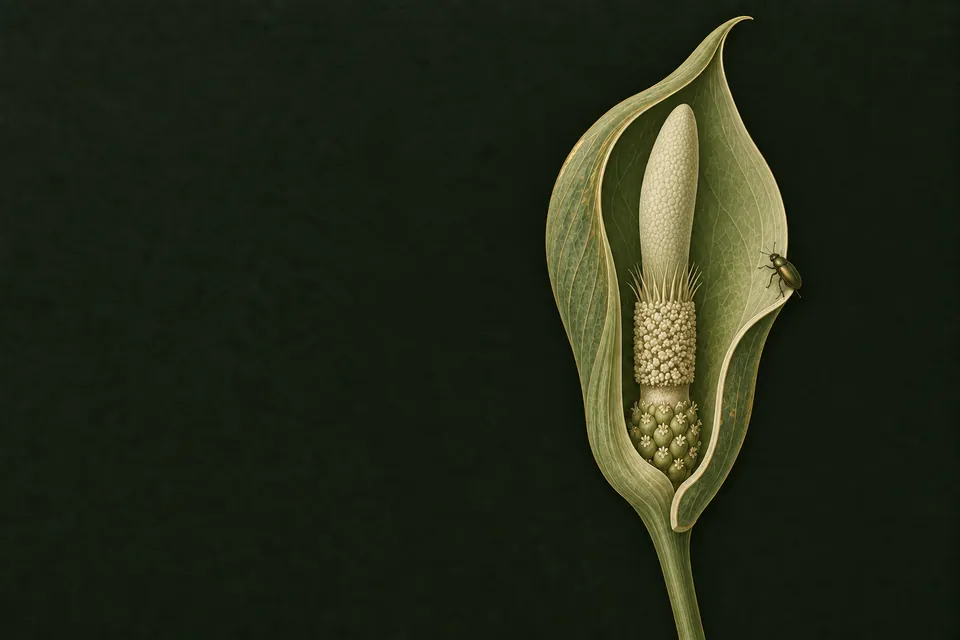
Every species spends part of the year as a bare tuber underground. Above ground the plant is a handful of cordate, sagittate or hastate leaves on sheathing petioles and a single inflorescence: a spathe rolled into a closed basal tube around the flowers, opening above into a limb, with a naked spadix appendix standing clear of the tube. Leaf shape and color vary so freely within one colony that the first leaf of the season and the last can look like different plants.
The name is much older than the genus. Linnaeus took up a word already in general use, recorded as a generic name in 1542 and, long before that, in classical Greek, where both Pliny and Dioscorides described more than one kind of aron. Arum maculatum alone is credited with more than a hundred English common names, nearly all of them drawn from the look of the plant in flower.
Recorded for Arum maculatum in England, Wales and Scotland by 1886. Most fall into a few families: paired names for the two spadix colors, clergy names for the hooded spathe, animal names for the berries, and a large group of frankly sexual names for the appendix.
DISTRIBUTION
Wholly Old World, and almost wholly temperate: Arum is the one genus of Araceae centered on Europe and the Mediterranean. The range runs from the Atlantic islands — the Azores, Madeira and the Canaries — east across the Mediterranean basin and the Caucasus into Central Asia, reaching Xinjiang, Tibet and the western Himalaya; north to Sweden, Denmark, Ireland and Great Britain; and south through Morocco, Algeria, Tunisia and Libya, and down the Levant into Iraq and Iran.
Beyond those 57 native places the genus is naturalized in 21 more — most of them states of the USA, both coastal and inland, along with New Zealand, Argentina, Norway and a handful of northern European countries where it does not occur wild. In coastal California, for example, Steve Hall reported on the Aroid-L mailing list finding Arum italicum naturalizing in several spots in San Francisco’s Golden Gate Park, some of the patches several feet across (April 10th, 1997), and Danny Wilson wrote that in Santa Cruz it had spread, as far as he could tell, across his neighborhood from a few plants set out many years before, even growing in street cracks, and was among the nastiest invasive plants in town (August 29th, 2004).
CHROMOSOMES
2n = 28 in 15 of the 17 species counted (88%).
+ 3 rarer counts
Shares add up to more than 100% because some species have been counted at more than one number, usually diploid and polyploid forms of the same species (e.g. Arum cyrenaicum at 28 and 56).
17 of 27 species have a published 2n count.
Base chromosome number: x = 7 (Terpó 1973), x = 14 (Petersen 1993).
What chromosome numbers mean for a cross, in the Chromosomes and Crossing guide.
Counted species (17)
- Arum apulum56
- Arum concinnatum84
- Arum creticum28
- Arum cylindraceum28
- Arum cyrenaicum28, 56
- Arum dioscoridis28
- Arum euxinum28
- Arum hygrophilum28
- Arum italicum28, 56, 83, 84, 85
- Arum korolkowii28
- Arum lucanum28
- Arum maculatum28, 42, 56, 84
- Arum nigrum28
- Arum orientale28
- Arum palaestinum28
- Arum pictum28
- Arum rupicola28
Sources (22)
- Alpınar, K. 2007. The Araceae of Turkey. Aroideana 30.
- Bashasha, J. A.; Imryed, Y. F.; Adam, H. J. 2025. First Karyotype Report of Arum cyrenaicum Hruby (Araceae) from AL-Jabal AL-Akhdar, Libya. Scientific Journal of University of Benghazi 38(2): 94–102.
- Bedalov, M.; Gutermann, W. 1982. Die Gattung Arum in den Ostalpen-Ländern. Stapfia 10: 95–97.
- Bedalov, M.; Küpfer, P. 2006. Studies on the Genus Arum (Araceae). Aroideana 29.
- Beuret, E. 1971. Répartition géographique de quelques Arum des groupes maculatum L. et italicum Mill. Bulletin de la Société Neuchâteloise des Sciences Naturelles 94: 29–36.
- Beuret, E. 1977. Contribution à l'étude de la distribution géographique et de la physiologie de taxons affines di- et polyploïdes. Bibliotheca Botanica (E. Schweizerbart'sche Verlagsbuchhandlung, Stuttgart).
- Boyce, P. 1989. A new classification of Arum with keys to the infrageneric taxa. Kew Bulletin 44(3): 383.
- Boyce, P. 1993. The Genus Arum. Kew Magazine Monograph (HMSO, London).
- Chartier, M.; Liagre, S.; Weiss-Schneeweiss, H.; Kolano, B.; Bessière, J.-M.; Schönenberger, J.; Gibernau, M. 2016. Floral traits and pollination ecology of European Arum hybrids. Oecologia 180(2): 439–451.
- Gfrerer, E.; Laina, D.; Gibernau, M.; Fuchs, R.; Happ, M.; Tolasch, T.; Trutschnig, W.; Hörger, A. C.; Comes, H. P.; Dötterl, S. 2021. Floral scents of a deceptive plant are hyperdiverse and under population-specific phenotypic selection. bioRxiv.
- Hadjikyriakou, G.; Hand, R.; Mansion, G. 2011. Arum cylindraceum subsp. pitsyllianum (Araceae), a New Taxon from Cyprus. Novon: A Journal for Botanical Nomenclature 21(4): 431–436.
- Löve, Á.; Kjellqvist, E. 1973. Cytotaxonomy of Spanish plants II. Monocotyledons. Lagascalia 3(2): 147–182.
- Marchant, C. J. 1972. Chromosome variation in Araceae: IV. Areae. Kew Bulletin 26(3): 395–404.
- Marchant, C. J. 1973. Chromosome variation in Araceae: V. Acoreae to Lasieae. Kew Bulletin 28(2): 199–210.
- Petersen, G. 1993. Chromosome Numbers of the Genera of Araceae. Aroideana 16.
- Prime, C. T. 1954. Arum neglectum (Towns.) Ridley. Journal of Ecology 42(1): 241–248.
- Prime, C. T. 1961. Taxonomy and nomenclature in some species of the genus Arum L. Watsonia 5(2).
- Prime, C. T.; Buckle, O.; Lovis, J. D. 1955. The distribution and ecology of Arum neglectum in southern England. Part I. Kent, Sussex, Hants. and Dorset. Proceedings of the Botanical Society of the British Isles 1(3-4): 287–296.
- Riedl, H. 1967. Die infraspezifischen Einheiten von Arum maculatum in Mitteleuropa. Phyton, Annales Rei Botanicae 12(1-4): 159–168.
- Sowter, F. A. 1949. Arum maculatum L. Journal of Ecology 37(1): 207–219.
- Terpó, A. 1973. Kritische Revision der Arum-Arten des Karpatenbeckens. Acta Botanica Academiae Scientiarum Hungaricae 18(1-2): 215–255.
- Turco, A.; Medagli, P.; Albano, A.; D'Emerico, S. 2014. Karyomorphometry on three polyploid species of Arum L. (Araceae, Aroideae). Comparative Cytogenetics 8(1): 71–80.
ECOLOGY
Arum keeps the Mediterranean calendar rather than the tropical one. Across most of the range the rain arrives in autumn and winter — falling as snow further north — and the summer is dry, so the plants make their growth in the cool half of the year and retreat into the tuber when the wet weather stops. Southern species start into growth in autumn or early winter and either flower at once or run on until spring; the northern woodland species wait for spring. In woodland the limiting factor is not water at all but summer shade, and the tuber simply sits out the closed canopy until autumn leaf-fall lets the light back down. On the continental margins the growing season is squeezed into a few months: Peter Boyce, writing on Aroid-L and naming Arum rupicola and Arum korolkowii as examples, described a short, warm, wet spring made wetter by snowmelt, a long, very hot, dry summer of 40 °C (104 °F) and above, and a short, warm, wet autumn in which the roots start but no shoot emerges; the tubers pass the winter ready to go and burst into growth as spring begins, leafing, flowering and fruiting within about three months, and the fruit disperses as the summer heat and drought set in (May 4th, 2007). The charts below draw the genus’s measured envelope across its whole native range; the extremes in them belong to the continental and desert margins — the Central Asian and Mesopotamian species — and not to the woodland plants most growers know.
Arum favors heavy, nutrient-rich, basic soils, and for all the size of its range the genus occupies only five kinds of place. The commonest is garrigue — low, spiny, often aromatic Mediterranean scrub on soils derived from limestone — where the tuber usually sits buried beneath a boulder or a low shrub. Taller maquis holds a few plants, and deciduous woodland holds several more, among them Arum maculatum; variants on that woodland turn up as coniferous forest margins in the Crimea and as evergreen laurel forest on Tenerife. The fourth habitat is stream- and lake-side marsh, and only two species are regularly found in it — Arum hygrophilum in the Middle East and Arum euxinum in northern Turkey. The fifth is rocky hillside almost bare of woody plants, which several species use and none is confined to. There are no truly alpine Arum: Arum jacquemontii climbs highest, to over 3,000 m in the Himalaya, and Arum idaeum comes nearest in character, growing close to the snow line in boulder rubble on Crete alongside Anchusa caespitosa and Crocus oreocreticus.
Araceae · Form
Morphology
A buried tuber, a few leaves and one inflorescence a year — a small vocabulary, used with enough variation that a colony can look like several species at once.
The tuber is the character that carries the classification — even a plant with no flower on it can be placed to section if the tuber can be seen.
There are two kinds, and they behave as differently as they look. The horizontal, rhizomatous tuber grows the way a bearded iris does: a growing point at one end throws the main shoot, the new tuber forms there later in the year as the top dies back, and buds along the length of the old tuber make their own shoots and their own tubers through the season. Those detach in time and set up as independent plants, so a horizontal-tubered species spreads into wide, open colonies.
The vertical, discoid tuber is closer to a tuberous begonia: a flat disc with one central growing point, sitting either flat with the growing point uppermost or on its side. Each new tuber forms on top of the last. The buds around the base of the main shoot mostly stay dormant unless that shoot is damaged, and when they do grow they usually stay attached — so a discoid-tubered species builds a compact, congested clump instead of a spreading sheet.
The roots come in two kinds as well. At the start of the season a few thick, unbranched contractile roots go straight down and anchor a tuber that has spent four or five months loose in the soil. Only once it is secure do the fine feeding roots follow, and those spread into a dense mat rather than driving downward — useful where the rain is heavy and brief, and where the soil worth having is in rock crevices and on stony slopes. At the end of the season the feeding roots wither and the tough core inside the contractile roots shortens, pulling the new tuber back down to about the depth its parent started at. That is what keeps it out of the summer heat.
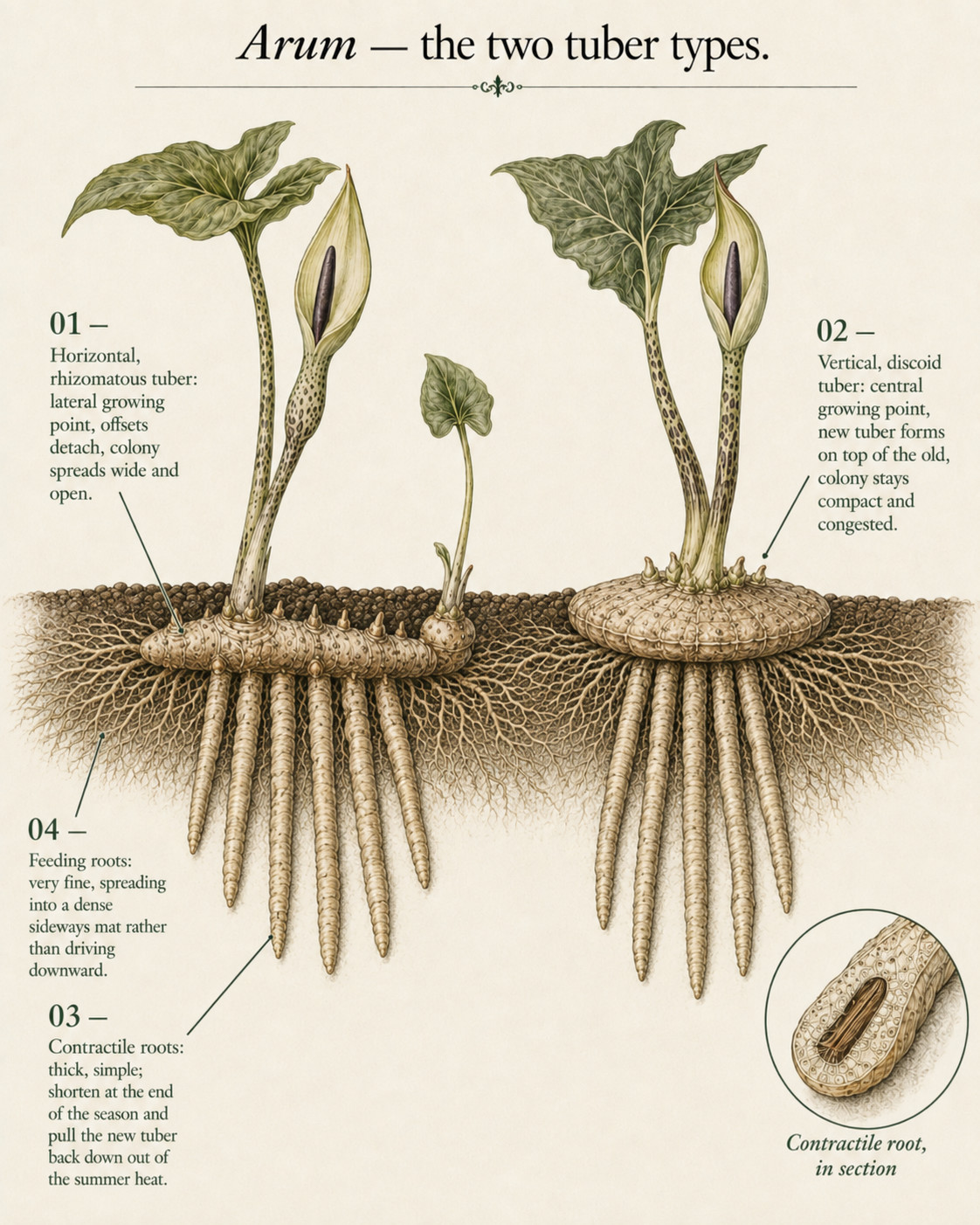
Fig · The two tuber types
Two flowering modes, and a vegetative plasticity wide enough that the first leaf of the season and the last can look like different species.
The shoot
Two or three cataphylls sheath the growing point and protect the shoot underground and as it comes through. In subgenus Arum the shoot starts in autumn, winter or spring depending on the species; each leaf emerges from the petiole-sheath of the one before it, and about two months in, the inflorescence begins to form inside. It expands and pushes out of the terminal leaf's petiole-sheath as that leaf matures — so the flower arrives at the end of the growing season.
Subgenus Gymnomesium, which holds only Arum pictum, inverts the whole calendar. The inflorescence comes before the leaves, terminally from the previous year's shoot, and it flowers in autumn as the new growth period opens rather than as it closes. The presence or absence of flower rudiments between the male and female zones is the reason the subgenus exists at all.
The leaf
Leaves are few to many, more or less erect, on free to moderately clasping petioles that are terete to D-shaped in section and carry a closed wing-like or open sheath at the base. The blade runs from cordate through sagittate to hastate, with posterior lobes that are usually well defined and occasionally almost absent. At the extremes sit the weakly lobed leaves of Arum euxinum and the hastate ones of Arum italicum, and every intermediate can be found.
The variation is worth taking seriously before naming anything. Within a single colony leaf shape and size range widely; in many species the first leaf out differs from those that follow, sometimes greatly, and so does the last; and a species with two growth flushes produces two quite different-looking sets of leaves in one year. Color moves as freely — pale green in Arum hygrophilum to deep green in Arum orientale, with silver or gray blotches, black speckles, purple tinting or silvery gray veins according to species, and petioles that may be plain green, deep purple, or striped in paler green, purple or greenish brown.
How much that variation can mislead is on record. Arum italicum was long split into subspecies on leaf shape and on vein-associated silver-gray variegation — the form most favored in gardens. Wider study of wild populations found intermediates everywhere, the supposed northern and southern types not separating on either character, and the variegation turning up in plants it was said to be absent from; the subspecies were sunk into one. Silver veining has misled in another way as well. Replying on Aroid-L in December 1997 to a grower whose silver-patterned plants were being grown as Arum maculatum, Peter Boyce wrote that he had never seen a true Arum maculatum with silver veining, only plain green or variously spotted leaves, and that the plants were probably Arum italicum, which he called extremely variable, or hybrids between the two. His test was when the plants break growth: Arum italicum comes up in late summer or early fall and stays in leaf until late June or July, while Arum maculatum emerges in winter to late winter and is generally gone by late May.⁴
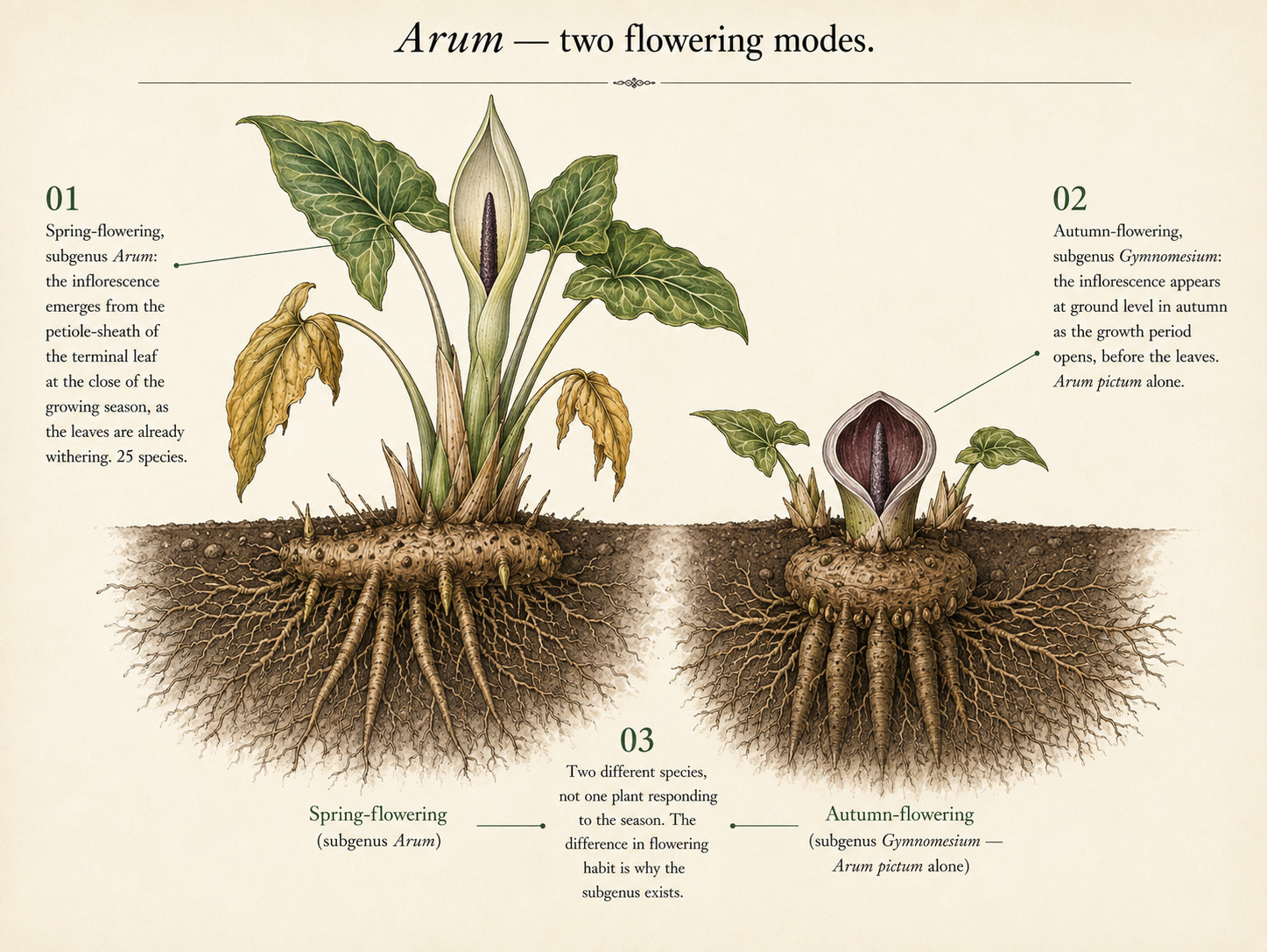
Fig · Spring-flowering and autumn-flowering
A tube, a limb and a bare club — three parts that do three different jobs, and between them the most tightly organized inflorescence in the family.
The spathe
The spathe is a bract of unusual shape, divided into a basal tube and an apical limb. The tube is generally cylindric with free margins and a constricted mouth that limits what can get in; in Arum creticum alone it is open and goblet-like. Inside, it may be greenish white, white or yellow, with or without a horizontal purple band around the middle; a few taxa are purple in the upper half and white in the lower, and in Arum euxinum, Arum hygrophilum and Arum purpureospathum the whole interior is purple.
The limb ranges from linear-lanceolate to broadly elliptic and from almost pure white through greens and purples to crimson — Arum creticum is pale yellow inside and out. Spotting is a warning to identifiers: in Arum dioscoridis it is a stable diagnostic feature, but in Arum maculatum and Arum italicum the pale greenish white spathe is only occasionally marked with small purplish black speckles, and the character is too inconstant to name a plant by. Plants with spotted spathes usually have speckled leaves to match. Names for the color forms of Arum dioscoridis have not always been applied correctly: Peter Boyce wrote on Aroid-L in August 2005 that plants in cultivation as Arum cyprium (a synonym of Arum dioscoridis) mostly do not match the plant originally described under that name, which had a yellow-green spathe with discrete, very deep purple spots and no staining or flushing. Scientific names, he added, were being used as cultivar tags and misapplied, and he suggested recognizing cultivars for the more distinct, stable color forms of Arum dioscoridis instead.⁵
The spadix
The spadix divides into a sterile appendix above and a fertile portion below. The appendix runs from narrowly cylindric to stoutly conic-cylindric, and its base either tapers gradually or narrows abruptly into a stipe — the presence or absence of that stipe is an important diagnostic character, and what it is for is not known. Below it, in most species, are two zones of bristles: the upper, above the staminate flowers, reads as modified stamens, and the lower, above the pistillate flowers, as modified pistils; intermediate structures at both boundaries support the reading. Whether the bristle bases are rough or smooth is consistent within a species.
The staminate flowers are crowded into a cylindric, oblong or globose zone, each of two to four fused anthers opening by a longitudinal slit in subgenus Arum or by a subapical pore in subgenus Gymnomesium. Anther color before dehiscence is diagnostic for many species and worth noting in the field. The pistillate flowers sit in a cylindric zone at the base, each a naked, sessile, oblong-ovoid gynoecium with a one-locular, many-ovuled ovary and a brush-like sessile stigma that exudes a droplet as it withers, leaving a dull purple to brown pit at the ovary apex.
At dehiscence most of the pollen falls to the bottom of the spathe-tube rather than staying on the anthers, and field observation suggests insects pick it up by crawling around inside the tube rather than by touching the anthers at all.
Scent, heat and the trap
The appendix is the scent organ, and what it emits ranges across the genus from fetid through oily to sweet, with some species scentless. The range shows up even among close relatives and within a single species: Peter Boyce wrote on Aroid-L in 1998 that Arum gratum smells of crushed smoke bush leaves (Cotinus coggygria) although most of the other members of the Arum orientale complex are foul-smelling,⁶ and one California grower, C.J. Addington, reported in 2007 that cultivated clones of Arum sintenisii vary from pleasantly fruity and candy-like through pungently over-ripe and rotten to odorless, a general impression rather than a measured comparison.⁷ What the smell does, what the heat does, how the tube holds insects overnight and how they get out again are the subject of a page of their own — several of the answers everyone repeats are wrong. See Arum reproduction.
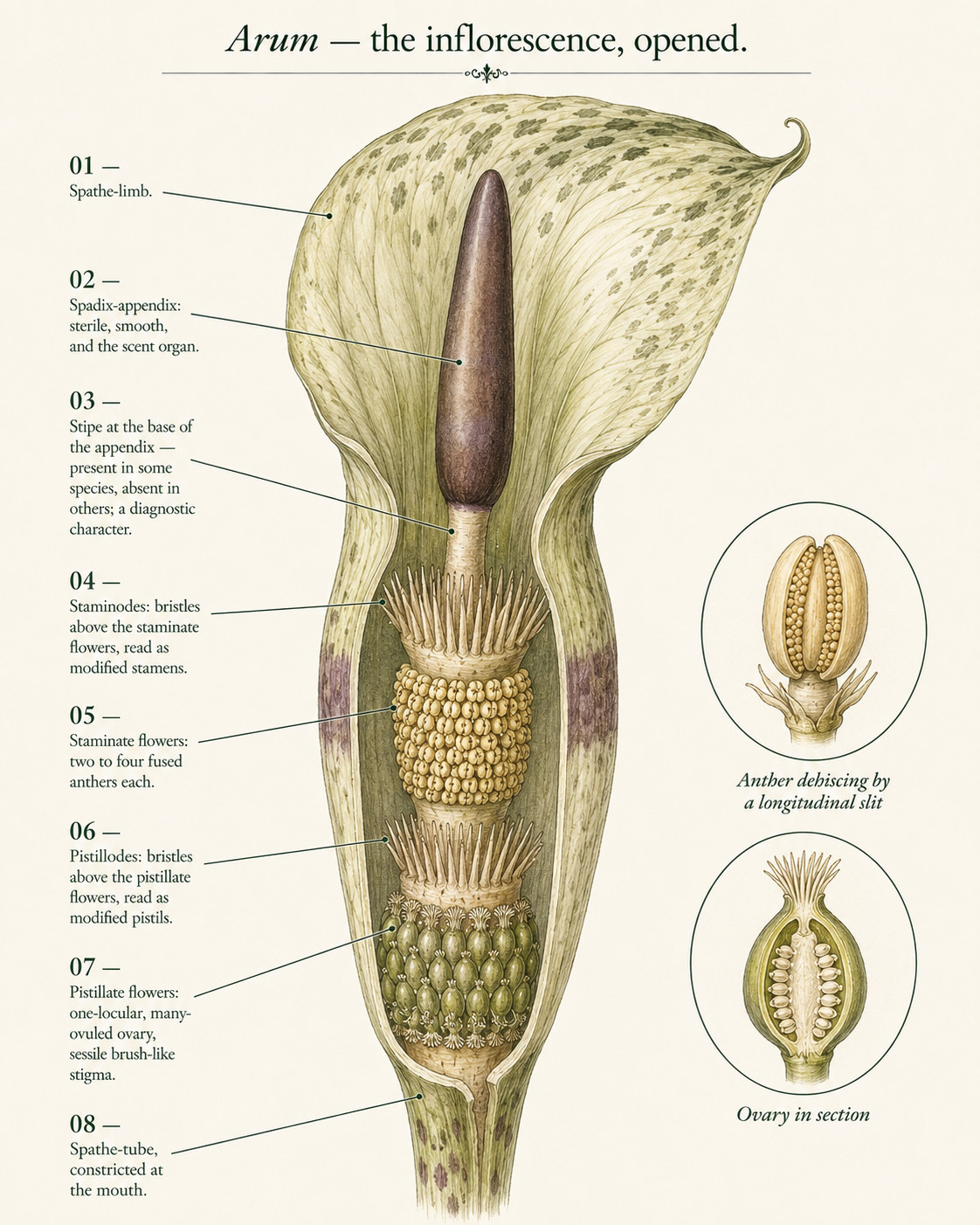
Fig · The inflorescence, opened
A spike of orange-red berries held up for birds — with one species that does none of it.
The fruiting head is uniform across the genus: a cylindric cluster of juicy, few-seeded, pyriform to globose glossy berries, stigmatic remains sunken at the tip, orange-red and carried clear of the foliage in a way that reads as adaptation to bird dispersal. As the head matures the peduncle thickens and hardens; in the species with hidden inflorescences it also elongates markedly, lifting the spike into view, while in those that display the inflorescence at flowering there is little or no elongation because there is nothing left to do.
Each fruit holds two to five seeds in a clear, orange, viscous pulp that comes from the breakdown of the funicles, trichomes and placenta hairs. The pulp also carries calcium oxalate crystals in varying amounts — Arum pictum the most, Arum hygrophilum little or none. Seeds are moderately large and ovoid to globose, with a leathery reticulate testa over copious starchy endosperm and a straight embryo. The pattern on that testa varies subtly but distinctly between species and has been suggested as a way into the taxonomically difficult ones.
Arum pictum departs here as well as at flowering: its peduncle does not elongate, and its infructescence is a globular head of much drier, silvery lilac berries sitting at ground level. How they are dispersed is not known.
Germination
There are two strategies, and they track winter cold. Species that do not meet cold winters — Arum dioscoridis, Arum nigrum, Arum pictum — germinate, put up an eophyll and start a tuber more or less at once, the first leaf appearing above ground within days. Species that do meet cold winters — Arum cylindraceum, Arum maculatum, Arum idaeum — germinate with no sign of growth above ground at all, building a comparatively large tuber underground and producing no foliage until the second growing season.
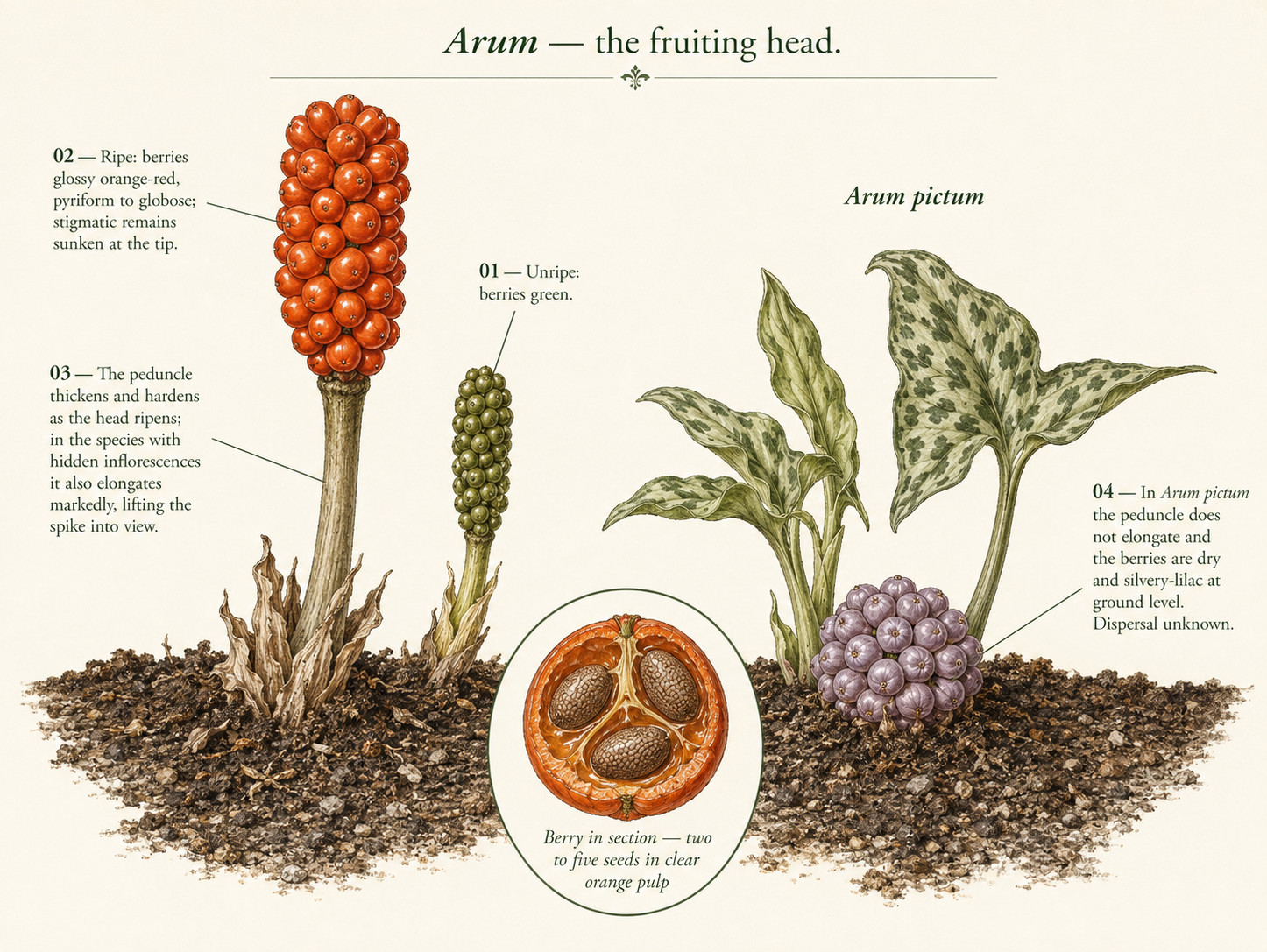
Fig · The fruiting head
Araceae · Care
Cultivation
Arum asks less than most bulbous subjects — no perfect drainage, no rigorously policed rest and growth — and forgives the occasional lapse. Getting the calendar right matters far more than getting the details right.
Fertile, humus-rich and on the limy side — these are plants of basic soils, not of ericaceous mixes.
Outdoors
Two things matter: a fertile, humus-rich soil, and a sunny position that does not get too hot. Prepare by clearing every perennial weed from the site and working in plenty of bulky compost if the soil is short of humus. The weeding is not a formality — once established, a colony is best left undisturbed, and anything creeping through it will be there for years. Plant the tubers about 9–10 cm deep and 15–18 cm apart in a wide, flat-bottomed hole, with a generous layer of grit underneath if the soil is heavy. Mark the spot; the emerging shoots are easy to hoe through.
In pots and frames
Choose the richest mix you would use for bulbs. The monograph's own recipe is two parts moss peat, one part loam and one part 3 mm grit — grit, not sand — with dolomitic limestone to bring the pH to about 7.5 and base fertilizer at the rate recommended for John Innes No. 3. Pots suit these plants better than pans, because arums root deeply and a deeper pot holds moisture longer. Fill to about half depth over a piece of plastic gauze, set the tubers around 5 cm deep, cover to within 2 cm of the rim and top the rest with grit: it suppresses moss and liverwort, keeps the neck of the plant dry and finishes the pot properly.
Clay is the more forgiving material, since it makes overwatering much harder, though clay pots large enough for the bigger species get heavy and expensive; plastic works well if you understand what the species wants. In a larger glasshouse a free root-run bed beats both — a border dug to 45 cm and conditioned with grit and peat, or a timber or brick bed over about 4 cm of shingle filled with the pot mix. Everything grows more strongly in one, and the creeping rhizomatous species, which outgrow conventional containers quickly, benefit most.
Nitrogen early for the leaves, phosphate later for the tuber — the feed changes when the plant's job changes.
Container-grown arums will not perform without feeding. Either scatter a granular feed on the surface at the start of the growth season, which is convenient if the plants are to be left alone for long stretches, or use a liquid feed with every other watering, which gives you far more control over what the plant is getting and when.
That control is the point, because the plant wants two different things across one season. A high-nitrogen feed through the first three months of growth builds the leaves. Switching to a high-phosphate feed from just before flowering until dormancy builds the tuber, which is what next year's plant is made of — a large, well-ripened tuber is the whole return on the season.
Arums exhaust the soil in even a fairly large pot, so annual repotting into fresh mix is part of feeding them rather than an alternative to it. Seedlings are the exception to the schedule: give them half-strength liquid feed at every watering as soon as the first leaf shows, which gets the most out of the first season.
A comprehensive collection needs both a garden and a frame: the northern species want to be outdoors, and many of the best-looking ones cannot take frost.
Which species go where
Species from the northern part of the range only really succeed outdoors. Marek Argent reported on Aroid-L in 2009 that plants and seedlings of Arum cylindraceum came through the winter of 2008–2009 in his Zone 6 garden in Poland, when night temperatures fell below −20 °C (about −4 °F).⁸,⁹ The more southerly ones, which include many of the most attractive, need protection from frost, so most growers keep them in a cold frame or bulb frame — a glass-covered raised bed planted directly — or in pots under glass. Not every southerly species is tender, however. James Waddick grew Arum hygrophilum, a species of the Middle East, in the Kansas City area (USDA Zone 5/6) for more than ten years and wrote on Aroid-L in 2013 that the plants were reliable and hardy there and bloomed regularly; the foliage was undamaged after a couple of nights at 15 °F (about −9 °C), though colder nights were expected to damage it, and the plants recovered in spring.¹⁰ If some of the tender species are to be tried outside, pick a well-drained sunny spot that does not catch early morning sun: frosted shoots survive a slow thaw far better than a bright morning, which ruptures the cells and collapses the plant.
Water and the season
In growth, do not let the plants dry out; a check at this stage is expensive and drying out simply pushes them toward dormancy. After flowering the leaves go over quickly, yellowing and withering. Reduce watering then, but do not stop it. Resist tidying: wait until the leaves are completely dead and brown, when they come away freely. Pulling a leaf that is not ready damages the new tuber and can take the growing point with it.
Dormancy
Dormant tubers must not get either too hot or too dry. In a frame, leave the side glass open through the rest for air movement; give the frame a thorough soaking in late August and put the glass back, which breaks dormancy and gets a root system established before the cold arrives. Pots want a warm, dry place out of full sun — plunged to half their depth in barely damp sand is better still, and keeps the tubers plump and reasonably cool. It is worth knowing that in the wild the species from seasonally arid country grow between rocks and under bushes, in shelter that holds a little soil moisture all summer; the tuber does not in fact tolerate prolonged heat and drought just because the climate is dry. The species of continental climates qualify this. Peter Boyce wrote on Aroid-L in 2007 that for Arum rupicola and Arum korolkowii, his examples of that group, hot summers to “ripen” the tuber matter more for flowering than winter cold. In the wild those tubers lie very deep, often nearly 1 m down, buffered from the summer heat, and he warned that in a pot, without that buffer, a tuber can overheat and dry out.¹¹
Winter
Through winter, check the plants over now and then for slug damage and for gray mold. When heavy frost is forecast, cover the frame two or three hours before nightfall and take the covering off as soon as possible after sunrise the next day.
Division if you want two or three plants; seed if you want to see what a species actually does across a population.
Division
Dividing arums is straightforward, and the ideal moment is while the plants are dormant — which is also when a plant in the open ground is impossible to find. Mark the growing point with a cane during the season and the problem goes away. Lift, check the tuber for rot, replant. Potted stock is easier still: divide at repotting. If a plant has to be divided in growth, keep the division damp until it is back in the ground and water the parent well afterward; plants divided in growth often fail to flower, and if an inflorescence does come it is good practice to cut it off as soon as the spathe clears the petiole-sheath so the plant can put the season into establishing.
Established clumps eventually need lifting anyway. The signs are smaller leaves and a marked drop in flowering. Do it as soon as the plants have died down in early summer, lift the colony with a fork, and replant the largest tubers.
Seed
Seed takes patience — four to five years from sowing to flowering on average, three for Arum dioscoridis and Arum pictum. Clean it first, whether fresh or bought. If the orange-red pericarp has dried onto the seed, soften it by soaking for about an hour in tepid water and rub it off. It has to go for two reasons: it appears to contain a germination inhibitor, and the warm damp conditions that germinate the seed also rot the pericarp, which then takes the seedling with it. The pericarp is caustic and rich in raphides and can burn the hands badly — wear gloves for this.
Sow at once, in plastic pots rather than trays: seedlings begin forming a tuber immediately and a shallow tray cramps that badly. Fill as for mature plants, sow on the surface, cover lightly, top with grit and soak. Fresh seed germinates at the start of the next growth season; old or dry seed can take a year longer. Seedlings of the cold-winter species spend that entire first season underground as a tuber with nothing showing, so do not discard a pot for at least two years. Once the first leaf appears, give them all the light you can, keep them from drying out, and keep them under glass for the first year to let the young tubers reach a reasonable size. Repot about three to a 10 cm pot when the rest of the collection is done, and treat them as mature plants from then on. Anything destined for the open ground is best kept in pots for three growing seasons before it is planted out. Feeding and timely potting on can beat the four-to-five-year average: Peter Boyce wrote on Aroid-L in 1998 that seedlings of the group centered on Arum orientale, fed regularly and moved up whole, without disturbing the root ball, into a larger pot with fresh compost below and around it as soon as roots show at the drainage holes, can make tubers the size of a Brazil nut by the end of the first season and flowering plants within three years.⁶ In 1997 he advised a grower of seed-raised Arum cyrenaicum to replant the tubers each mid-July about 2.5 cm deep, five to a 10 cm pot in the first year and probably one to an 8 cm pot in the next, to feed at every other watering, and to consider moving them up whole into a 15 cm pot about halfway through the season, and thought some of the more vigorous tubers would probably flower by the third year.¹²
Robust plants, on the whole — the real risk is water, not insects.
Pests
Aphids are the most troublesome, infesting and distorting newly emerging leaves and inflorescences, and they are also the reason to take them seriously: they move virus around a collection. Red spider mite turns up less often and is much harder to shift once it arrives; a light infestation can be knocked back by spraying the undersides of the leaves with a fairly coarse jet of water, and keeping the air damp — the usual advice — does not work. Slugs and snails are more of a problem outdoors and in frames than under glass, and despite how toxic every part of the plant is to mammals they eat both new shoots and mature leaves; hand removal at night is the most effective control there is. If you do use bait, keep the pellets out of the leaf-axils, where they decompose in wet weather and rot the leaf tissue.
Diseases
Disease is rare in a well-grown collection, and the one that matters is wet rot of the tuber, caused by severe overwatering or by too much moisture during dormancy. On a dormant tuber, caught in time, cut the rotten areas away, leave it out a couple of days to dry off, and repot into almost dry mix. On a growing plant it is effectively terminal: by the time you see flaccid leaves and slimy petioles the tuber is gone. Remove it, and repot the unaffected tubers into fresh mix, disturbing them as little as possible. Leaves are rarely troubled by fungal disease, though botrytis can take them if a frame or glasshouse stays very humid for a long spell, as in prolonged fog.
Virus
Arums are relatively trouble-free here too, and a strongly growing plant rarely shows anything. Sickly ones — particularly where the roots have been damaged by overwatering — may show distorted, yellow-marbled leaves and small, malformed inflorescences. Destroy any plant showing those symptoms rather than nursing it, and if virus is suspected anywhere in a collection, control the aphids, which are how it travels.
Arum Timeline
An interactive timeline showing the year each Arum species was first described as Arum (species may previously have been classified in other genera)
Arum Species & Cultivars
Arum Hybrids and Hybrid Cultivars
Named cultivars selected from hybrid parentage. Counted separately from the hybrids above.
Sources
The papers behind the morphology & cultivation tab
- Boyce, P. C. (1993). The Genus Arum: a Kew Magazine Monograph. Royal Botanic Gardens, Kew.
- Boyce, P. C. (2006). Arum – a decade of change. Aroideana 29: 132–137.
- Britten, J. & Holland, R. (1886). A Dictionary of English Plant-Names. Trübner & Co., London.
- Aroid-L mailing list, Peter Boyce, December 3rd, 1997
- Aroid-L mailing list, Peter Boyce, August 25th, 2005
- Aroid-L mailing list, Peter Boyce, January 5th, 1998
- Aroid-L mailing list, C.J. Addington, June 23rd, 2007
- Aroid-L mailing list, Marek Argent, July 15th, 2009
- Aroid-L mailing list, Marek Argent, August 20th, 2009
- Aroid-L mailing list, James Waddick, November 21st, 2013
- Aroid-L mailing list, Peter Boyce, May 4th, 2007
- Aroid-L mailing list, Peter Boyce, May 30th, 1997
Complete Arum Bibliography
Every source cited across all Arum species, cultivar and hybrid pages
- Chartier et al. 2013. Geographical variations of odour and pollinators, and test for local adaptation by reciprocal transplant of two European Arum species. Functional Ecology. doi.org ARUM APULUMARUM BESSERIANUMARUM CONCINNATUMARUM CRETICUMARUM CYLINDRACEUMARUM CYRENAICUMARUM DIOSCORIDISARUM EUXINUMARUM GRATUMARUM HAINESIIARUM HYGROPHILUMARUM IDAEUMARUM ITALICUMARUM JACQUEMONTIIARUM KOROLKOWIIARUM LUCANUMARUM MEGOBREBIARUM NIGRUMARUM ORIENTALEARUM PALAESTINUMARUM PICTUMARUM PURPUREOSPATHUMARUM RUPICOLAARUM SINTENISII
- Diaz et al. 2006. The effectiveness of some mechanisms of reproductive isolation in Arum maculatum and A. italicum (Araceae). Botanical Journal of the Linnean Society. doi.org ARUM APULUMARUM BESSERIANUMARUM CONCINNATUMARUM CRETICUMARUM CYLINDRACEUMARUM CYRENAICUMARUM DIOSCORIDISARUM EUXINUMARUM GRATUMARUM HAINESIIARUM HYGROPHILUMARUM IDAEUMARUM ITALICUMARUM JACQUEMONTIIARUM KOROLKOWIIARUM LUCANUMARUM MACULATUMARUM NIGRUMARUM ORIENTALEARUM PALAESTINUMARUM PICTUMARUM PURPUREOSPATHUMARUM RUPICOLAARUM SINTENISII
- iNaturalist inaturalist.org
- Arum apulum Aroidpedia page
- Arum besserianum Aroidpedia page
- Arum concinnatum Aroidpedia page
- Arum creticum Aroidpedia page
- Arum cylindraceum Aroidpedia page
- Arum cyrenaicum Aroidpedia page
- Arum dioscoridis Aroidpedia page
- Arum euxinum Aroidpedia page
- Arum gratum Aroidpedia page
- Arum hygrophilum Aroidpedia page
- Arum italicum Aroidpedia page
- Arum korolkowii Aroidpedia page
- Arum lucanum Aroidpedia page
- Arum maculatum Aroidpedia page
- Arum megobrebi Aroidpedia page
- Arum meryemianum Aroidpedia page
- Arum nigrum Aroidpedia page
- Arum orientale Aroidpedia page
- Arum palaestinum Aroidpedia page
- Arum pictum Aroidpedia page
- Arum purpureospathum Aroidpedia page
- Arum rupicola Aroidpedia page
- Arum sintenisii Aroidpedia page
- Albre et al. 2003. Pollination ecology of Arum italicum (Araceae). Botanical Journal of the Linnean Society. doi.org
- Monksilver Nursery: Arum monksilvernursery.co.uk ARUM ITALICUM ’ANGELIQUE’ARUM ITALICUM ’ANN MACNAB’ARUM ITALICUM ’BILL BAKER’ARUM ITALICUM ’CAROLINE HAYES’ARUM ITALICUM ’FILIGREE’ARUM ITALICUM ’GODZILLA’ARUM ITALICUM ’GOLD RUSH’ARUM ITALICUM ’GREEN GIFT’ARUM ’BLACKSPOT’ARUM ’CHAMELEON’ARUM ’ITMA’ARUM ’MARGARET OWEN’ARUM ’SPLISH SPLASH’ARUM ’STREAKED SPECTRE’
- Bröderbauer et al. 2013. The design of trapping devices in pollination traps of the genus Arum (Araceae) is related to insect type. Botanical Journal of the Linnean Society. doi.org
- Linz et al. 2010. Molecular phylogeny of the genus Arum (Araceae) inferred from multi–locus sequence data and AFLPs. TAXON. doi.org
- Gibernau et al. 2025. Mediterranean island endemic Arum pictum emits isomyocorene as a major component of floral scent. Comptes Rendus. Chimie. doi.org
- Szenteczki et al. 2022. Transcriptomic analysis of deceptively pollinated Arum maculatum (Araceae) reveals association between terpene synthase expression in floral trap chamber and species-specific pollinator attraction. G3 Genes|Genomes|Genetics. doi.org
- Aroid-L mailing list, Peter Boyce, January 5th, 1998 hort.net
- Aroid-L mailing list, Peter Boyce, February 25th, 2007 hort.net
- Aroid-L mailing list, Tony Avent, July 2010 hort.net
- Juniper Level Botanic Garden — Arum world juniperlevelbotanicgarden.org
- Leclerc et al. 2025. Subtle ecophysiological divergences in a deceptive strategy to attract the same pollinators in two sympatric Arum. Annals of Botany. doi.org
- Royal Horticultural Society rhs.org.uk
- Albre & Gibernau 2008. Reproductive biology of Arum italicum (Araceae) in the south of France. Botanical Journal of the Linnean Society. doi.org
- Angioy et al. 2004. Function of the heater: the dead horse arum revisited. Proceedings of the Royal Society of London. Series B: Biological Sciences. doi.org
- Annales Musei Goulandris 9: 33 (1994 publ. 1995) researchgate.net
- Aroid-L mailing list, C.J. Addington, June 23rd, 2007 hort.net
- Aroid-L mailing list, Danny Wilson, August 29th, 2004 hort.net
- Aroid-L mailing list, James Waddick, November 21st, 2013 hort.net
- Aroid-L mailing list, Marek Argent, August 20th, 2009 hort.net
- Aroid-L mailing list, Marek Argent, July 15th, 2009 hort.net
- Aroid-L mailing list, Peter Boyce, August 25th, 2005 hort.net
- Aroid-L mailing list, Peter Boyce, December 3rd, 1997 hort.net
- Aroid-L mailing list, Peter Boyce, May 30th, 1997 hort.net
- Aroid-L mailing list, Peter Boyce, May 4th, 2007 hort.net
- Aroid-L mailing list, Sheldon Hatheway, January 25th, 2012 hort.net
- Aroid-L mailing list, Steve Hall, April 10th, 1997 hort.net
- Aroideana 10: 8 (1987) aroid.org
- Bağbahçe Bilim Dergisi 10(1): 33 (2023) dergipark.org.tr
- Barabé et al. 2004. On the presence of extracellular calcium oxalate crystals on the inflorescences of Araceae. Botanical Journal of the Linnean Society. doi.org
- Barreto et al. 2025. How to turbo charge respiration – thermogenic metabolism in plants. Current Opinion in Plant Biology. doi.org
- Botanical Society of Britain and Ireland — Arum maculatum × italicum bsbi.org
- Bröderbauer et al. 2012. Reconstructing the origin and elaboration of insect‐trapping inflorescences in the Araceae. American Journal of Botany. doi.org
- Bulletin de la Société Botanique de France 63: 11 (1916 publ. 1917) biodiversitylibrary.org
- Bulletin de la Société Botanique de Genève, sér. 2, 4: 159 (1912) biodiversitylibrary.org
- Bullettino dell'Orto Botanico della Regia Università di Napoli 3: 409-410 (1913) babel.hathitrust.org
- Diagnoses Plantarum Orientalium Novarum 13: 6 (1854) archive.org
- Diagnoses Plantarum Orientalium Novarum 13: 7 (1854) archive.org
- Diagnoses Plantarum Orientalium Novarum 13: 8 (1854) archive.org
- Diagnoses Plantarum Orientalium Novarum 13: 9 (1854) archive.org
- Flora Taurico-Caucasica 2: 407 (1808) biodiversitylibrary.org
- Florae Graecae Prodromus 2: 245 (1816) biodiversitylibrary.org
- Florae Siculae Synopsis 2(2): 597 (1844) biodiversitylibrary.org
- Gfrerer et al. 2023. Variation in scent amount but not in composition correlates with pollinator visits within populations of deceptive Arum maculatum L. (Araceae). Frontiers in Plant Science. doi.org
- Icones Aroidearum: t. 39 (1857) archive.org
- Kew Bulletin 36: 643 (1981) doi.org
- Laina et al. 2022. Local Insect Availability Partly Explains Geographical Differences in Floral Visitor Assemblages of Arum maculatum L. (Araceae). Frontiers in Plant Science. doi.org
- Lobin et al 2007. Arum megobrebi - [Willdenowia 37, 445-449]. doi.org
- Mansion et al. 2008. Phylogenetic Analysis Informed by Geological History Supports Multiple, Sequential Invasions of the Mediterranean Basin by the Angiosperm Family Araceae. Systematic Biology. doi.org
- Marotz-Clausen et al. 2024. Where are volatiles produced in the highly synorganised inflorescence of Arum maculatum L.?. Biochemical Systematics and Ecology. doi.org
- Notes from the Royal Botanic Garden Edinburgh 41(1): 46 (1983) journals.rbge.org.uk
- Ollerton & Diaz 1999. Evidence for stabilising selection acting on flowering time in Arum maculatum (Araceae): the influence of phylogeny on adaptation. Oecologia. doi.org
- Österreichische Botanische Zeitschrift 8: 349 (1858) biodiversitylibrary.org
- Österreichisches Botanisches Wochenblatt 7: 213 (1857) biodiversitylibrary.org
- Plant Delights Nursery: Arum ‘Love Child’ plantdelights.com
- Plant Lust — Arum cyrenaicum × concinnatum plantlust.com
- Rumphia 1: 118 (1836) archive.org
- Sayers et al. 2021. Divergence in floral scent and morphology, but not thermogenic traits, associated with pollinator shift in two brood-site-mimicking Typhonium (Araceae) species. Annals of Botany. doi.org
- Serviss, Campbell & Fuller 2025. First record of Arum italicum (Araceae) from the Oklahoma (U.S.A.) flora. Journal of the Botanical Research Institute of Texas 19(3): 341–346. doi.org
- Seymour 2010. Scaling of heat production by thermogenic flowers: limits to floral size and maximum rate of respiration. Plant, Cell & Environment. doi.org
- Species Plantarum 2: 966 (1753) biodiversitylibrary.org
- Supplementum Plantarum: 410 (1782) biodiversitylibrary.org
- Synopsis Aroidearum: 11 (1856) researchgate.net
- The Gardeners Dictionary, ed. 8: no. 2 (1768) archive.org
- Trudy Imperatorskago S.-Peterburgskago Botaničeskago Sada (Acta Horti Petropolitani) 2: 407 (1873) biodiversitylibrary.org
Chromosome counts
The 24 papers behind the published chromosome numbers on the Arum pages and in the genus's Chromosomes section.
- Alpınar, K. 2007. The Araceae of Turkey. Aroideana 30.
- Bashasha, J. A.; Imryed, Y. F.; Adam, H. J. 2025. First Karyotype Report of Arum cyrenaicum Hruby (Araceae) from AL-Jabal AL-Akhdar, Libya. Scientific Journal of University of Benghazi 38(2): 94–102.
- Bedalov, M.; Gutermann, W. 1982. Die Gattung Arum in den Ostalpen-Ländern. Stapfia 10: 95–97.
- Bedalov, M.; Küpfer, P. 2006. Studies on the Genus Arum (Araceae). Aroideana 29.
- Beuret, E. 1971. Répartition géographique de quelques Arum des groupes maculatum L. et italicum Mill. Bulletin de la Société Neuchâteloise des Sciences Naturelles 94: 29–36.
- Beuret, E. 1977. Contribution à l'étude de la distribution géographique et de la physiologie de taxons affines di- et polyploïdes. Bibliotheca Botanica (E. Schweizerbart'sche Verlagsbuchhandlung, Stuttgart).
- Boyce, P. 1989. A new classification of Arum with keys to the infrageneric taxa. Kew Bulletin 44(3): 383.
- Boyce, P. 1993. The Genus Arum. Kew Magazine Monograph (HMSO, London).
- Chartier, M.; Liagre, S.; Weiss-Schneeweiss, H.; Kolano, B.; Bessière, J.-M.; Schönenberger, J.; Gibernau, M. 2016. Floral traits and pollination ecology of European Arum hybrids. Oecologia 180(2): 439–451.
- Gfrerer, E.; Laina, D.; Gibernau, M.; Fuchs, R.; Happ, M.; Tolasch, T.; Trutschnig, W.; Hörger, A. C.; Comes, H. P.; Dötterl, S. 2021. Floral scents of a deceptive plant are hyperdiverse and under population-specific phenotypic selection. bioRxiv.
- Hadjikyriakou, G.; Hand, R.; Mansion, G. 2011. Arum cylindraceum subsp. pitsyllianum (Araceae), a New Taxon from Cyprus. Novon: A Journal for Botanical Nomenclature 21(4): 431–436.
- Itô, T. 1942. Chromosomen und Sexualität von der Araceae. Cytologia 12(2-3): 313–325.
- Kalu, E. J.; Kanu, A. M. 2014. Cytotaxonomic studies of three ornamental aroids. International Letters of Natural Sciences 18: 105–113.
- Löve, Á.; Kjellqvist, E. 1973. Cytotaxonomy of Spanish plants II. Monocotyledons. Lagascalia 3(2): 147–182.
- Marchant, C. J. 1972. Chromosome variation in Araceae: IV. Areae. Kew Bulletin 26(3): 395–404.
- Marchant, C. J. 1973. Chromosome variation in Araceae: V. Acoreae to Lasieae. Kew Bulletin 28(2): 199–210.
- Petersen, G. 1993. Chromosome Numbers of the Genera of Araceae. Aroideana 16.
- Prime, C. T. 1954. Arum neglectum (Towns.) Ridley. Journal of Ecology 42(1): 241–248.
- Prime, C. T. 1961. Taxonomy and nomenclature in some species of the genus Arum L. Watsonia 5(2).
- Prime, C. T.; Buckle, O.; Lovis, J. D. 1955. The distribution and ecology of Arum neglectum in southern England. Part I. Kent, Sussex, Hants. and Dorset. Proceedings of the Botanical Society of the British Isles 1(3-4): 287–296.
- Riedl, H. 1967. Die infraspezifischen Einheiten von Arum maculatum in Mitteleuropa. Phyton, Annales Rei Botanicae 12(1-4): 159–168.
- Sowter, F. A. 1949. Arum maculatum L. Journal of Ecology 37(1): 207–219.
- Terpó, A. 1973. Kritische Revision der Arum-Arten des Karpatenbeckens. Acta Botanica Academiae Scientiarum Hungaricae 18(1-2): 215–255.
- Turco, A.; Medagli, P.; Albano, A.; D'Emerico, S. 2014. Karyomorphometry on three polyploid species of Arum L. (Araceae, Aroideae). Comparative Cytogenetics 8(1): 71–80.