Subfamily Monsteroideae·Tribe Monstereae
Rhaphidophora
DESCRIPTION
Rhaphidophora is a genus of 105 accepted species of root-climbing lianes in the family Araceae, native from West Africa through India, Sri Lanka and the Himalaya, southern China and the Ryukyu Islands, Indo-China and the Malay Archipelago to New Guinea, Australia and the islands of the western Pacific as far as Samoa. It belongs to the tribe Monstereae of the subfamily Monsteroideae, of which it is the largest genus in Tam and colleagues’ reckoning, and Boyce counted it among the largest aroid genera of tropical Asia. His regional revisions describe medium-sized to very large, occasionally enormous climbers, slender to robust, a few of them flowering while they still wear their juvenile form and a very few clustering as rheophytes. What tells the genus from its look-alikes is the fruit: in Boyce’s key, each ovary holds eight or more ovules on two, rarely three, placentas that intrude from its walls, and ripens many small, straight seeds, 1.3–3.2 mm long, with a brittle, smooth coat, where Epipremnum ripens a few larger, curved seeds and Scindapsus a single one. Hasskarl published the name in 1842, and the genus was, in Boyce’s words, “dogged by interpretative confusion” from the start: Hasskarl’s first descriptions gave an ovary of one chamber with a single ovule, exactly the diagnosis of Scindapsus, his later one an ovary of two chambers with two ovules in each, exactly the plan of Epipremnum, and the specimens he annotated as Rhaphidophora lacera are Epipremnum pinnatum. What anchored the name was the synonym he cited, Roxburgh’s Pothos pertusus of southern India and Sri Lanka, whose ovary has two intruding placentas each bearing many ovules; in 1978 Nicolson concluded that this element, not the descriptions, fixes the genus, and Rhaphidophora pertusa is its type. The name joins the Greek rhaphis, a needle, and pherō, I bear, for the needle-like trichosclereids, single cells up to 1 cm long, that run through its tissues and show as fine hairs at the edge of a torn leaf.
The plant on the windowsill is Rhaphidophora tetrasperma, known as “mini monstera,” “dwarf monstera,” “Monstera Ginny,” “Philodendron Ginny” and “Philodendron Piccolo,” although it is neither a Monstera nor a Philodendron. The name “mini monstera” was chosen, North Carolina’s extension service explains, because the plant looks like a miniature Monstera deliciosa, and as a houseplant it rarely flowers. In the wild it is a climber of Peninsular Malaysia and the far south of Thailand that Boyce knew in 1999 from only six collections. The likeness is an old one: Roxburgh, describing in 1820 the climber of the Coromandel Coast that became the type of the genus, thought it “so much like Dracontium pertusum, that they may be readily taken for the same plant,” and Dracontium pertusum is the American climber that Engler and Krause treated as Monstera pertusa. Other species reached science by way of gardens. Rhaphidophora cryptantha was described in 2001 from a plant at Fairchild Tropical Garden in Florida that had come from the botanic garden at Lae in Papua New Guinea; its wild origin was not known with certainty. Boyce called Craig Allen the first person to have flowered it, and in 2000 the two made fertile herbarium specimens of the plant at Fairchild, before describing the species together.⁵,³⁰ Rhaphidophora neglecta was named in 2019 from a single plant grown at the Royal Botanic Gardens Sydney since about 1970 under the name Rhaphidophora decursiva, its provenance never recorded; the epithet means ‘ignored.’ And the shingling juvenile of Rhaphidophora korthalsii was once described as a species of another genus altogether, Pothos celatocaulis.
Neither Engler and Krause’s monograph of 1908 nor Boyce’s regional revisions divide the genus into sections. Engler and Krause keyed the 60 species they recognized by the adult leaf: entire and unperforated; perforated or pinnatifid with a pointed base; or pinnatifid to pinnatipartite with a rounded or blunt base. Boyce, who put the genus at about 100 species in 1999, found that such keys, as had been said not altogether unjustly, worked as “keys to individual leaves rather than to species,” and in 2000 he proposed eight informal groups for Indo-China and Thailand, Sunda and Wallacea, each named for its earliest accepted species. In 2001, calling these “a first, pragmatic attempt at creating morpho-taxonomic units,” he added eight more for New Guinea and the Pacific and renamed the Hollrungii Group for Rhaphidophora spathacea; the Pertusa Group followed in 2012. The Hongkongensis Group was to him “perhaps the most easily recognizable, although paradoxically the most taxonomically intractable” of them all. In 2004 Tam and colleagues sequenced one chloroplast region from 41 species and found the genus “strongly paraphyletic,” its species scattered among three clades: 34 beside Anadendrum, one beside Scindapsus and Epipremnum, and six with Monstera, Amydrium and Epipremnum pinnatum; they treated the three as informal groups and changed no names. Zuluaga and colleagues’ 2019 study of the subfamily, with 23 samples of the genus, recovered Rhaphidophora as a single lineage only in the combined chloroplast analysis, and without support; in the nuclear and total-evidence trees some species fell beside Anadendrum. Kew accepts all 105 species in Rhaphidophora.
Lianescent aroids, Boyce wrote, are often collected under incorrect names in Asia. His readiest test is to tear a mature leaf: hair-like trichosclereids at the torn edge mark a monsteroid climber, abundant in Rhaphidophora, Epipremnum and Scindapsus, sparse in Amydrium and absent in Anadendrum. Superficially, he and Wong wrote in 2015, Rhaphidophora is difficult to tell from Scindapsus, but in ripe fruit the two are readily distinguished by the seeds, ellipsoid and numerous in one, kidney-shaped and solitary in the other; Epipremnum ripens a few curved seeds with a bony coat. Boyce found the climbers with small inflorescences easy enough to key to genus by such characters, those with large inflorescences so intractable that he had to fall back on critical floral characters. Monstera, which DNA places close to some species of Rhaphidophora, has an ovary of two chambers and usually ripens a single seed without endosperm, where Rhaphidophora seeds carry copious endosperm. The shingling juveniles invite confusion too: in cultivation Rhaphidophora cryptantha has been confused with Monstera dubia, whose young plants shingle in a similar way, but its leaves point up and those of Monstera dubia down.
“Mini monstera” and the other trade names of Rhaphidophora tetrasperma are misnomers: the plant is neither a Monstera nor a Philodendron, although, as North Carolina’s extension service points out, all three belong to the same family. The Chinese names are those of the Flora of China, which calls the genus ya jiao teng shu and builds the names of six of its twelve species on ya jiao teng, among them da ye ya jiao teng for Rhaphidophora megaphylla and cu jing ya jiao teng for Rhaphidophora crassicaulis. Hime-habukazura is the name Tawada had been using for the Ryukyu plant when Hatusima described Rhaphidophora liukiuensis in 1962; Hatusima adopted it for the species and, with the suffix for a genus, for Rhaphidophora itself. Roxburgh recorded Guj-pippul and Peeplee in the Sylhet district in 1820, the first for “this very large, powerful species,” the second for a climber “rooting on trees, like the common Ivy of Europe.” The Thai names and the Malay da-do-li-pae are those of the Flora of Thailand, which gives ta khap for two species; akar asam tebing paya is Ridley’s, from his 1925 flora of the Malay Peninsula, where he recorded that the leaves of Rhaphidophora lobbii were eaten in curries; ámlong, madulúnang and mananáu are the local names in Merrill’s enumeration of Philippine plants. Waria, the Wasuk name written on the type label, gave Rhaphidophora waria its epithet; Boyce noted that it has nothing to do with the Waria valley. In Fiji, Nicolson reported, yalu and matha name Epipremnum pinnatum as well, and the Samoan names are those of Whistler’s flora of Samoa.
DISTRIBUTION
Asian above all, with an outpost in the equatorial forests of Africa. Kew maps the genus in 56 places. Its four African species keep, as Boyce and Haigh put it in 2016, to the equatorial humid evergreen forests: Rhaphidophora africana fills all 15 African places, from Guinea, Sierra Leone and Liberia to Uganda, and they took it to be “undoubtedly polyphyletic,” likely hiding upwards of four species, while Rhaphidophora bogneri, Rhaphidophora pusilla and Rhaphidophora ovoidea are mapped by Kew in Cameroon, Gabon, Equatorial Guinea and Ivory Coast. Engler set the African plants apart in 1906 as the genus Afrorhaphidophora, for their ovules attached at the base of the placentas, a feature that seemed to him and Krause a bridge to the American Stenospermation; Boyce includes them in Rhaphidophora, and Zuluaga and colleagues, dating the divergence of Rhaphidophora africana from its closest relative in their tree to about 14 million years ago, read the African species as the product of long-distance dispersal from Southeast Asia, though they would not speculate on the time or number of dispersals to Africa. In Asia the genus runs from India, Sri Lanka and the Maldives along the Himalaya from its western ranges to Tibet, through Bangladesh, Assam, Myanmar, Thailand and Indo-China to southern China, Hainan, Taiwan and the Ryukyus; across the Andaman and Nicobar Islands, the Malay Peninsula and the whole Malay Archipelago to New Guinea, the Bismarck Archipelago and the Solomons; south to the Northern Territory and Queensland; and out to the Carolines and Guam, the Santa Cruz Islands, Vanuatu, Fiji and Samoa. The widest-ranging Asian species are Rhaphidophora decursiva, in 18 places from India and Sri Lanka to Hainan, and Rhaphidophora korthalsii, in 15, most of them in Malesia, Papuasia and the western Pacific, a species Boyce found common throughout Malesia and bewilderingly variable.
Within Asia, Boyce saw several nodes of diversity: the Himalaya from southeastern Nepal to northeastern Vietnam; West Malesia; the Philippines; and East Malesia. On Kew’s count Malesia holds 48 of the 105 species, Papuasia 30, Indo-China 26, China 12 and the Indian subcontinent 11; Australia and eastern Asia have 4 each, and the two Pacific and three African regions between 1 and 3. New Guinea alone has 28 species, 18 of them, Rhaphidophora okapensis and Rhaphidophora gorokensis among them, native nowhere else, and the Philippines 12, 8 of them endemic, among them Rhaphidophora banosensis and Rhaphidophora cretosa; in all, 63 of the 105 species, from Rhaphidophora guamensis of Guam to Rhaphidophora ovoidea of Ivory Coast, are native to a single place. Boyce, finding 29 of the 30 species of New Guinea, Australia and the western Pacific endemic to that region, against 5 of 13 in Borneo, 1 of 15 in Peninsular Malaysia, 4 of 15 in Sumatra and 7 of 11 in the Philippines, suggested in 2001 that Rhaphidophora is a genus of Gondwanan origin. The count is still rising. Twenty-three of the 105 species date from Boyce’s accounts of 1999–2001 and seven more have been named since; in 2018, on a trail at Mulu in Sarawak that they had walked many times, Wong and Boyce came upon two unnamed species flowering within two kilometers of each other, published in 2022, and they report numerous Bornean species still unnamed, largely because the plants are mostly found sterile. Kew doubts the record of Rhaphidophora oligosperma in New Guinea, and gives Rhaphidophora peeploides no native place at all, only doubtful records from Borneo and Sulawesi: Engler described it in 1898 from plants in the botanic garden at Bogor, without a wild origin. The New South Wales record is Rhaphidophora neglecta, the Sydney garden plant, which Hay and Boyce suspect is a species of mainland Asia, and Rhaphidophora pertusa is listed as introduced in the West Himalaya.
CHROMOSOMES
4 species have been counted.
4 of 105 species have a published 2n count.
Base chromosome number: x = 15 (Mayo et al. 1997).
What chromosome numbers mean for a cross, in the Chromosomes and Crossing guide.
Counted species (4)
- Rhaphidophora bogneri60
- Rhaphidophora decursiva54
- Rhaphidophora korthalsii56, 60
- Rhaphidophora peepla120
Sources (3)
- Boyce, P. C.; Haigh, A. 2016. Rhaphidophora bogneri (Araceae: Monsteroideae: Monstereae) a new species from West Africa, and notes on the Rhaphidophora africana complex. Aroideana 39(2): 101–120.
- Marchant, C. J. 1970. Chromosome variation in Araceae: I. Pothoeae to Stylochitoneae. Kew Bulletin 24(2): 315–322.
- Mayo, S. J.; Bogner, J.; Boyce, P. C. 1997. The Genera of Araceae. Royal Botanic Gardens, Kew.
ECOLOGY
Rhaphidophora is chiefly a genus of evergreen forest, from the lowlands to middle elevations in the mountains. Boyce’s genus account places its species as bole-climbers and on rocks, rarely as rheophytes, usually in well-drained wet, humid or seasonally moderately dry evergreen forest, primary or established secondary, subtropical and tropical, at low to mid-montane elevations; the 2015 compendium of Malesian aroid genera adds peat swamp forest for Rhaphidophora lobbii and freshwater swamp forest for Rhaphidophora minor. The species accounts fill in the extremes. Rhaphidophora liukiuensis was found climbing high on trees in the mangrove on Iriomote in the Ryukyus, and Rhaphidophora bogneri grows in lowland rain forest on leached red soils at about 20 m in Gabon. Higher up, Rhaphidophora nicolsonii grows in sub- to upper montane forest at 1,500–2,000 m in Peninsular Malaysia, Rhaphidophora gorokensis in lower montane rain forest and forest of Fagaceae and Nothofagaceae on limestone at 1,600–2,440 m in New Guinea, and the Flora of China takes Rhaphidophora lancifolia and Rhaphidophora luchunensis to 2,500 m and records Rhaphidophora peepla, on trees and stone walls, at 1,800–2,800 m. The Flora of China also gives seasons: Rhaphidophora hookeri flowers from March to July and Rhaphidophora peepla in September and October, and several species ripen their fruit only in the year after flowering, Rhaphidophora decursiva flowering from May to August and fruiting from July to September of the next. Rhaphidophora neglecta, of unknown origin, had, by 2019, grown outdoors in Sydney for about fifty years, where the winter monthly minimum can fall to about 5.5 °C, with a winter rest in its growth, which to Hay and Boyce strongly suggested that it is not an equatorial plant. The charts below draw the genus’s measured envelope across its native range, and all 56 of its native places resolve in the climate data.
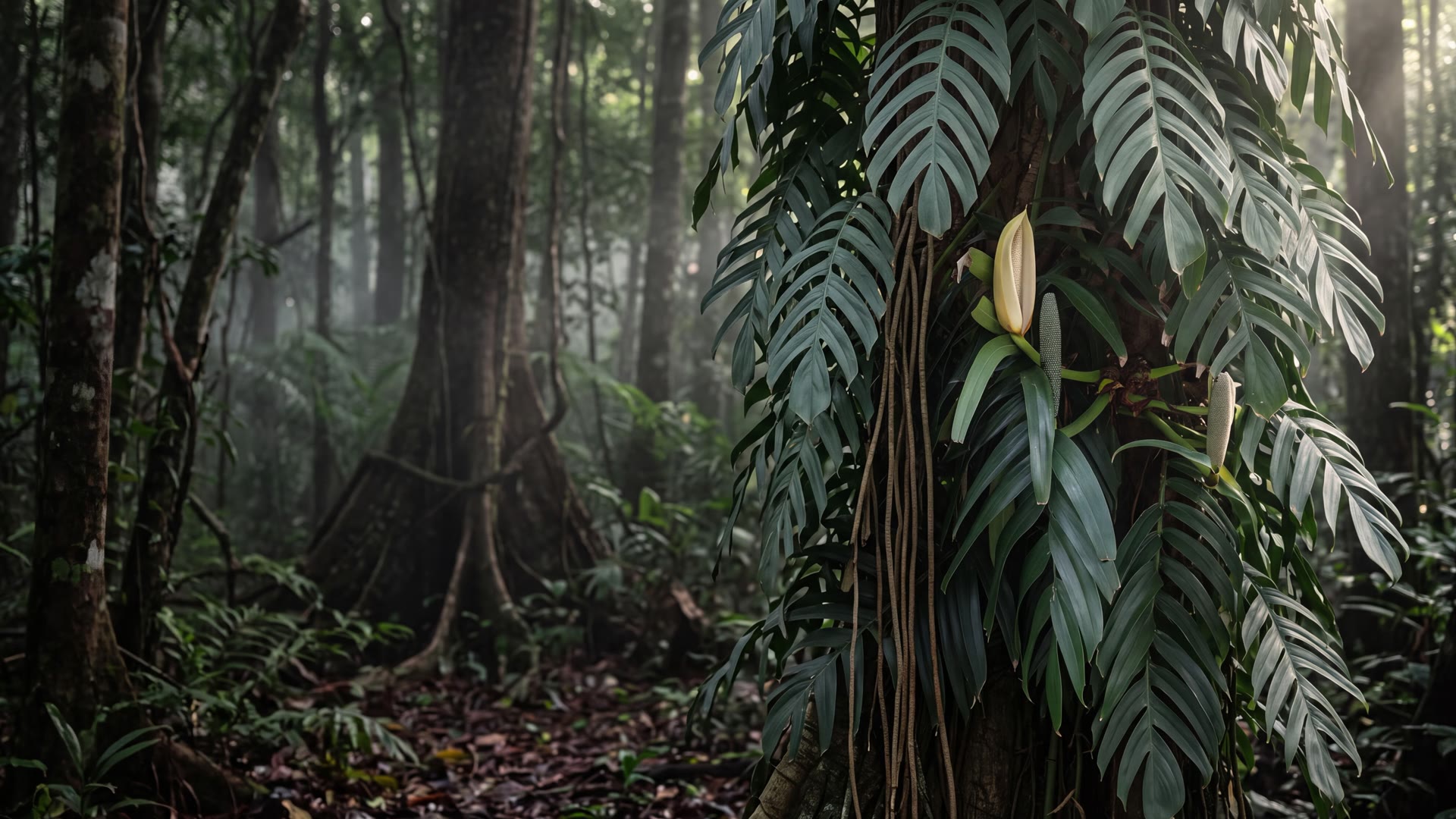
Nearly every species is a root-climbing liane. Seedlings are seldom seen: in Rhaphidophora angustata the seedling is leafy from germination and, in Boyce’s term, skototropic, alternating tufts of leaves with long leafless shoots, while in Rhaphidophora korthalsii it grows straight into a shingling juvenile pressed flat to the trunk. Young plants often spread over the ground in colonies, the largest generally where conditions are less favorable to the adult, under a poor canopy or in dry, exposed places. Grown plants broadly follow one of three plans: clinging stems rooted along their length that send out free flowering side shoots, unbranched clinging stems that flower at the tip, or clinging leaders whose clinging side shoots alone flower; and some species send flagellate foraging stems, often very long, down to the ground to root and climb again. A few flower in their juvenile form, Rhaphidophora okapensis and Rhaphidophora latevaginata without any change at all, Rhaphidophora hayi with only a token adult phase, and Rhaphidophora beccarii in some of its populations; to Boyce and Bogner it appeared that such neoteny may have arisen independently several times in the tribe. Others are specialists. Rhaphidophora minor and Rhaphidophora lobbii often grow in swampy places, unusual ground for monsteroids; Rhaphidophora angustata carries its flowering shoots as fans of large leaves that trap falling litter; three Malesian species are rheophytes; and Rhaphidophora muluensis grows in peat swamp forest over flooded karst at Mulu in Sarawak. Of pollination there are only fragments. In Yunnan, flies of the drosophilid genus Colocasiomyia breed in the inflorescences and infructescences of Rhaphidophora decursiva, Rhaphidophora hookeri, Rhaphidophora peepla and Rhaphidophora crassicaulis, their young larvae wintering between the growing pistils of Rhaphidophora peepla, but a 2019 review of aroid pollination counted them only as visitors, without ruling out that they pollinate. In Thailand the hanging inflorescences of Rhaphidophora hookeri smell powerfully of fruit at night and draw large ruteline beetles, and Beath’s 1993 study of the forest aroids of Ghana found that Rhaphidophora africana can pollinate itself and might be pollinated by Hoplia beetles feeding on stigmatic secretions and pollen. Across the tribe, scent runs from the peanut butter of Epipremnum giganteum to the raw mushrooms and sour milk of Rhaphidophora neglecta. When the fruit ripens, the enlarged tops of the fruits break away to expose the seeds in sticky pulp, red, orange, yellow or white, and the Flora of Thailand speculates that the hanging infructescences of Rhaphidophora hookeri, held clear on side shoots and smelling of overripe champedak, may be dispersed by bats.
Araceae · Form
Morphology
A root-climber, slender in some species and enormous in others, whose leaves may stay entire, open windows or split into segments, and whose young plants often climb pressed flat against the bark like roof tiles. The character that defines the genus lies in the ovary: in Boyce’s key, eight or more ovules stacked on placentas that run up its wall, ripening into many small, straight seeds.
Clinging stems that root along their length, free shoots that flower, whips that run down to new ground, and two kinds of root, one to hold and one to feed. Cut, the stem bleeds a clear juice that sets like amber, and needle-like cells run through the tissues.
The stem
In Boyce’s genus description Rhaphidophora is a root-climbing liane, medium-sized to very large and occasionally enormous, slender to robust, and only very seldom a clustering rheophyte, as Rhaphidophora beccarii is. Hay and Boyce describe its species as mostly climbers and nomadic climbers, the latter Moffett’s term, taken up by Zotz, for climbing plants that germinate on or at least near the ground, typically lose the older parts of their stem as they ascend, and keep their contact with the soil through roots. The range of size is wide. Rhaphidophora corneri, refound in Kelantan in 2010 after 75 years, climbs to 2.7 m and runs shoots along the ground for up to 2.4 m; Rhaphidophora tetrasperma is a liane to 5 m and Rhaphidophora glauca one to 10 m; Rhaphidophora decursiva reaches 20 m or more on a stem 3–5 cm thick, and Rhaphidophora megaphylla, which the Flora of China calls very large to gigantic, climbs to 40 m.
Boyce sorted the adult shoots into three plans. In the first, by far the commonest in Peninsular Malaysia and seen in Rhaphidophora lobbii, Rhaphidophora puberula and Rhaphidophora angustata, clinging stems that never flower root along their whole length and send out free side stems that flower at their tips. In the second, every stem clings and flowers, and each looks unbranched though it is a chain of segments, each ended by an inflorescence, sometimes aborted; free stems usually appear only when something, such as the weight of the foliage, pulls a shoot down, and they soon climb again. That is the plan of Rhaphidophora korthalsii. In the third, the plan of Rhaphidophora foraminifera, the main stem and its side branches all cling, but only the side branches flower. Boyce suggested that the first plan has evolved repeatedly, though phylogenetic analysis would be needed to show it.
The surface of the stem helps to sort species. It may be smooth, rough, or densely hairy to scaly: minutely hairy and rough in Rhaphidophora lobbii, densely gray-pubescent in the Himalayan Rhaphidophora hookeri, slightly roughened on the stoutest stems of Rhaphidophora glauca. In section the stems run from round to rectangular, and the climbing stems of the Hongkongensis Group are square to rectangular, though terete in Rhaphidophora cretosa of Mindanao, which Boyce placed in the group. With age the stem turns sub-woody or somewhat corky, or wears a matte to slightly glossy, pale brown papery skin. The remains of the prophylls, cataphylls and leaf sheaths may cling as fibers at the tips or along the newer growth, or be absent altogether, and in a few species, Rhaphidophora foraminifera among them, the cataphylls and prophylls dissolve into a black mucilage that dries to parchment-like scraps on the petioles, the young blades and the inflorescences.
Whips
Some species send out flagellate foraging stems, often exceedingly long, that reach the ground, root, wander and climb again. Engler and Krause described such whips in many species of the subfamily in 1908: side shoots that find no hold stand out, then hang, grow very long internodes with cataphylls or small leaves, root where they reach the ground, creep on with larger leaves, and climb the first support they meet. Not every species makes them. None has been seen on Rhaphidophora tetrasperma, and in Rhaphidophora hayi they are weakly developed and mostly replaced by short side shoots that break away.
Roots, sap and needles
The roots are of two kinds. Short clasping roots, arising from the nodes and internodes, anchor the stem to its tree or rock; feeding roots run from the aerial stem down to the soil and carry nutrients to the plant, and are smooth, hairy or prominently scaly, later often woody. They differ by species: corky and smooth in Rhaphidophora decursiva, densely scaly in Rhaphidophora crassicaulis, and in the Korthalsii Group so densely ramentose-scaly that Boyce counted them among the group’s marks. Rhaphidophora tetrasperma makes stout feeding roots, singly or in pairs, from most nodes of its free shoots, and Rhaphidophora corneri a single stout, corky root at each node.
Cut a Rhaphidophora and the surface bleeds a clear, odorless, sticky juice that either dries almost invisibly or sets into a yellowish, translucent jelly and finally hardens into a brittle, amber-like mass. The Flora of China records no latex ducts. Not every cut stem is odorless: the freshly cut stems of Rhaphidophora hayi, in the key to Australian Tropical Rainforest Plants, give off a smell like fish. Through the tissues run trichosclereids, needle-like single cells up to 1 cm long and visible to the naked eye. Boyce counts them abundant in the genus, but in 1968 Singh, working from herbarium leaves at Singapore, found sclereids, linear or H-shaped, in the leaf mesophyll of 13 of the 17 Rhaphidophora species he examined, but none in Rhaphidophora beccarii, Rhaphidophora corneri, Rhaphidophora korthalsii or Rhaphidophora minor.

Fig · Up the trunk on clasping roots
Leaves entire, windowed, divided, or all three on one plant, on a petiole with a knee at each end. Many species climb first as shingles pressed to the bark, and a few flower without ever leaving that stage.
Petiole, sheath and knee
The leaves stand in two ranks or a loose spiral, spread evenly along the stem, scattered, or crowded toward its tip. In Rhaphidophora decursiva each foliage leaf is separated from the next by up to seven nodes that bear only cataphylls, which gives the plants of its group, in Boyce’s words, “a rather sparse appearance.” The petiole is grooved or weakly keeled, with a knee, or geniculum, at each end. The sheath along it may stop short of the upper knee, reach it or overtop it, one side sometimes greatly expanded into an ear, especially in juvenile plants, before it dries, frays into netted or simple fibers and falls or crumbles away. In the Hongkongensis Group it runs past the base of the blade as short or long ligules and falls to leave a horseshoe-shaped scar around the top of the knee. In Rhaphidophora neglecta it covers only the lowest 6–7 cm of a petiole up to 54 cm long, where in Rhaphidophora decursiva it runs two-thirds of the way along.
Rhaphidophora decursiva has been mistaken for Epipremnum pinnatum,³¹ and in July 2007 Boyce set out four differences between them besides those of the ovary, fruit and seed.³² Epipremnum pinnatum bears about one foliage leaf at each node, pinholes along the midrib, matted fibrous material at the shoot apex and irregular longitudinal crests on the stem. Rhaphidophora decursiva has scattered foliage leaves separated by up to seven nodes that carry only a cataphyll, and no pinholes, no fibrous material at the shoot apex and no such crests.
The blade
Leaf shape runs from uniformly oblong-elliptic, as in Rhaphidophora montana, to pinnately divided, as in Rhaphidophora tetrasperma, or perforated, as in Rhaphidophora corneri, or all three together in forms of Rhaphidophora korthalsii. The holes open beside the midrib and the primary veins and sometimes run out to the margin, so that windows can sit alongside fully formed segments, and between the segments the midrib is often bare. Engler and Krause traced the holes to the bud, where patches of tissue between the primary veins fall behind in growth, dry and tear. In several species of the genus, they wrote, a long hole opens between two primary veins, reaching from the margin almost to the midrib, and when the thin strip of margin beyond it tears, the blade becomes fully pinnatipartite; each new generation of shoots shows it more strongly. In Rhaphidophora neglecta the leaflets are joined in the bud only by their very tips and are all free in the open leaf, each on a small, pulvinus-like pad on the rachis, a way of joining that Hay and Boyce called unique in the subfamily, with the possible exception of some leaflets in Amydrium zippelianum.
The holes themselves separate species. In Borneo, Wong and Boyce key out four perforated species by them: Rhaphidophora foraminifera, whose large holes run evenly along both sides of the midrib on a blade yellow-puberulent beneath; Rhaphidophora microperforata, with a line of translucent dots on each side, ½–1 cm from the midrib, that become ragged pinholes and, on the many leaves they examined, never enlarged; Rhaphidophora muluensis, with irregular holes on both sides; and Rhaphidophora megasperma, with irregular holes on one side only. In Rhaphidophora corneri one to four large holes, ovate to rhombic or trapezoid, open on the wider side of an otherwise entire blade. Size runs from blades 2.5–16 cm long in Rhaphidophora minor to 50–70 cm, occasionally 90 cm, in Rhaphidophora megaphylla, 60–100 cm by 40–50 cm in Rhaphidophora decursiva, and 1–1.2 m in Rhaphidophora neglecta.
The veins
The venation is pinnate. Between the primary veins run interprimaries, roughly parallel to them and sometimes indistinguishable from them, as in Rhaphidophora monticola of the Philippines, though usually fainter and often drying paler. The secondary veins range from striate in Rhaphidophora monticola to netted in Rhaphidophora korthalsii, and in Rhaphidophora angustata they are very hard to tell from the primaries. Occasionally the veins are hairy, with domatia in the angles between them, and in some species the fine venation is sunk so deep in the tissue as to be almost invisible; in the living leaf of Rhaphidophora neglecta it cannot be seen at all. Each pinna of Rhaphidophora glauca carries three conspicuous parallel primary veins. In Rhaphidophora minor the interprimaries run subparallel to the primaries but are much less distinctive, sometimes degrading into a weak reticulum, though Boyce’s definition of its group has the primaries and interprimaries not differentiated, so that the blade looks densely veined; the species dries a characteristic straw color.
Two lives
Many species begin as shingle climbers. In Boyce’s definition the juvenile has a very short petiole and a relatively broad blade, each leaf more or less overlapping its neighbor like the tiles of a roof, and it climbs the larger tree trunks; Engler and Krause had described such juvenile shoots in 1908, pressed to the support, with short internodes and crowded, short-stalked leaves covering the clinging roots, in Rhaphidophora korthalsii. The seedling itself is seldom seen. In Rhaphidophora korthalsii, Rhaphidophora tetrasperma, Rhaphidophora hayi and the Hongkongensis Group it grows straight into a shingling shoot; in Rhaphidophora angustata and Rhaphidophora lobbii it is leafy at germination and probably skototropic, alternating congested leafy shoots with long leafless ones. Skototropism, which Mayo, Bogner and Boyce report from Monstera, is growth toward “the defined area of shadow represented by the nearest tree bole.” Not every species shingles: the seedlings and juveniles of the Hookeri Group spread their leaves from the start, and those of the Decursiva Group never shingle.
That juvenile was once taken for a species of its own. In February 1880 N. E. Brown gave the name Pothos celatocaulis to a climber that Burbidge had brought from northwestern Borneo to the Veitch nursery, because each leaf overlapped the base of the one above so that the stem was entirely concealed, and he had little doubt that its flowering state would look quite different. When a plant grown under that name at Bogor flowered in January 1919, Alderwerelt described its leaves “growing gradually larger till they become pinnated and then suddenly much enlarged,” and in 1999 Boyce sank the name into Rhaphidophora korthalsii.
A few species never grow up. Boyce and Bogner called them neotenic, plants that keep their juvenile vegetative form at sexual maturity, and separated species that are habitually neotenic from those in which only some plants are. Rhaphidophora okapensis, described from the Eastern Highlands of Papua New Guinea, and Rhaphidophora latevaginata of Borneo and Peninsular Malaysia flower with no change at all, while Rhaphidophora hayi, of New Guinea and Queensland, makes only a token adult phase when it flowers. Rhaphidophora beccarii they counted as neotenic only now and then, taking the plants that flower without its divided leaves, described as Rhaphidophora fluminea, for neotenic ones; Wong and Boyce reported in 2022 that Rhaphidophora fluminea has since been restored as a species, though Kew’s list still treats it as a synonym of Rhaphidophora beccarii. Elsewhere in the tribe they knew complete neoteny only in Scindapsus lucens and the American Monstera tuberculata, and they concluded that it may have arisen independently several times. In Rhaphidophora cryptantha the inflorescences even rise and open on short, easily dislodged shoots carried behind the appressed shingling leaves, which often hide them entirely, a way of flowering Boyce found unique in the genus.

Fig · Shingle, pre-adult and adult
One to ten at a time, each in a canoe-shaped spathe that is usually shed before anthesis is over, around a spadix of naked, bisexual flowers. Inside the ovary, in most species, many ovules on placentas that run up its wall: the character that defines the genus.
Arrangement and the spathe
The inflorescences come singly or several together. The first is subtended by a foliage leaf, usually fully developed, or by a cataphyll that disintegrates very swiftly, and each later one usually by a prophyll and a cataphyll, so that at anthesis an inflorescence may stand naked or half hidden in netted fibers and papery shreds. In the Spathacea Group they come in clusters of 3–10, each subtended by a conspicuous papery cataphyll that separates it from the next, and the spathe persists and withers in place. In Rhaphidophora megaphylla up to four arise together at the tips of the main clinging shoots and, as the axis grows on past them, come to look as if they arise from the leaf axils. Most species flower on free side shoots, fewer on the main clinging stem. In Rhaphidophora hookeri the inflorescences hang from the tips of the free shoots, and when Boyce and Haigh described Rhaphidophora bogneri from Gabon in 2016, whose inflorescences hang as well, they knew of pendent inflorescences in no other species of the genus.
The spathe is ovate to narrowly or broadly canoe-shaped and stoutly to weakly beaked. It barely gapes or opens almost flat at anthesis and then usually falls before anthesis is complete; in Rhaphidophora angustata it may stay into the first stages of fruit, and in Rhaphidophora neoguineensis it dries and persists. Its texture runs from stiff to soft or stoutly leathery, and Boyce gives its colors as dirty white, greenish, cream or yellow, though they range further. The spathe of Rhaphidophora lancifolia opens orange on both surfaces, that of Rhaphidophora peepla dull orange outside, that of Rhaphidophora okapensis yellow, turning purple, and that of Rhaphidophora tetrasperma white, with black remnants of the cataphylls clinging to it. That of Rhaphidophora megaphylla is 20–27 cm long and very thick. In Rhaphidophora neglecta the sequence can be followed: at female anthesis the spathe gapes to its base, showing the spadix along its whole length; at male anthesis it gapes wide; afterward it blackens. The small yellow spathe of Rhaphidophora cryptantha inflates and gapes at female anthesis, then closes again and dries onto the developing fruit.
The spadix and the flower
The spadix is sub-globose to club-shaped, cylindric or spindle-shaped, sessile or on a stipe, often inserted obliquely on the peduncle and tapering toward its tip. It is about 1.8 cm long in Rhaphidophora pusilla and about 2 cm in Rhaphidophora corneri, and 18–25 cm in Rhaphidophora megaphylla. The flowers are bisexual and naked, with no perigone. The lowest and highest on the spadix are often sterile and lack a stigma, and the uppermost are frequently scattered or partly fused into an appendix. Each has four to six stamens with strap-shaped filaments, whose anthers usually push well out between the ovaries at male anthesis and open by a lengthwise slit; rarely they stay put and the pollen is pressed out from between the ovaries, as Boyce described for Rhaphidophora glauca. The stylar region is well developed, usually broader than the ovary and flat-topped, rarely drawn up into a cone, and the stigma, sticky when the flower is female, is a point, a broad ellipse or an oblong, set across the spadix or along it.
The pollen grains are ellipsoid to hamburger-shaped and medium-sized, 24–55 µm and 33 µm on average in the figures Boyce took from Grayum, though those of Rhaphidophora bogneri measure only 18–20 µm. The chromosome counts in Boyce’s account are 2n = 60 and 120, with 42, 54 and 56 also reported; Zuluaga and colleagues, after Cusimano and colleagues, take 15 as the haploid number of the subfamily, doubled to 30 by a genome duplication in the clade to which Rhaphidophora belongs.
Inside the ovary
The ovary has one chamber, or two partly divided, its lower part flattened from side to side and its upper part angled, most often six-sided. The ovules, few to many, anatropous and on long stalks, sit on placentas that are parietal to basal and sometimes almost axile, with partial walls pushing in to varying degrees. In Boyce’s key to the monsteroid and anadendroid climbers of Peninsular Malaysia and Singapore, Rhaphidophora is the genus with eight or more ovules stacked on two, rarely three, placentas that push in from the wall; Epipremnum has four, rarely six, at the base of a single placenta, and Scindapsus a single ovule at the base of the chamber. In Curtis’s Botanical Magazine he put it plainly: the four genera of mainly Asian lianes are separated primarily on the number, size and disposition of the ovules, and thus the seeds, and Rhaphidophora is defined by fruits with numerous small seeds attached to a placenta running up the wall of the fruit.
There are exceptions and test cases. Hooker described Rhaphidophora tetrasperma in 1893 with one chamber and “placentas each 2-ovuled,” and its epithet means four-seeded; Scortechini, who collected it, had drawn and described the ovary as two-chambered with one erect ovule in each. In cultivation Rhaphidophora cryptantha was confused with a Monstera, and it was the ovary that placed it: dissection showed two intrusive placentas and numerous ovules.
Who comes
Díaz Jiménez and colleagues, reviewing the aroids with bisexual flowers in 2019, found that the Asian species and the African Rhaphidophora africana seem to be served by different insects: Colocasiomyia fruit flies, which breed in the inflorescences of Rhaphidophora decursiva and Rhaphidophora hookeri and are documented only as visitors; Hymenoptera, suggested for Rhaphidophora pertusa; and, in Ghana, the diurnal Hoplia beetles that Beath found at Rhaphidophora africana, feeding on the stigmatic secretions in the female phase and on pollen in the male. That species, whose white spadix gives off a sweet odor through an anthesis of only two days, can also pollinate itself. In the group of genera the review calls the Rhaphidophora clade, all the flowers of a spadix pass through the female phase together and then through the male. The scents run from the peanut butter of Rhaphidophora decursiva and the weak, slightly acrid raw mushrooms and sour milk of Rhaphidophora neglecta to the fruity Rhaphidophora hookeri and Rhaphidophora australasica, whose flowers smell of rotting vegetation.

Fig · The spathe opens, falls and bares the spadix
The tops of the fruits break away in plates and bare the seeds in sticky pulp, red, orange, yellow or white by species. Many small, straight seeds to a fruit are the mark of the genus, though one species has crested, kidney-shaped seeds, and the molecular trees do not keep the genus in one piece.
As the fruits ripen their stylar regions swell, greatly or even massively, and a break forms at the base of each, so that the whole top falls away and exposes the chamber, with many seeds bedded in sticky pulp. Engler and Krause described the tops of all the berries, glued together, coming loose of themselves and being thrown off in tatters like a fleece, leaving the berries bare and red. In Rhaphidophora glauca the tough stylar tissue falls away as irregular plates to expose seeds in copious, pale orange pulp, and in Rhaphidophora neglecta the fruits split crosswise in plates to reveal bright orange pulp, against the white to yellow pulp of Rhaphidophora decursiva. The Flora of Thailand gives the pulp of the genus as red, yellow or white; Rhaphidophora peepla turns from green to dull orange before its plates slough, Rhaphidophora luchunensis has free, juicy orange berries, and the infructescence of Rhaphidophora megaphylla reaches 30 cm by 5 cm. Ripening is slow: the Flora of China gives Rhaphidophora lancifolia flowering in October and November and fruiting the following October.
The seeds are oblong, straight and small, with a thin, smooth testa, a straight embryo running along the axis and copious endosperm. Boyce’s key gives them as many, ellipsoid and 1.3–3.2 mm long by 0.6–1.0 mm wide, with a brittle testa, and the Flora of China gives seeds of 1.5–2 mm, yellow, in Rhaphidophora lancifolia, and of about 2 mm by 0.7 mm, spotted, in Rhaphidophora laichauensis; those of Rhaphidophora bogneri, about 2 mm long, sit on two or three intrusive placentas. Rhaphidophora jubata of Bougainville and New Britain is the exception, and is named for it: its seeds, about 8–12 to a fruit on two placentas, are kidney-shaped, flattened and conspicuously crested along the back, a form of seed Boyce found common in Epipremnum but not before recorded in Rhaphidophora, though they keep the brittle testa of the genus rather than the tough, bony one of Epipremnum. Seed is not always made: the plant of Rhaphidophora neglecta in Sydney ripens its infructescences and lets them split open without forming seed.
Engler and Krause had no doubt that Rhaphidophora and Rhodospatha, with several ovules on the placentas and endosperm in the seeds, represented the oldest type in the tribe, and they derived Epipremnum and Amydrium from Rhaphidophora. The molecular trees have not kept the genus in one piece: Tam and colleagues found it strongly paraphyletic, and Zuluaga and colleagues recovered it as a single lineage only without support. Its many small seeds of very similar shape, Zuluaga and colleagues found, are matched, apparently by convergence, in the American Stenospermation. When Hay and Boyce named Rhaphidophora neglecta, with no seed to examine, they placed it by its many-ovuled pistil on two intrusive placentas and by its divided leaves, since no other genus of the subfamily with many-ovuled pistils has a species with divided, or even perforated, leaves; the tree, they judged, was not yet resolved enough to redraw the boundaries of the genera.

Fig · Many small seeds in colored pulp
Araceae · In cultivation
Cultivation
Rhaphidophora tetrasperma, which NC State Extension says has become popular as a houseplant, is known as “mini monstera,” “dwarf monstera,” “Monstera Ginny” or “Philodendron Ginny,” though it is neither a Monstera nor a Philodendron: a slender liane of Peninsular Malaysia and southern Thailand, kept in a pot as a climber that rarely flowers. Rhaphidophora decursiva, listed by the RHS as “dragon tail,” is grown commercially in Florida and in gardens from Costa Rica to Australia, and a few others reach collections, the Himalayan Rhaphidophora glauca at Kew and the shingling Rhaphidophora hayi and Rhaphidophora cryptantha among them.
Open, moisture-holding and free-draining, with a damp surface to cling to. A bare cane holds the stem up but gives the roots nothing to grip.
NC State Extension puts Rhaphidophora tetrasperma in a moist, well-drained potting mix high in organic matter, acid to neutral, and gives the vine a trellis, totem or moss pole to climb, or lets it trail from a hanging basket. At Kew, Boyce reported in 1999, the climbing aroids had been moved off the traditional peat- and loam-based composts, heavy, slow to drain and easily compacted, onto much more open, fibrous and free-draining mixes, and the difference in growth was remarkable. The standard mix there was equal parts bark chips, coir, sphagnum moss and coarse grit, open in texture yet moisture-retentive, and it let the plants be watered and fed far more often without stagnant conditions developing at the roots. In the trials for Kaewduangta’s 2008 doctoral thesis at Chiang Mai University, cuttings of Rhaphidophora glauca and Rhaphidophora peepla were rooted in equal parts rice-husk charcoal and coarse sand before potting.
The support matters too. Cane tepees, being light, keep the pots from toppling, but they do not encourage the clasping roots, so every new shoot has to be tied in, and since many climbing aroids will not flower until their stems are attached by those roots, plants on canes rarely bloom. Moss-covered totems suit the roots but are so heavy that the plants usually have to be over-potted to keep them upright, and over-potting brings stagnant compost and lost roots. For its research collections Kew built climbing frames 4 m high, covered with horticultural-grade coir matting and set up like a ridge tent, with the plants in small pots wired to the base, since most aroid lianes have modest root systems in the ground; the stems were trained onto the damp coir, where the clasping roots soon took hold, though in 1999 the frames were still on trial and had yet to bring a plant into flower. Outdoors a tree serves: the Rhaphidophora neglecta in the Royal Botanic Gardens Sydney, as Hay and Boyce describe it, climbs its host to about 10 m, its older stems coming away to spread and hang.
Frequent feeds through an open mix: at Kew a weekly liquid feed, given to the roots in the pot, the aerial roots and the leaves alike.
Kew’s regime for its climbing aroids in 1999 was water given freely throughout the year and a weekly liquid feed applied to the terrestrial roots, the aerial roots and the foliage. The open mix is what makes that possible, Boyce wrote: water and food can be given much more often without stagnant conditions developing at the roots, and the regular flow of water and nutrients through the pot is much closer to the plants’ natural conditions, to which they respond accordingly.
The trials for Kaewduangta’s 2008 doctoral thesis at Chiang Mai University, testing climbers from the hills around Khun Wang as ornamentals, record a different regime. The cuttings were watered once a week and sprayed with a 15–15–15 liquid fertilizer every two weeks, then moved to pots 8 inches (20 cm) across and given a foliar spray of the same fertilizer once a month. Grown this way in the greenhouse, Rhaphidophora glauca grew quickly at first, then more slowly, to a height of 153 cm in its first year, and Rhaphidophora peepla reached 65 cm.
Bright, indirect light, warmth and humid air for Rhaphidophora tetrasperma. The Himalayan species take it cooler, and one long-misnamed climber, Rhaphidophora neglecta, had lived outdoors in Sydney for about half a century when Hay and Boyce named it in 2019.
Light
NC State Extension wants bright, indirect light for Rhaphidophora tetrasperma: it tolerates a little direct sun, but too much bright sun burns the leaves. In Miami Rhaphidophora decursiva has been grown commercially in a shade house; the variegated sport patented in 2025 was photographed there as a one-year-old plant in a 3-gallon container under 73 percent light exclusion.
Warmth
NC State gives 65–80 °F (18–27 °C) for Rhaphidophora tetrasperma, away from drafts, says it thrives in humidity of 60 percent, and rates it for USDA zones 9a to 12b outdoors. In the wild, Boyce recorded in 1999, it grows in disturbed, rather dry to moist or wet forest on sandstone and granite, at 190–760 m. The species differ. At Kew Boyce found the Himalayan species, Rhaphidophora glauca among them, plants of higher altitudes and rather northern latitudes, tolerant of much lower temperatures than their southern relatives, thriving and flowering in temperatures that would make the more commonly grown aroid lianes shed their leaves and decline; given warmth ideally not below 18 °C nor above 28 °C, and moderate humidity, they grew luxuriantly and flowered regularly. Rhaphidophora cryptantha, by contrast, is very intolerant of cool conditions in cultivation, which suggests to Boyce that it comes from low elevations. By 2019, Hay and Boyce reported, the Rhaphidophora neglecta in Sydney had thrived outdoors for about 50 years where the winter monthly minimum can drop to about 5.5 °C, resting through the winter on a dormant shoot and starting each season’s growth with a series of inflorescences in early summer. One grower in Orlando, Florida (USDA zone 9b), wrote in December 2004 that Rhaphidophora decursiva there loses its leaves below 30–31 °F (about −1 °C) but had so far come through 27 °F (about −3 °C).³³
Water
NC State waters Rhaphidophora tetrasperma when the top inch (2.5 cm) of the mix is dry. Kew’s open mix was watered freely throughout the year.
Flowering
In a pot Rhaphidophora tetrasperma rarely flowers; when it does, NC State describes a white spadix in a cream-colored spathe. Cedeño-Fonseca and colleagues likewise found it, like the similar Monstera tacanaensis, to flower only rarely in cultivation, while Monstera deliciosa flowers readily once it reaches a certain size. Attachment may matter: many climbing aroids, Boyce wrote, will not flower until their stems are fixed by their clasping roots to a suitable surface. The type clone of Rhaphidophora bogneri, from a plant collected in Gabon in 1973, is grown at Kew, and Boyce and Haigh illustrate it in full flower, with inflorescences in bud, in the female phase and late in the male phase at the same time.
At Kew, Boyce wrote, stem cuttings of Rhaphidophora glauca root in about two weeks in a warm frame, trials for a Chiang Mai thesis raised two species in tissue culture, and one species of New Guinea and Queensland sheds its own cuttings. A variegated Rhaphidophora decursiva patented in 2025 began as a sport.
Cuttings
In most instances, Boyce wrote, cuttings are the readiest means of increase, and NC State propagates Rhaphidophora tetrasperma by stem cuttings. Kew’s method, given for Rhaphidophora glauca, was to cut the stem into sections 10–15 cm long, remove the leaves or reduce them considerably, lay the sections on an open, humus-rich mix in a seed tray in a propagation frame at no less than 22 °C, and expect roots in about two weeks and growth from the nodes in about a month; once growing strongly, the stem is cut into pieces, each with a rooted portion, and potted singly. Layers, natural or induced, and seed also serve. In the trials for Kaewduangta’s 2008 doctoral thesis at Chiang Mai University, three-node cuttings of Rhaphidophora glauca and Rhaphidophora peepla dipped for a minute in indole-3-butyric acid rooted best at 4,000 or 8,000 mg per liter, against untreated cuttings, a commercial rooting preparation at 0.8 percent and 12,000 mg per liter.
Tissue culture, and a plant that sheds its own cuttings
The same trials raised both species in tissue culture from apical shoot meristems and internode sections. On Murashige and Skoog medium the plantlets of both species rooted profusely, and those of Rhaphidophora glauca grew tallest with 8 or 10 mg per liter of the cytokinin benzylaminopurine and no auxin, reaching 3.5–3.8 cm in four weeks. Rhaphidophora hayi needs no help: the short, free side shoots that replace most of its foraging whips break off readily and serve as units of vegetative propagation, a character Boyce and Bogner called unique in the subfamily, though in 2001 Boyce found Rhaphidophora cryptantha flowering in the same way on the tips of easily dislodged short shoots.
Sports and names
‘TUXRAP1’, a Rhaphidophora decursiva whose leaves are uniformly mottled yellowish gray, began as a sport: a single whole-plant mutation found in September 2021 among unnamed, solid green, commercially grown plants in a shade house in Miami. It was propagated by stem divisions from October 2021, came true through ten successive generations, and received a United States plant patent on April 22nd, 2025. NC State lists a ‘Variegata’ of Rhaphidophora tetrasperma, a tiny plant with variegated, deeply serrated leaves, a name the RHS records as not established. The trade names are a muddle of their own. Boyce listed Epipremnum pinnatum ‘Ginny’, Philodendron imbe ‘Ginny’ and ‘dwarf Monstera pertusa’ as misapplied names, all referable to Rhaphidophora tetrasperma, and the RHS gives Monstera minima as a name misapplied to it. Cedeño-Fonseca and colleagues note that it is sometimes confused with Monstera tacanaensis; in Rhaphidophora tetrasperma the midrib and primary veins are narrow, slightly sunken above and the same color as the rest of the blade, where those of Monstera tacanaensis are wide, raised and paler.
A short list: spider mites, fungus gnats and scale indoors, leaf spot and root rot, and most of the rest is the pot. The sap irritates.
NC State Extension lists spider mites, fungus gnats and scale, armored or soft, as the pests of Rhaphidophora tetrasperma grown as a houseplant, and bacterial leaf spot and fungal diseases such as root rot among its potential diseases. A UF/IFAS profile of the tessellated or palm scale, Eucalymnatus tessellatus, a soft scale that Borchsenius considered spread by people to all parts of the world on its cultivated hosts, lists Rhaphidophora decursiva among them.
Several complaints are not pests. On NC State’s account of Rhaphidophora tetrasperma, yellowing leaves may come from overwatering or too little light, drooping or curling leaves from thirst, and brown margins and spots from too little moisture or humidity. Over-potting, which the weight of a moss totem tempts, leads to stagnant compost and the loss of roots, Boyce warned. The plant is also not to be eaten. NC State rates Rhaphidophora tetrasperma poisonous if ingested, with low severity, its toxic principle calcium oxalate crystals: eating it irritates the mouth and causes excessive drooling, difficulty swallowing, difficulty breathing and stomach irritation, and handling it can irritate the skin, so gloves are suggested. It lists the plant as a problem for children, cats and dogs.
Rhaphidophora Timeline
An interactive timeline showing the year each Rhaphidophora species was first described as Rhaphidophora (species may previously have been classified in other genera)
Sources
The papers behind the morphology & cultivation tab
- Boyce, P. C. (1999). The genus Rhaphidophora Hassk. (Araceae–Monsteroideae–Monstereae) in Peninsular Malaysia and Singapore. Gardens' Bulletin Singapore 51(2): 183–256.
- Boyce, P. C. (1999). Plate 377. Rhaphidophora glauca. Curtis's Botanical Magazine 16(4): 273–280.
- Boyce, P. C. (2000). The genus Rhaphidophora Hassk. (Araceae–Monsteroideae–Monstereae) in the southern and western Indonesian Archipelago. Gardens' Bulletin Singapore 52(1): 101–183.
- Boyce, P. C. & Bogner, J. (2000). An account of neotenic species of Rhaphidophora Hassk. (Araceae–Monsteroideae–Monstereae) in New Guinea and Australia. Gardens' Bulletin Singapore 52(1): 89–100.
- Boyce, P. C. (2001). The genus Rhaphidophora Hassk. (Araceae–Monsteroideae–Monstereae) in New Guinea, Australia and the tropical Western Pacific. Gardens' Bulletin Singapore 53(1&2): 75–183.
- Boyce, P. C., Zulhazman Hamzah & Sofiman Othman (2012). Studies on Monstereae (Araceae) of Peninsular Malaysia IV: The enigmatic Rhaphidophora corneri refound after 75 years. Gardens' Bulletin Singapore 64(2): 281–288.
- Boyce, P. C. & Haigh, A. (2016). Rhaphidophora bogneri (Araceae: Monsteroideae: Monstereae), a new species from West Africa, and notes on the Rhaphidophora africana Complex. Aroideana 39(2): 101–120.
- Hay, A. & Boyce, P. C. (2019). Rhaphidophora neglecta – a long-overlooked new species of Araceae–Monstereae growing in the Royal Botanic Gardens, Sydney. Aroideana 42(2–3): 4–17.
- Wong, S. Y. & Boyce, P. C. (2022). Studies on Monstereae (Araceae) of Borneo III – Two new Rhaphidophora species with perforated leaf blades. Aroideana 45(2): 533–542.
- Engler, A. & Krause, K. (1908). Araceae–Monsteroideae. In: Engler, A. (ed.), Das Pflanzenreich IV.23B (Heft 37). Leipzig: Wilhelm Engelmann.
- Hooker, J. D. (1893). Araceae. In: The Flora of British India 6(19) [Rhaphidophora tetrasperma at p. 548].
- Brown, N. E. (1880). Pothos celatocaulis. Gardeners' Chronicle, n.s., 13: 200.
- Alderwerelt van Rosenburgh, C. R. W. K. van (1920). New or noteworthy Malayan Araceae. 1. Bulletin du Jardin Botanique de Buitenzorg, sér. 3, 1: 359–389.
- Singh, H. (1968). Foliar sclereids in some species of Raphidophora and Scindapsus. Gardens' Bulletin Singapore 22(3): 461–467.
- Mayo, S. J., Bogner, J. & Boyce, P. C. (1997). The Genera of Araceae. Royal Botanic Gardens, Kew.
- Tam, S.-M., Boyce, P. C., Upson, T. M., Barabé, D., Bruneau, A., Forest, F. & Parker, J. S. (2004). Intergeneric and infrafamilial phylogeny of subfamily Monsteroideae (Araceae) revealed by chloroplast trnL-F sequences. American Journal of Botany 91(3): 490–498.
- Zuluaga, A., Llano, M. & Cameron, K. (2019). Systematics, biogeography, and morphological character evolution of the hemiepiphytic subfamily Monsteroideae (Araceae). Annals of the Missouri Botanical Garden 104(1): 33–48.
- Díaz Jiménez, P., Hentrich, H., Aguilar-Rodríguez, P. A., Krömer, T., Chartier, M., MacSwiney G., M. C. & Gibernau, M. (2019). A review on the pollination of aroids with bisexual flowers. Annals of the Missouri Botanical Garden 104(1): 83–104.
- Zotz, G., Bautista, A. P., Kohlstruck, J. & Weichgrebe, T. (2020). Life forms in aroids – natural variability vs. terminological confusion. Aroideana 43(1&2): 315–333.
- Cedeño-Fonseca, M., Díaz Jiménez, P., Zuluaga, A. & Blanco, M. A. (2020). A comparison of Monstera deliciosa and M. tacanaensis, with comments on Monstera section Tornelia (Araceae). Aroideana 43(1&2): 32–73.
- Cedeño-Fonseca, M., Hay, A. & Blanco, M. A. (2022). A taxonomic revision of Monstera Adans. (Araceae: Monsteroideae) in Costa Rica. Aroideana 45(1): 4–198.
- Li, H. & Boyce, P. C. (2010). Rhaphidophora. In: Wu, Z. Y., Raven, P. H. & Hong, D. Y. (eds), Flora of China 23: 10–14. Beijing: Science Press; St. Louis: Missouri Botanical Garden Press.
- Boyce, P. C., Sookchaloem, D., Hetterscheid, W. L. A., Gusman, G., Jacobsen, N., Idei, T. & Nguyen, V. D. (2012). Araceae. In: Santisuk, T. & Larsen, K. (eds), Flora of Thailand 11(2). Bangkok: The Forest Herbarium, Royal Forest Department.
- Florida Tuxedo Plants Inc. (inventor A. de Vallois) (2025). Rhaphidophora plant named 'TUXRAP1'. US Plant Patent PP36,628 P2, issued April 22, 2025.
- CSIRO (2020). Australian Tropical Rainforest Plants, online edition: Rhaphidophora hayi P.C.Boyce & Bogner. CSIRO.
- Dekle, G. W. (1999). Tessellated scale, Eucalymnatus tessellatus (Signoret) (Insecta: Homoptera: Coccidae). UF/IFAS EDIS EENY-090 (IN247).
- NC State Extension (n.d.). Rhaphidophora tetrasperma (Dwarf Monstera, Mini Monstera, Monstera Ginny, Philodendron Ginny, Philodendron Piccolo). North Carolina Extension Gardener Plant Toolbox.
- Royal Horticultural Society (n.d.). Rhaphidophora decursiva (dragon tail). RHS Plants.
- Royal Horticultural Society (n.d.). Rhaphidophora tetrasperma. RHS Plants.
- Aroid-L mailing list, Peter Boyce, October 2nd, 2000.
- Aroid-L mailing list, Helmut Reisenberger, September 10th, 2008.
- Aroid-L mailing list, Peter Boyce, July 20th, 2007.
- Aroid-L mailing list, Eric, December 21st, 2004.
- Kaewduangta, W. (2008). Development of creepers from Doi Khunwang as ornamentals. PhD thesis (Horticulture), Graduate School, Chiang Mai University, September 2008.
- Boyce, P. (2004). A review of Epipremnum (Araceae) in cultivation. Aroideana 27: 205–211.