

The Araceae · Morphology
AROID MORPHOLOGY
One blueprint — a stem, a leaf, a spike of flowers in a hood — and from it climbing vines, floating rosettes, underground tubers, and leaves with holes in them.
The Section
The plant is the evidence
Araceae is a family of about 150 genera built on one idea: a spike of tiny flowers wrapped in a modified leaf. What varies — enormously — is everything around that spike. This section is about the plant, not the flower: how an aroid is put together, what its parts are called, and which of those parts actually carry information.
The companion section, Aroid Reproduction, covers what the inflorescence does — the heat, the scent, the trapped insects, the crossing methods. This section covers what the plant is. Where the two meet, each points at the other.
- 4 types of fine venation
- 6× independent origins of holed leaves
- 5 genera with resin canals
- 1 free-floating species outside the duckweeds
Why form is worth this much attention
Because most of what a grower can see is vegetative, and most of what a taxonomist writes down is too. A revision separates species on the angle a vein leaves the midrib, on whether two veins meet before they reach the edge, on whether a gland in a vein axil is red or pale green. Those are not ornamental details. They are the characters the names are built on.
And form is where the family's best stories live. A leaf that grows toward darkness to find a tree trunk. A vine whose juvenile leaves lie flat against bark like roof tiles and whose adult leaves hang a meter clear of it. Holes that open by programmed cell death before the leaf has unfurled. A single leaf, in one genus, that looks like a small tree.
What follows works down the plant and then outward from it: the leaf and the four kinds of venation the family is built on, then the stem and the root, then the characters that only show inside the tissue, then the single feature a taxonomist reaches for first in each genus. A glossary and the genus guides close it.
A caution that governs the whole section
A character is not an identification. Almost every distinctive feature on these pages is shared by several genera, absent from some members of the genus it supposedly marks, or different in a juvenile plant than an adult one. The useful question is never “does it have X?” but “what combination does it have, at what stage, and what does the literature say that combination means?”
Part I
The leaf, and the four venations
Aroid leaves run from linear to gigantic, from entire to four times divided. At the gigantic end, John Mood wrote in 1997 that the lamina of one specimen of Alocasia robusta he measured at Quoin Hill, Sabah, Malaysia, was 263 × 162 cm, on a petiole two meters long30. The Genera of Araceae lists the shape range as linear through elliptic, ovate, cordate, sagittate, hastate, trifid, pedatifid, pinnatifid, pedatisect, pinnatisect and radiatisect — with bipinnatifid, tripinnatifid and even partially quadripinnatifid leaves on top1. But the character that organizes the family is not outline. It is the fine venation: what the smallest veins do between the large ones.
Four patterns
| Type | What the small veins do | Where |
|---|---|---|
| Reticulate | Net-like, superficially like a dicot leaf | Anthurium and the whole of Pothoideae; Lasioideae; most Aroideae, including Arum; and in Monsteroideae, Monstera and Rhaphidophora |
| Parallel-pinnate | Primaries and secondaries leave the midrib pinnately, then run parallel to one another to the margin | Philodendron, Aglaonema, Homalomena and Engler's old Philodendroideae2 |
| Colocasioid | Fine veins branch at almost a right angle, arch hard toward the margin, and fuse into a sinuous interprimary collective vein | Tribes Colocasieae and Caladieae — Alocasia, Colocasia, Xanthosoma, Caladium |
| True parallel | Grass-type, no pinnate framework at all | Gymnostachys. One genus, in the entire family |
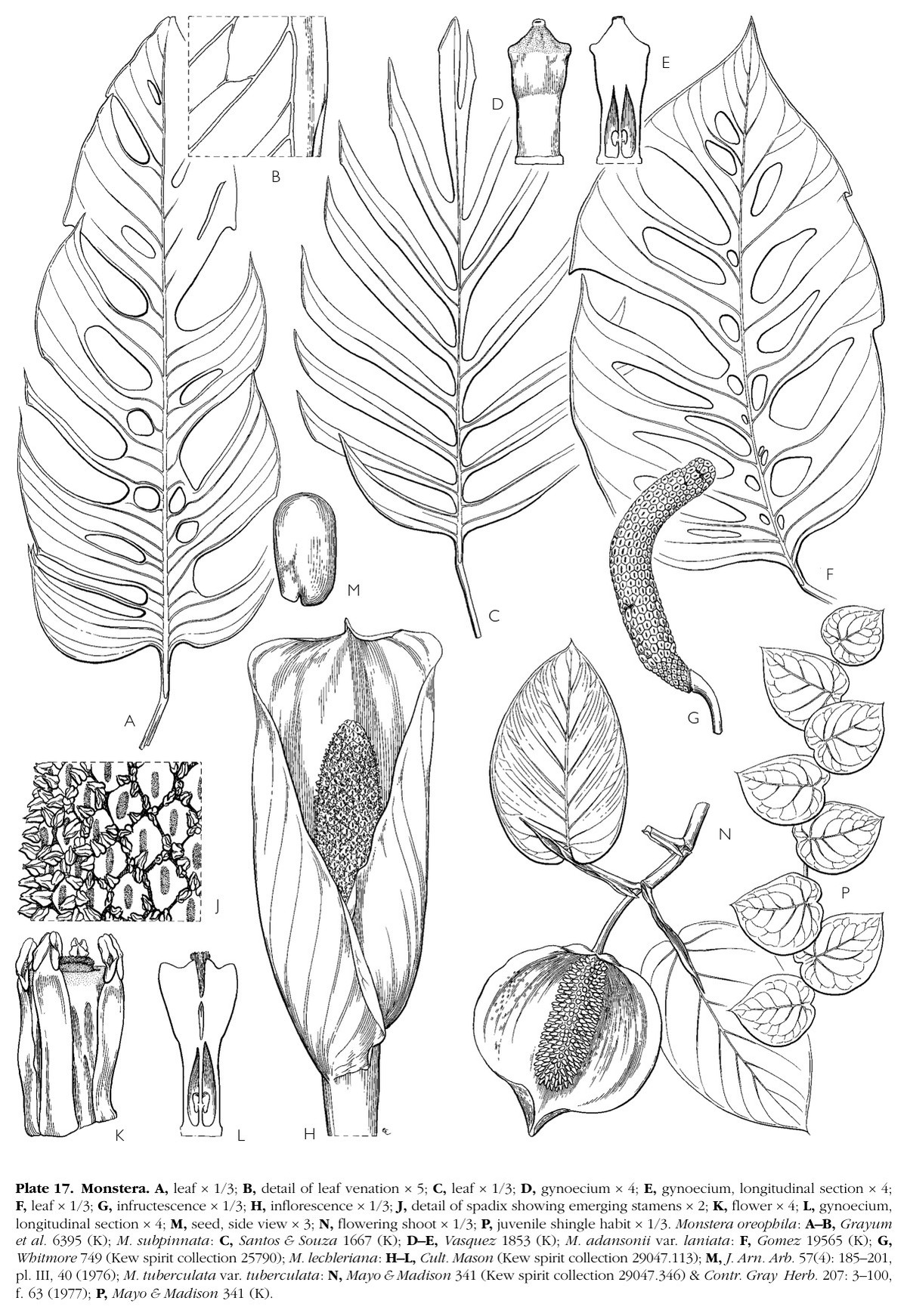
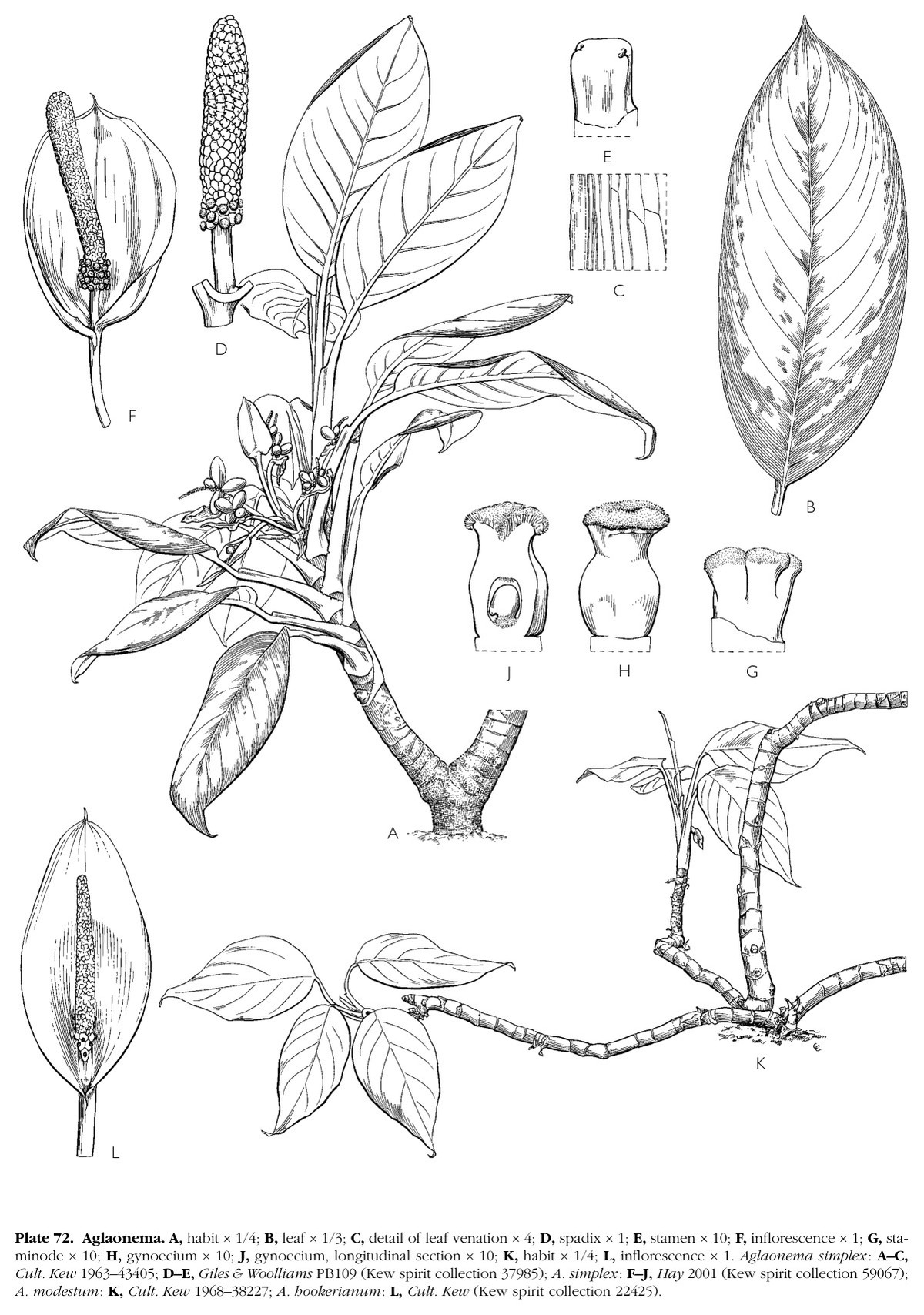
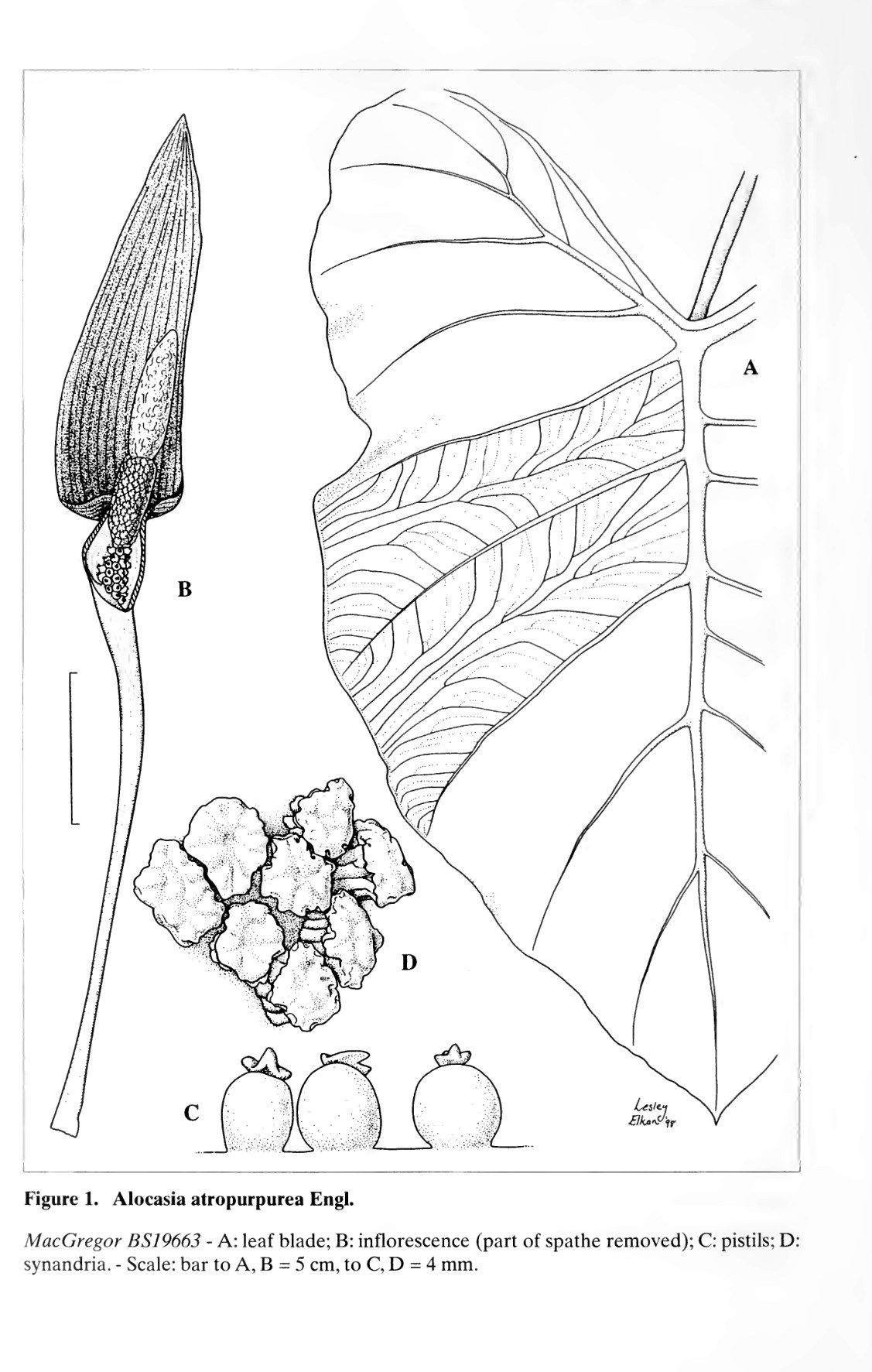
The term parallel-pinnate was coined deliberately to keep the third pattern apart from the fourth1 — older literature called it “striate” and Engler used it to assemble his subfamily Philodendroideae. Molecular work has since shown that grouping to be built on a character that evolved more than once2, which is a useful reminder: a real, visible, repeatable character can still be the wrong thing to classify on.
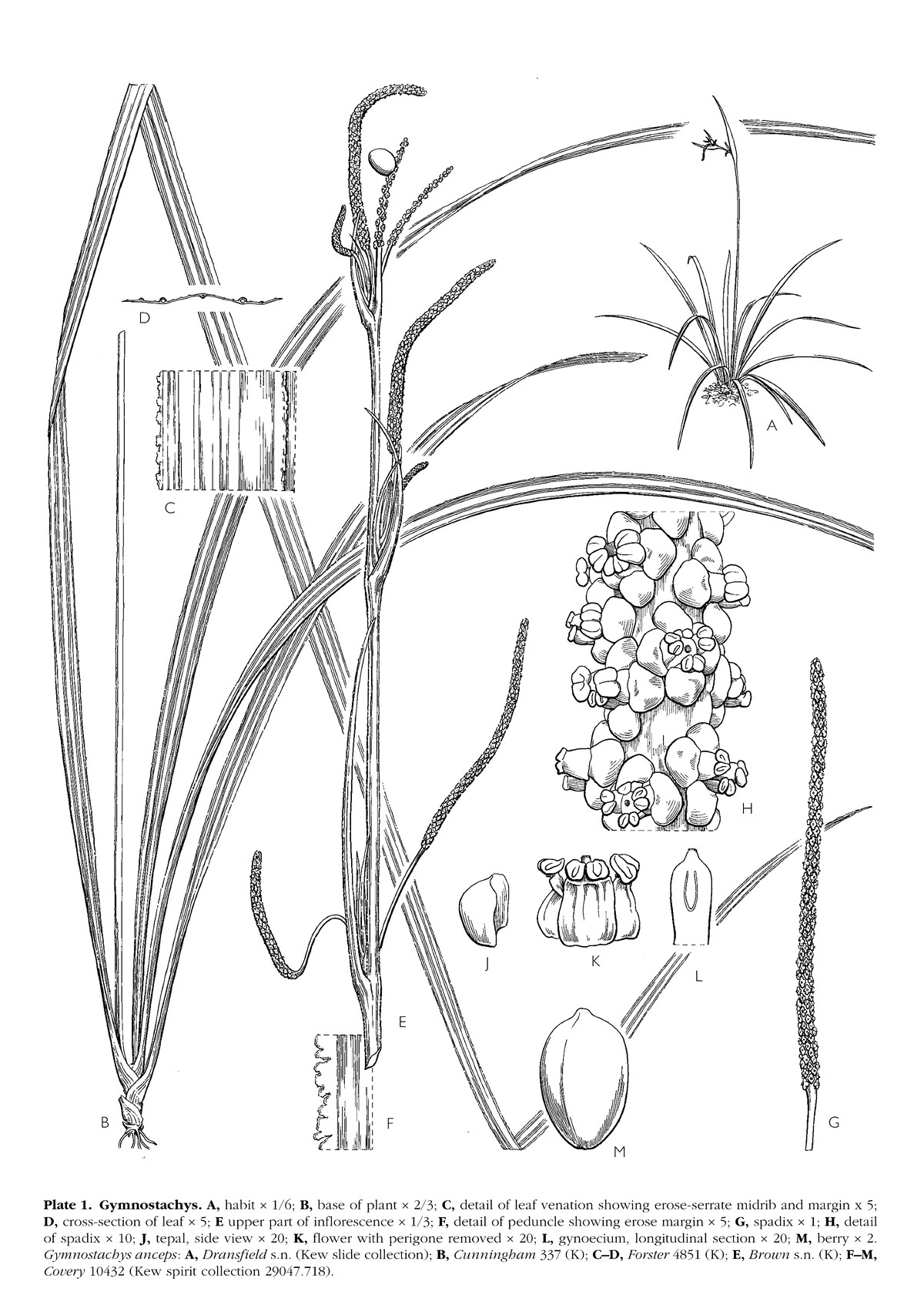
Intermediates exist between most of the types, and the only large-scale comparative survey of aroid venation remains Ertl's, from 19321.
Peltate, and why it matters
A peltate leaf has its petiole attached inside the blade margin rather than at the edge. It appears in tribe Colocasieae, and in Anthurium, Caladium and Homalomena1 — and in the molecular analysis, peltate leaves are the only morphological synapomorphy recovered for the Colocasia clade2. It is also strongly age-dependent: in Philippine Alocasia, seedling leaves are almost always peltate while most adults are not3.
Holes
Perforated leaves occur in Monstera, Rhaphidophora, Epipremnum, Amydrium, Dracontioides, Cyrtosperma, Dracontium, and in the juvenile leaves of Anchomanes and some Cercestis1, 4. They have evolved independently at least six times2 — which is the first clue that they are doing something useful.
How the holes form was long described as necrosis: cells dying at an early stage of leaf development, their nuclei visibly dark and shrunken beside the healthy nuclei of their neighbors5 — already, in 1969, a description of what would later be given a name. In Monstera obliqua a 2005 study gave the process its modern name and mechanism, programmed cell death: the cell walls at the perforation site are left intact and the rim cells re-differentiate as epidermis6 — the same outcome as the lace plant Aponogeton madagascariensis, reached by convergent evolution.
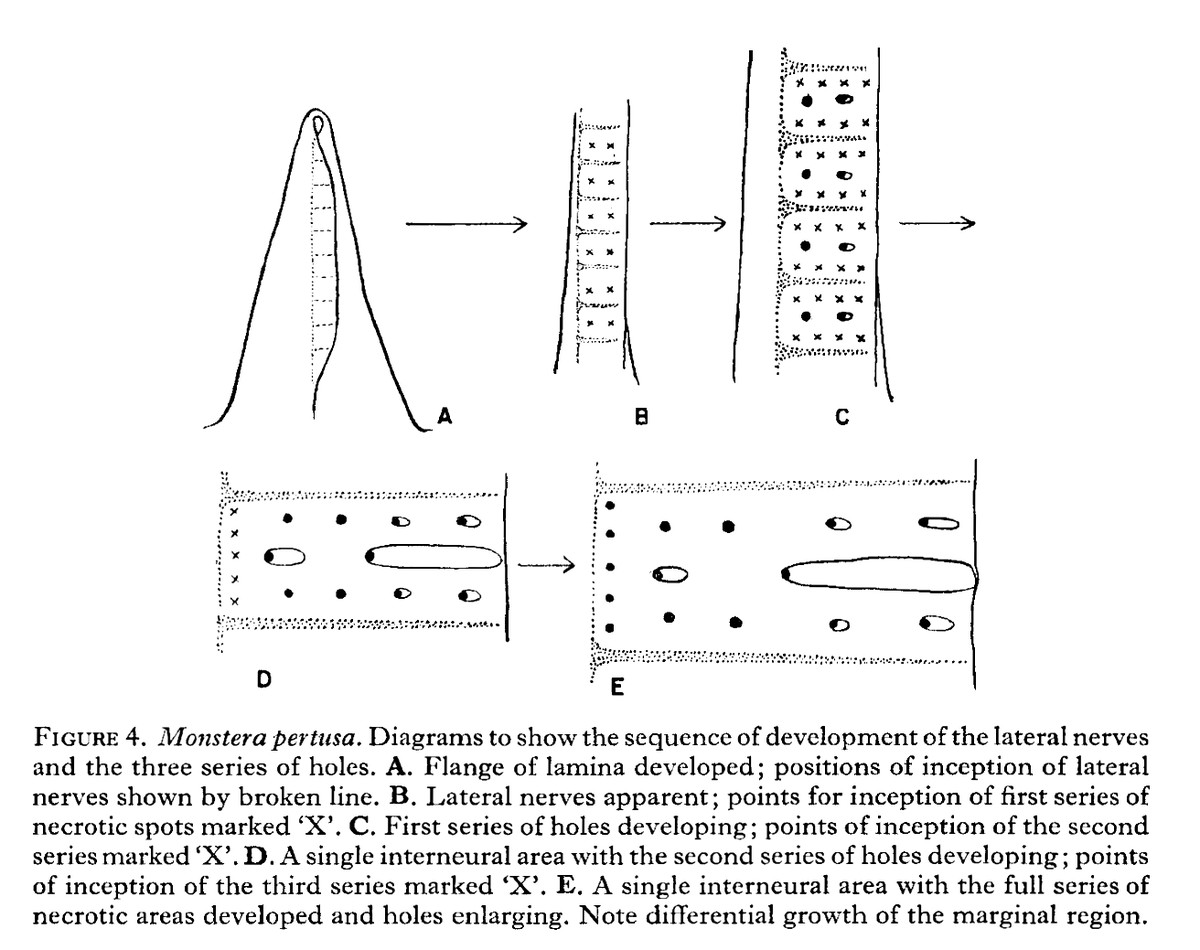
Why the holes? Nobody has settled it
Water to the roots. Proposed in 1892; Madison called it “a fanciful interpretation with no basis in reality” in his 1977 revision4. A later student experiment measured the opposite of what dismissal predicts — roughly twelve times more water collected beneath holed leaves than beneath leaves with the holes filled in7.
Cooling. Madison suggested the holes break up the still-air layer4; the objection is that the comparison plants are full-sun pioneers while Monstera is a shade plant, and that leaf shape had no measurable effect on the temperature of tropical understorey climbers8.
Wind, and herbivores. The same student experiment found no significant wind effect, and found holed leaves suffered more insect damage, not less7.
Sunfleck economics. The most recent proposal is that fenestration does not raise average carbon gain at all — it lowers the variance in it, which under a flickering understorey light regime raises long-run fitness8.
⚠ The experimental work here is a single undergraduate field study on one species, with samples of 15–30 per treatment7. It is the only direct test among the sources cited here, and it should be weighted as such.
Two leaves on one plant
Heteroblasty — a plant's leaves changing sharply between an early stage and a later one — has been reported in the climbing genera Cercestis, Monstera, Philodendron, Pothos, Rhaphidophora and Syngonium1, though the evidence backing each genus is far from equal. The term itself is broader than leaves: properly it covers any abrupt, substantial change in a plant's metamers or habit, and “juvenile” and “adult” are terms for reproductive status, not a synonym for early and later leaf form21. In Syngonium the arrow-shaped blade is the pre-adult climbing stage — the seedling's is entire — and the adult is trifid to pedatisect1, 19. A third of the genus does none of this: 13 of the 33 species in the genus revision are entire-leaved, and their juvenile blades differ from the adult only in being smaller19. Growers keep the plants juvenile deliberately, because in the species they grow the adult is a different-looking plant.
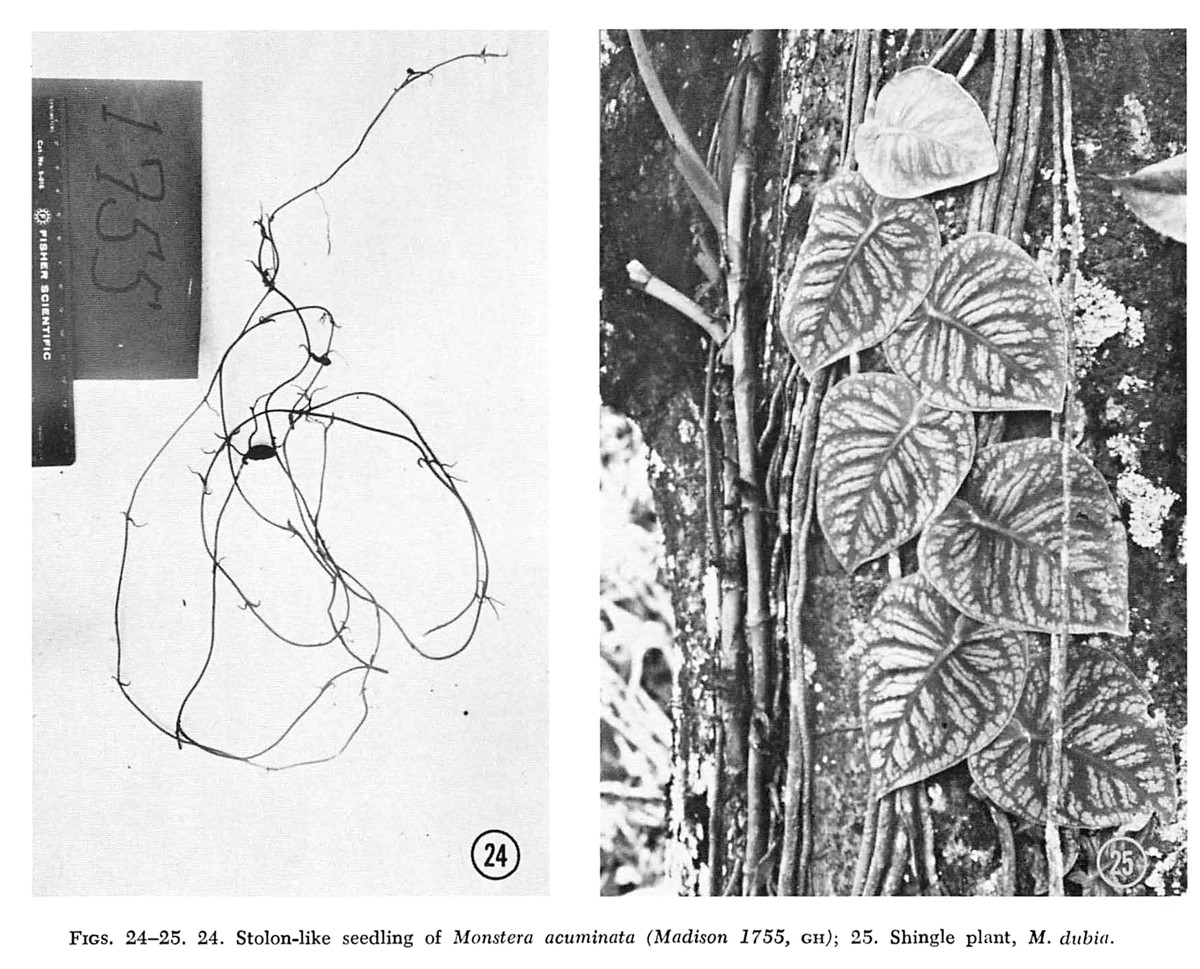
The extreme form is the shingle plant: a juvenile climber with almost no petiole, blades pressed flat and overlapping against the bark like roof tiles1. Across all flowering plants the habit has arisen in ten families, 22 genera and at least 158 species — and exactly one of those species is from mainland tropical Africa10. In Araceae it appears in Pothos, Rhaphidophora, Monstera and Scindapsus10. What it is for is again unsettled: protection of the adventitious roots from drying was the classical answer4, while the current favorites are trapping and recycling carbon dioxide, and capturing nutrients from water running down the trunk — with the honest note that few of the hypotheses have ever been explicitly tested10. Whether the stage can return is a separate question. Thomas B. Croat of the Missouri Botanical Garden wrote in 2007 that Monstera dubia, whose shingle plant is pictured below, definitely changes from its shingled, mottled juvenile forms to preadult, solid green leaves and never reverts to the juvenile form31.
Part II
The stem, and the root
An aroid stem is one of four things: an underground tuber, an underground rhizome, an erect aerial stem, or a climbing stem with long internodes1. A fifth form is not a stem at all — Arisaema and Typhonodorum build a pseudostem out of wrapped petiole sheaths1.
The distribution is not what an older generation of botanists expected. The erect, cane-like habit of Aglaonema, Dieffenbachia, Homalomena and Schismatoglottis was once read as primitive; it is in fact concentrated in the more advanced genera, while long-internode climbing is commonest in the tribes with bisexual flowers — the older lineages1. Underground storage organs are common in Lasioideae and especially in Aroideae1; in the Thai flora alone, well over half the species are geophytes11.
One caution on the first of the four stem types above: “tuber” names how an organ looks more than a single inherited structure. Peter Boyce wrote that aroid tubers are not homologous and have arisen independently several times in the family26, and Wilbert Hetterscheid described tuber and rhizome as two parts of one continuum of stems, the tuber being the condensed, food-storing end, and “tuber” as more an appearance term than a reliable systematic one27.
A tuber’s appearance can still carry information, though. Wilbert Hetterscheid wrote that an Amorphophallus tuber usually has a noticeable depression on top in which the bud rests (he put the chance at 90 percent), whereas Gonatopus, which he said is often misidentified as Amorphophallus in Africa, has a more pyramidal tuber32. Vegetative plants of Amorphophallus bulbifer are difficult to separate from Amorphophallus muelleri, he wrote, but the tuber may help: smooth in the first, and in the second covered all over with distinct, raised, ring-like (annulate) root scars33. And he called the tuber of Amorphophallus sumawongii quite recognizable, because it is usually pretty yellow to orangish yellow when first taken from the soil34.
Climbing, and the two kinds of hemiepiphyte
Most Pothoideae and Monsteroideae are hemiepiphytes, and among the advanced genera the habit is confined to tribe Culcasieae, Philodendron and Syngonium1. The two routes are worth keeping apart:
Hemiepiphytes begin life above the ground and send feeder roots down to the forest floor1. A second growth form is often lumped in with them: seedlings that germinate on the floor, climb a trunk, and keep growing after the stem below them rots away. The preferred term for that habit is now nomadic vine, not “secondary hemiepiphyte” — the plant typically never loses its connection to the ground at all; it is the old stem above the roots that dies, not the roots’ hold on the soil17.
How a seedling finds a trunk in the first place is one of the family's best-known findings: skototropism, growth toward darkness rather than light, described for a Monstera in 197512. ⚠ The paper names its plant Monstera gigantea; Madison's revision notes the name is ambiguous and the species is probably Monstera tenuis or Monstera dubia4 — worth knowing before repeating the species name.
Roots do two different jobs
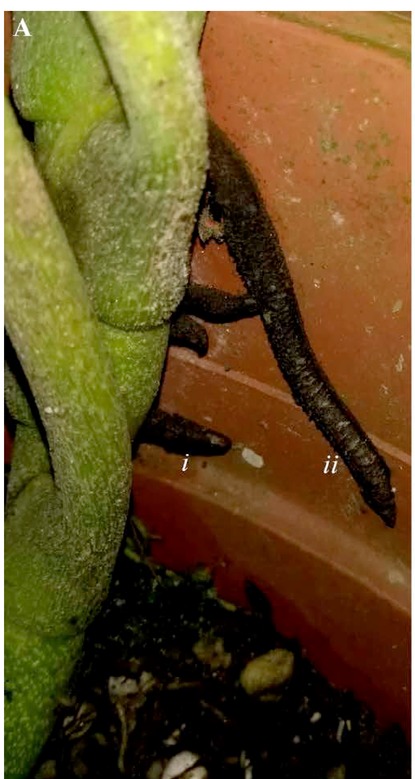
Aroid roots are always adventitious, and in climbing hemiepiphytes they are dimorphic1: short anchor roots that grip the bark, and long feeder roots that run to the soil. The difference only appears once the plant is about a meter up and the stem is 7–10 mm thick. Anchor roots reach 20–30 cm in Monstera; feeder roots in the same genus may extend 30 meters to the forest floor1, 4. Some climbers — Scindapsus pothoides among them — do not show a clear distinction between anchor and feeder roots1, and Syngonium anchor roots may lack root hairs and appear cemented on by dried mucilage1. A different root habit turns up in true epiphytes. Writing from Sarawak in February 2007, Peter Boyce listed Scindapsus crassipes, Scindapsus geniculatus and Scindapsus beccarii, with a couple of undescribed species, as obligate primary epiphytes (plants that begin on the host and stay on it), all forming fans of foliage that work as litter traps. In Scindapsus geniculatus, he added, short, erect, pointed roots form extensively into the accumulated litter, as in many Anthurium35.
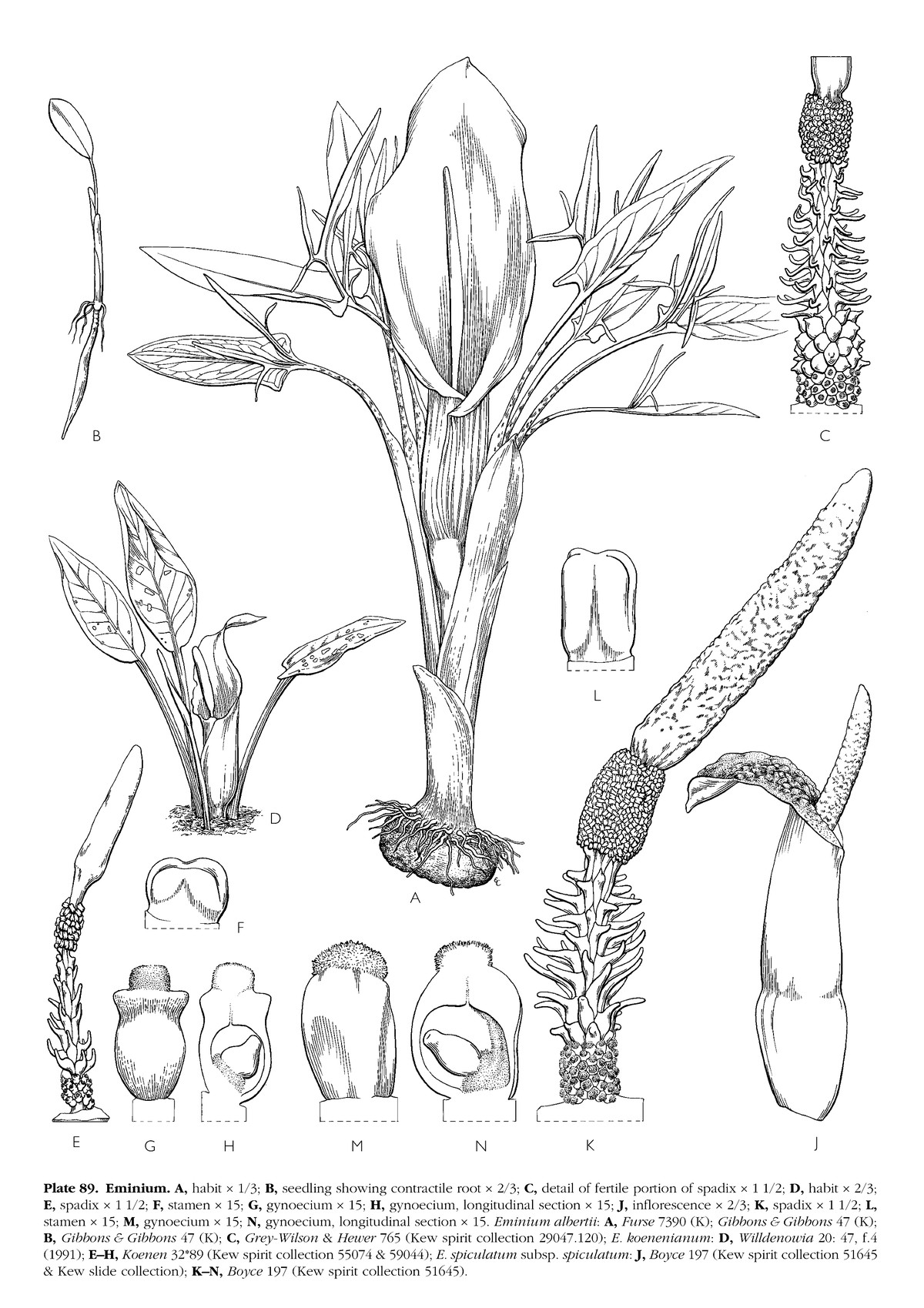
Geophytes have their own specialization: contractile roots, which pull the stem back down when it creeps too near the surface, in Arisarum, Arum, Biarum and Cryptocoryne1.
Water
Rheophytes — plants of swift streams, flooded to the waterline — are recognizable as a form: narrow leathery leaves on a firmly attached, usually rock-gripping stem1. In Araceae they are concentrated in the Schismatoglottideae, with Homalomena, Anubias, Holochlamys and rarely Anthurium1. Galantharum kishii, a Borneo species of the Schismatoglottideae, is a working example: its co-describer, Peter Boyce, reports that it grows as a rheophyte, submerged by spate flow for part of the time and fully exposed when the river level is low28, 29.
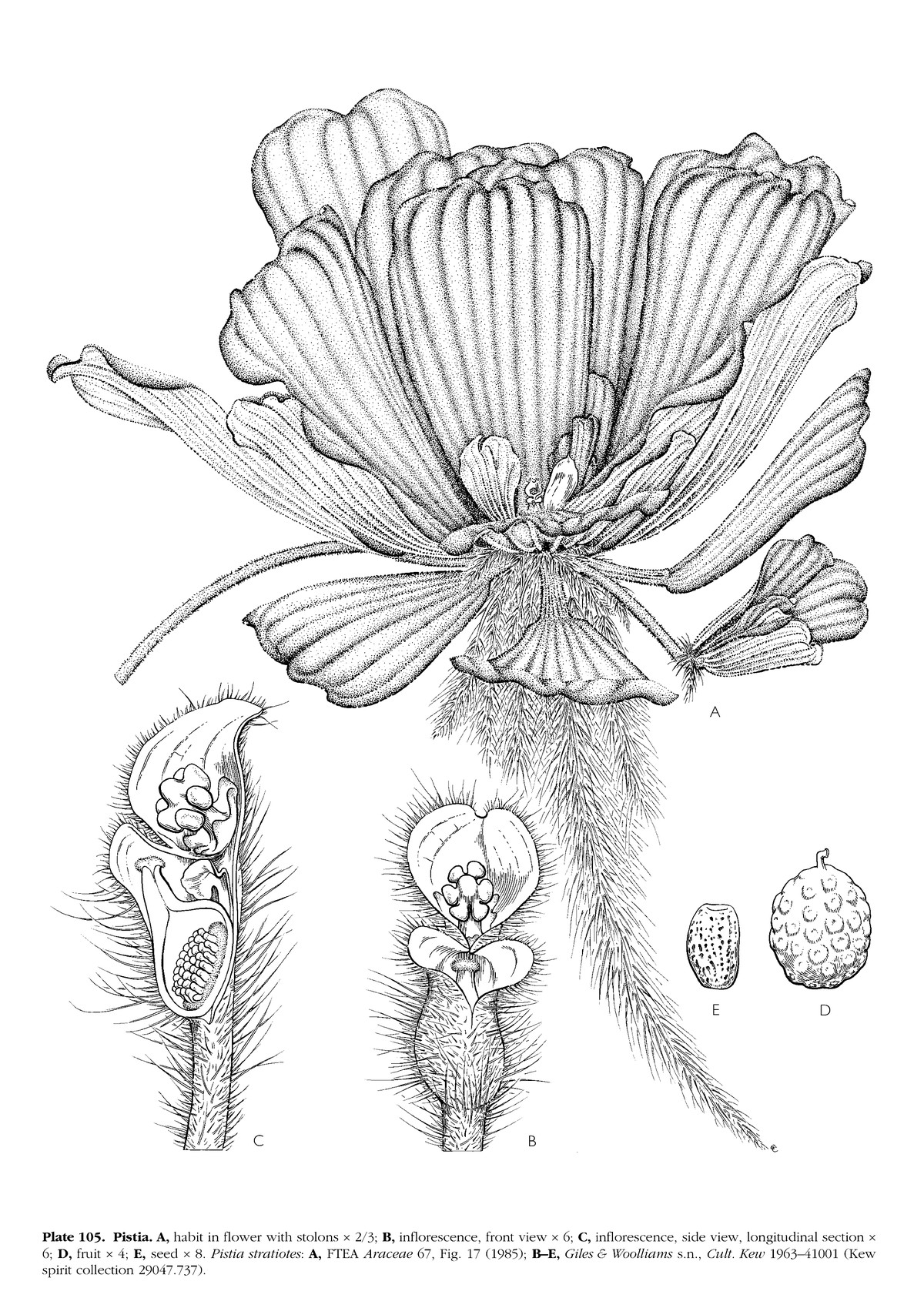
Aquatics that grow submerged are rarer: Jasarum steyermarkii, with linear leaves in rocky pools along a small rocky stream, and many Cryptocoryne1. The duckweeds of subfamily Lemnoideae — Lemna, Wolffia and their relatives — are free-floating2, and outside them exactly one species floats free: Pistia stratiotes, a rosette of spongy wedge-shaped leaves with no midrib and a curtain of feathery roots beneath1.
The module
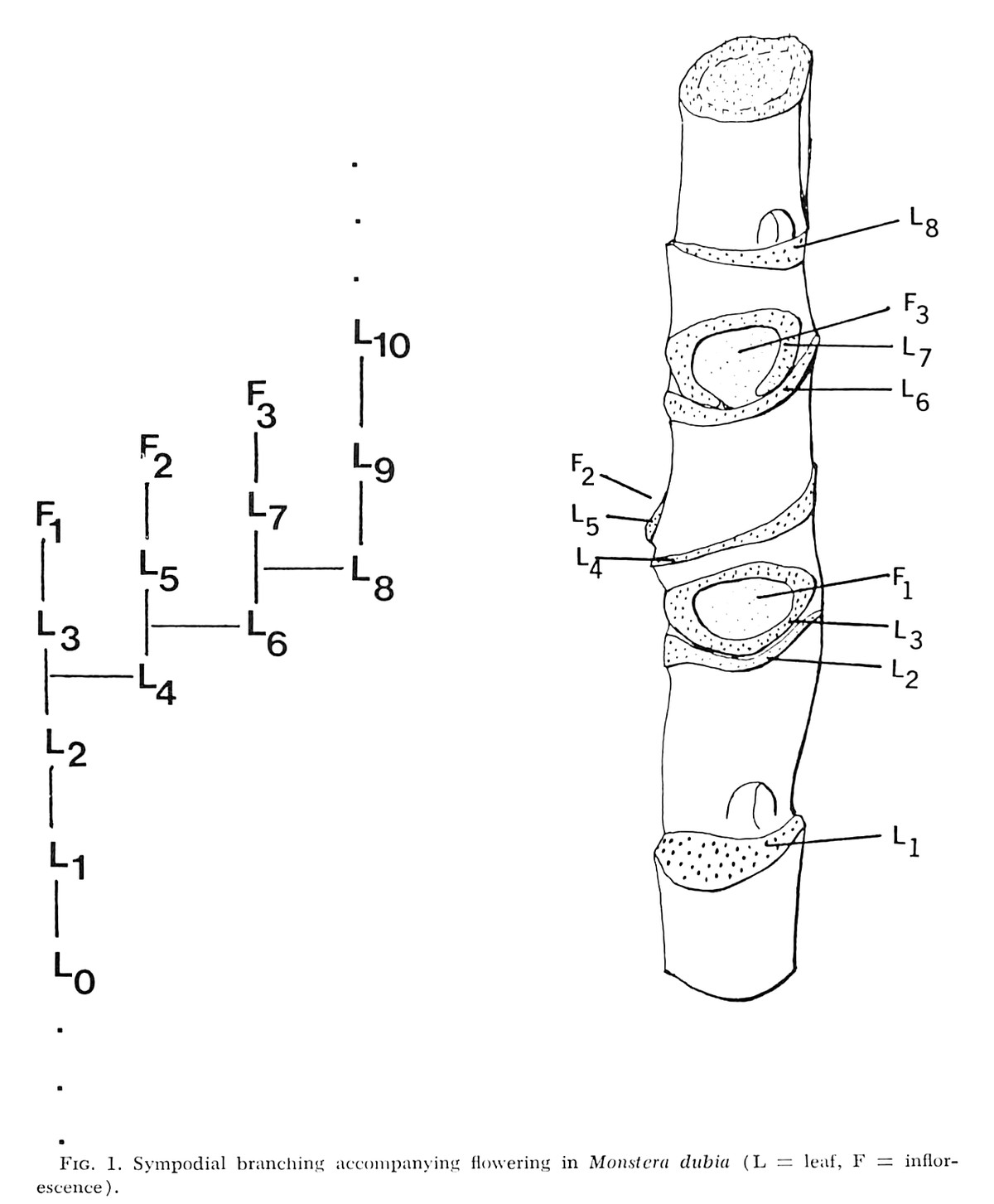
One last piece of architecture, because species descriptions lean on it constantly. A flowering aroid stem is almost always a sympodium: a chain of articles, each beginning with a two-keeled prophyll, continuing through a run of leaves, and ending in an inflorescence1. The continuation shoot usually arises at the second node below the spathe. Engler's rule treated Orontioideae as a categorical exception, with the shoot arising at the first node throughout the subfamily — but direct observation conflicts with that: in Acorus, Orontium and Calla the shoot has actually been seen at the ordinary second node, and Gymnostachys remains unconfirmed either way20, while in Symplocarpus the renewal shoot has been described arising in the axil of the shoot’s upper foliage leaf25. Cataphylls, when they persist, become a visible character in their own right: membranous in some species, a mass of net-fibers in others, and conspicuously mottled in Arisaema and some Alocasia1, 9.
Part III
Inside the tissue
Three internal characters are used across the family, and one of them is the reason an aroid leaf can hurt you.
Raphides — the needles
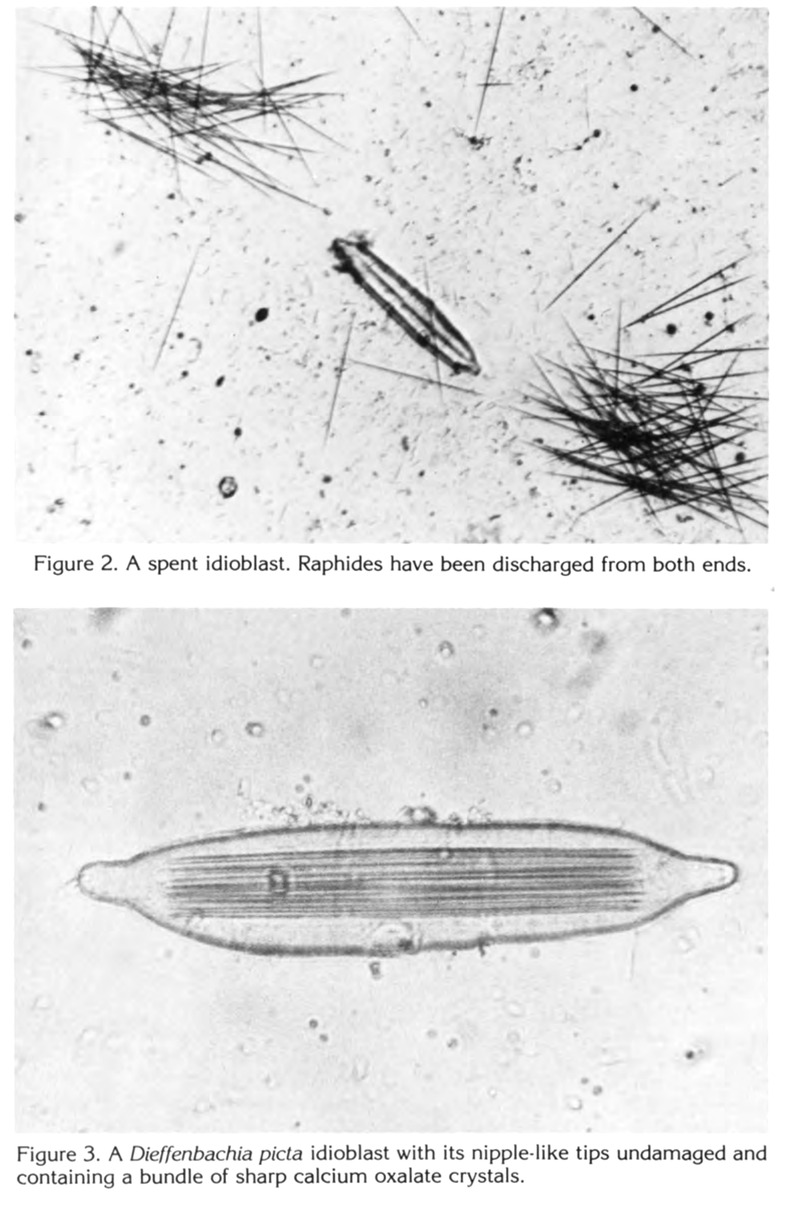
Calcium oxalate crystals are abundant throughout Araceae, and needle-shaped raphides are always present1. They are twinned, H-shaped in cross-section and often barbed along their length. They sit inside specialized cells: thin-walled idioblasts, and thick-walled biforines that eject their contents through a pore at either end — about 50 × 150 µm in Colocasia and 40 × 90 µm in Alocasia, which is unusual in ejecting the entire mass of crystals and mucilage together1.
The needles are the delivery system, not the poison — probably
“Raphides alone are harmless… Raphides, however, are only the vehicles of irritating substances”1. That is the classical reading. For Dieffenbachia specifically, though, the exact cause of the burning is still unresolved: the protein evidence is unclear, and raphide-assisted delivery remains an untested hypothesis rather than a demonstrated mechanism, in that genus and probably beyond it.
Fruit raises the same doubt. Madison’s 1977 revision of Monstera left it unclear whether the prickling of unripe fruit comes from raphides or from needle-shaped sclereids (trichosclereids) in its stylar portion4. Ripe fruit does not suit everyone either: Leland warned that some people are sensitive to the calcium oxalate even in fully ripe Monstera deliciosa fruit36, and D. Christopher Rogers wrote that some people who eat the ripe fruit of his plants of that species get a strong, pin-pricking tingling on the lips while others, eating fruit from the same plant, do not; he suggested it may be the needle-like crystals37. Neither remark is a test of the cause.
The crystals that are not inside anything
Everything above is intracellular: crystals held in a cell until it fires. Calcium oxalate also turns up outside cells altogether, on the inflorescence, and it does so in two different places that are worth keeping apart18.
On the surface of floral organs it accumulates as globular masses of druses, or occasionally as crystal sand. Mixed in with the pollen it is raphides or styloids — prismatic crystals — and that second one is widespread in the family. They are separate observations, not one seen twice: across the twenty-three species examined for surface crystals, no raphides were seen on the staminal epidermis of any of them18.
In Philodendron the surface crystals appear on nearly mature stamens, first under the cuticle, then breaking through it just before the anthers open — and by the time the spathe opens they are gone from the stamen surface18. Where they go is not settled. Raphides and prismatic crystals do turn up with the pollen at anthesis in some of the same species, and the authors say plainly that it is not possible to determine conclusively whether these are the same crystals18.
A character the reference book does not record
Keating’s survey of aroid anatomy — the volume the field reaches for — reports raphides, styloids and druses inside cells and does not mention extracellular crystals at all18. An absence in a reference work is not the same as an absence in the plant. Sometimes it only records where nobody was looking.
And it will not sit still long enough to be scored
The survey’s own conclusion is that this is a species-level character, not a generic one: raphides come out with the pollen in Anthurium acaule and not in Anthurium upalaense18. But the tables are rougher than that. Repeat observations disagree with each other: Anthurium longistamineum is scored four times from one garden accession — none, rare, and present twice — and Arisarum vulgare six times from one Corsican collection, running from none through sparse to abundant18.
So a single inflorescence cannot settle it, and neither can a single plant. It is the same difficulty Part VII of the Alocasia guide runs into with interprimary collective veins: a character that varies within an individual cannot separate two individuals on one look.
What any of it is for is unknown. The survey asks directly whether extracellular crystals are linked to pollination, and answers that the function remains unclear18.
Laticifers and resin canals
Most aroids carry laticifers — latex-bearing canals — and their form is taxonomically loaded. Anastomosing (branching and rejoining) laticifers are limited to the tribes Caladieae, Colocasieae and Zomicarpeae; articulated non-anastomosing ones occur in Calla, Orontium and nearly all Aroideae1. Engler defined his subfamilies Pothoideae and Monsteroideae partly by their lack of laticifers1. Tribe Cryptocoryneae was long reported to lack them too — until they were found in the stems, roots and cataphylls (though not the foliage leaves) of both Cryptocoryne and Lagenandra1.
Resin canals are far rarer. A survey of 91 genera found them in the roots of five: Culcasia, Cercestis, Homalomena, Furtadoa and Philodendron1. In Culcasia and Philodendron they are visible in the leaf without magnification. The same resin has a job at flowering time: in Philodendron it glues pollen onto the pollinating beetle1. (Note for currency: Furtadoa has since been sunk into Homalomena, which reduces that list to four genera as currently circumscribed.)
And the genus that has none of it
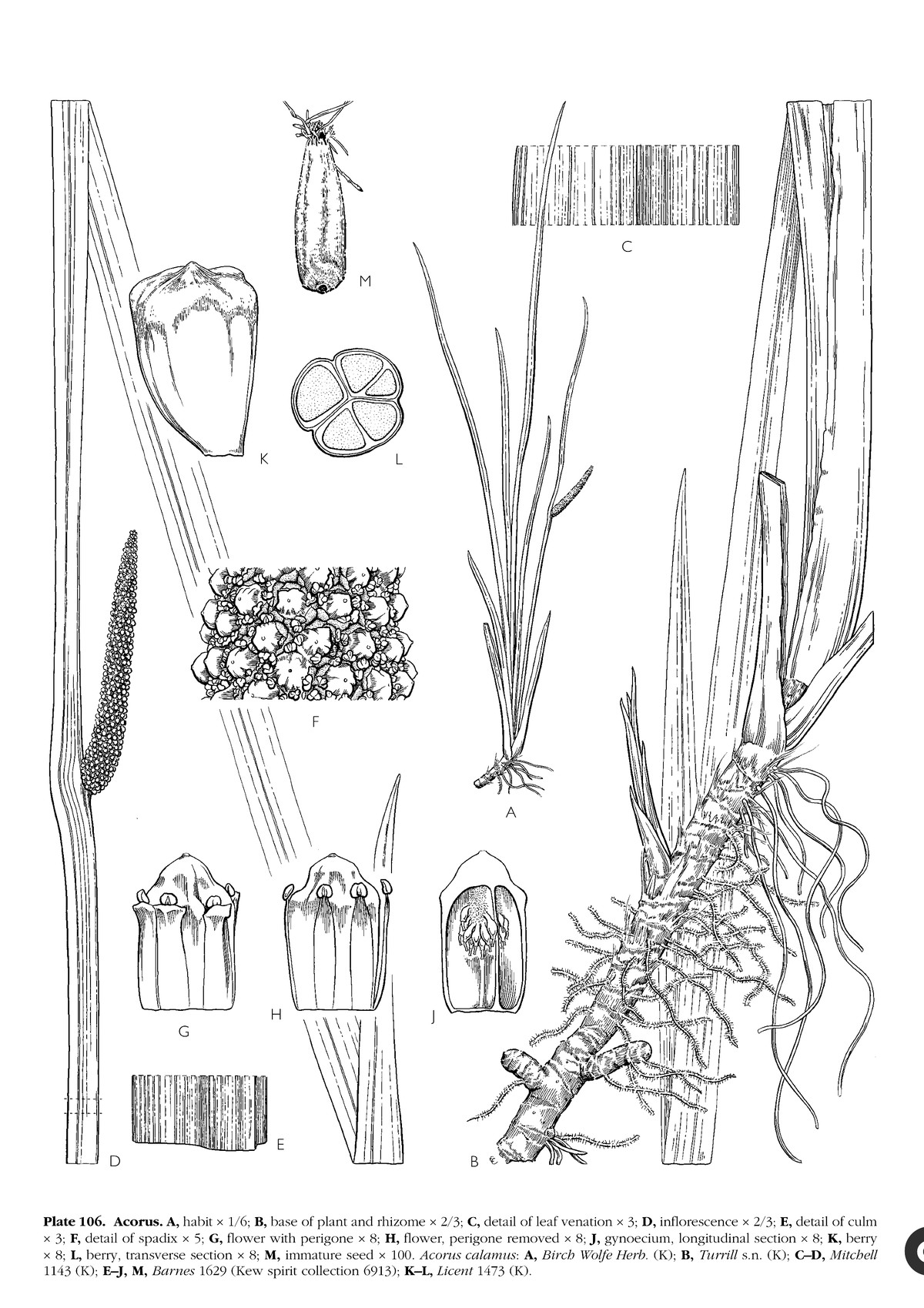
Acorus — long treated as an aroid, now placed in its own family Acoraceae as the sister to all other monocots — lacks both laticifers and raphides1. In a family where raphides are otherwise universal, their absence is one of the clearest signals that the plant was never really an aroid.
A naming trap worth knowing
Rhaphidophora is not named for raphides. Hasskarl named the genus in 1842 on the basis of trichosclereids — needle-shaped sclereids, a different structure entirely — which he had illustrated correctly and labeled confusingly1.
Part IV
The tell: genus by genus
One character per genus — the vegetative feature a taxonomist reaches for first. None of these is an identification on its own, and several are shared. They are starting points, not verdicts.
| Genus | The tell |
|---|---|
| Anthurium | A geniculum — a distinct joint at the top of the petiole that lets the blade swivel. Plus reticulate fine venation. |
| Philodendron | Parallel-pinnate venation, a petiole only rarely geniculate, and intravaginal squamules. Resin canals visible in the leaf. |
| Monstera | Neotropical, reticulate-veined, elaborately perforated. The only fenestrate climber in the New World tropics. |
| Rhaphidophora | Palaeotropical counterpart of Monstera; stem often square in cross-section; leaves distichous. |
| Epipremnum | ⚠ Vegetatively near-inseparable from Rhaphidophora. The genera are divided on seed structure, not on the leaf. |
| Scindapsus | The climber that never fenestrates: adult blade always entire. |
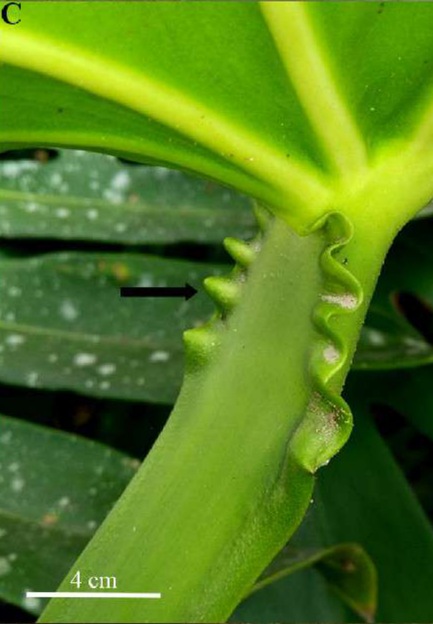
| Pothos | Two forms: in subgenus Pothos the petiole is flattened and blade-like, often auriculate at the top, with only a slight apical articulation; in subgenus Allopothos it sheaths normally and carries a conspicuous apical geniculum instead23. |
| Alocasia | Colocasioid venation, wax glands in the vein axils, blade peltate as a juvenile and usually sagittate as an adult. |
| Colocasia | Peltate at every stage, posterior lobes rounded and partly to almost wholly fused. |
| Xanthosoma | The New World one: cordate to sagittate to pedatisect, and only rarely peltate. |
| Caladium | Usually variegated, on a small tuber, and peltate in some but not all species. Separated from Xanthosoma chiefly by pollen shed in solitary grains rather than tetrads22. |
| Dieffenbachia | Erect green cane with conspicuous annular leaf scars; sheath more than half the petiole. |
| Aglaonema | The Old World cane: same habit as Dieffenbachia, but parallel-pinnate venation. |
| Spathiphyllum | An acaulescent rosette herb that still has a geniculate petiole — an unusual combination. |
| Syngonium | Textbook heteroblasty in the pedatisect species: arrow-shaped pre-adult climbing blade, trifid to pedatisect adult. Do not rule the genus out on an entire leaf — 13 of 33 species are entire-leaved, with juveniles differing from adults only in size19. |
| Homalomena | Crushed tissue is aromatic (terpenoids)13. |
| Schismatoglottis | Superficially the same plant — but not aromatic13, and often with a long apical ligule on the sheath. |
| Amorphophallus | Usually a single dracontioid leaf: one petiole, one trisect blade, further divided — a whole crown on one stalk. |
| Arisaema | Trifoliolate, palmate, pedate or radiate blade on a pseudostem of petiole sheaths24; sex expression shifts with the plant's condition13. |
| Zantedeschia | Blade often marked with pale translucent spots, though how spotted a leaf is varies unreliably even between adjacent plants. |
| Cryptocoryne | Stoloniferous aquatic with supervolute leaf ptyxis — the young leaf rolled with one half around the other, whereas in Lagenandra each margin is involute. |
| Anubias | Thick creeping rhizome, leathery leaves, geniculate petiole. An African rheophyte, not a true aquatic. |
| Pistia | The only living free-floating aroid outside the duckweeds2: a pubescent rosette, no midrib, feathery hanging roots. |
The table stops at the genus, but the habit of reading features together carries below it. A grower holding two packets of seed, one sold as Philodendron selloum and one as Philodendron bipinnatifidum, asked what the difference was. Eduardo G. Gonçalves answered that the two names are the same species taxonomically, that Philodendron mello-barretoanum and Philodendron lundii are also sold as Philodendron selloum, that all the seeds look alike, and that the way to tell is to grow the plants on and observe stem and petiole38. Soft, easily detachable “scales” on the stem with a petiole concave above, he wrote, mark Philodendron bipinnatifidum; hard scales that do not detach easily, again with a concave petiole, mark Philodendron mello-barretoanum; and no persistent scales with a petiole flattened above marks Philodendron lundii.
The comparison everyone actually needs
Alocasia, Colocasia and Xanthosoma are the three big-leaved genera that get confused with one another in every plant shop on earth. All three share colocasioid venation, so the fine veins will not separate them. What does:
| Alocasia | Colocasia | Xanthosoma | |
|---|---|---|---|
| Peltate? | Juvenile yes; adult usually not (peltate in some species) | Yes, always | Rarely |
| Adult blade | Sagittate, less often hastate or cordate | Ovate-cordate to sagittate-cordate, posterior lobes rounded and fused | Cordate, sagittate, hastate, trifid or pedatisect |
| Vein-axil glands | Wax glands present in the axils of the primaries14 | — | — |
| Native range | Asia to the Pacific | Asia | Neotropical |
| Fine venation | Colocasioid in all three — this character cannot separate them | ||
The unsupported rule
You will read everywhere that Alocasia holds its leaves pointing up and Colocasia points them down. It may well be a useful field impression. But it is not stated in the taxonomic sources cited here — not in The Genera of Araceae, not in the Flora of China, not in the Flora of Thailand, and not in Hay's revisions of Alocasia. Until it can be cited, treat it as a growers' heuristic rather than a diagnostic character, and reach for peltation and the vein-axil glands instead.
And where the leaf genuinely runs out
Two of the most-searched genera on this list cannot be separated vegetatively at all. Rhaphidophora and Epipremnum are divided on the structure of the seed — ovule number and seed shape — and not on anything you can photograph on a houseplant1. Typhonium and Arum are, in Mayo's treatment, separated from their tribemates on the sterile flower zone rather than the leaf. Even a conspicuous leaf marking can mislead inside Arum. Peter Boyce, replying to a grower about silver-veined plants grown as Arum maculatum, wrote in 1997 that he had never seen a true Arum maculatum with silver veining, only plain green or variously spotted leaves, and thought such plants probably Arum italicum subsp. italicum, which he called extremely variable, or hybrids between that and Arum maculatum. His check was when the plants break growth: Arum italicum emerges in late summer or early fall and stays in leaf until late June or July, whereas Arum maculatum emerges in winter to late winter and is generally gone by late May39.
A spotted petiole can prove just as unreliable inside a single species. Michael Pascall, curator of Whyanbeel Arboretum in Far North Queensland, grew seed of a strongly spotted form of Amorphophallus galbra and got only one seedling with a spotted petiole, the rest all green; he wrote that the only true way to identify these variable plants is by the flower40.
That is not a failure of the method. It is the method telling you the truth: some questions the leaf cannot answer, and the honest next step is the inflorescence, the seed, or the sequence.
Reference
The words, plainly
Every term used across this section, in the sense the taxonomic literature uses it.
- Adaxial / abaxial
- Upper surface / lower surface of the blade. Many characters differ between the two, so descriptions always say which.
- Anterior lobe / posterior lobes
- The forward part of a divided blade, and the two basal lobes behind the petiole insertion.
- Costa
- The main rib of a lobe. A divided aroid leaf has an anterior costa and two posterior costae.
- Colocasioid venation
- Fine veins leaving the primaries at nearly a right angle, arching to the margin and fusing into a sinuous collective vein. Tribes Colocasieae and Caladieae.
- Parallel-pinnate venation
- Primaries and secondaries leaving the midrib pinnately, then running parallel to the margin. Called “striate” in older work. Not the same as grass-type parallel venation.
- Reticulate venation
- Net-like fine venation, superficially like a dicot leaf.
- Interprimary collective vein
- A vein formed where secondary veins meet between two primary lateral veins. Whether it forms at all can be diagnostic.
- Marginal / intramarginal / submarginal vein
- A vein at the very edge; one running a short distance inside it; one that the major venation runs into some way in from the edge. Different structures — and some species have more than one.
- Geniculum (pulvinus)
- A swelling or joint at the top of the petiole that lets the blade move independently. Nearly universal in Pothoideae and Monsteroideae.
- Peltate
- Petiole attached within the blade margin rather than at the edge.
- Sagittate / hastate / cordate
- Arrow-shaped with lobes pointing back; spear-shaped with lobes pointing out; heart-shaped.
- Pedate / pedatisect
- Divided with the side segments themselves branching outward, like a bird's foot; pedatisect means divided all the way to the axis.
- Dracontioid
- The Amorphophallus-type leaf: trisect, with the primary divisions themselves pinnatisect or further divided.
- Fenestrate
- Perforated. In the later foliage of many Monstera species, the holes open during early leaf development by programmed cell death — demonstrated in Monstera obliqua.
- Heteroblasty
- An abrupt, substantial change in a plant's leaves or habit between an early growth stage and a later one. Not confined to leaves, and not the same thing as juvenile and adult, which properly describe reproductive status rather than leaf form.
- Shingle plant
- A juvenile climbing stage with almost no petiole and blades pressed overlapping against the bark.
- Hemiepiphyte
- Germinates above the ground, sends feeder roots down to the forest floor.
- Nomadic vine
- Germinates on the ground, climbs, keeps growing after the old stem below it rots — but typically keeps its roots in the soil throughout. Formerly lumped in as a secondary hemiepiphyte.
- Skototropism
- Growth toward darkness — how a seedling climber finds a tree trunk.
- Anchor root / feeder root
- Short roots that grip bark; long roots that run to the soil. Climbing hemiepiphytes make both.
- Rheophyte
- A plant of swift streams, flooded to the waterline: narrow leathery leaves, firmly attached stem.
- Sympodium, prophyll, cataphyll
- The stem as a chain of articles. The first leaf of each article is the prophyll, usually two-keeled — a small scale generally visible only in section, though in some species it grows several centimeters long with the keels obvious unaided. A cataphyll is any scale leaf under about a tenth of a full leaf's length; between that and a full-sized foliage leaf is a reduced leaf.
- Ptyxis
- How a single young leaf is folded or rolled in the bud. The young leaf is supervolute in Cryptocoryne, one half rolled around the other; each margin is involute in Lagenandra.
- Raphides, biforines
- Needle-shaped calcium oxalate crystals, always present in Araceae; and the thick-walled cells that eject them.
- Laticifer / resin canal
- Canals carrying latex, present in most of the family; canals carrying resin, in only a handful of genera.
Every botanical term used across Aroidpedia, with how to say it and a picture for many, is in the Aroid Glossary.
The Genera
Now read one all the way down
Each guide reads one genus the way a revision reads it — the characters that carry information, the ones that only look as though they do, and the point where the plant stops answering.
-
Read now
Alocasia
The leaf read character by character — Hay's A–N diagram on real leaves, the venation hierarchy from costa to secondary vein, and two case studies where a vein a few millimeters from the edge is the whole diagnosis.
Read the guide
-
Read now
Anthurium
The one genus that wrote down how to describe itself: Croat and Bunting published the vocabulary, character by character, with lettered figures for blade outline, sinus and vein category. The guide follows it — including Croat's warning that in Anthurium a measurement is mostly the plant's age, and only the ratio is the character.
Read the guide
-
Read now
Philodendron
Croat, who revised the Central American species across nearly four hundred pages, wrote that probably no morphological character in this genus is more diagnostic than the cataphyll — then sorted every species by what its cataphylls do. The deepest divisions turn out to sit in tissue, not in outline.
Read the guide
-
Read now
Monstera
Four kinds of shoot on one plant, a juvenile once described as a dicot, and eleven leaves of a single species running from entire to a narrow strap. The adult leaf turns out to be the least reliable thing about the genus.
Read the guide
-
Read now
Amorphophallus
A crown that looks like a small tree and is a single leaf, built on a three-part plan subdivided until you cannot see it. Of the sixty-three characters that Ittenbach's revision of the African species lists as most important, the blade contributes none — and whether you ever see leaf and flower together depends on which continent the plant came from.
Read the guide
-
Read now
Schismatoglottis
The other half of that pair — and a genus defined, since 2024, by what its shoot does after flowering. Eighty-five species left on that character; the free ligule and most of the leaves that grow plantlets went with them.
Read the guide
-
In preparation
Rhaphidophora
The Old World answer to Monstera — and not named for raphides at all, but for trichosclereids its author illustrated correctly and labeled confusingly.
-
In preparation
Epipremnum
The genus that proves the point of this whole section: vegetatively near-inseparable from Rhaphidophora, and conventionally divided from it on ovule number — though a molecular test found seed shape alone does not cleanly separate the two.
-
In preparation
Scindapsus
The climber that never makes a hole, and whose anchor roots may not differentiate from feeder roots at all.
-
In preparation
Colocasia
Taro, and the type of colocasioid venation. Peltate from seedling to adult — the character that most reliably separates it from the Alocasia it is constantly confused with.
-
In preparation
Xanthosoma
Usually sagittate and only rarely peltate, neotropical rather than Asian, and sharing the venation type that makes the three big-leaved genera so hard to tell apart at a glance.
-
In preparation
Caladium
Where leaf variegation becomes the thing the plant is grown for — and where pollen structure, not the peltate leaf, does the work of separating it from Xanthosoma.
-
In preparation
Arisaema
No true aerial stem — the trunk is a column of wrapped petiole sheaths. Sex expression shifts with the plant's condition from one year to the next.
-
In preparation
Syngonium
Arrow-shaped as a juvenile, trifid to pedatisect as an adult. Growers keep it juvenile on purpose, because the adult is a different-looking plant.
-
In preparation
Aglaonema
Same erect, annular-scarred habit as Dieffenbachia, on the other side of the world and with a different fine venation.
-
In preparation
Dieffenbachia
The green cane of the New World understorey, and one of the best-studied plants in the family for what happens at flowering.
-
In preparation
Homalomena
The character is chemical, not visual: crush a leaf and it smells of terpenoids. Its lookalike Schismatoglottis does not.
-
In preparation
Cryptocoryne
The young leaf is supervolute in the bud, one half rolled around the other; in Lagenandra, each margin is involute. One of very few genera in the family that lives submerged.
-
In preparation
Spathiphyllum
An acaulescent herb that nonetheless carries a geniculate petiole — an unusual pairing, and a reminder that habit and character do not travel together.
Why so many at once
The genus pages are written from the same library, so the comparative material already exists — what each one needs is photography of real leaves, which is the slow part. If you grow any of these and can photograph a leaf properly, front and back, that is exactly the missing ingredient: get in touch through the contact page.
Sources
The books and papers behind this section
This hub is a synthesis, and one book carries most of it. Where a claim is contested — and several here are — the competing readings are given in the text rather than resolved silently.
- Mayo, S. J., Bogner, J. & Boyce, P. C. (1997). The Genera of Araceae. Royal Botanic Gardens, Kew. The spine of this section. The venation types and the coining of “parallel-pinnate”; the blade-shape range; peltate genera; the stem and habit types; the hemiepiphyte definitions; anchor and feeder roots; contractile roots; rheophytes and aquatics; the sympodial module; raphides, biforines, laticifers and the five resin-canal genera; the geniculum's distribution; the absence of raphides in Acorus; the Rhaphidophora naming trap; and most of the genus signature table.
- Cusimano, N., Bogner, J., Mayo, S. J., Boyce, P. C., Wong, S. Y., Hesse, M., Hetterscheid, W. L. A., Keating, R. C. & French, J. C. (2011). Relationships within the Araceae: comparison of morphological patterns with molecular phylogenies. American Journal of Botany 98(4): 1–15. The character-by-character audit of which morphology tracks the molecular tree. Source for fenestration having arisen at least six times, aculeate petioles at least five, peltate leaves as the only synapomorphy of the Colocasia clade, and the finding that Engler's striate-venation subfamily was built on a homoplasious character.
- Hay, A. (1999). The genus Alocasia (Araceae–Colocasieae) in the Philippines. Gardens' Bulletin Singapore 51(1): 1–41. Seedling leaves almost always peltate while most adults are not — the clearest ontogenetic caution in the section.
- Madison, M. (1977). A revision of Monstera (Araceae). Contributions from the Gray Herbarium 207: 3–100. The shingle-plant description, the 30-meter feeder roots, the dismissal of the water-drip hypothesis as “a fanciful interpretation with no basis in reality,” the cooling hypothesis, and the correction that the skototropism paper's Monstera gigantea is probably Monstera tenuis or Monstera dubia.
- Melville, R. & Wrigley, F. A. (1969). Fenestration in the leaves of Monstera and its bearing on the morphogenesis and colour patterns of leaves. Botanical Journal of the Linnean Society 62: 1–16. doi:10.1111/j.1095-8339.1969.tb01952.x — the classical necrosis account, and the 0.14–0.15 mm figure the authors read as the shared spacing of lateral-nerve and hole initials in the leaf initial — not the spacing of holes in a mature leaf — under a diffusion-reaction pattern.
- Gunawardena, A. H. L. A. N. et al. (2005). Programmed cell death and leaf morphogenesis in Monstera obliqua (Araceae). Replaces necrosis with programmed cell death: TUNEL-positive nuclei, intact cell walls at the perforation site, rim cells re-differentiating as epidermis — convergent with the lace plant.
- Lubenow, C. (2011). Experimental tests of hypotheses for leaf fenestration in Monstera deliciosa. CIEE Monteverde. ⚠ An undergraduate field study on one species, with 15–30 replicates per treatment. It is the only direct experimental test in this library, and it is cited as such: ~12× more water beneath holed leaves, no significant wind effect, and more herbivore damage on holed leaves rather than less.
- Muir, C. D. (2013). How did the Swiss cheese plant get its holes? The American Naturalist 181(2): 273–281. The variance-reduction model: fenestration does not raise mean carbon gain, it lowers the variance under sunflecks. Also the objections to the cooling and camouflage hypotheses, and the observation that there are no fenestrated trees.
- Boyce, P. C. & Wong, S. Y. (2012). Araceae of Malesia I: The Genera. Malayan Nature Journal 64(1): 33–67. The modern Malesian recasting of the generic characters — the tessellate venation state, the cataphyll and ligule examples, and the hapaxanthic shoot option that the 1997 treatment does not carry.
- Zona, S. (2020). Shingle-leaf climbers. The cross-family census of the shingle habit — ten families, 22 genera, at least 158 species, with only one species in mainland tropical Africa — and the statement that few of the functional hypotheses have ever been explicitly tested.
- Boyce, P. C., Sookchaloem, D., Hetterscheid, W. L. A., Gusman, G., Jacobsen, N., Idei, T. & Nguyen, V. D. Araceae. In: Flora of Thailand 11(2): 1–221. The geophyte proportion of a regional flora, and a second glossary treatment of colocasioid venation that hedges Mayo's wording.
- Strong, D. R. & Ray, T. S. (1975). Host tree location behavior of a tropical vine (Monstera gigantea) by skototropism. Science 190: 804–806. The original description of growth toward darkness. See reference 4 on the species identity.
- Li, H. et al. (2010). Araceae. In: Flora of China 23: 3–79. Science Press, Beijing & Missouri Botanical Garden Press, St. Louis. The aromatic/non-aromatic split between Homalomena and Schismatoglottis, the Alocasia wax glands, and paradioecy in Arisaema attributed to nutrition.
- Hay, A. (1998). The genus Alocasia (Araceae–Colocasieae) in West Malesia and Sulawesi. Gardens' Bulletin Singapore 50(2): 221–334. The Alocasia leaf-blade diagram and terminology that the Alocasia guide is built on.
- Cedeño-Fonseca, M., Hay, A., Grayum, M. H. & Blanco, M. A. (2020). Two new endemic species of Monstera (Araceae: Monsteroideae: Monstereae) from Golfito in southern Costa Rica. Webbia 75(1): 123–132. doi:10.36253/jopt-8091 — the photograph of a support root and a feeding root on one stem.
- Middendorf, E. (1983). The remarkable shooting idioblasts. Aroideana 6(1): 9–11. The photomicrographs of a loaded and a spent raphide idioblast in Dieffenbachia.
- Cedeño-Fonseca, M., Hay, A. & Blanco, M. A. (2022). A taxonomic revision of Monstera Adans. (Araceae, Monsteroideae, Monstereae) in Costa Rica. Aroideana 45(1): 2–197. The photograph of a geniculum on Monstera deliciosa, with the petiole wings going undulate across the joint.
- Barabé, D., Lacroix, C., Chouteau, M. & Gibernau, M. (2004). On the presence of extracellular calcium oxalate crystals on the inflorescences of Araceae. Botanical Journal of the Linnean Society 146: 181–190. The whole extracellular-crystal section of Part III: druses and crystal sand on floral surfaces, raphides and styloids mixed with pollen, the development sequence in Philodendron (under the cuticle, through it before the anthers open, gone from the stamen surface by the time the spathe does), the observation that Keating’s anatomy survey records no extracellular crystals at all, and the repeat observations of single accessions that disagree with one another. Read from its Tables 1 and 2 rather than its abstract: the two tables measure different things.
- Croat, T. B. (1981). A revision of Syngonium (Araceae). Annals of the Missouri Botanical Garden 68(4): 565–651. The genus revision, and the reason the Syngonium heteroblasty statement in Part I is scoped rather than genus-wide. Its Key to the Sections (p. 580) divides the genus on adult blade division; of the 33 species recognized, 13 sit in the entire-leaved sections Cordatum and Oblongatum, where the juvenile leaves are “almost identical to the adult leaves, differing only in being much smaller” (p. 572). It also distinguishes the entire seedling blade from the arrow-shaped pre-adult climbing blade (p. 571) — two stages usually collapsed into the one word “juvenile”.
- Ray, T. S. (1987). Leaf types in the Araceae. American Journal of Botany 74(9): 1359–1372. Renewal-shoot position within the sympodium, including direct field observations that complicate a blanket Orontioideae exception; and the size thresholds distinguishing a cataphyll, a reduced leaf and a full foliage leaf, and a small proleptic prophyll from a larger sylleptic one.
- Ray, T. S. (1990). Metamorphosis in the Araceae. American Journal of Botany 77(12): 1599–1609. doi:10.1002/j.1537-2197.1990.tb11400.x — the broader definition of heteroblasty as an abrupt, substantial change in a plant's metamers or habit, not leaves alone; the caution that “juvenile” and “adult” properly denote reproductive status; and the genus-by-genus evidence behind the climbing-genera list in Part I.
- Madison, M. (1981). Notes on Caladium (Araceae) and its allies. Selbyana 5(3–4): 342–377. The generic-level revision of the tribe: pollen shed in solitary grains in Caladium versus tetragonal tetrads in Xanthosoma, placenta and ovule number, and the finding that only three of the seven Caladium species treated are actually peltate.
- Hay, A. (1995). The genus Pothos L. (Araceae–Potheae) in New Guinea, Solomon Islands and Australia. Blumea 40: 397–419. The key that splits Pothos into subgenus Pothos, with a blade-like unsheathed petiole and only a slight apical articulation, and subgenus Allopothos, with an ordinary sheathing petiole and a conspicuous apical geniculum.
- Ma, Z. & Li, H. (2017). The genus Arisaema (Araceae: Aroideae: Arisaemateae) in China — a taxonomic revision and annotated list of species. Aroideana 40(3): 49–134. A key to fourteen Chinese sections, with leaf blades trifoliolate, palmate, pedate or radiate; sect. Attenuata and sect. Fimbriata are always trifoliolate.
- Rosendahl, C. O. (1911). Observations on the morphology of the underground stems of Symplocarpus and Lysichiton, together with some notes on geographical distribution and relationship. Minnesota Botanical Studies 4: 137–152. Direct dissection of Symplocarpus foetidus and Lysichiton camtschatcense: each renewal shoot carries two leaves, a spathe and an inflorescence, and the shoot arises in the axil of the upper foliage leaf (p. 142). Grade: direct observation of rhizomes; the paper does not number the nodes below the spathe.
- Aroid-L mailing list, Peter Boyce, February 13th, 2010. The statement, in a reply agreeing with Wilbert Hetterscheid, that tubers in aroids are not homologous and have arisen independently several times over the family’s minimum age of 140 million years. Signed with a first name only; attributed to Peter Boyce from the thread.
- Aroid-L mailing list, Wilbert Hetterscheid, February 13th, 2010. Tubers as condensed food-storage stems; the long creeping rhizome at one extreme and the tuberous rhizome at the other as a continuum; and “tuber” as more an appearance term than a reliable systematic one. Examples from Typhonium, Arum, Amorphophallus, Sauromatum and Arisaema.
- Aroid-L mailing list, Peter Boyce, May 11th, 2015. A reply to a question whether Galantharum kishii grows submerged or exposed: a rheophyte, submerged by spate flow part of the time and fully exposed when river levels are low. The message is unsigned; a later reply in the thread quotes it as Peter Boyce’s, and Boyce is the co-describer of the species.
- Aroid-L mailing list, Peter Boyce, June 19th, 2015. The same account, signed “Peter”: Galantharum kishii as a plant adapted to the flood zone of streams and rivers, buffeted by spate flow for part of each year and high and dry for part.
- Aroid-L mailing list, John Mood, September 11th, 1997. The lamina of one Alocasia robusta specimen measured at Quoin Hill, Sabah, Malaysia: 263 × 162 cm, on a petiole two meters long. Offered by the writer, who measured it himself, as an example of gigantic aroid leaves.
- Aroid-L mailing list, Tom Croat, January 8th, 2007. The statement that Monstera dubia definitely changes from its shingled, mottled juvenile forms to preadult, solid green leaves and never reverts. The same message adds that the adult stems are characteristically very warty.
- Aroid-L mailing list, Wilbert Hetterscheid, June 23rd, 2000. Reply in a thread about tubers bought as Amorphophallus abyssinicus: Gonatopus in Africa is often misidentified as Amorphophallus, as are Anchomanes species, and an Amorphophallus tuber usually has a noticeable depression on top in which the bud rests, whereas Gonatopus is more pyramidal. He put the “usually” at a 90% chance, an offhand estimate rather than a count. Signed with a first name only.
- Aroid-L mailing list, Wilbert Hetterscheid, August 7th, 1997. Vegetative plants of Amorphophallus bulbifer are difficult to separate from Amorphophallus muelleri, but the tuber may help: smooth in Amorphophallus bulbifer, with distinct annulate, elevated root scars all over in Amorphophallus muelleri.
- Aroid-L mailing list, Wilbert Hetterscheid, February 26th, 2001. The tuber of Amorphophallus sumawongii is quite recognizable because it is usually pretty yellow to orangish yellow when first taken from the soil, often somewhat branched and with a slightly irregular surface. Written without a photograph at hand; signed with a first name only.
- Aroid-L mailing list, Peter Boyce, February 8th, 2007. Reply to a question about true epiphytes in Southeast Asia: in Sarawak Scindapsus crassipes, Scindapsus geniculatus, Scindapsus beccarii and a couple of undescribed species are obligate primary epiphytes, all forming fans of foliage that function as litter traps, and Scindapsus geniculatus forms short, erect, pointed roots into the litter as many Anthurium do. Signed “Peter”; a later message in the thread quotes it under Peter Boyce’s name.
- Aroid-L mailing list, Leland, July 6th, 2008. Advice on eating a Monstera deliciosa fruit, including the warning that some people are sensitive to the calcium oxalate even in fully ripe fruit. Signed with a first name only; anecdotal.
- Aroid-L mailing list, D. Christopher Rogers, August 6th, 2009. Some people cannot eat ripe Monstera deliciosa fruit because of a strong tingling, pin-pricking sensation on the lips, while not everyone reacts even to fruit of the same plant; the writer suggests the needle-like crystals. He signs as an invertebrate ecologist, and the account is anecdotal.
- Aroid-L mailing list, Eduardo G. Gonçalves, May 8th, 2003. Stems and petioles as the way to tell Philodendron bipinnatifidum (soft, easily detachable “scales”; petiole concave above), Philodendron mello-barretoanum (hard, not easily detachable “scales”; petiole concave above) and Philodendron lundii (no persistent “scales”; petiole flattened adaxially), given in reply to a question about seed sold as Philodendron selloum and Philodendron bipinnatifidum. Signed with a first name only; attributed to Eduardo G. Gonçalves, who says in an earlier message that he wrote the article on this species complex.
- Aroid-L mailing list, Peter Boyce, December 3rd, 1997. Reply about plants grown as silver-veined Arum maculatum: the crucial question is when they break growth. Arum italicum emerges in late summer or early fall and stays in leaf until late June or July; Arum maculatum emerges in winter to late winter and is generally gone by late May. He had never seen a true Arum maculatum with silver veining, and thought such plants probably Arum italicum subsp. italicum or hybrids between that and Arum maculatum.
- Aroid-L mailing list, Michael Pascall, August 16th, 2001. Seed of a form of Amorphophallus galbra with a very spotted petiole, collected at Mount Amos near Cooktown, gave one seedling with a spotted petiole and the rest green; the writer, curator of Whyanbeel Arboretum, concludes that the only true way to identify these variable plants is by the flower.