Subfamily Monsteroideae·Tribe Monstereae
Epipremnum
DESCRIPTION
Epipremnum is a genus of 15 accepted species of root-climbing lianes in the family Araceae, native from northeastern India, southern China and the Ryukyu Islands through Indo-China and the Malay Archipelago to New Guinea, northern Australia and the islands of the western Pacific, with the golden pothos wild on Mo’orea in the Society Islands. It belongs to the tribe Monstereae of the subfamily Monsteroideae, one of the four Asian genera of climbers there in Boyce’s account, with Rhaphidophora, Scindapsus and Amydrium, and the DNA evidence sets the American Monstera close beside part of it. Boyce’s 1998 revision describes slender to gigantic climbers, from Epipremnum silvaticum, a slender climber to 6 m then known from a single Sumatran collection, to Epipremnum giganteum, which his account takes to 60 m. What tells the genus from its look-alikes is the ovary and the seed: a single chamber with one intruding placenta and few ovules, two in most species and up to eight in Epipremnum amplissimum, ripening a few large, strongly curved seeds with a bony coat, where Rhaphidophora packs many small straight seeds into each berry and Scindapsus ripens only one. Schott named the genus in 1857, in a letter to the journal Bonplandia on the aroids of Hong Kong, defining it, as Boyce tells it, on the plant he called Epipremnum mirabile, now included in Epipremnum pinnatum. The name, in Schott’s explanation as Engler and Krause quote it, joins the Greek epi, upon, and premnon, a trunk, “quia truncos adradicat”: because it roots on to trunks.
The plant on the windowsill is Epipremnum aureum, sold as golden pothos, devil’s ivy or simply pothos, although it is not a Pothos, a genus of another subfamily. Boyce thought its variegated clones perhaps the most commonly cultivated aroid in the world, and its names trace a long confusion. It was published in 1880 as Pothos aureus, from sterile young plants said to have come from the Solomon Islands; Engler moved it to Scindapsus in 1908, still unflowered, and Birdsey to Rhaphidophora after plants flowered in Puerto Rico and Florida; Bunting placed it in Epipremnum in 1964, and Nicolson reduced it in 1978 to a cultivar of Epipremnum pinnatum, as Boyce still treated it in 1998. In 2004 Boyce treated it as a species again, having found that the type of Nadeaud’s Epipremnum mooreense, collected in natural forest on Mo’orea, was the same plant in its plain green form; the golden plant of the trade was probably a horticultural selection, and the species page tells that story in full. Two more species reach the trade: Epipremnum pinnatum, among other forms as the blue-gray ‘Cebu Blue’ from the Philippines, and Epipremnum amplissimum, sold under a variety of trade names, among them ‘Exotica’, most of which, Boyce wrote, imply an origin in Thailand or Vietnam, although it is native to New Guinea, the western Pacific and northern Australia.
Neither Engler and Krause’s monograph of 1908 nor Boyce’s revision of 1998 divides the genus into sections. Engler and Krause sorted the 14 species they recognized by a key whose first cut is the adult leaf, entire in one group and pinnatifid in the other, and they held Epipremnum to be an offshoot of Rhaphidophora, kept apart from it by the seed; Boyce argued twice that the line between Epipremnum and Scindapsus was much weakened, because Epipremnum ceramense and Epipremnum falcifolium seem habitually to ripen a single seed. What the modern literature offers instead are two groups found in DNA. In a 2004 study of one chloroplast region, Tam and colleagues found Epipremnum pinnatum unresolved with Amydrium and three other Epipremnum beside Scindapsus. Zuluaga and colleagues’ 2019 study of the subfamily, with five plastid and two nuclear markers and six of the species, split the genus the same way: Epipremnum amplissimum, Epipremnum carolinense, Epipremnum falcifolium and Epipremnum papuanum formed a clade sister to Scindapsus, while Epipremnum pinnatum and Epipremnum aureum paired beside Amydrium, in a group sister to Monstera. They noted that Epipremnum pinnatum shares with Amydrium its pinnatifid adult leaves, and concluded that the taxonomy of Epipremnum “needs to be revisited,” but proposed no new names, and Kew accepts all 15 species in the genus. The other nine species were not in the sample.
Boyce’s key sets Epipremnum apart by its ovary and seed: four, rarely six, ovules at the base of a single intruding placenta, and a few curved seeds 3–7 mm long with a bony, ornamented coat. Before the fruit ripens he advised cutting open a young one and counting the ovules, few in Epipremnum and almost always many in Rhaphidophora; but Epipremnum ceramense and Epipremnum falcifolium often abort all but one and ripen a single seed like a Scindapsus. Without flowers, tearing a mature leaf shows hair-like trichosclereids at the torn edge in Epipremnum, Rhaphidophora and Scindapsus, few in Amydrium and none in Anadendrum or Pothos, although Seubert, as cited by Zuluaga and colleagues, found none in the leaf blade or aerial roots of Epipremnum pinnatum. That species is most easily taken for Rhaphidophora korthalsii, which has more than one primary vein in each leaf segment, lacks the irregular whitish ridges on the stem of Epipremnum pinnatum, and grows up as a shingle climber; the venation difference often quoted between Epipremnum and Amydrium was, to Boyce, “really a question of degrees.” Monstera, the American member of the group, has a two-chambered ovary and a seed without endosperm, where the seeds of Epipremnum carry it.
Golden pothos and pothos are wrong names: the plant is not a Pothos, a genus of another subfamily, and the trade name survives from Pothos aureus, the name under which it was published in 1880. Boyce thought it unfortunate that the golden cultivar registered in 1990 should be called ‘Golden Pothos’ and so, however obscurely, imply a relationship; variegated philodendron, printed by Birdsey in 1951 with hunter’s robe, is wrong in the same way. Money plant is the name Furtado recorded in Malaya, “apparently on the superstitious belief that the person who finds his plant in flower would quickly acquire wealth,” and Hung and colleagues give it for India, with hunter’s robe, devil’s ivy and silver vine for North America and golden vine for China. Taro vine is the name under which Oppenheimer reported the variegated plant in 2007, as Epipremnum pinnatum, as probably the commonest climbing aroid in Hawaii. The Thai names are those of the Flora of Thailand, which gives phlu chang for species of Pothos, Rhaphidophora and Scindapsus as well. The Tonga plant is N. E. Brown’s name for the climber behind Tonga, a Fijian remedy for neuralgia made in part from its inner stem. Angis, Tontonkarili and Ummŭie are the local names printed with collections from Timor, northern Sulawesi and Yap, and toilalech, its Palauan name, was among the medicinal plants most often named in a 2011 study of two villages in Palau. Qi lin ye is the name in the Flora of China, which calls the genus qi lin ye shu.
DISTRIBUTION
Asian and Pacific, and nearly all of it the work of one species. Kew maps the genus in 39 places, and Epipremnum pinnatum is native in 38 of them: from the Andaman and Nicobar Islands, India, Bangladesh and Assam through Myanmar, Thailand and Indo-China to Hainan, southern China, Taiwan and the Ryukyus; through the whole Malay Archipelago to New Guinea, the Bismarck Archipelago and the Solomon Islands; to the Northern Territory and Queensland; and out across the Pacific to the Carolines and the Marshalls, New Caledonia, Vanuatu, Fiji, Tonga, Samoa and the Cook Islands. As Boyce put it, the one species accounts for most of the genus’s distributional extremes, while every other species has a restricted range. The 39th place is the Society Islands, where Epipremnum aureum climbs large tree trunks to 20 m on Mo’orea; Nadeaud, who described it in 1899 under the name Epipremnum mooreense, found it only in the Maatea and Vai’anae valleys. Twelve of the 15 species are native to only one of those places on Kew’s count; besides Epipremnum pinnatum, only Epipremnum amplissimum, from New Guinea and the Solomons to Vanuatu and Queensland, and Epipremnum giganteum, from Myanmar to Vietnam and the Malay Peninsula, reach five.
The genus is richest in New Guinea, with five species on Kew’s count, three of them found nowhere else, and Papuasia, New Guinea with the Bismarck Archipelago and the Solomons, holds 6 of the 15. Malesia holds 7, among them Epipremnum falcifolium of Borneo, Epipremnum nobile of Sulawesi, Epipremnum silvaticum of Sumatra and two species of the Moluccas; Indo-China, the Indian subcontinent, Australia and each of the three Pacific regions hold 2, China and eastern Asia 1 each. The second species of the Indian subcontinent is Epipremnum meeboldii, which Krause described in 1910 from Manipur, calling it the first Epipremnum known from the tropical Himalaya. Several are barely known: Boyce knew Epipremnum moluccanum and Epipremnum silvaticum in 1998 only from their types, and suspected that Epipremnum giganteum, one of the ubiquitous climbers of Peninsular Malaysia, is uncommon in herbaria because collectors pass it by for its size. Outside the native range, Boyce found the golden form of Epipremnum aureum “frequently met with as an escape from horticulture throughout the tropics,” and Kew lists Epipremnum aureum as introduced in the Americas from Florida and Bermuda to Brazil, in West, Central and East Africa and on the islands of the Indian Ocean, from India and Sri Lanka to southeastern China and the Lesser Sundas, in Queensland, and across the Pacific to Hawaii and the Tuamotus, as well as in the Solomon Islands, its first reputed home. Epipremnum pinnatum is listed as introduced only in Honduras, Colombia and the Caribbean.
CHROMOSOMES
1 species have been counted.
1 of 15 species have a published 2n count.
Base chromosome number: x = 15 (Mayo et al. 1997).
What chromosome numbers mean for a cross, in the Chromosomes and Crossing guide.
Counted species (1)
- Epipremnum pinnatum56, 60
Sources (3)
- Itô, T. 1942. Chromosomen und Sexualität von der Araceae. Cytologia 12(2-3): 313–325.
- Marchant, C. J. 1970. Chromosome variation in Araceae: I. Pothoeae to Stylochitoneae. Kew Bulletin 24(2): 315–322.
- Mayo, S. J.; Bogner, J.; Boyce, P. C. 1997. The Genera of Araceae. Royal Botanic Gardens, Kew.
ECOLOGY
Epipremnum is a genus of evergreen forest, mostly of the lowlands and hills. Boyce’s genus account places its species as climbers on the boles of trees in low- to mid-elevation evergreen forest, now and then persisting in disturbed ground or growing on rock in exposed places, and the species accounts fill in the range. Epipremnum silvaticum is known from swampy forest at 20 m in Sumatra; Epipremnum falcifolium grows near rivers in mixed dipterocarp and swampy secondary forest in Borneo at 5–250 m, Epipremnum ceramense on forest margins on steep, clayey hillsides at 45–60 m, and Epipremnum giganteum on quartz ridges, limestone and marble cliffs and in hill and swamp forest at 90–170 m; the Flora of Australia finds Epipremnum amplissimum in permanently or almost permanently swampy ground or near springs, at low elevation. Higher up, Epipremnum meeboldii was found in damp, shady places at 2,000–3,000 feet (about 610–910 m) in Manipur, Epipremnum aureum in flower at about 600 m on Mo’orea, and Epipremnum nobile, the highest, in rain forest dominated by Eucalyptus deglupta and in montane forest of Fagaceae and Eugenia at 1,000–1,700 m in Sulawesi. Epipremnum pinnatum spans nearly all of it, from 1 m to 1,600 m in Boyce’s account, in dense to open rain and monsoon forest, coastal forest and rubber plantations, on granite, andesite and limestone; in China it climbs trees, rocks and stone walls below 2,000 m, and in Borneo, where Boyce and colleagues knew it from a few localities in eastern Sabah, it grows only on limestone. Flowering seasons are recorded for few species: Epipremnum pinnatum flowers from April to July in China, and Epipremnum amplissimum year round in Australia. The charts below draw the genus’s measured envelope across its native range, and all 39 of its native places resolve in the climate data.
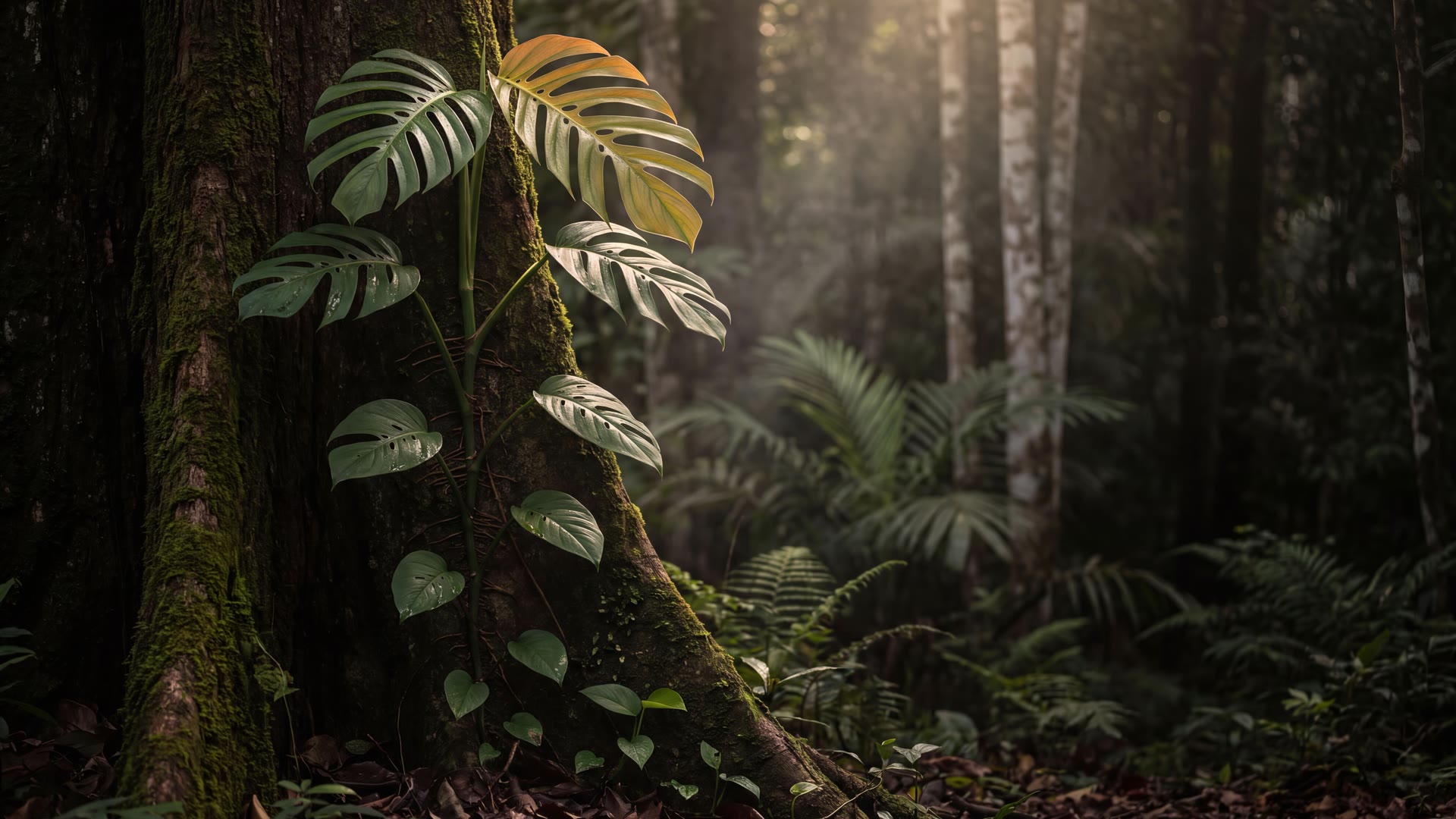
Every species is a root-climber. Seedlings are seldom seen; young plants spread over the ground in colonies, modest in Epipremnum giganteum and extensive in Epipremnum falcifolium, and the juveniles of Epipremnum amplissimum can carpet open swamps. The adult clings to its tree along the whole stem, and some species, perhaps all in Boyce’s view, send out flagellate foraging stems that reach the ground, root and climb again. The leaf changes as the plant climbs, most of all in Epipremnum pinnatum: N. E. Brown described a plant grown at Chelsea from Fijian stock that, let climb a wall, passed from small entire leaves to pinnatisect ones 2–3 feet long with the stalk, and Engler and Krause noted that the species had been named again and again for leaves that differ so much with age. Its young plants are not shingle climbers, as in the look-alike Rhaphidophora korthalsii, but sprawl and climb on long-stalked leaves, while Epipremnum aureum keeps much the same leaf shape as it grows, small on the ground and large in the trees. Epipremnum pinnatum flowers profusely wherever it grows and Epipremnum aureum hardly at all, a reluctance that a 2016 study linked to a shortage of gibberellins; a spray of gibberellic acid brought juvenile and adult plants into flower. Of pollination there is only a hint. Boyce wrote that in Monstera, after Madison, the sterile flowers at the base of the spadix usually produce a nectar droplet and appear to attract pollinators, and that “they perhaps function similarly in Asian genera” (Madison himself described a large stigmatic drop at those flowers and wrote that they may be functioning as nectaries); in 2010 he and his colleagues published a photograph of an Epipremnum spadix whose lowermost, sterile flowers were associated with sticky droplets “likely involved with pollinator reward.” The newly opened inflorescences of Epipremnum giganteum smell strongly of peanut butter, a collector’s label calls the apricot-yellow spathe of Epipremnum nobile sweet-scented, and Boyce’s description of Epipremnum pinnatum records “no detectable odour when fresh.” When the fruit ripens, the thick tops of the styles fall away in plates to expose the seeds in sticky pulp, orange-red in Epipremnum pinnatum and red in Epipremnum falcifolium; Boyce names no animal that takes it. The golden pothos, Moodley wrote, is mainly dispersed vegetatively. In South Africa, where it has not been seen in flower, a survey of KwaZulu-Natal counted 78 naturalized populations of Epipremnum aureum, about 187,000 plants over about 3 hectares; on Tokunoshima, in southwestern Japan, it covers wide stretches of coastal forest, and even small rootless pieces left in the shade regrow. Florida’s Exotic Pest Plant Council listed it in 2019, as Epipremnum pinnatum ‘Aureum’, among the invasive plants of central and southern Florida, and in Puerto Rico it is naturalized and common in moist secondary forest, as Epipremnum pinnatum perhaps is too.
Araceae · Form
Morphology
A root-climber that clings along its whole length and sends out whips to find the next tree, with leaves that either stay entire for life or open windows and split as the plant climbs. Inside the ovary lies the character that names it: one placenta pushing in from the wall, a few ovules at its foot, and later a few large, curved, bony seeds.
Clinging stems that root along their whole length, whips sent out to find the next tree, and two kinds of aerial root: short ones that hold on and long ones that feed. No milky sap; the defense is a needle-shaped cell.
The stem
Every Epipremnum is a root-climbing liane, and Boyce’s 1998 account runs from slender to gigantic. In West and Central Malesia alone the range is from Epipremnum nobile, a climber to 5 m, and Epipremnum silvaticum, to 6 m, up to Epipremnum pinnatum at 15 m and Epipremnum giganteum, which climbs to 60 m and often survives logging as a high climber on the last of the once-emergent trees. The adult stem clings to its support and roots along its entire length. It looks like one continuous axis but is, in Boyce’s term, only physiognomically monopodial: each stretch ends in an inflorescence, sometimes aborted, and growth continues from below it. Hay placed Epipremnum pinnatum in Chamberlain’s architectural model, a clinging axis that flowers at its tip and is carried on by another clinging axis from beneath the inflorescence, with no free lateral branches. Free stems usually appear only by accident, when the weight of the inflorescences and fruits tears a tip from its support, and they soon climb again. Epipremnum giganteum alone seems to flower regularly on both clinging and free stems, even on the same plant.
The surface of the stem sorts the species. It is smooth in most of the West and Central Malesian species Boyce treated, minutely rough in Epipremnum moluccanum, and in Epipremnum pinnatum and Epipremnum aureum lustrous green with prominent, irregular, whitish crests running lengthwise, which Boyce in 2004 called the key character separating those two from all other climbing aroids. With age it turns sub-woody, exceptionally corky in Epipremnum giganteum, or wears a matt to slightly glossy papery skin, pale brown in Epipremnum pinnatum and orange-brown in Epipremnum aureum.
Whips and colonies
In 1908 Engler and Krause sorted the shoots of the climbing Monstereae into three kinds: juvenile shoots pressed to the support, main shoots, and flagella, side shoots that find nothing to hold, hang down, grow very long internodes with reduced leaves, reach the ground, root and creep, and climb the next support they meet. Epipremnum makes the third kind freely. Boyce found these foraging stems in some species, perhaps in all, and often exceedingly long: to 5 m in Epipremnum ceramense, 6–8 mm thick with internodes 15–18 cm long, and 7 m or more in Epipremnum falcifolium. Engler and Krause described those of Epipremnum pinnatum hanging here and there, with internodes 15–20 cm long and small lanceolate leaves; in Epipremnum aureum they are common and massive, arising high in the canopy and reaching the ground. The seedling is seldom seen, but the pre-adult plants of several species form colonies on the ground, modest in Epipremnum pinnatum and extensive in Epipremnum falcifolium.
Roots and armor
The aerial roots are of two kinds, in Boyce’s terms. Clasping roots, short and specialized, arise from the nodes and the internodes and anchor the plant to its tree or rock, turning corky with age. Feeding roots run from the aerial stem down to the soil and supply the plant; they become woody and prominently lenticellate. The genus description calls them rather uncommon and often absent, but some species make them in quantity. Those of Epipremnum ceramense are very long, hanging free or following the trunk to the ground, and on Halmahera they are used to tie the outriggers of canoes; at the Batu Caves near Kuala Lumpur in February 1906, Engler found Epipremnum giganteum forming mighty bushes and letting down aerial roots up to 30 m long; and Epipremnum aureum produces a profusion of robust feeding roots, many hanging free to the ground. Even the root surface is diagnostic: lenticellate and corky in Epipremnum pinnatum, scaly in Rhaphidophora korthalsii, the climber most like it.
Cut an Epipremnum and no milky sap runs out. Engler and Krause found no latex vessels anywhere in the subfamily, but the ground tissue shot through with long, H-shaped needle cells whose arms can reach 1–3 mm. These trichosclereids are abundant in every tissue of Epipremnum, Scindapsus and Rhaphidophora and sparse in Amydrium, and Boyce’s field test is to tear a mature leaf and look for the hairs standing out along the torn edge. The test has a snag: Zuluaga and colleagues, citing Seubert’s survey of 1997, note that Epipremnum pinnatum shares with Amydrium a lack of trichosclereids in the aerial roots and the leaf blade.

Fig · A clinging stem, hanging roots and a foraging whip
Two plans in one genus: in some species the blade stays entire for life, in others it opens pinholes beside the midrib and splits into segments as the plant climbs. The houseplant is a juvenile kept small in a pot.
Petiole, sheath and knee
The petiole is grooved above and has a geniculum at each end, the upper one being the knee that, in Engler and Krause’s account of the subfamily, lets the blade move into a good position toward the light. Along it runs a prominent sheath that soon dries and breaks down into netted or simple fibers before it falls. In Epipremnum pinnatum the sheath reaches halfway along the upper knee and decays into untidy, partly netted fibers, and with the remains of the cataphylls and prophylls it builds netted sheaths that clothe the upper stem for a long time; Epipremnum aureum lacks those netted remains. The sheath is also the quickest way to tell Epipremnum pinnatum from the similar pinnatifid species of Amydrium, whose sheath stops at the top of the lower knee, leaving the rest of the petiole round, with two sharp, low keels. In Epipremnum amplissimum the sheath persists, which Hay found otherwise a mark of Scindapsus.
The blade
The blade runs from thin to stiffly leathery and from entire to regularly or irregularly pinnatifid, and the division was the first cut in Engler and Krause’s key of 1908: an adult blade entire, neither perforated nor pinnatifid, against one pinnatifid or pinnatisect. Of the eight taxa Boyce treated for West and Central Malesia, only Epipremnum pinnatum and Epipremnum aureum, which he then ranked as its cultivar, divide. The windows come first. In some plants minute translucent dots appear beside the midrib, then perforate and enlarge, sometimes as far as the margin, so that holes can sit alongside fully formed segments. Engler and Krause explained how: in the bud the tissue between the primary veins lags behind the tissue next to them, dries and tears. In Epipremnum pinnatum only small holes 1–2 mm across are scattered along the midrib, and when the thin strip of margin beyond a hole tears as the leaf unrolls, the blade becomes pinnately lobed. Hay saw a similar process in the bud of the pinnately lobed species of Rhaphidophora, where the lobes are still joined at their tips and the joins break as the leaf opens, and Boyce found the mature segment tips of Epipremnum pinnatum truncate, their outer margin drawn out into a fragile thread.
The venation follows the plan. Each segment of Epipremnum pinnatum carries a single compound primary vein, where the similar Rhaphidophora korthalsii has more than one, and Boyce found a fully netted fine venation only in the species with divided or windowed leaves; Hay put the genus as pinnatifid by fenestration with reticulate venation, or entire with striate venation. The extremes are far apart. Epipremnum giganteum, bright green and densely striate, its primary veins barely distinguishable from the veins between them and its translucent margin flushing red or yellow in exposed places, reaches 120 cm by 50 cm; the divided blades of Epipremnum pinnatum reach 93 by 60 cm.
Two lives
Boyce called the genus homophyllous, with the reservation that the blades of some species grow more divided and more perforated as they mature. There is no shingling stage of the kind that marks Rhaphidophora korthalsii. The juvenile of Epipremnum pinnatum sprawls or climbs with long-stalked, ordinary leaves, entire in Hay’s key and, in Engler and Krause’s description, narrowly lanceolate with scattered pinpricks; the adult blade is broadly oblong, broadly cordate and divided, and 45–60 cm long in their account. The difference is great enough that the plant, known to Rumphius and named by Linnaeus, was given new names again and again, though Engler and Krause saw the extreme forms together on a single plant covering a tall tree. Epipremnum aureum changes less: its pre-adult leaves are ovate and thicker, its pinholes few and hardly ever open, its divisions sporadic and shallow, and the blade simply grows larger without changing shape.
The plant sold in pots is the juvenile. Hung and colleagues treated small-leaved plants grown horizontally as juveniles and plants trained up a pole, with leaves several times larger, as adults, and NC State Extension notes that in a container the plant generally keeps its juvenile leaf shape, making large, mature leaves once it has a support and enough light. UF/IFAS gives the contrast in numbers: heart-shaped indoor leaves seldom over 15 cm (6 inches) long, against lobed, fenestrate leaves up to 90 cm (3 feet) long on vines that climb trees 15 m (50 feet) tall in the tropics. The variegation belongs to the cultivars. Boyce keyed Epipremnum pinnatum as never variegated and the golden plant as usually yellow, more rarely white, and suggested that the wholly green plants of it he saw at Bogor are somatic segregates from a variegated chimera; the juveniles of Epipremnum amplissimum, in Hay’s account, commonly carry a bluish gray variegation.

Fig · Juvenile and adult, divided and entire
One to several at the tip of a clinging shoot, a canoe-shaped spathe that is shed early, a stalkless spadix of naked bisexual flowers, and inside each ovary the character that names the genus.
Arrangement and the spathe
The inflorescences come singly or several together. The first is subtended by a foliage leaf, usually fully developed and in some species with an exceptionally broad sheath, and each later one by a prophyll and a cataphyll, so that at anthesis an inflorescence may be almost naked or half hidden in netted and papery fibers. Epipremnum nobile usually carries several together; in Epipremnum pinnatum they are solitary or, more rarely, two or more, and Hay described them as a terminal sympodial cluster. The spathe is canoe-shaped and beaked, stiff to rather softly leathery, and dirty white, greenish or yellow. It gapes or opens almost flat at anthesis and falls before anthesis is over. Its colors separate species: waxy-glaucous to deep yellow inside in Epipremnum giganteum, cream, yellow or orange-yellow outside in Epipremnum nobile, green outside and dull yellow or pale green inside in Epipremnum pinnatum, and whitish, spreading wide with its margins bent back, in Epipremnum aureum. It reaches 36 cm long in Epipremnum ceramense.
The spadix and the flower
The spadix is cylindrical and blunt, its base often set slightly askew, and nearly always without a stalk; Epipremnum moluccanum is the exception, its spadix raised on a stipe, a character it shares with Epipremnum papuanum of New Guinea. It runs from 8–13.5 cm long in Epipremnum nobile to 34 cm in Epipremnum ceramense. The flowers are bisexual and naked, with no perigone, packed into a flat-topped honeycomb that comes to anthesis more or less all at once, and the lowest and highest on the spadix are often sterile and lack a stigma. Each has four stamens with strap-shaped filaments, their anthers pushed well out between the ovaries at male anthesis and opening by a lengthwise slit. The stylar region is prominent to massive, and the stigma, sticky when the flower is female, is a line or a point: linear and set lengthwise along the spadix in Epipremnum pinnatum and most of the species Boyce keyed, a point or short oval set around the circumference in Epipremnum moluccanum and Epipremnum nobile. The pollen is fully zonate, hamburger-shaped and 36–44 µm across. Boyce gave the chromosome number as 2n = 60, with counts of 56 and 84, and Hung and colleagues counted 60 chromosomes in Epipremnum aureum ‘Marble Queen’.
Inside the ovary
The ovary has a single chamber, often compressed and angled, and one placenta that pushes in from the wall, carrying 2–8 anatropous ovules. That was Schott’s definition of the genus in 1857, drawn from the only species he knew: a one-chambered ovary with a single intrusive parietal placenta bearing two ovules near its base. Engler and Krause gave usually two ovules, rarely four, at the very base of the placenta, and six to eight in two rows in Epipremnum amplissimum; Boyce’s species accounts give four in Epipremnum nobile and three to seven in Epipremnum silvaticum. It is the pairing of placenta and ovules that separates the Asian climbing genera in Boyce’s keys. Rhaphidophora has eight or more ovules stacked on two, rarely three, parietal placentas; Scindapsus a single ovule on a basal placenta; Epipremnum a few ovules at the base of one intrusive placenta, 2–4(–6) in his key of 1998 and 4(–6) in that of 1999. Amydrium has one intrusive placenta too, with two ovules, and is told apart by other means: few trichosclereids, a fully netted fine venation, and fruits whose tops do not break away.
Who comes
Boyce’s revision leaves the pollinators unnamed. He noted that the sterile flowers at the base of a Monstera spadix produce a nectar droplet and seem to attract visitors, and suggested they may do the same in the Asian genera. The scents differ: the newly opened inflorescences of Epipremnum giganteum smell strongly of peanut butter, a collector’s label records the spathe of Epipremnum nobile as apricot-yellow and sweet-scented, and Boyce found no detectable odor in fresh Epipremnum pinnatum. Flowering itself differs more. Epipremnum pinnatum flowers profusely wherever it grows, wild or cultivated, while Epipremnum aureum is famously shy: Engler and Krause knew no flower of it at all in 1908, and the first recorded flowerings, in Puerto Rico and at the Fairchild Tropical Garden in Florida, were reported by Birdsey in 1962.

Fig · The spathe, the spadix and the flower
The tops of the fruits break away to bare the seeds in sticky pulp. There are few seeds, curved and bony, and in two species usually only one, which is where the line between Epipremnum and Scindapsus blurs.
As a fruit ripens its stylar region swells, massively in Epipremnum falcifolium and Epipremnum giganteum, until a break forms at its base and the whole top falls away, exposing the chamber with the seeds bedded in sticky pulp. Across the spadix the tough stylar tops cling together and come away as irregular plates, in Boyce’s account, or more or less all together, in Hay’s, leaving the seeds in the fleshy lower half of each fruit; Engler and Krause described the berries as casting off their tops. The colors vary: green ripening orange in Epipremnum ceramense, dull orange in Epipremnum giganteum, red with red pulp in Epipremnum falcifolium, and mid-green with orange-red pulp in Epipremnum pinnatum.
The seeds are what Engler and Krause used to hold the genus apart. They took it for an offshoot of Rhaphidophora, alike in habit and distribution, but one that could not be united with it because the seed is built so differently. In Epipremnum the seeds are few and curved, often strongly, with endosperm and a bony testa, smooth to ornamented: 3–7 mm long and 1.5–4 mm wide in Boyce’s key, 4.5 by 3.5 mm in Epipremnum pinnatum, whose fruits usually hold two, and about 5 by 4.5 mm and prominently ornamented in Epipremnum ceramense. Engler and Krause called them kidney-shaped around a curved embryo, the seed of a one-seeded berry smooth and rounded, several together angular and a little compressed. Rhaphidophora packs many small, straight seeds, 1.3–3.2 mm long, with a brittle, smooth testa, into each fruit. When no ripe fruit is at hand, Boyce’s advice is to open an immature one and count the ovules: few in Epipremnum, almost always many in Rhaphidophora.
The line with Scindapsus is thinner. A Scindapsus fruit holds a single curved seed, and Epipremnum ceramense and Epipremnum falcifolium seem habitually to abort all but one ovule, ripening fruits with one massive seed near the base; a specimen of Epipremnum ceramense in the Bogor herbarium had been named as a Scindapsus on the strength of its one-seeded ovary. Boyce took the pair as strong evidence for merging the two genera. The old difference in the seed had gone too: Scindapsus seeds were long described as lacking endosperm, but Seubert found that they hold a little, though their embryo is still relatively larger. A molecular study points the same way. In the tree of Zuluaga and colleagues, Epipremnum falcifolium, Epipremnum amplissimum, Epipremnum carolinense and Epipremnum papuanum form a group beside Scindapsus, while Epipremnum pinnatum and Epipremnum aureum sit with Amydrium, and they concluded that the taxonomy of Epipremnum needs to be revisited.
Boyce found the seedling stage mostly unobserved. At the Bogor Botanic Gardens, where Epipremnum pinnatum has spread widely through the grounds, Zulkarnaen and colleagues photographed seedlings on the ground and young plants starting up the trunks.

Fig · Few seeds, curved and bony
Araceae · In cultivation
Cultivation
Epipremnum aureum, sold as “pothos” though it is no Pothos, is perhaps the most commonly cultivated aroid of all, in Boyce’s words, and the plant sold is a rooted juvenile cutting unlikely ever to flower. It asks for little: bright shade, warmth, a mix that drains, and water only as the pot dries. Epipremnum pinnatum, and now and then Epipremnum amplissimum or Epipremnum giganteum, are grown the same way and grow much larger.
Open and moisture-holding, never waterlogged, and something to climb if the adult leaf is wanted.
What matters most is drainage. Florida’s growers blend sphagnum peat, pine bark, vermiculite or perlite by volume into a medium with good moisture-holding capacity and aeration, a pH of 6.5–7.0 and soluble salts of 3–5 dS/m, and add 10–20% coarse sand to totems 90 cm (3 feet) tall or more so that they do not blow over. The RHS asks for an open, moisture-retentive but well-drained and slightly acidic compost, mixed from three parts ericaceous peat-free compost, one part grit and one part medium orchid bark, and NC State Extension for a mix high in organic matter with good drainage. The acid end has a limit: in UF/IFAS’s guide to the crop’s diseases, a potting soil acidified to pH 5.0 or below is one cause of manganese toxicity in stock plants, corrected with lime to pH 6.0–6.5.
The pot should not be too large. The RHS repots only when the roots crowd or show through the drainage holes, into a pot one size larger every two or three years, since an oversized pot stays wet and the roots rot. Support changes the plant. Given something to climb and enough light it begins to make large, mature leaves, NC State notes; the RHS keeps a moss or coir pole damp so that the stems root into it, and Florida’s nurseries grow stock plants on poles when they want large-leaved tip cuttings for totems. The plant is not particular about the medium itself: Hay found that a cutting of it would keep growing for a long time in a jar of tap water.
A steady feeder in the nursery, a light one indoors, and none at all for a month after a move.
Florida production feeds with an N:P:K ratio of 3:1:2 or 3:1:3 at about 24 g of nitrogen per square meter a month (5 lb per 1,000 square feet), from controlled-release or soluble fertilizer or both, and checks the result by leaf analysis. Once a plant is placed indoors, the same guide advises neither repotting nor feeding for about four weeks, no fertilizer at all while the soluble salts read 3.0 dS/m or more, and leaching the pot with water when they pass 5.0 dS/m, to spare the leaves and roots. At home the RHS feeds once a month from April to October with a general houseplant fertilizer, and NC State every other month, except in winter.
Two symptoms point at the feeding. New leaves that come in smaller than the old ones and lose their variegation mean too little light, too little fertilizer or a shortage of magnesium, which UF/IFAS treats with magnesium nitrate sprays. Yellow flecks or spots on older leaves, with darkening veins and early leaf drop, seen mostly on old stock plants, are manganese toxicity, from excess micronutrients, an over-acid mix or fungicides that contain manganese; the remedy is to stop supplying the element and to lime the mix.
Bright shade, warmth and a pot that dries partway between waterings. It tolerates dim rooms, pays for them in leaf size and color, and flowers only when forced.
Light
Florida nurseries grow the crop under 63–80% shade; beyond 80%, growth and the color of the variegated cultivars fall off. Indoors it tolerates as little as about 540 lux (50 foot-candles), but the new leaves come in small and the variegated cultivars lose their color; about 1,600 lux (150 foot-candles) keeps both. The RHS wants bright, indirect light and no direct summer sun, which scorches the leaves, and finds that too little light costs the variegation and the growth. Direct sun is a real limit. Burned, dead patches confined to the pale sectors come from too much light or heat, and the leaves cannot recover. On Tokunoshima, where Epipremnum aureum has run wild in the coastal forest, Hachisuka and colleagues found that cuttings left outside the forest nearly all died, their leaves blackening soon after exposure to direct sun, while almost all of those inside the forest lived.
Warmth
Production runs at 70–90 °F (21–32 °C) and a relative humidity of 60–100%, and quality and growth begin to slip when days routinely pass 95 °F (35 °C) or nights fall below 65 °F (18 °C). Indoors UF/IFAS recommends 70–80 °F (21–27 °C) and the RHS 18–30 °C (65–86 °F), away from cold drafts and radiators. The RHS rates Epipremnum aureum H1B, a plant for a minimum of 10–15 °C (50–59 °F) that can go outdoors only in summer. Cold marks the leaf: a few hours at 33–40 °F (1–4 °C), or a sudden change of temperature, leaves scattered brown patches in the middle of the blade. In December 2004 a writer in Orlando, Florida (USDA zone 9b) recalled that Epipremnum aureum and Epipremnum pinnatum were killed to the ground when the temperature fell to near 20 °F (−7 °C) in the December 1989 freeze, then resprouted and climbed back into the trees, though the writer did not know how much more cold they would take.¹⁹ High humidity is not essential in the RHS’s view, though NC State suggests a humidifier or a tray of wet pebbles.
Water
Keep the mix moist but, in most rooms, a little on the dry side, in UF/IFAS’s phrase. The RHS waters only when the compost is nearly dry, preferring rainwater or filtered water to keep the mix acid, and NC State lets it dry between waterings. Yellowing older leaves mean a pot kept either too dry or too wet, and root rot and blackened leaf margins follow overwatering.
Flowering on demand
Epipremnum pinnatum needs no help. The form most often cultivated, dark green with copiously divided adult leaves and no cultivar name, flowers regularly once it has climbed more than 2 m, in Boyce’s experience, producing clusters of dull yellow spathes and fruiting prolifically. Epipremnum aureum is the opposite. Boyce’s inquiries at Bogor found both the variegated and the wholly green plants there shy to flower, and UF/IFAS’s breeders note that it does not flower in greenhouses or indoors, so that no hybrid cultivar is known.
Hung and colleagues looked for the reason. They grew ‘Jade’, a plain green cultivar that Boyce thought might be a reversion of ‘Aureum’ or of ‘Marble Queen’, at Apopka, Florida, on poles set upright, as adults, and laid flat, as juveniles. In both they found no transcripts of the gibberellin biosynthesis gene EaGA3ox1, no detectable GA1 or GA3 in the shoot tips and only low levels of GA4. A single spray of gibberellic acid at 2,500 mg per liter brought flower buds 7 weeks later on the flat plants and 8 weeks later on the upright ones, one to three inflorescences to a plant, the juveniles’ much the smaller. Their abstract says the plant does not flower in the wild or in cultivation, and their introduction counts only the one flowering reported in 1962, by Birdsey, without mentioning Furtado’s report, in 1964, of the plant in flower in Singapore.
Adult plants that have climbed into trees may flower without treatment, though the reports are unverified. In April 2000, Julius Boos wrote that he had seen Epipremnum in bloom near the ends of cascading shoots high on native pines in West Palm Beach, Florida.²⁰ Lynn, who believed a plant in a yard near Tampa to be Epipremnum aureum, wrote that it had flowered when quite large;²¹ two days later Lynn added that it grew on a live oak and had not been photographed.²²
One node, one leaf and three or four weeks. The trade roots single-node cuttings shipped in from the tropics; a windowsill manages the same in a glass of water.
Cuttings
Every node roots. The standard commercial cutting is 2.5–4 cm (1–1½ inches) of stem with a node and its leaf; the bud breaks in 2–3 weeks and the cutting roots in 3–4. Much of the propagating material for the United States market is grown in Central America or the Caribbean, where single-node cuttings are harvested and shipped north for rooting, and UF/IFAS’s plant pathologists warn that they frequently arrive infected. At home the RHS takes stem cuttings trimmed below a leaf joint and stands them in water until roots appear, or pins a trailing stem into a pot of compost until it roots at the node, and it lists leaf-bud and tip cuttings in spring or summer. The plant regrows from very little. In the coastal forest of Tokunoshima, Hachisuka and colleagues found that a single leaf with a piece of stem and one root could regrow in low light, and that cuttings with no roots at all survived and regrew, making more new roots than cuttings that had them; they advise that no small piece be left behind when the plant is cleared from a forest.
Sports and cultivars
Seed plays almost no part. Epipremnum aureum so rarely flowers that its cultivars are sports and selections rather than hybrids, and the University of Florida’s breeders turned to induced mutation instead; one of their selections, a small-leaved mutant of ‘Marble Queen’, carries a United States plant patent. Boyce listed the cultivars in 2004 without vouching for them. Four had been registered with the Vaste Keurings Commissie: ‘Aureum’ and ‘Marble Queen’ on July 28th, 1988, ‘Golden Pothos’ on September 13th, 1990, and ‘Johanna Queen’ on April 8th, 1993. ‘Aureum’, the typical plant, has juvenile leaves with large, jagged golden patches that spread until adult leaves are mostly yellow; ‘Marble Queen’ replaces the yellow with cream or white, and Boyce had never seen a mature plant of it; ‘Golden Pothos’ is wholly yellow, a registered name he found unfortunate because it implies a relationship to Pothos. ‘Hawaiian’ and ‘Wilcoxii’ are densely flecked with yellow, ‘Mayan Gold’ and ‘Neon’ are plain golden and acid green-yellow, and ‘Jade’ and ‘Tropic Green’ are plain green, close to the wild plant of Mo’orea.
Epipremnum pinnatum has forms of its own: ‘Cebu Blue’, from Cebu in the Philippines, with narrow, deeply cut, pale blue-gray leaves whose color deepens in bright light and a spathe pale green inside; ‘Key Leaf’, a juvenile whose blade is reduced to a narrow, wavy strip along the midrib widening into the basal lobes; and ‘New Guinea’, from western Papua New Guinea, glossy and finely perforated but never divided, even as an adult. The plant sold as Epipremnum pinnatum ‘Ginny’ is no Epipremnum but Rhaphidophora tetrasperma. Epipremnum amplissimum is grown as a pre-adult with narrow, soft leaves splashed with pale bluish gray, under a variety of trade names, among them ‘Exotica’, most of which, Boyce wrote, imply an origin in Thailand or Vietnam, though it comes from New Guinea and the western Pacific to Vanuatu and northern Australia. Hay found its juveniles would sprawl over an aquarium, rooting in the water, and warned that outdoors it becomes enormous and apt to be very invasive in wet places. In July 2008 Boyce wrote that the silver-marked plant grown as Epipremnum amplissimum can get very large as an adult and then loses its silver markings.²³
Few insects and a handful of rots, and much of the trouble arrives with the cutting. Several leaf problems that look like disease are not.
The insect list is short. The RHS finds the plant generally free of pests and diseases; NC State advises watching for mealybugs and scales, armored or soft, and lists the banded greenhouse thrips among its common insect problems.
The diseases belong mostly to the nursery, and UF/IFAS’s guide for commercial greenhouses begins with the cutting: inspect unrooted cuttings on arrival and discard any that look diseased. The commonest is Phytophthora root rot, caused by the water mold Phytophthora nicotianae and often brought in with imported cuttings; it starts in the roots and turns the leaves dark brown to black while the veins do not blacken, and its swimming spores spread in irrigation water and splash. Bacterial wilt, caused by Ralstonia solanacearum, strikes at the single-node rooting stage, where losses in the propagation beds can approach 100%: the leaves wilt, the veins of leaves and stems turn black, and a cut stem oozes bacteria. No bactericide controls it in a nursery, so infected plants, soil and pots are bagged and removed. Rhizoctonia solani, arriving in contaminated potting mixes, rots the roots of cuttings and blights the leaves with irregular dark spots until they mat together, and southern blight, Sclerotium rolfsii, spreads white, feathery mycelium over soil and stems in hot, wet weather, studded with sclerotia that turn from white through yellow and orange to brown.
A newer threat is aroid leaf rust, Pseudocerradoa paullula. In 2022 Urbina and colleagues found it on Epipremnum pinnatum in South Florida nurseries, on 60% of about 50 mature plants, some leaves with up to 30% of their tissue damaged: round spots, often with a yellow halo, and pustules erupting mostly on the underside. Inoculated plants showed pale, chlorotic spots after 10 days and pustules after 25. They had not seen the rust on any Epipremnum in the landscape and suspect nursery conditions, excess humidity and nutrients, dense planting and overhead watering, of favoring the airborne fungus.
Several problems are not disease. Ethylene, from rotting plant matter, faulty greenhouse heaters or shipping trucks, turns leaves yellow and then tan, mostly in fall and winter; the fungicide mefenoxam bleaches leaf margins white and burns the tips; and manganese toxicity flecks the older leaves. The plant is also not to be eaten. Its tissues hold insoluble calcium oxalate crystals, and chewing it brings intense burning of the mouth, tongue and lips, drooling, vomiting and difficulty swallowing. The ASPCA lists Epipremnum aureum as toxic to dogs and cats, NC State as a problem for cats, dogs and horses that can also irritate the skin, and the RHS as harmful if eaten and irritating to skin and eyes, to be handled with gloves. In Florida, UF/IFAS assesses Epipremnum aureum as a high invasion risk and does not recommend it.
Epipremnum Timeline
An interactive timeline showing the year each Epipremnum species was first described as Epipremnum (species may previously have been classified in other genera)
Sources
The papers behind the morphology & cultivation tab
- Boyce, P. C. (1998). The genus Epipremnum Schott (Araceae–Monsteroideae–Monstereae) in West and Central Malesia. Blumea 43(1): 183–213.
- Boyce, P. C. (1999). The genus Rhaphidophora Hassk. (Araceae–Monsteroideae–Monstereae) in Peninsular Malaysia and Singapore. Gardens' Bulletin Singapore 51(2): 183–256.
- Boyce, P. C. (2004). A review of Epipremnum (Araceae) in cultivation. Aroideana 27: 205–211.
- Engler, A. & Krause, K. (1908). Araceae–Monsteroideae. Das Pflanzenreich IV.23B (Heft 37): 4–139. Leipzig: Wilhelm Engelmann.
- Hay, A. (1990). Aroids of Papua New Guinea. Christensen Research Institute Publication No. 10. Madang: Christensen Research Institute.
- Hay, A. (1993). Rhaphidophora petrieana – a new aroid liane from tropical Queensland; with a synopsis of the Australian Araceae–Monstereae. Telopea 5(2): 293–300.
- Zuluaga, A., Llano, M. & Cameron, K. (2019). Systematics, biogeography, and morphological character evolution of the hemiepiphytic subfamily Monsteroideae (Araceae). Annals of the Missouri Botanical Garden 104(1): 33–48.
- Hung, C.-Y., Qiu, J., Sun, Y.-H., Chen, J., Kittur, F. S., Henny, R. J., Jin, G., Fan, L. & Xie, J. (2016). Gibberellin deficiency is responsible for shy-flowering nature of Epipremnum aureum. Scientific Reports 6: 28598.
- Zulkarnaen, R., Martiansyah, I., Damayanti, F., Wardani, F. F., Yudaputra, A., Robiansyah, I., Hutabarat, P. W. K. & Harto, H. (2024). The biology of invasive native plant as an ex-situ collection: a case study of Epipremnum pinnatum (L.) Engl. (Araceae) in Bogor Botanical Garden, Indonesia. Jurnal Riset Biologi dan Aplikasinya 6(2): 60–72.
- Hachisuka, R., Ishikawa, K. & Ugawa, S. (2023). Influence of the light environment, cutting size, and existence of roots on the survival and regrowth of an invasive species, Epipremnum aureum. Tropics 32(2): 35–48.
- Urbina, H., Jones, C., Moore, M. R. & Gazis, R. (2024). Susceptibility of centipede tongavine, Epipremnum pinnatum, commercially grown in nurseries in Florida to aroid leaf rust, Pseudocerradoa paullula. Plant Disease 108(1): 217.
- McConnell, D. B., Chen, J., Henny, R. J. & Everitt, K. C. (2003). Cultural guidelines for commercial production of interiorscape Epipremnum. UF/IFAS EDIS ENH894 (EP151).
- Henny, R. J., Chen, J. & Mellich, T. A. (2011). New Florida foliage plant cultivar: pothos 'Pearls and Jade'. UF/IFAS EDIS ENH1180 (EP441).
- Norman, D. J. & Ali, A. (2018). Pothos (Epipremnum aureum) diseases: identification and control in commercial greenhouse production. UF/IFAS EDIS PP340.
- North Carolina State Extension. Epipremnum aureum (Devil's ivy, golden pothos, marble queen, pothos, taro vine). North Carolina Extension Gardener Plant Toolbox.
- Royal Horticultural Society. How to grow Epipremnum. RHS Growing Guide.
- ASPCA. Golden pothos. Toxic and non-toxic plants, ASPCA Animal Poison Control.
- Birdsey, M. R. (1962 [1963]). Pothos aureus transferred to Rhaphidophora. Baileya 10(4): 155–159.
- Aroid-L mailing list, Eric, December 21st, 2004
- Aroid-L mailing list, Julius Boos, April 18th, 2000
- Aroid-L mailing list, Lynn, April 17th, 2000
- Aroid-L mailing list, Lynn, April 19th, 2000
- Aroid-L mailing list, Michael Pascall, July 21st, 2008
- Furtado, C. X. (1964). Pothos aurea, Hort. Linden. Gardens' Bulletin, Singapore 20: 377–380.
- Schott, H. W. (1857). Aroideae Hongkongenses. Bonplandia 5: 44–45.
- Seubert, E. (1997). The sclereids of Araceae. Flora 192(1): 31–37.
- Seubert, E. (1993). Die Samen der Araceen. Koeltz Scientific Books, Koenigstein.
- Henny, R. J. & Chen, J. (2010). Epipremnum plant named 'UFM12'. U.S. Plant Patent PP21,217 P2 (application US 12/316,132, filed 9 December 2008; published 17 August 2010). Assignee: University of Florida / Florida Foundation Seed Producers.