
Subfamily Monsteroideae·Tribe Spathiphylleae
Spathiphyllum
Field guidesSpathiphyllum
DESCRIPTION
Spathiphyllum is a genus of 76 accepted species of forest-floor herbs in the family Araceae, native from central Mexico to the northern third of South America, with three species on the far side of the Pacific, in the eastern Malay Archipelago, New Guinea and the islands beyond. The rhizome creeps, often just below the ground, so that most species look stemless: a clump of long-stalked leaves, and above them a white or green spathe on a stalk as long as the leaves or longer. It belongs to the subfamily Monsteroideae, where it forms the tribe Spathiphylleae with one other genus, Holochlamys of New Guinea. What tells it from every other aroid, in Cardona's 2004 account, is a combination: bisexual flowers clothed in a perianth, a persistent, leaf-like spathe, petioles sheathed for two-thirds of their length or more, pollen long described as inaperturate (Bogner found it polyaperturate in Spathiphyllum pygmaeum in 2011), and a life on the ground. Holochlamys has a very short peduncle, an ovary described as one-chambered and a thin spathe that clasps the spadix and soon rots; Rhodospatha and Stenospermation, often confused with it, have flowers without a perianth and a spathe that falls at flowering. The count is still moving. Bunting recognized 36 species in 1960; 17 of the 76 were named in 2024 alone, 16 of them in Croat and colleagues' revision for Mexico and Central America, the first to cover the whole region, and those authors know of 26 more still unpublished, seven of them found in Colombia by Felipe Cardona, and perhaps of one undescribed species in Asia.
The plant on the windowsill is the peace lily, sold also as spathe flower, white sails and snowflower, and under the wrong name white anthurium. It is one of the most popular plants of the foliage trade, worth $32 million wholesale in the United States in 1998, in cultivars from the small 'Petite' to the large 'Mauna Loa' and 'Sensation'. Which wild species stand behind them is less clear. In 1960 the plant most often grown was the one the American trade had sold since 1935 as Spathiphyllum 'Clevelandii', which Bunting took to be Spathiphyllum wallisii: a species Eduard Regel described in 1877 from a young plant flowering for the first time in a garden, and then known only in cultivation. The name is Greek for spathe leaf. Schott gave no derivation when he published the genus in 1832, but his diagnosis opens on the very thing the name describes, spatha foliaris persistens, a leaf-like spathe that persists, and ends by noting that the flowers are sweet-scented.
Bunting sorted the genus in 1960 into four sections, all of them Engler's, on the perianth, the shape and length of the pistil, and the way the spathe joins its stalk; Cardona kept all four for Colombia in 2004, and the 2024 revision keys out three for Mexico and Central America, where the fourth, holding only Spathiphyllum humboldtii, does not occur. Bunting read sect. Massowia as an offshoot of great age, since its three species lived so far apart: Spathiphyllum cannifolium east of the Andes, Spathiphyllum laeve, then known only from Isla del Coco, and Spathiphyllum commutatum across the Pacific. The two Old World species added since have fused tepals too. Nicolson established section Chlaenophyllum for Spathiphyllum solomonense as its sole member; Hay found the spathe of Spathiphyllum schlechteri open and flat in the living plant, and Nicolson accepted the correction. The first molecular test confirmed only sect. Spathiphyllum, strongly supported and sister to the rest of the genus, and placed Holochlamys in a clade with the Asian species and Spathiphyllum cannifolium, with support too low to change any names.
Peace lily, spathe flower, white sails and snowflower are trade names; white anthurium is a wrong one, for the plant is not an Anthurium. The oldest of these English names is the sweet-scented pothos of Curtis's Botanical Magazine, which figured Spathiphyllum cannifolium in 1802 as Pothos cannaefolia, its flowers "diffusing an agreeable odour, especially in the evening"; in Queensland the same species became the fruit-fly lily, for a perfume said to draw male fruit flies. The names from Trinidad, Colombia, Venezuela, Mexico, Guatemala, El Salvador, Indonesia and the Philippines are those Bunting recorded in 1960. Huisnay, in its several forms, names Spathiphyllum matudae from Chiapas to El Salvador, where the young spadices are eaten, cooked with eggs or cooked and pickled in vinegar. Julius Boos wrote on the Aroid-L mailing list on September 14th, 2002 that in northern South America the young inflorescences of wild Spathiphyllum are gathered, sold in markets in the Guianas and used in curries; on December 17th, 2006 he passed on a report that the blooms of Spathiphyllum cannifolium are cooked in curries in Suriname and northern South America, and on September 26th, 2009 he recalled reading that the unopened blooms of that species, the blooms alone, used to be collected and cooked as food. The Aguaruna names were printed with the descriptions of two of the four Peruvian species named in 2005.
DISTRIBUTION
Almost wholly American, and wholly tropical. The range begins in central Mexico, where Spathiphyllum cochlearispathum reaches nearly 20° N in Veracruz and Spathiphyllum brevirostre 20° N in Puebla, runs down both coasts and through every country of Central America, and covers the northern third of South America: Colombia, Venezuela and the Guianas, the Pacific side to Ecuador, and the Amazonian forest to Peru and Brazil, with one species, Spathiphyllum grazielae, on Brazil's eastern edge. The genus is absent from Argentina, Uruguay and Paraguay, and Bolivia's one known species is still unpublished, so the map stops short of it. Spathiphyllum cannifolium, which Bunting called the most widespread species, is the only one on Trinidad. Out in the Pacific lies Isla del Coco, where the type of Spathiphyllum laeve, a species now known from Nicaragua to Colombia, was collected on June 18th, 1898, and where Spathiphyllum abelianum, which Kew files under Costa Rica, is known from three populations only. On Kew's count the richest places are Colombia, with 23 species, and Panama, with 22; then Peru and Venezuela with 13 each, Costa Rica and southeastern Mexico with 12, Ecuador with 9. Most species range narrowly, and the 2024 revisers found Central American endemism highest at the two ends: on Kew's count 11 of Mexico's 17 species and 8 of Panama's 22 grow nowhere else, against three in Costa Rica and two in Honduras.
Then, across the Pacific, three species more. Spathiphyllum commutatum runs from the Philippines through northeastern Sulawesi and the northern Moluccas to Palau, New Britain and Bougainville; Spathiphyllum solomonense, described in 1967 from a plant a planter had brought in from the interior of Bougainville, is known also from Malaita; and Spathiphyllum schlechteri, first described as a Holochlamys, grows in southeastern New Guinea. Spathiphyllum commutatum is missing from mainland New Guinea, where Nicolson looked for it and found only Holochlamys in its habitat. Of three aroid genera once thought to span tropical America and tropical Asia, molecular work has left Spathiphyllum the only one. How a wholly tropical genus crossed the Pacific, or went round it, was still "very elusive" to Hay in 1990; Nicolson, noting that its only close relative lives in New Guinea, suggested that the tribe began in the Old World; a molecular study of the subfamily in 2019 inferred the reverse, a dispersal from South America to the Pacific islands, most likely over a long distance. Kew doubts two records, Spathiphyllum cuspidatum in French Guiana and Spathiphyllum solomonense in New Guinea, and lists the genus as introduced in nine places: Cuba, the Dominican Republic, Puerto Rico and the Venezuelan Antilles; Bangladesh, the Comoros and the Cook Islands; and Honduras and southwestern Mexico, where other species are native.
CHROMOSOMES
2n = 30 in 4 of the 5 species counted (80%).
5 of 76 species have a published 2n count.
Base chromosome number: x = 15 (Cabrera et al. 2008).
What chromosome numbers mean for a cross, in the Chromosomes and Crossing guide.
Counted species (5)
- Spathiphyllum commutatum30
- Spathiphyllum floribundum60
- Spathiphyllum friedrichsthalii30
- Spathiphyllum pygmaeum30
- Spathiphyllum wallisii30
Sources (3)
- Bogner, J. 2011. A new dwarf Spathiphyllum species (Araceae) from Ecuador. Willdenowia 41(1): 125–127.
- Cabrera, L. I.; Salazar, G. A.; Chase, M. W.; Mayo, S. J.; Bogner, J.; Dávila, P. 2008. Phylogenetic relationships of aroids and duckweeds (Araceae) inferred from coding and noncoding plastid DNA. American Journal of Botany 95(9): 1153–1165.
- Marchant, C. J. 1973. Chromosome variation in Araceae: V. Acoreae to Lasieae. Kew Bulletin 28(2): 199–210.
ECOLOGY
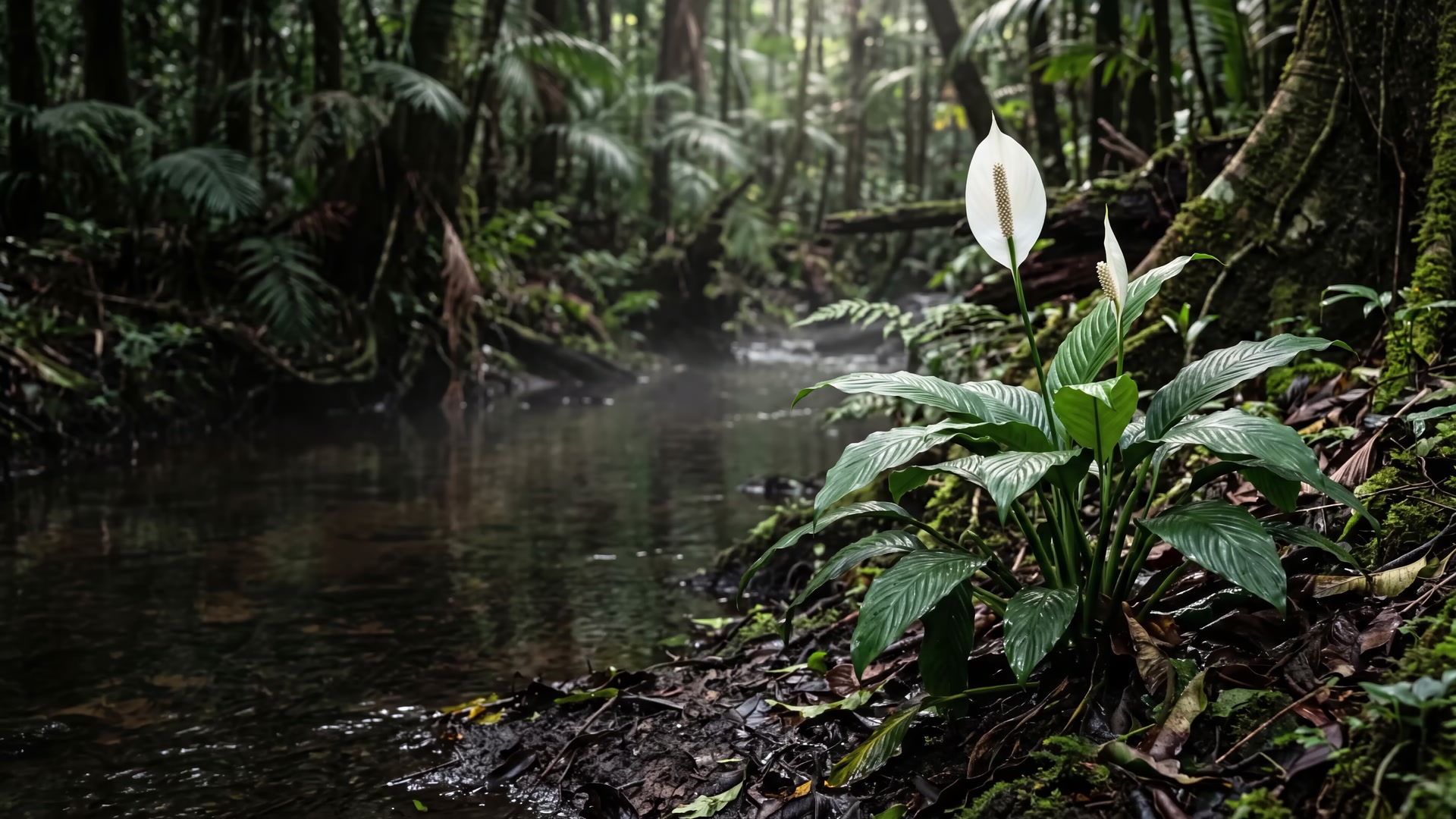
Spathiphyllum is a genus of wet, shaded lowland forest, and its latest revisers count it among the aroids most dependent on abundant water, for its leaves are thin and it lives on the ground. Bunting placed most species between 100 and 1,000 m, in foothills and river valleys, in permanently wet or moist places that may be flooded at times; in Colombia Cardona found it from sea level to 1,300 m, commonest in the lowlands, in partially or periodically flooded primary forest with little light. At Nouragues in French Guiana, where Spathiphyllum humboldtii grows in swampy ground along creeks, the rainforest gets 2,990 mm of rain a year at a mean of 26.3 °C. The span runs from Spathiphyllum friedrichsthalii, at or near sea level and rarely as high as 240 m, to two highland species: Spathiphyllum montanum, a cloud-forest plant of Costa Rica and western Panama at 1,100–2,020 m, rarely lower, and Spathiphyllum hubertkrusei of Oaxaca and Guerrero, at 1,000–2,150 m in tropical dry forest, the upper figure read from Google Earth for a site whose label gave 680 m. Of the Old World species only Spathiphyllum schlechteri climbs into lower montane forest, to 1,300 m. Flowering has been followed through the year in few species: Spathiphyllum croatii of Veracruz flowers all year, peaking from April to August, at the end of the dry season and the start of the rains; Spathiphyllum cannifolium flowers all year round in Colombia, and Spathiphyllum maldonadoanum of Tabasco in February and March and again from June to September. The charts below draw the genus's measured envelope across its native range, and 30 of its 31 native places resolve in the climate data; the one that does not is Isla del Coco.
Nearly every species is a terrestrial herb whose roots break out through the leaf bases, and where it grows is decided by water. Most Central American species live in the forest understory, often close to streams but not in them; Spathiphyllum quindiuense grows on rocks in streams, and Spathiphyllum friedrichsthalii and Spathiphyllum uspanapaense mostly in swamps or rooted along watercourses. Nancy Greig, who wrote on the Aroid-L mailing list that she was very familiar with Spathiphyllum friedrichsthalii in Costa Rica, described it growing in open areas, in large rainforest gaps and swampy fields, in full sunlight and usually in several inches of water. In her account the swamp that the boardwalk crosses at La Selva Biological Station is flooded with several inches of water for most of the year, except at the height of the dry season, and its dominant plant is Spathiphyllum friedrichsthalii (August 25th, 2010). Most South American species grow in or beside streams, often on rock: Spathiphyllum grazielae on waterfalls, Spathiphyllum neblinae on rocks and mossy stream banks in southern Venezuela, and Spathiphyllum davidneillii on sandstone cliffs in Ecuador, where it is also a true epiphyte, perhaps the first reported in the genus. Eduardo G. Gonçalves wrote on the Aroid-L mailing list that he found wild Spathiphyllum cannifolium near Tefé in Amazonas state, Brazil, growing in full sun along small streams with Urospatha sagittifolia (May 11th, 2001), and later described it growing in full sunlight in swamps with Urospatha and some Montrichardia in Brazil's Amazonas state and in Venezuela (May 23rd, 2002). He also wrote that Spathiphyllum gardneri of central Brazil grows on river banks, where most plants are usually flooded during the rainy season, not just at the roots but completely submerged for a month or two, sometimes with only the infructescences above the water (May 23rd, 2002). On Trinidad, Julius Boos, a native of the island, wrote on the same list that he had seen Spathiphyllum cannifolium only on river banks, never in forest far from a stream: in large, crowded groups on river-deposited gravel about 4 inches (10 cm) thick, with water slowly percolating through it; Spathiphyllum cannifolium plants on blackish, very fertile ground about 2–3 feet (60–90 cm) above the river, he wrote, can be close to 6 feet (1.8 m) tall (September 26th, 2009). Some species form great colonies along rivers and others stand scattered in the shade, and the difference runs into how they are pollinated. The inflorescence works in the open and by day, and in many species its scent is strongest from early morning until after noon; in cultivated Spathiphyllum cannifolium nearly all of it comes between 06:00 and 09:00. Male euglossine bees come for the scent itself, brushing it from the spadix and carrying it off in their hind legs, as they do at orchids. At Nouragues each of three aroids flowering side by side drew its own few euglossine species, and Spathiphyllum humboldtii, whose perfume is 60% ipsdienol, was visited from sunrise to noon. Where the plants crowd together, as in Spathiphyllum friedrichsthalii and Spathiphyllum croatii, pollen-collecting bees do most of the work, pollinating by mistake when they land on a female-phase spadix with no pollen to give, and the scattered Spathiphyllum ortgiesii is served mainly by pollen-collecting bees too. No study has reported a spadix warming itself, and no one has yet studied how the three Old World species are pollinated, on the side of the ocean that has no euglossine bees.
Araceae · Form
Morphology
A seemingly stemless herb of wet ground, built on the plan of its subfamily, but with flowers that, unlike those of Monstera and its tribe, each wear a ring of tepals. The spathe behind the spadix does not fall. It stays, and as it ages it usually turns green.
A short rhizome at or just under the soil surface, so the plant looks stemless. A handful of species break the pattern, one by climbing and one by growing as an epiphyte.
The stem
Spathiphyllum is a genus of terrestrial herbs, and the stem is the part a grower rarely sees. It is a rhizome that creeps, often just below the surface of the ground, with internodes so short that the plant appears to have no stem at all, and the roots push out through the bases of the petioles. Height varies about twentyfold. Spathiphyllum pygmaeum of Zamora-Chinchipe, Ecuador, no taller than about 15 cm, was the smallest species known when Bogner described it in 2011, while Spathiphyllum friedrichsthalii grows to 3 m, and Spathiphyllum wilfridoanum of Tabasco, up to 2.15 m tall, has internodes up to 6 cm thick.
Exceptions to the terrestrial habit are few. Spathiphyllum quindiuense grows on rocks in streams, and Spathiphyllum davidneillii is a true epiphyte, perhaps the first reported in the genus, though it still keeps to sandstone outcrops. Hay described Spathiphyllum solomonense of the western Pacific as a low climber with a stem about 9 cm thick, and the genus as a whole as without an aerial stem, or only rarely climbing. Some species build clumps, as Spathiphyllum commutatum soon does, while Spathiphyllum schlechteri of New Guinea is usually solitary.
Each new module of the shoot begins with two prophylls, one set directly on top of the other, a construction Hay knew from no other genus of the family except Holochlamys, the tribe's second genus. The genus descriptions disagree on the cataphylls: Bunting described them as narrow, two-keeled and often two-thirds as long as the petiole, Croat and colleagues as usually missing.
Roots and armor
Cut the plant and nothing milky runs out, because the subfamily has no laticifers. In their place its tissues carry trichosclereids, needle-shaped cells, often H- or T-shaped in the subfamily, and Nicolson found large numbers of a distinctive kind only in Spathiphyllum and Holochlamys, which he took as support for uniting the two in one tribe. They reach into the flower: in Spathiphyllum solomonense they are abundant in the perianth and the carpels, and Bunting records them in the ovary walls throughout the genus.

Fig · A short stem in wet ground
A long, sheathed petiole with a swollen knee at the top, the subfamily's pattern. The blade is simple, entire and thin, its parallel veins graded thick and thin, and its shape is an important guide to the species.
Petiole, sheath and geniculum
The leaves are several to many, erect or arching outward, and the petiole is usually as long as the blade or longer. It is sheathed, often for its whole length, and at the top it thickens into a geniculum, up to 5 cm long in Bunting's account but up to 9 cm in Spathiphyllum cochlearispathum, Spathiphyllum croatii and Spathiphyllum hubertkrusei in the 2024 species accounts, grooved above and occasionally winged; it is 4–5 mm long in Spathiphyllum pygmaeum. The wings vary by species. In Spathiphyllum cannifolium the petiole is winged, often right up to the geniculum, and the wing soon breaks down into fibers on older leaves; in Spathiphyllum wendlandii the base of the blade runs down onto the geniculum as a wing 3 cm or more wide, crisped at the margin. Bunting called the whole genus glabrous, but the petioles of Spathiphyllum laeve are often densely covered with minute star-shaped scales, and the 2024 key uses them to separate it.
The blade
The blade is simple and entire, often undulate at the margin, oblong to elliptic or lanceolate, drawn out to a point, often oblique, and moderately thin. Its absolute size varies greatly, but Bunting found the ratio of length to width constant enough to separate many species. The extremes are far apart: blades 7–10 cm long in Spathiphyllum pygmaeum, 100–130 cm long and 24–32 cm wide in Spathiphyllum solomonense, and about fifteen times as long as wide in Spathiphyllum schlechteri.
The veins
The venation is the tribe's. Primary lateral veins run out to the margin, and between each pair the interprimary and minor veins alternate in descending order of size, so that thick and thin lines repeat across the blade; only the highest orders join in a transverse network. The number of primary veins and the angle at which they leave the midrib seemed to Bunting constant within a species and valuable in naming one: 30–40° in Spathiphyllum gracile, for instance, against 75–80° in Spathiphyllum patulinervum. Without flowers the genus is hard to place: Hay found sterile Spathiphyllum commutatum almost impossible to tell from broad-leaved Holochlamys beccarii.

Fig · Two faces, two shapes and the geniculum
Inflorescences borne singly, each on a stalk that often tops the leaves. A spathe that opens like a leaf and stays, a spadix fertile to the tip, and flowers each ringed by tepals: the sections are drawn mostly on those tepals and the pistil inside them.
Arrangement and the spathe
The inflorescence is solitary, on a peduncle as long as the leaves or longer and bent at its top like the petiole, and it commonly holds spathe and spadix upright above the leaves. The peduncle of Spathiphyllum pygmaeum is about 8 cm long; the inflorescence of Spathiphyllum cochlearispathum is 70–140 cm long, on a peduncle of up to 156 cm, the height of a man in Bogner's phrase.
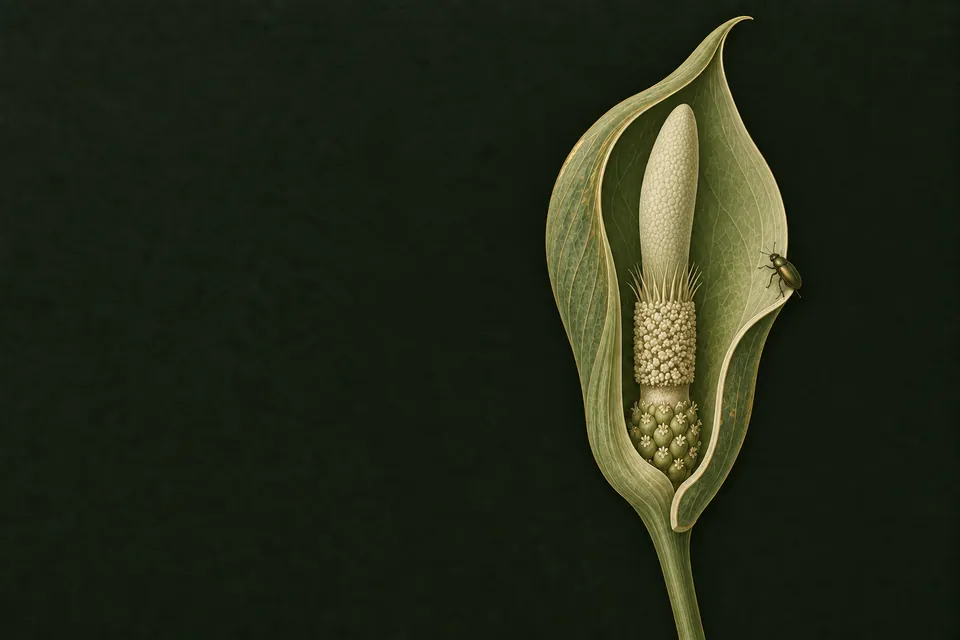
The spathe begins rolled around the spadix and opens to a hood or a flat blade, upright or bent back. It is boat-shaped and unconstricted, like the spathes of the rest of the subfamily, and it persists, where Holochlamys, the tribe's other genus, has an extremely short peduncle and a thin spathe that, in Hay's words, clasps the spadix and quickly rots. In most species the color changes with age, the midrib and main veins usually turning green after anthesis. Spathiphyllum wallisii opens white and becomes green; Spathiphyllum maldonadoanum opens yellowish green and turns dark green; and Spathiphyllum pygmaeum is pure white with a green tip.
In Bunting's key, the spathe of section Spathiphyllum runs down the peduncle for 2–10 cm, and in the other sections it usually does not. Above that point the spadix usually sits on a stipe up to 4 cm long (5 cm in Spathiphyllum commutatum), which the 2024 genus description finds often fused in part to the spathe. Spathiphyllum solomonense is the odd one out: its green spathe clasps the spadix, and on the surface, Nicolson wrote, it did not look like a Spathiphyllum at all, but he placed it in its own section, Chlaenophyllum.
The spadix and the flower
The spadix is cylindric, erect and shorter than the spathe, and it carries bisexual flowers from base to tip, with no sterile appendage. The perianth, with vegetative characters, is what separates the tribe from the naked-flowered Monstereae. It is a single series of 4–6 tepals, rarely 7, arching over the pistil, usually free, thickened and often truncate at the tip, and enlarging with age. Bunting found only two species with a distinctively modified tip: the tepals of Spathiphyllum wendlandii are ragged at the apex and often deeply notched, and those of Spathiphyllum ortgiesii stand erect to form a collar around the pistil. In a minority the tepals are fused: into a membranous four- to six-sided cup from which only the stigma rises in Spathiphyllum laeve, and all but short lobes at the tip in Spathiphyllum ayalae and Spathiphyllum guadalupense.
The stamens match the tepals in number and stand opposite them, their broad, flat filaments lengthening as the flower ages, and the anthers open outward by a lengthwise slit. The pollen is mostly forced out onto the surfaces of the tepals, where it hangs as a powdery ribbon. Bunting described the grains as without pores, and the 2024 genus description still calls them inaperturate, but electron micrographs in Bogner's account of Spathiphyllum pygmaeum showed ribbed, polyaperturate grains 25–28 µm long; he wrote that the pollen tube appears somewhere in the cleft between two ribs at germination, and he called the old description an error.
The ovary has three locules, rarely two or four, with the ovules on a central axis, sitting in a clear, water-absorbing matrix that fills each locule. There is one ovule per locule in Spathiphyllum laeve and up to eight in Spathiphyllum friedrichsthalii, a count Bunting found inconstant from flower to flower. The style is conic, sometimes long exserted, sometimes truncate. Serial sections of Spathiphyllum solomonense show an undivided perianth cup carrying about eighteen vascular bundles, perhaps three for each of six fused tepals, around six stamens and three united carpels with one or two ovules each.
The sections
Bunting drew four sections on the tepals, the style and the attachment of the spathe; the key for Mexico and Central America that Croat and colleagues adapted from Cardona keeps three. In section Massowia the tepals are fused into a cup: Bunting placed Spathiphyllum cannifolium, the Asian Spathiphyllum commutatum and Spathiphyllum laeve there; Nicolson established the separate section Chlaenophyllum for Spathiphyllum solomonense. In section Amomophyllum the tepals are free, at least at the tip, and the truncate pistil scarcely rises above them, as in Spathiphyllum floribundum and Spathiphyllum darienense; in section Spathiphyllum the conic pistil stands well beyond them, in Spathiphyllum friedrichsthalii by three or more times their length. Bunting's fourth, section Dysspathiphyllum, held Spathiphyllum humboldtii alone. He read the fused cup as an ancient advance; Nicolson, noting that the genus's only close relative is Papuan, raised the reverse, that fused tepals came first. Holochlamys, whose tepals are united too, appears to sit inside Spathiphyllum in the 2015 molecular study, in a clade with the Asian species and Spathiphyllum cannifolium, though with low support.
Who comes
The flowers are female first: in the cultivated plants of the Florida breeding program all the flowers on a spadix mature together, and the stigmas dry before any pollen appears. The male phase is the longer, 7–8 days against 3–4 in Spathiphyllum friedrichsthalii; there is no floral chamber, and no heat has ever been reported. The scent runs in the morning, and the visitors are mostly bees: male euglossines that collect the perfume, and pollen-foraging stingless bees, which made 86.6% of the visits to Spathiphyllum friedrichsthalii on Barro Colorado Island.

Fig · Spathes, and three kinds of flower
The berries swell on the spadix behind a spathe that stays. Each holds one to eight seeds, smooth in some species and furrowed and warty in others.
The fruiting spadix stays smooth in some species and is roughened in others: in Spathiphyllum friedrichsthalii the persistent styles stand up from it, while that of Spathiphyllum cannifolium is smooth, with spheroid, flat-topped fruits. The berries are obovoid to ovoid and often beaked, and the 2024 genus description gives them as greenish, as in Spathiphyllum cochlearispathum, whose infructescence reaches 17 cm with berries about 1 cm long. They are not always green. Those of Spathiphyllum ayalae ripen white, those of Spathiphyllum silvicola white with a yellow top, those of Spathiphyllum laeve are succulent, white with a green tip and pinched near the middle, and Hay's account of the genus in Papua New Guinea gives a yellow or orange berry.
A berry holds one to eight seeds, often about as many as there were ovules. The seeds are oblong, elliptic, ovate or kidney-shaped, often very angular, pale yellow to brown, and smooth or finely warty between vertical rows of small pits. Spathiphyllum cochlearispathum has seeds about 4 mm long, smooth and shiny between the rows of pits; Spathiphyllum commutatum has tan seeds shaped from an oblique kidney to a comma or a horseshoe; and the dried seeds of Spathiphyllum ayalae are black and glossy. The embryo is elongate and slightly curved, in copious endosperm.
How much of a spadix sets fruit depends on its visitors and on the species. Open to their bees, Spathiphyllum croatii and Spathiphyllum ortgiesii set fruit in every flower counted, while on Barro Colorado Island, in Montalvo and Ackerman's study, Spathiphyllum friedrichsthalii filled 34% of its ovules in the open against 84% by hand, and its fruit took about 72 days to ripen. A few species fruit without a visitor: in Spathiphyllum grandifolium pollen falls from the upper flowers onto stigmas still receptive below, and bagged plants of Spathiphyllum humboldtii set germinable seed that the authors who studied them suspect is apomictic, though neither case is proven. Spathiphyllum abelianum of Isla del Coco is described with white berries that lack seeds.

Fig · The spathe stays, the berries swell
Araceae · In cultivation
Cultivation
The peace lily of the trade is a Florida foliage crop: raised from tissue culture, brought into flower on schedule with a hormone spray, and sold in bloom. What it wants at home is what the genus has on the forest floor, which is shade, warmth, and roots kept moist but never drowned.
Rich and moisture-holding, but open enough that the roots get air. Wet, airless mixes invite the commonest diseases.
The genus lives on water. Croat and colleagues count it among the aroids most dependent on abundant water, because its leaves are thin and it grows in the ground, and Bunting described most species as plants of permanently wet or moist, shady places, sometimes flooded. A pot has to hold that water without drowning the roots. Florida's growers use substrates with high water- and nutrient-holding capacity, typically 50–60% Canadian peat by volume mixed with pine bark, vermiculite or coir. The UF/IFAS house-plant card asks for a rich, organic peat- or bark-based potting soil, kept moist but never left standing in water; NC State Extension recommends a mix high in organic matter and an acid soil, below pH 6.0; and the RHS grows Spathiphyllum wallisii in peat-free compost. Peter Boyce of the Royal Botanic Gardens, Kew, wrote on the Aroid-L mailing list that he had obtained the Spathiphyllum plants in the Victoria Tank of the Princess of Wales Conservatory from an aquarist as 'Kelantan Sword' (April 22nd, 1999), a name he thought covered Spathiphyllum cannifolium or, more probably, Spathiphyllum commutatum. He wrote that they were growing in a heavy loamy compost with their pots submerged to within 1 cm of the rims, in water at 80 °F (27 °C), and flowering almost continuously (April 26th, 1999).
What goes wrong is air. A saturated mix makes the plant wilt or collapse, with dead leaf margins and sparse, black-tipped roots, most often in cold weather, when the plant uses less water; the remedy is to water less often or to use a mix with more pore space. Clemson's extension service finds root and stem diseases the plant's commonest problem and ties them usually to overwatering. Outdoors, in the frost-free gardens of USDA zones 10B–12, the UF/IFAS card asks for well-drained soil amended with organic matter.
A steady, moderate feeder in the greenhouse and a light one indoors. Overfeeding, not hunger, is what burns the tips.
Florida production feeds by the season: a 3-1-2 ratio of nitrogen, phosphate and potash at about 15 g of nitrogen per square meter a month (3.0 lb per 1,000 square feet) in the warm season, and about 12 g (2.5 lb) in the cool one. Growers check the root zone every 2–3 weeks by the pour-through method. At a soluble-salts reading of 1 dS/m an unfed plant will show deficiency, 2 dS/m is adequate, and at 3 dS/m or above the rate or frequency should come down. Foliar feeds belong on the underside of the leaf, because the waxy upper surface is left with a gray residue.
Indoors the plant needs far less. The production guide suggests a 20-20-20 soluble fertilizer at 50 ppm nitrogen once a month, or a quarter of the commercial strength, and warns that high salts burn the leaf tips and margins; leaching the pot before cutting back helps. The UF/IFAS house-plant card is leaner still, a low dose of liquid fertilizer three times a year, and rates the plant not salt tolerant. NC State feeds at a quarter strength and flushes the soil between applications.
Two winter problems look alike. Slow growth with yellowing leaves in a cold pot is a nutrient deficiency, corrected with foliar sprays of iron or manganese, or magnesium if only the margins of the lower leaves yellow. But cold can mimic hunger. A plant held at 52 °F (11 °C) shows no visible injury yet grows less for weeks afterward, and the UF/IFAS researchers warn that this invisible chilling injury may be mistaken for poor fertilization.
Shade, warmth and an evenly moist pot. It tolerates low light, it shows plainly when it is thirsty, and it flowers on a clock that growers have learned to reset.
Light
Florida growers produce the crop at about 16,000–27,000 lux (1,500–2,500 foot-candles), roughly 75% shade in winter and 80% in summer. Too much light bleaches the leaves, a pale color often mistaken for nutrient deficiency; in brighter light or above 90 °F (32 °C) the leaves curl and burn at the tips and margins and flowering is sparse. Indoors the advice agrees: bright, indirect light and no direct sun in the UF/IFAS card, partial to deep shade at NC State, and partial shade at the RHS, which warns that flowering may suffer in deep shade. Bunting noted in 1960 that Spathiphyllum wallisii tolerates artificial light and low humidity, though it may flower less there. Ron Iles of Ireland, a specialist in Spathiphyllum species and cultivars, wrote on the Aroid-L mailing list that the species with delicate leaves are plants of shaded swamps, but that leathery-leaved forms such as Spathiphyllum cannifolium tolerate full sun without necessarily preferring it (June 13th, 2001), and that Spathiphyllum cannifolium with its roots in water seemed to thrive in full tropical sunlight, though it would be lost if it dried out completely under those conditions (March 5th, 2004; March 6th, 2004).
Warmth and cold
Production runs at 70–90 °F (21–32 °C). Against cold and drafts the production guide gives 68–85 °F (20–29 °C) by day with a drop of 5 °F (3 °C) at night, and the UF/IFAS card prefers 75–85 °F (24–29 °C). Growers generally hold the genus to be more cold-tolerant than other foliage plants, and beside Aglaonema, often visibly injured at 50 °F (10 °C), it appears to be. But chilling still hurts it. When Qu and colleagues held 15 cultivars at 38 °F (3 °C) for five days, injured leaf area ran from 2.5% in '5598' to 100% in 'UF576-14' and 'UF474-1'; mature leaves suffered more than young ones, and the damage began at the tips and edges and turned black. At 45 °F (7 °C) some cultivars are injured, and five days at 52 °F (11 °C) slows growth without leaving a mark. The RHS rates Spathiphyllum wallisii H1B, a plant for a minimum of 10–15 °C (50–59 °F).
Water
In the production guide the commonest failure indoors is thirst. An underwatered plant wilts until it lies on the soil, a collapse the trade calls a crash; a thorough watering revives it within hours, and frequent drooping leaves brown tips and edges. NC State keeps the soil moist but not soggy, lets it dry between waterings and finds watering from below works well; the RHS waters and mists freely during growth and keeps the humidity high. Wiping the broad leaves with a damp cloth removes dust and the occasional pest.
Flowering on schedule
Left alone, most plants flower once a year, in late winter or, in central Florida, very early spring, and plants 9–15 months old usually bloom between February and April. Henny and Chen found no response to day lengths of 8, 12 or 16 hours, but sorted cultivars into those that flower continuously once mature, those that flower only in spring and early summer after reaching a set age, such as 'Petite' and 'Viscount', and those that flower more than once a year, such as 'Little Angel'.
The trade does not wait. In the early 1980s researchers at the University of Florida in Apopka found that a single foliar spray of gibberellic acid starts flower buds whatever the season. Flowers follow in 9–12 weeks by the production guide, 70–110 days in Henny and Chen's account, and three to five months in the breeders' notes, sooner in warm weather. The standard spray is 250 ppm; in one trial 125 ppm flowered every plant of 'Petite' and 'Taylor's Green' but only 60% of 'Viscount'. The costs are some distorted flowers, stretched growth, narrow strap-shaped new leaves and smaller flowers, and growth regulators are not legal everywhere. Indoors a bloom lasts a month or so; NC State describes the white spathe turning pale green after about 10 days and staying attractive for at least another month. One grower on the Aroid-L mailing list wrote that the white spathe of a small supermarket plant, sold as 'White Sails' and thought by the grower most likely to be Spathiphyllum 'Wallisii', gave off a sweet cinnamon fragrance (May 14th, 2001). The identification is the grower's own and was not confirmed.
Division at home, tissue culture in the trade, seed for the breeders. The parentage of most modern cultivars is unpublished.
Division and tissue culture
A clump divides. Basal shoots can be separated from the mother plant and potted up; the RHS divides in winter or straight after flowering, and Hay advised digging up the clumps of Spathiphyllum commutatum, or taking crowns from them with a sharp knife without disturbing the rest. In production, tissue culture is now the most common method: plantlets from the laboratory are grown on in multi-cavity liner trays and then planted into larger pots. It also gives clean stock. Tissue-cultured plants at the last laboratory stage should be free of Cylindrocladium spathiphylli, the fungus behind the crop's worst root rot, and Florida's plant pathologists advised growers to start from them.
Seed and breeding
Seed is the breeders' route, and one cultivar, 'Cupido', is raised only from seed. The UF/IFAS program brings parents into flower together with gibberellic acid, and no effect on pollen production or seed set has been observed. Hand pollination is simple: the stigmas are dry and brown before the pollen appears, so no emasculation is needed; the light pollen, shed over three to four days in these cultivated plants, is tapped into a container and applied with a soft brush; and one pollination can fertilize a whole spadix. In these cultivated plants UF/IFAS gives four to six months to ripe fruit, the spadix turning yellowish and soft as the seeds mature. Pollen of 'Mauna Loa' kept at 7 °C (45 °F) and 65% relative humidity still germinated at 57% after 24 weeks, and tissue culture brings a chosen hybrid to commercial numbers in two to three years.
Where the cultivars come from
Within about twenty years of the gibberellic-acid discovery, breeders had released more than 40 named cultivars. Henny and Chen found nothing in the literature on their genetic background, though the spread of flowering responses points to interspecific hybrids somewhere in their ancestry. A cross of Spathiphyllum cannifolium and Spathiphyllum patinii, named Spathiphyllum × hybridum by N. E. Brown in 1883, arose in cultivation, and by 1960 Bunting could not say whether it survived. The plant sold as 'Clevelandii' was first offered by Julius Roehrs & Co. in 1935; Birdsey called it a hybrid, but seedlings raised in Miami came up uniform, and Bunting treated it as Spathiphyllum wallisii, a species he knew only from cultivation. The Florida list of 2003 ran from the compact 'Petite' and 'Sonya' to 'Sensation', a plant of up to 1.2 m (4 feet) with enormous ribbed leaves, and 'Domino' was then the only variegated one on the market. Ron Iles, a specialist in Spathiphyllum species and cultivars, wrote on the Aroid-L mailing list that 'Domino' was an introduction of Milestone Agriculture in Florida, and a message relaying his words named John Carmi of Milestone as its producer. He described its white variegation as stable and not browning, unlike many variegated mutations in the genus, and said that the variegation can extend into the spathes as well as the leaves (August 28th, 2002; August 29th, 2002; November 22nd, 2003).
Few insects and one notorious fungus. Mealybugs, scales and mites are the pests to watch; root rot is the disease, and it thrives in warm, wet conditions.
The insect list is short. Clemson's extension service finds that peace lilies have few insect pests, though fungus gnats, mealybugs, spider mites and scales, armored or soft, can be problematic. The UF/IFAS card names mealybugs and scale indoors and mites and scale outdoors, and NC State calls mealybugs probably the commonest insect indoors, noting that pests gather under the leaves, where wiping removes some of them.
The serious trouble is disease, and one fungus dominates it. A root and petiole rot was discovered in Florida's nurseries in December 1978; its cause, first identified as Cylindrocladium floridanum, was described in 1982 as a new species, Cylindrocladium spathiphylli. The first signs are wilting and yellowing of the oldest leaves, and by then 30–40% of the roots may have rotted; blackish, slightly sunken lesions follow on the lower petioles, and a badly infected plant lifts easily from the soil. The fungus is most active in warm, wet, humid weather, the conditions in which the plant grows best, and spreads in splashing and running water and on infested soil and plants that people move between nurseries. In 1983 the genus was its only known natural host, and only Spathiphyllum floribundum seemed to tolerate it. Of 16 chemicals then tested, only one gave limited control, so the defense is pathogen-free plants from tissue culture, new soil, new or sanitized pots, and raised benches.
Other rots attack the crop too. Myrothecium petiole rot attacks small tissue-cultured plants as they establish and later causes leaf spots; Phytophthora parasitica causes an aerial blight of black or dark brown spots up to 2.5 cm (an inch) across and, in cooler, drier weather, a root rot; and Pythium splendens, found on most foliage plants with root rot, attacks the crop as well.
Several complaints are not pests. A collapsed plant in a dry pot is thirst; bleached leaves are too much light; brown tips come from salt, direct sun, underwatering or low humidity; and a plant that will not flower is often simply too young. The plant is also not to be eaten. Its tissues contain insoluble calcium oxalate crystals, and chewing it burns the mouth, tongue and lips and causes drooling, vomiting and difficulty swallowing. The ASPCA lists it as toxic to dogs and cats, NC State as a problem for children, cats, dogs and horses, and the RHS as harmful if eaten and irritating to skin and eyes.
Spathiphyllum Timeline
An interactive timeline showing the year each Spathiphyllum species was first described as Spathiphyllum (species may previously have been classified in other genera)
Sources
The papers behind the morphology & cultivation tab
- Croat, T. B., Ortiz, O. O., Díaz Jiménez, P., Cedeño-Fonseca, M. & Hay, A. (2024). Revision of Spathiphyllum (Araceae) for Mexico and Central America. Aroideana 47(2): 1–353.
- Bunting, G. S. (1960). A revision of Spathiphyllum (Araceae). Memoirs of the New York Botanical Garden 10(3): 1–53.
- Eyde, R. H., Nicolson, D. H. & Sherwin, P. (1967). A survey of floral anatomy in Araceae. American Journal of Botany 54(4): 478–497.
- Nicolson, D. H. (1968). The genus Spathiphyllum in the East Malesian and West Pacific islands (Araceae). Blumea 16(1): 119–121.
- Hay, A. (1990). Aroids of Papua New Guinea. Christensen Research Institute Publication No. 10. Madang: Christensen Research Institute.
- Bogner, J. (2011). A new dwarf Spathiphyllum species (Araceae) from Ecuador. Willdenowia 41(1): 125–127.
- Zuluaga, A., Cameron, K., Croat, T. & Medecilo, M. (2015). Testing the monophyly of Spathiphyllum, and the relationship between Asian and tropical American species. Aroideana 38E(1): 107–115.
- Croat, T. B., Swart, A. & Yates, E. D. (2005). New species of Araceae from the Río Cenepa region, Amazonas Department, Perú. Rodriguésia 56(88): 65–126.
- Chen, J., McConnell, D. B., Henny, R. J. & Everitt, K. C. (2003). Cultural guidelines for commercial production of interiorscape Spathiphyllum. UF/IFAS EDIS EP161 (ENH958).
- Henny, R. J. & Chen, J. (2006). Spathiphyllum flowering – keys to the future. UF/IFAS EDIS EP320 (ENH1047).
- Henny, R. J., Chen, J. & Mellich, T. A. (2008). Tropical foliage plant development: breeding techniques for Anthurium and Spathiphyllum. UF/IFAS EDIS EP366 (ENH1102).
- Henny, R. J. & Chen, J. (2013). Florida foliage house plant care: Spathiphyllum. UF/IFAS EDIS EP477 (ENH1216).
- Chen, J., Qu, L., Henny, R. J., Robinson, C. A., Caldwell, R. D. & Huang, Y. (2001, rev. 2014). Chilling injury in tropical foliage plants: I. Spathiphyllum. UF/IFAS EDIS EP101 (ENH841).
- Qu, L., Chen, J., Henny, R. J., Robinson, C. A., Caldwell, R. D. & Huang, Y. (2000). Response of Spathiphyllum cultivars to chilling temperatures. Proceedings of the Florida State Horticultural Society 113: 165–169.
- Henny, R. J., Chen, J. & Mellich, T. A. (2000). Flowering response of three Spathiphyllum cultivars to treatment with three levels of gibberellic acid. Proceedings of the Florida State Horticultural Society 113: 169–170.
- Schoulties, C. L., Chase, A. R. & El-Gholl, N. E. (1983). Root and petiole rot of spathiphyllum caused by Cylindrocladium spathiphylli. Plant Pathology Circular No. 218 (revised January 1983). Florida Department of Agriculture and Consumer Services, Division of Plant Industry.
- Chase, A. R. (1999). Update on chemical control of Spathiphyllum diseases. Southeastern Floriculture, January/February 1999.
- NC State Extension. Spathiphyllum (peace lily, spathe flower, white sails). North Carolina Extension Gardener Plant Toolbox.
- Royal Horticultural Society. Spathiphyllum wallisii (Wallis peace lily). RHS plant profile.
- ASPCA. Peace lily. Toxic and non-toxic plants, ASPCA Animal Poison Control.
- Clemson Cooperative Extension, Home & Garden Information Center. Peace lily. HGIC 1512 (revised February 15, 2022).
- Brown, N. E. (1883). Spathiphyllum ×hybridum [protologue]. The Gardeners' Chronicle, new series 19: 500.
- Montalvo, A. M. & Ackerman, J. D. (1986). Relative pollinator effectiveness and evolution of floral traits in Spathiphyllum friedrichsthalii (Araceae). American Journal of Botany 73(12): 1665–1676.
- Birdsey, M. R. (1951). The cultivated aroids. Berkeley, California: The Gillick Press.
- Cardona, F. (2004). Synopsis of the genus Spathiphyllum (Araceae) in Colombia. Annals of the Missouri Botanical Garden 91(3): 448–456.
- Chen, J. & Henny, R. J. (2015). Commercial production of ornamental tropical foliage plants: micropropagation. EDIS EP520 (ENH1259), UF/IFAS Extension, University of Florida.
- Norman, D. J., Henny, R. J., Yuen, J. & Reich, L. (2002). Identification of one-septate Cylindrocladium species affecting Spathiphyllum and Rumohra adiantiformis (leatherleaf fern) in Florida. Proceedings of the Florida State Horticultural Society 115: 263–266.