
Stories · October 2026
YOUR “POTHOS” HAS A PAST
The tangled history behind one of the most familiar names in houseplants.
Spend enough time around houseplants, and “pothos” begins to sound like a growth habit.
A vine with heart-shaped leaves? Pothos. Something silvery spilling from a hanging basket? Pothos. A vaguely familiar climber making its way up a moss pole? Probably pothos.
This is where my botanical eye starts to twitch.
Epipremnum, Scindapsus and Philodendron are distinct genera. There is also an actual genus called Pothos, which makes the casual use of its name for all these other plants particularly confusing.
But follow that name into the botanical literature, and something unexpected happens. The people confidently sorting out the plants begin to look rather less certain themselves. The confusion was in print long before anyone posted a houseplant identification question online.
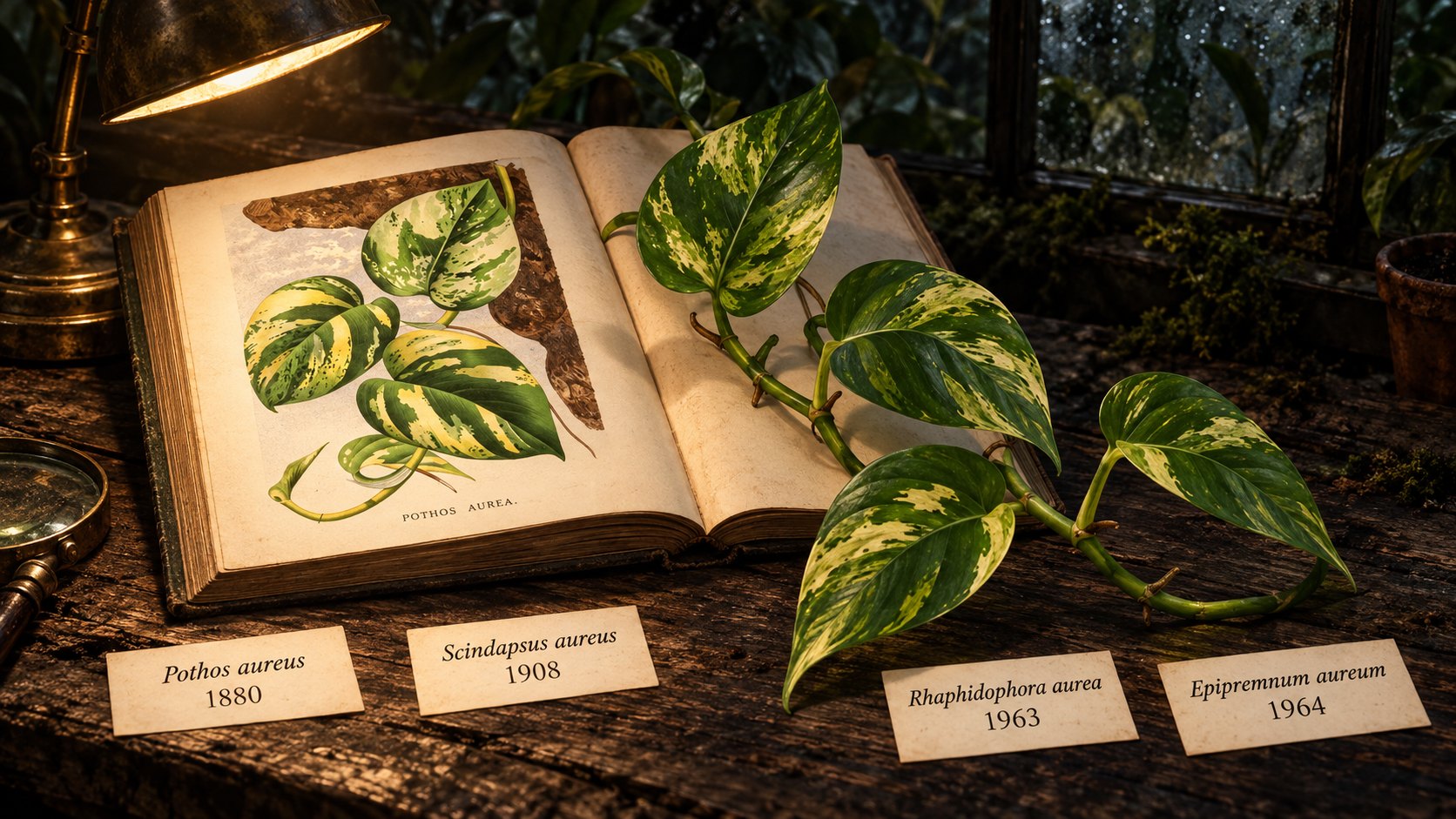
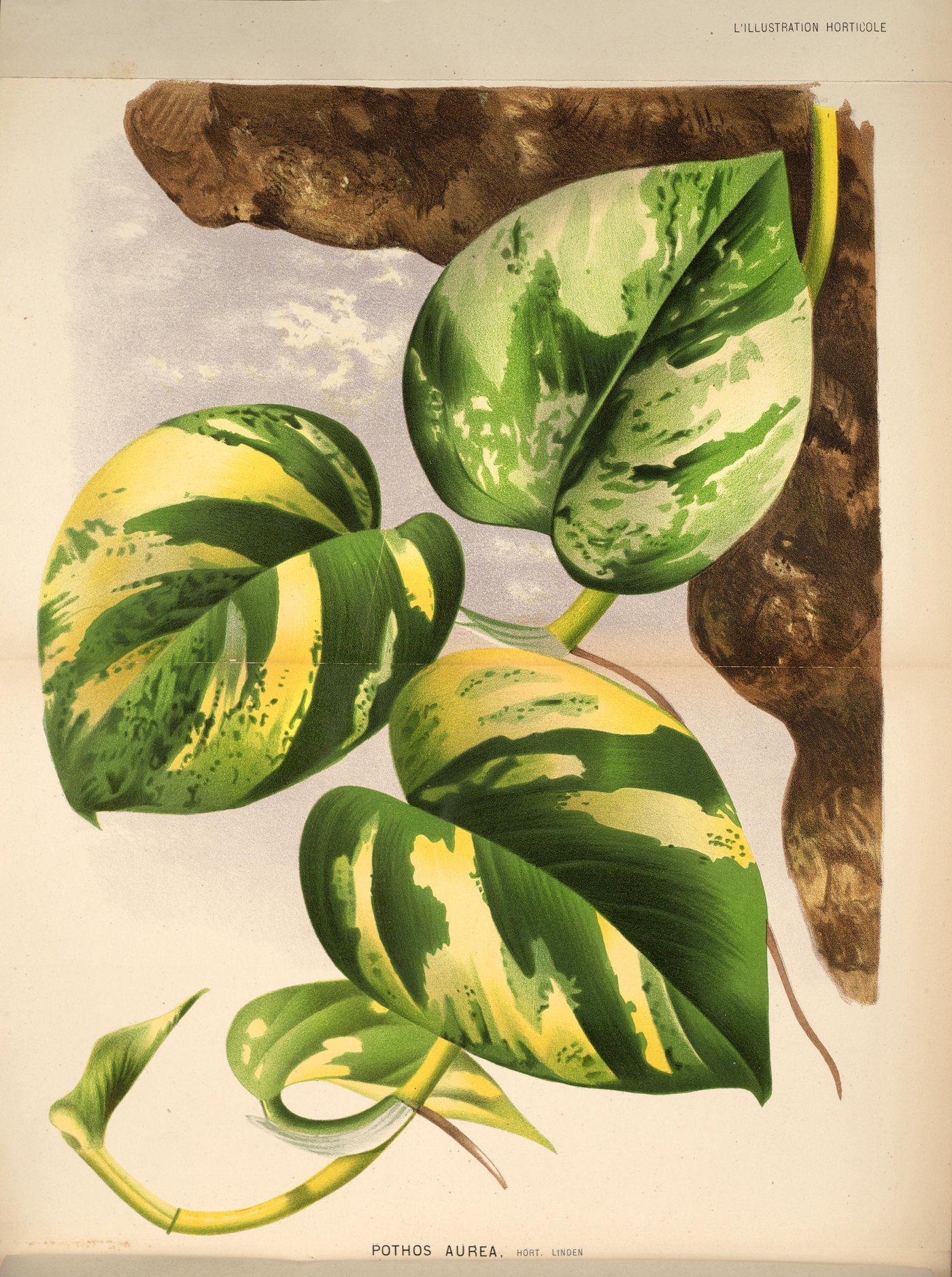
A plate from 1880
In 1880, L’Illustration Horticole introduced its readers to a handsome climber with leaves splashed in gold. The accompanying color plate is immediately recognizable to anyone who has grown the plant. Across its foot sits the name Pothos aurea, standardized in modern botanical records as Pothos aureus.1
Today that plant is Epipremnum aureum.
Before going further, one branch of the story needs straightening out: these plants are related. All belong to Araceae, the aroid family. Epipremnum and Scindapsus share the subfamily Monsteroideae; Philodendron belongs to Aroideae; the true Pothos belongs to Pothoideae. Their family resemblance is understandable. Treating their names as interchangeable is where things become muddled.2
The real Pothos
The real Pothos has a much older paper trail than the golden vine on so many bookshelves.
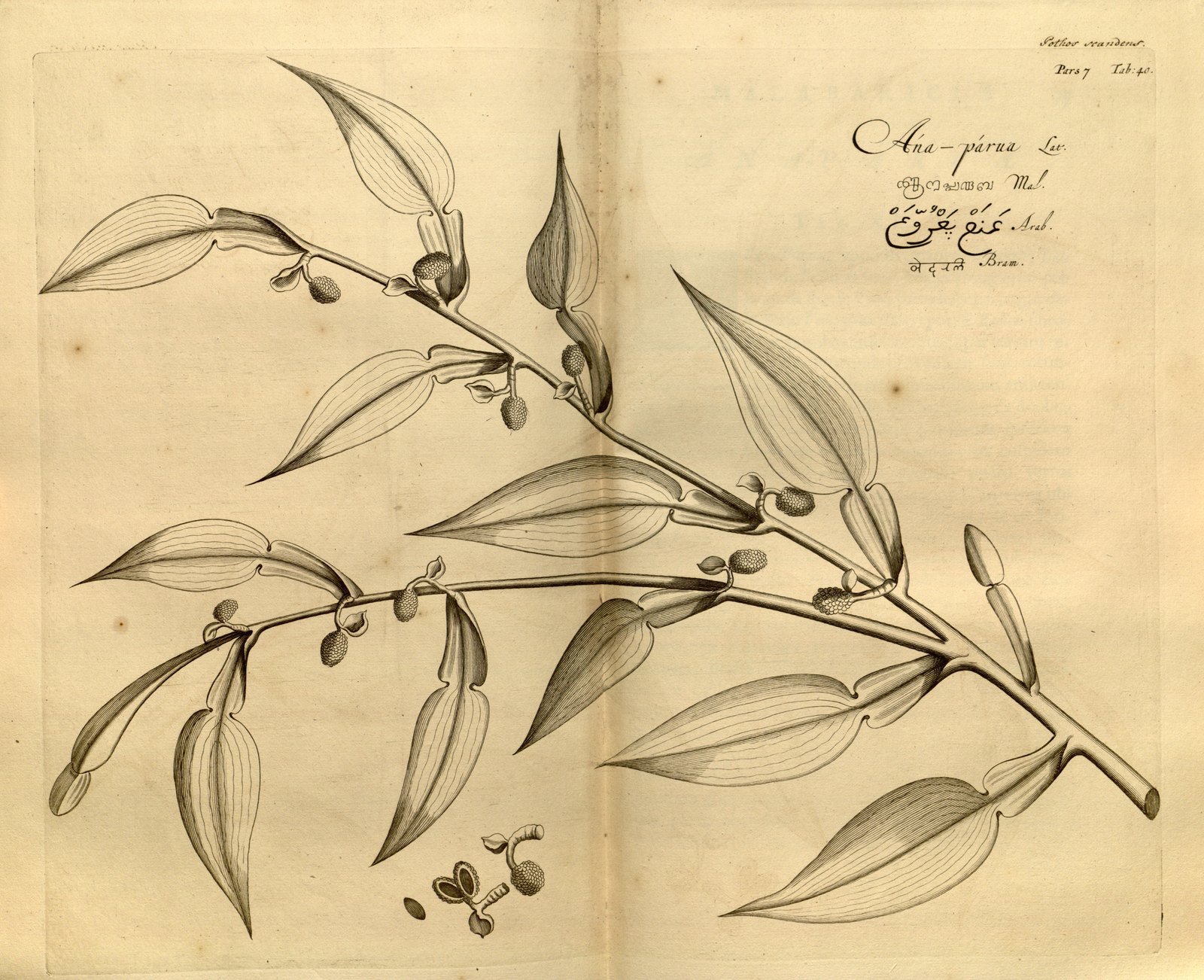
In 1678, the first volume of Hortus Malabaricus briefly mentioned a plant called Ana-Parva.3 Ten years later, volume seven supplied a fuller description and an illustration of Ana-parua, subsequently identified as Pothos scandens.4 The plant entered these European botanical books under a local name, well before it received the scientific name used today.
Then, in 1753, Linnaeus published Pothos in Species plantarum. His original entry contained just one species, Pothos scandens. The genus’s later, more miscellaneous membership had yet to accumulate.5
Leaves without flowers
Across the Atlantic, another part of the problem was already visible. In his 1693 book on American plants, Charles Plumier illustrated climbing aroids that later botanists would associate with Philodendron. He placed them under descriptive Colocasia names and called four of them “sterile.”6
His explanation is revealing. Despite observing numerous plants in different seasons, he had never seen their flowers or fruits. He was describing the limits of his observations, not declaring the plants incapable of reproduction.
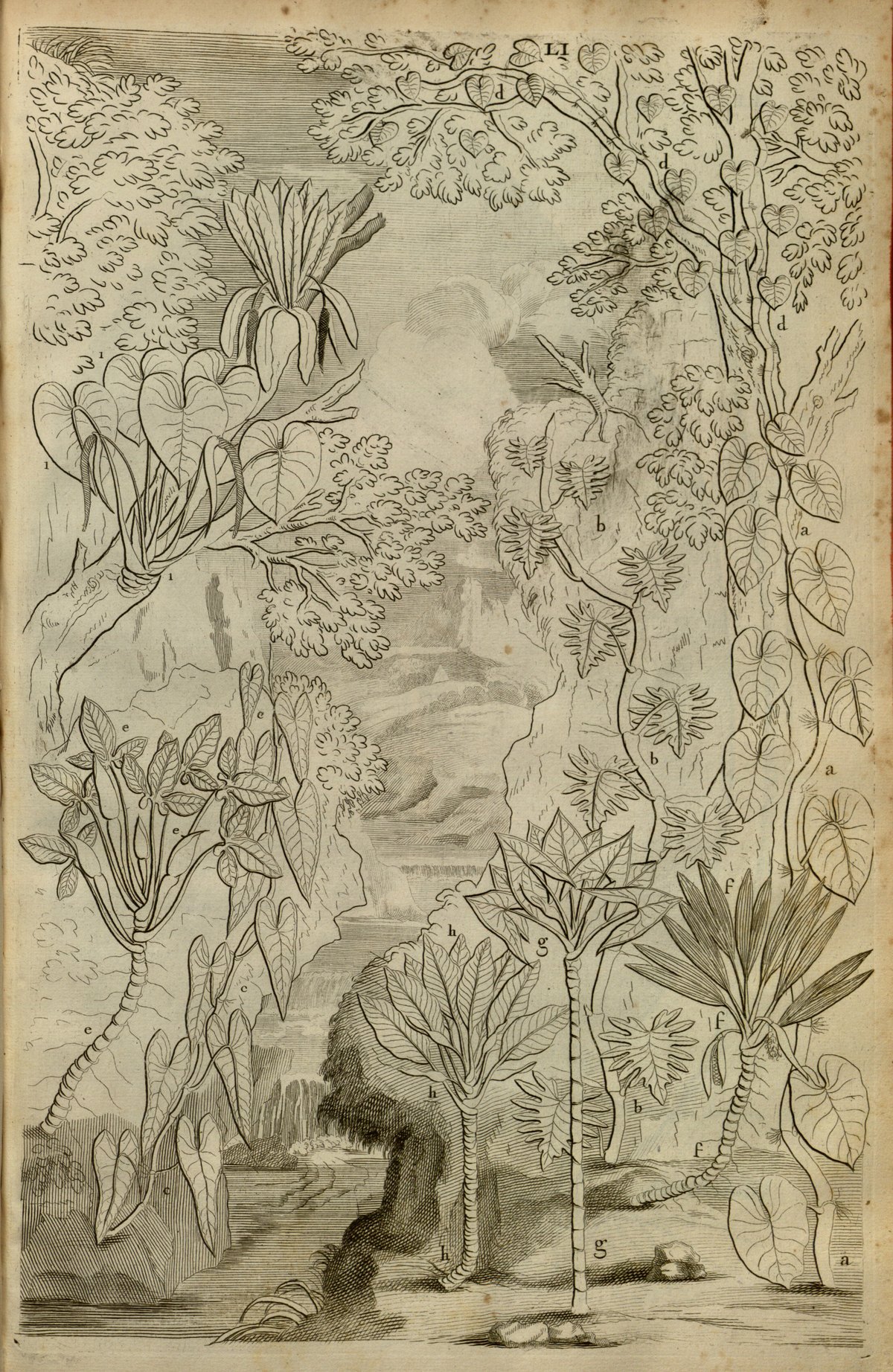
The leaves were available. The evidence inside the flowers was harder to obtain.
That difficulty runs through this entire story. Most people meet houseplants as foliage and choose them for the sweep of a leaf, a splash of silver, a pleasing silhouette. Botanists trying to establish their relationships often need something quite different: flowers, ovaries, ovules and seeds.
In an aroid, the familiar spathe and spadix form an inflorescence, a structure bearing many small flowers. Those flowers can reveal distinctions that a whole basket of attractive leaves conceals.
True Pothos, for example, typically has bisexual flowers surrounded by six small floral parts called tepals. Epipremnum and Scindapsus have bisexual flowers without that floral covering, and their classical separation rests on differences in ovules and seeds. Philodendron has separate male and female flowers, arranged in different zones of the spadix.7,8,9 A willingness to climb tells remarkably little about any of those details.
Schott’s three genera
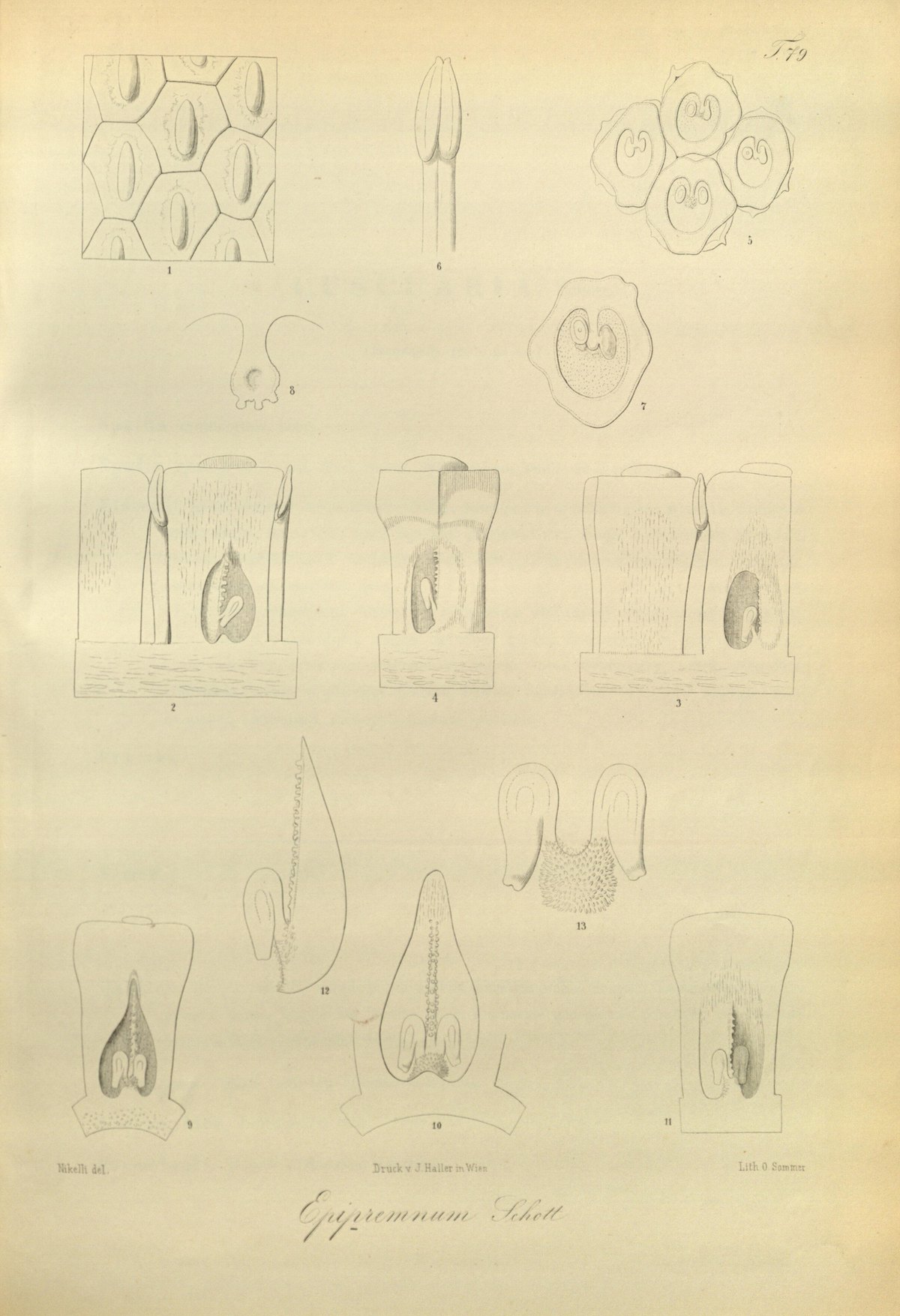
Heinrich Wilhelm Schott devoted much of his career to making sense of such distinctions.
He established Philodendron in 1829, at first spelling it Philodendrum. Delightfully, the description appeared in a Viennese journal of art, literature, theater and fashion.10 In 1832, he established Scindapsus.11 In 1857, he established Epipremnum.12

That last date deserves a pause.
The genus Epipremnum already existed when the golden vine was described as a Pothos in 1880.
The eventual name was available. Assigning the plant to it was another matter.
A veranda in Singapore
The golden vine continued its travels through the literature. Engler moved it to Scindapsus in 1908, in the account of the Monsteroideae he wrote with Kurt Krause.13 Later, flowering material helped clarify the reproductive characters its familiar foliage could not supply.
One contemporary account offers a scene far more memorable than a herbarium label. In Singapore, a plant growing in a kerosene tin on Mrs. R. R. Sarathee’s third-floor veranda flowered in September 1961. C. X. Furtado documented it in a paper published in 1964, complete with a drawing and a photograph.14
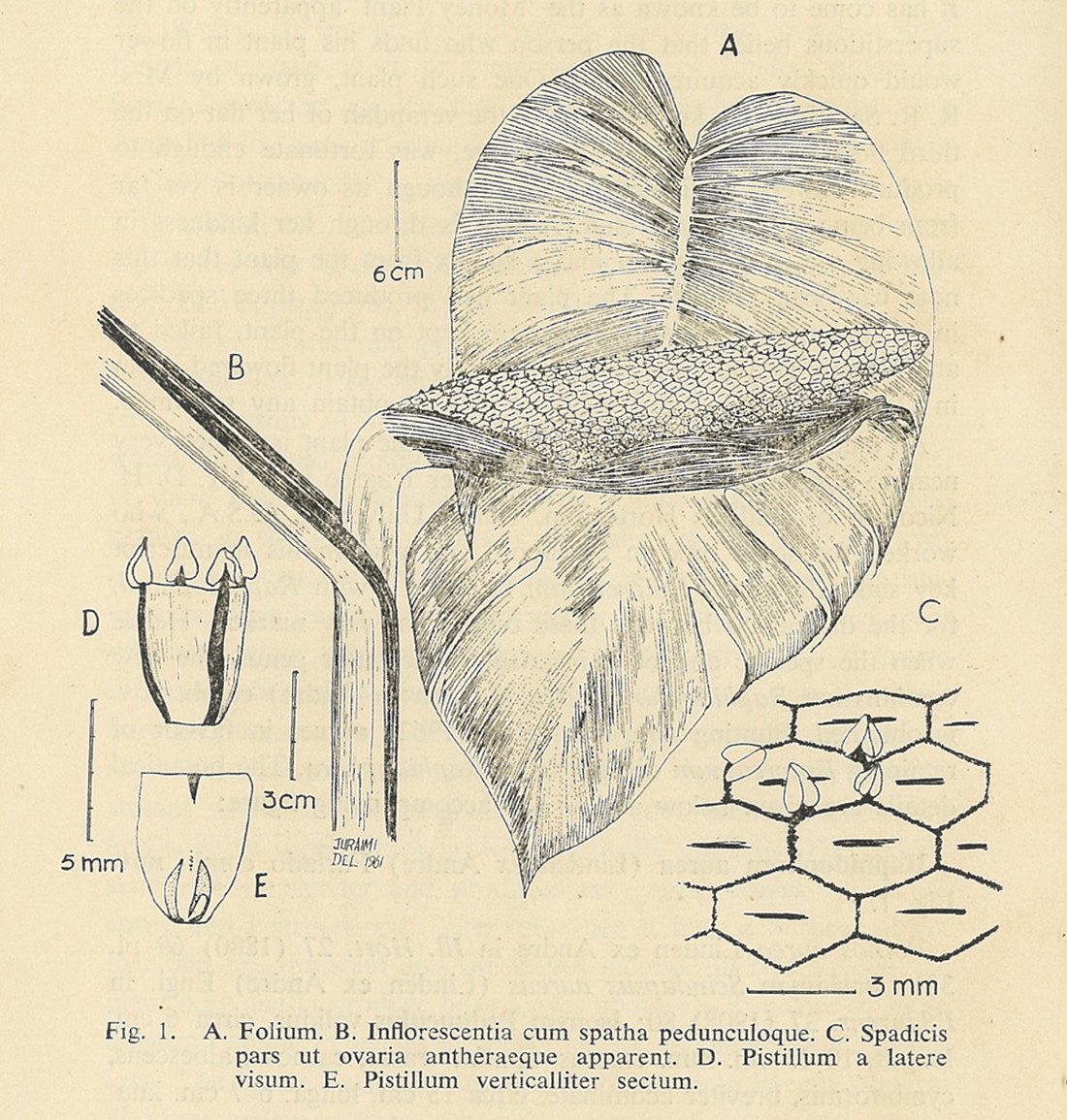
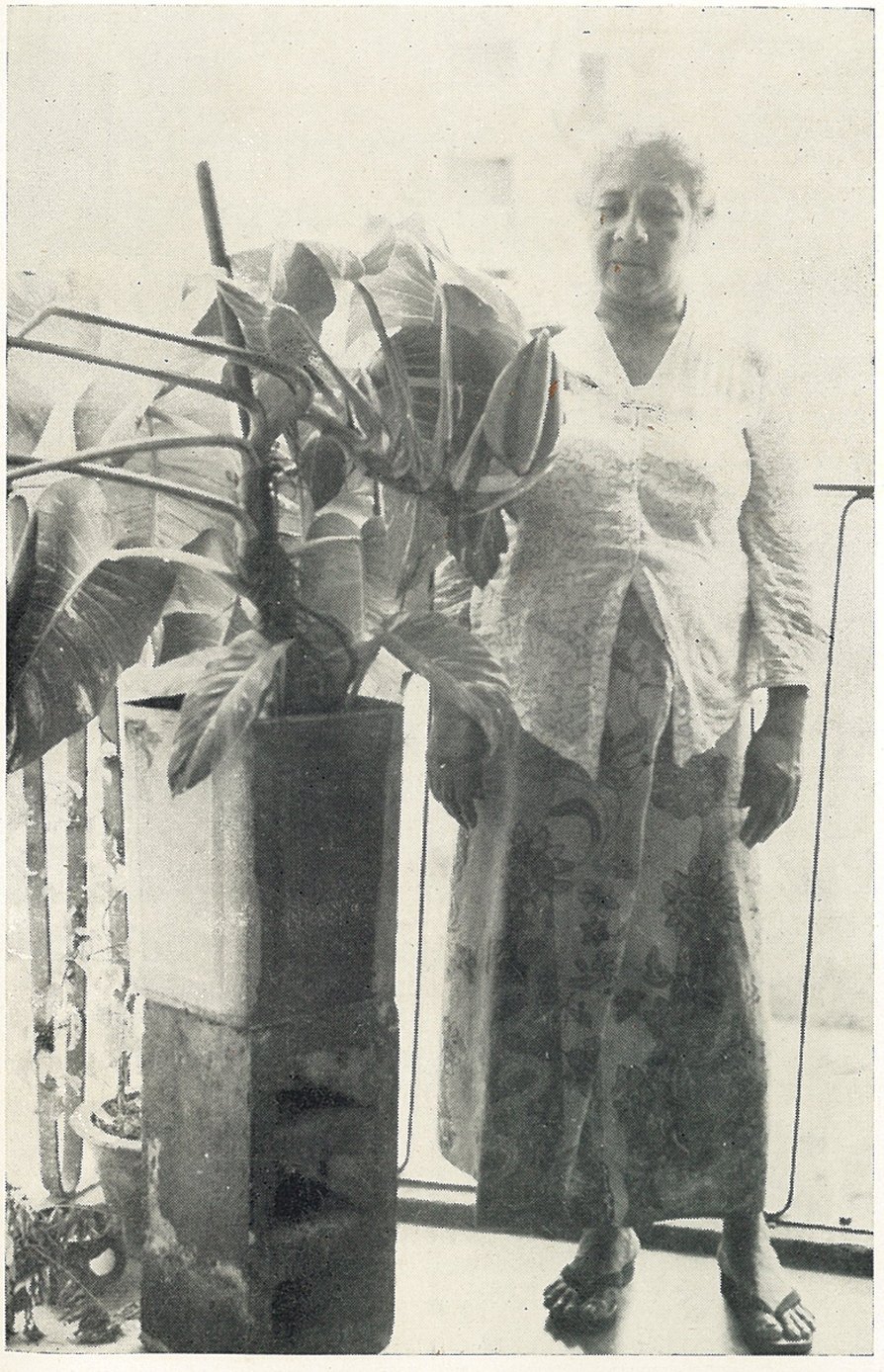
There it was: an ordinary cultivated climber producing the extraordinary evidence botanists wanted to examine.
Even flowers did not make every naming decision automatic. Monroe Birdsey published the combination Rhaphidophora aurea in January 1963,15 and Furtado’s paper placed the plant in Rhaphidophora too. George Bunting published Epipremnum aureum a year later.16 Their choices reflected different views of how broadly the genera should be defined: Birdsey followed a treatment that united Epipremnum with Rhaphidophora,17 while Bunting kept them separate.
This was a disagreement about the boundaries of genera, not merely someone overlooking the correct label.
More borrowed names
And the golden vine is only part of the naming tangle.
The plant sold as satin pothos was described as Scindapsus pictus in 1842.18 Yet the later names now treated as its synonyms include Pothos argyraeus, Pothos endresii and Pothos argenteus.19 Even Philodendron hederaceum, the species behind the heartleaf philodendron, has an authentic Pothos connection: the plant named Arum hederaceum in 1760 became Pothos hederaceus in 1775, before Schott placed it in Philodendron in 1829.20
These records do not establish exactly how every modern common name spread. They do establish that the overlap reaches much deeper than a recent misunderstanding among houseplant growers.
The name on the label
So where does that leave my original grievance? With more reason for it, not less.
The name on the nursery label is a fossil: the classification of 1880, kept in circulation long after botany set it aside. The plant sold as “golden pothos” is Epipremnum aureum; the one sold as “satin pothos” is Scindapsus pictus. Calling either of them pothos files it under a genus it does not belong to, and buries the real Pothos beneath both.
What I would like to see retired is the name, and with it the assumption that every similar-looking climber must be the same kind of plant. Learning Epipremnum, Scindapsus and Philodendron gives a grower more than three words to put on labels. It opens three botanical histories, with different flowers, different relationships and different questions still worth asking.
And somewhere beyond the golden vine is Pothos itself: the genus that still bears the name.
It deserves an introduction.
Sources
- André, É. (1880). Pothos aurea, Hort. Linden. L’Illustration Horticole 27: 69, plate 381. archive.org/details/mobot31753002364179
- Cabrera, L. I., Salazar, G. A., Chase, M. W., Mayo, S. J., Bogner, J. & Dávila, P. (2008). Phylogenetic relationships of aroids and duckweeds (Araceae) inferred from coding and noncoding plastid DNA. American Journal of Botany 95(9): 1153–1165. doi:10.3732/ajb.0800073
- Rheede tot Drakestein, H. A. van (1678). Hortus Indicus Malabaricus 1: 88. archive.org/details/mobot31753003370076
- Rheede tot Drakestein, H. A. van (1688). Horti Malabarici pars septima: 75–76, plate 40. biodiversitylibrary.org/item/14378
- Linnaeus, C. (1753). Species plantarum 2: 968. Stockholm: Laurentius Salvius. ipni.org/n/30071824-2
- Plumier, C. (1693). Description des plantes de l’Amérique, avec leurs figures: 37–40, plates 51–55. Paris: Imprimerie Royale. biodiversitylibrary.org/item/15502
- Boyce, P. C. (2000). The genus Pothos (Araceae–Pothoideae–Potheae) of Thailand and Indochina. Blumea 45: 147–204. repository.naturalis.nl/pub/525903
- Boyce, P. C. (1998). The genus Epipremnum Schott (Araceae–Monsteroideae–Monstereae) in West and Central Malesia. Blumea 43: 183–213. repository.naturalis.nl/pub/526254
- Plants of the World Online. Philodendron Schott. Royal Botanic Gardens, Kew. powo.science.kew.org
- Schott, H. W. (1829). Für Liebhaber der Botanik. Wiener Zeitschrift für Kunst, Literatur, Theater und Mode 94: 779–780. anno.onb.ac.at
- Schott, H. W., in Schott, H. W. & Endlicher, S. L. (1832). Meletemata botanica: 21. Vienna: Carl Gerold. biodiversitylibrary.org/bibliography/40101
- Schott, H. W. (1857). Aroideae Hongkongenses. Bonplandia 5: 44–45. ipni.org/n/2779-1
- Engler, A. & Krause, K. (1908). Araceae–Monsteroideae. Das Pflanzenreich IV.23B (Heft 37): 80. ipni.org/n/88159-1
- Furtado, C. X. (1964). Pothos aurea, Hort. Linden. Gardens’ Bulletin, Singapore 20: 377–380, plate. nparks.gov.sg
- Birdsey, M. R. (1963; issue dated 1962). Pothos aureus transferred to Rhaphidophora. Baileya 10(4): 155–159. ipni.org/n/88446-1
- Bunting, G. S. (1964; volume dated 1963). Studies in Araceae. Annals of the Missouri Botanical Garden 50: 23–28. doi:10.2307/2394915
- Bakhuizen van den Brink, R. C. (1958). Are Epipremnum Schott, Rhaphidophora Hassk. and Monstera Adans. congeneric? Blumea, Supplement 4: 91–92. repository.naturalis.nl/pub/526306
- Hasskarl, J. C. (1842). Scindapsus pictus. Tijdschrift voor Natuurlijke Geschiedenis en Physiologie 9: 164. archive.org/details/tijdschriftvoorn09amst
- Plants of the World Online. Scindapsus pictus Hassk. Royal Botanic Gardens, Kew. powo.science.kew.org
- Plants of the World Online. Philodendron hederaceum (Jacq.) Schott. Royal Botanic Gardens, Kew; with Jacquin, N. J. von (1760), Enumeratio systematica plantarum: 31, and Aublet, J. B. C. F. (1775), Histoire des plantes de la Guiane Françoise 2: 840. powo.science.kew.org
