
Aroidpedia
The Spathe
What opened this month on Aroidpedia
No. 1 · Launch edition · September 2026
Aroidpedia has a new home, and this is its letter.
This is a special launch edition. Starting October 1st, The Spathe will arrive on the first of every month with what opened on the site: the records that joined the archive, the pages that appeared, a story from the collections, and news from the people who grow these plants.
On September 2nd, the whole site moved to a new build. The archive itself is unchanged. A species record begins with the original published description of that species; a cultivar or hybrid record begins with its registration or another published source. Each record then adds photographs or illustrations of the plant and, for a species, where it grows in the wild. What changed is everything around it.
Sent September 13th, 2026 to the readers of The Spathe

A new Aroidpedia
Descend from the canopy into the collection.
The home page now opens with a short film and descends, chapter by chapter, to the archive itself: the newest records, the Aroid Guide, the grower map, and a search that understands places as well as names. Type a country, a province or an island, and the records from there come up. Every record now takes comments, with no account needed, and every page ends with a corrections form: report a wrong date or a misplaced locality in two lines, and it comes straight to us.
Now documented
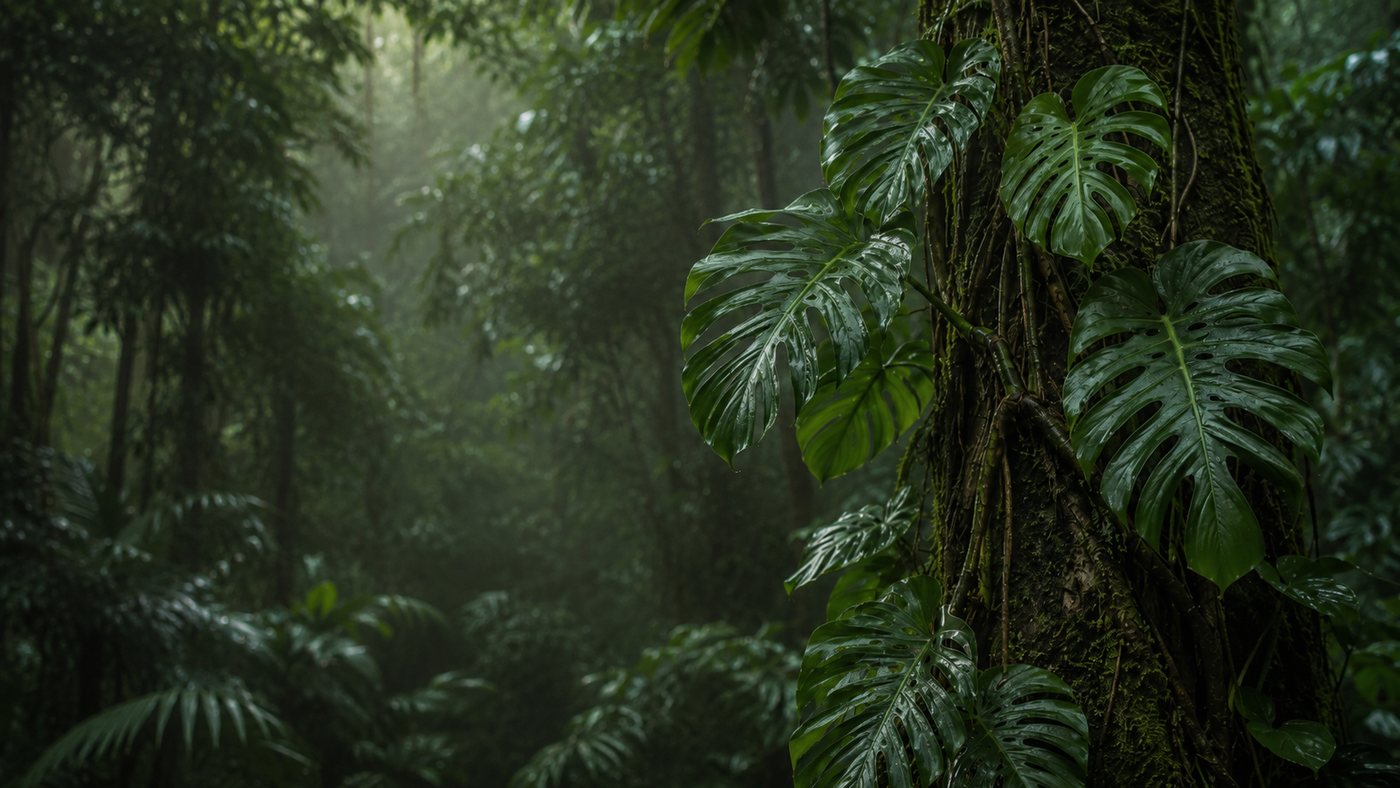
Monstera, name by name.
85 records have joined the archive: 73 species, 9 cultivars and 3 hybrid cultivars. That is the genus as it stands in September 2026 — every accepted species, and every cultivar and hybrid we could trace to a registration or a published source. It arrives with its morphology, identification and reproduction guides.
Four of the eighty-five


- Monstera tuberculata — Its young leaves grow pressed flat against the trunk, overlapping like shingles. Lundell named it in 1939.
- Monstera deliciosa ‘Masterpiece’ — A registered sport from Michael D’Andrea, named because its speckled coloration “is a work of art.”
- Monstera tacanaensis — Eizi Matuda named it in 1972. It ranges from Chiapas, in southern Mexico, to Panama.
- Monstera deliciosa ‘Key Lime Pie’ — A 2024 release from William Rotolante, named for variegation the color of key lime pie.

The Aroid Guide
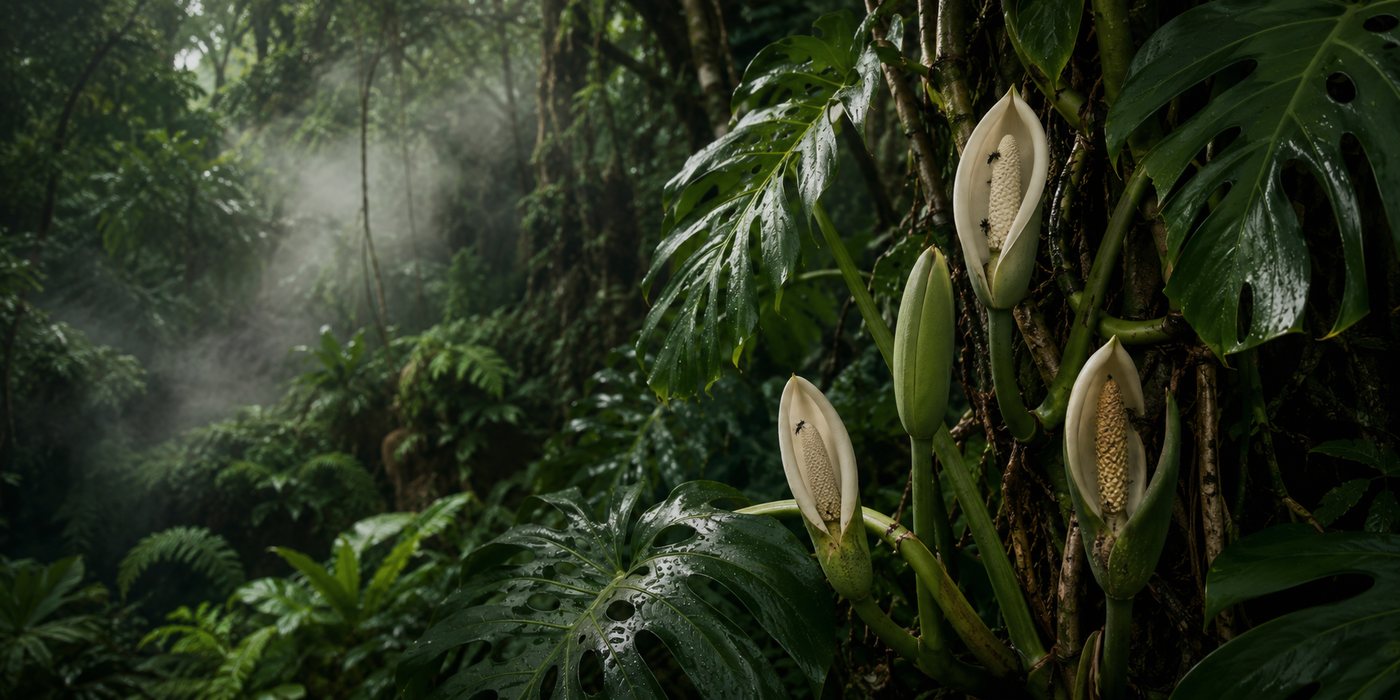
How an aroid works.
The reference behind every record, in three parts: Morphology, on how the plant is built; Identification, on telling look-alikes apart; and Reproduction, on how the inflorescence works, who pollinates what, and why some crosses fail. Each part is written genus by genus, from the published literature and from growers’ own experience.
Printable field cards
Field cards to print.PDF ↓
Eight of the reproduction guides end in a one-page field card: the flowering sequence, the pollination window, the pollinators and the crossing rules, made to be printed and kept by the bench.
Choose a genus to download its card (PDF)
AlocasiaAmorphophallusAnthuriumArisaemaArumMonsteraPhilodendronSpathiphyllum
Morphology · 6 generaIdentification · 5 generaWhy some crosses fail
Where the archive stands
Four genera documented. 150 on the map.
Alocasia (339 records), Amorphophallus (248), Arum (47) and now Monstera (85) are documented in full as of September 2026: every accepted species — as Plants of the World Online lists it, unless newer published work says otherwise — and every cultivar and hybrid we could trace to a registration or a published source. New names are added as they are published.
All 150 genera in Aroidpedia’s roster of the family have a page, with the native range mapped, the climate, and the genus’s place on the family tree. Monstera was the first genus built entirely on the new site, and more are in preparation.
4
genera
466
species
79
cultivars
174
hybrids
The counts as this issue went out
The Aroid Map
Beneath every collection is a network of people.
The Aroid Map shows who grows what, and where: growers, collectors, breeders and researchers around the world. Filter it by genus, search it by name or place, and find the aroid community nearest you. It grows only when people add themselves — a name, a country and the genera you grow. No account, and no address beyond the country you choose to show.
Mark the calendar
The 49th IAS Tropical Plant Expo
September 19–20, 2026 · Miami
Miami-Dade County Fair & Expo, Fuchs Pavilion · 10901 SW 24th St, Miami, FL
Saturday 9–5, Sunday 9–4 · $20 a day, $30 for both, $5 off for IAS members · parking $10 a day
The International Aroid Society’s annual show: more than 80 vendors, free talks, the Aroid Awards and a silent auction. Hands-on workshops need their own ticket as well as Expo admission; workshop tickets go on sale soon.
Aroids After Dark, the Society’s fundraising dinner and plant auction, is on Saturday, September 19th, from 7 to 11 p.m. in the Blue Ribbon Room, with Joey Santore and Fraser Cook. Tickets are $125, and it is expected to sell out. Aroidpedia will be walking the floor — if you are there, say hello.
From the archive
Following a collector up Kerinci, 1920.
On March 15th, 1920, the Dutch collector Hendrik Bünnemeijer gathered an Amorphophallus in forest on Gunung Kerinci, Sumatra’s highest volcano, and wrote down one altitude: 1,770 meters. His specimen, number 8835, became the type of Amorphophallus incurvatus, described in 1922. The label names the mountain and the height. It does not say where on the mountain.
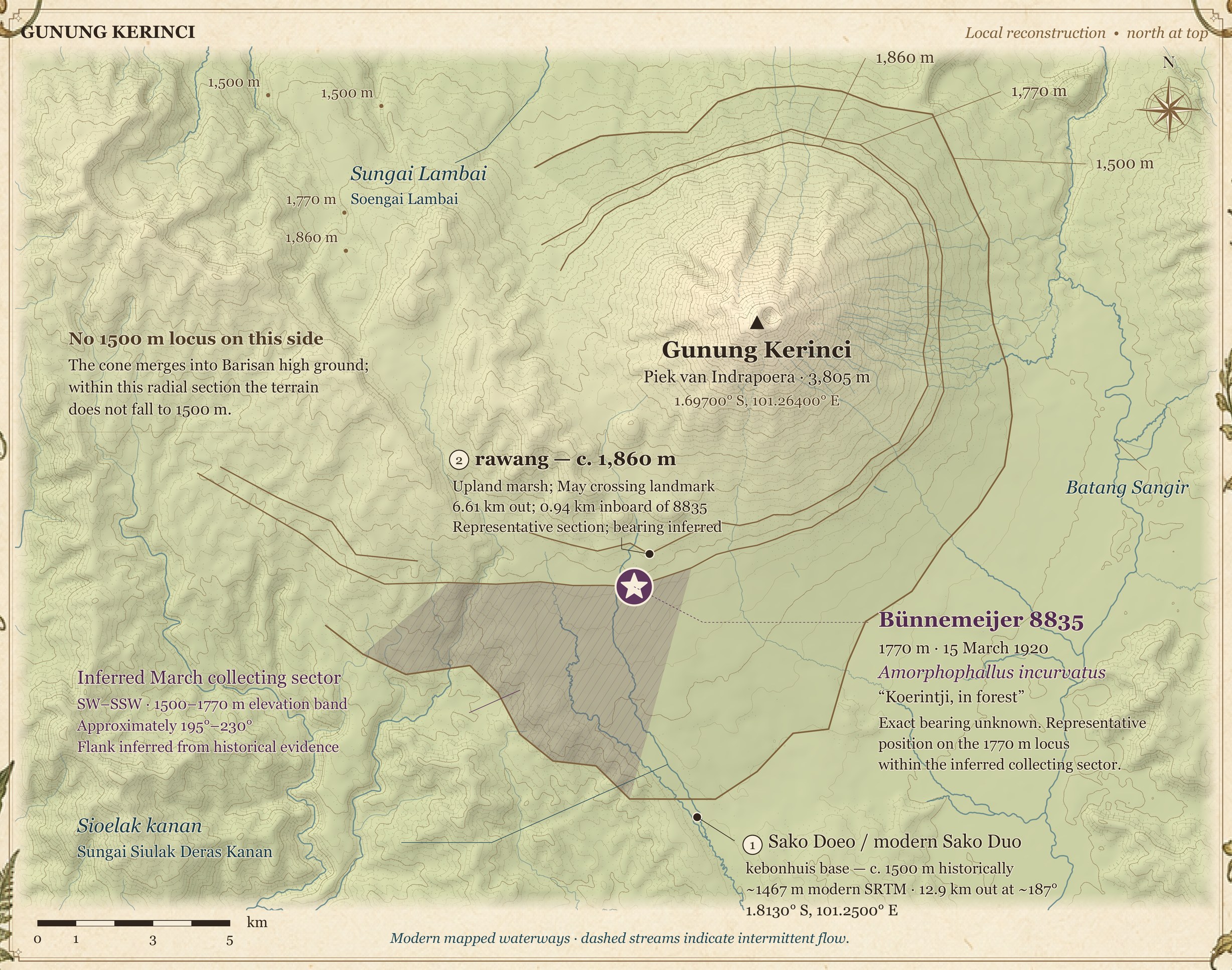
Detail of the reconstruction plate on the record. The shaded sector is the inferred March collecting corridor on Kerinci’s south-southwest flank, between 1,500 and 1,770 meters. The star represents collection 8835 within that corridor; it is not a verified collecting coordinate.
So we read the specimen beside its neighbors. Bünnemeijer worked on and around Kerinci from February to May 1920, numbering more than 2,600 collections on the expedition: one made on the mountain the same day, two the next day at 1,700 meters, another the day after at about 1,200. He also published his own account of the route, with a sketch map.
Modern elevation data, mapped from orbit at 30-meter resolution, helped us test the reconstruction those records suggest: each recorded height became a contour around the mountain, read against the slopes his account describes. The result is a probable collecting corridor, not a single point. The elevation is documented; the bearing is argued.
From the editor

Send us what you are growing.
Thank you for reading this first issue. Much of what makes an archive like this useful comes from the people who grow these plants, and I would like the next issues to carry more of your work.
Send us photographs from your own growing, an observation from your bench or from the field, a plant with a history, a cross that worked or one that did not. Write to us, and we will build the page with you. The next issue arrives on October 1st.
Robert Wainblat
Editor, Aroidpedia